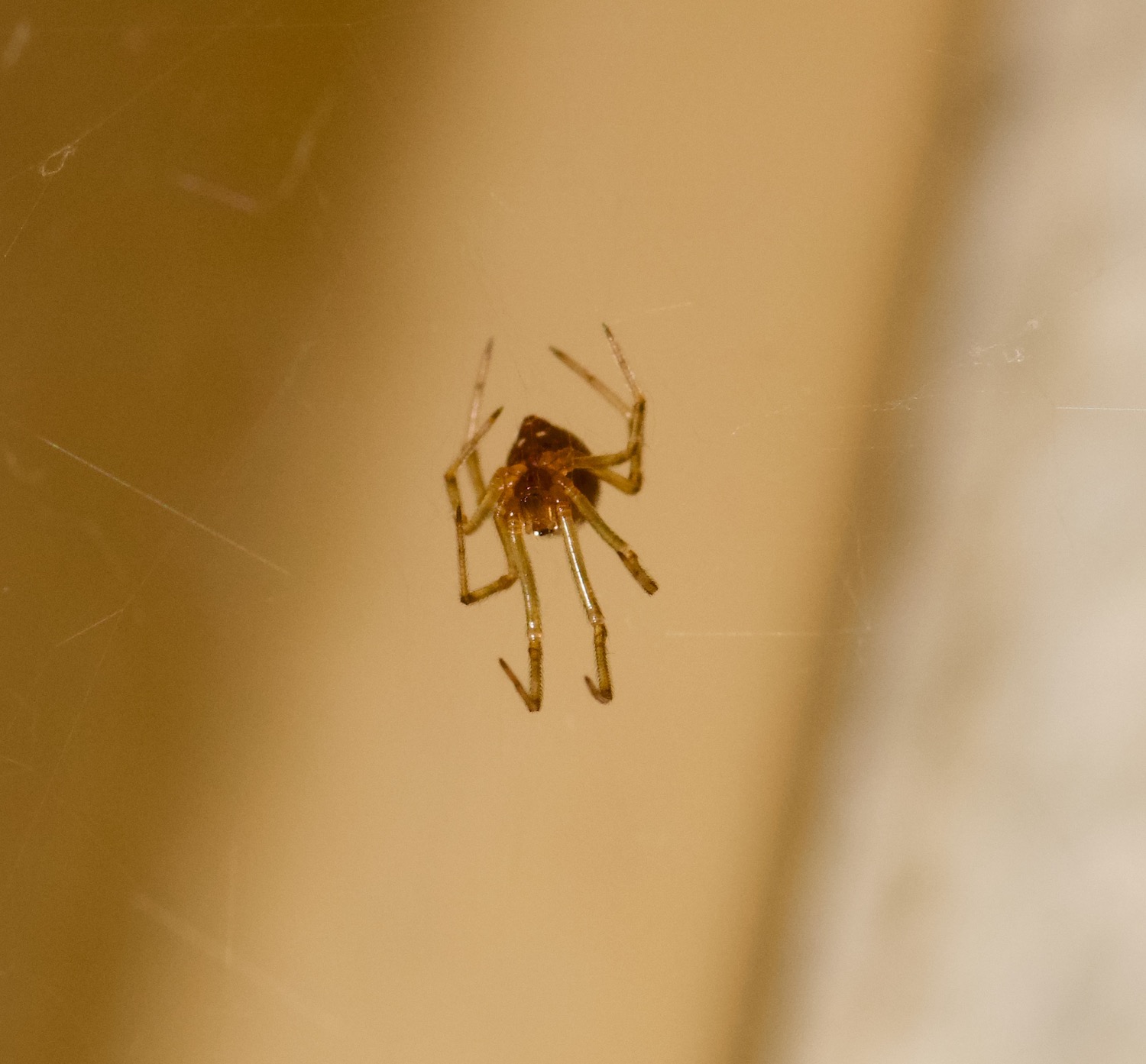
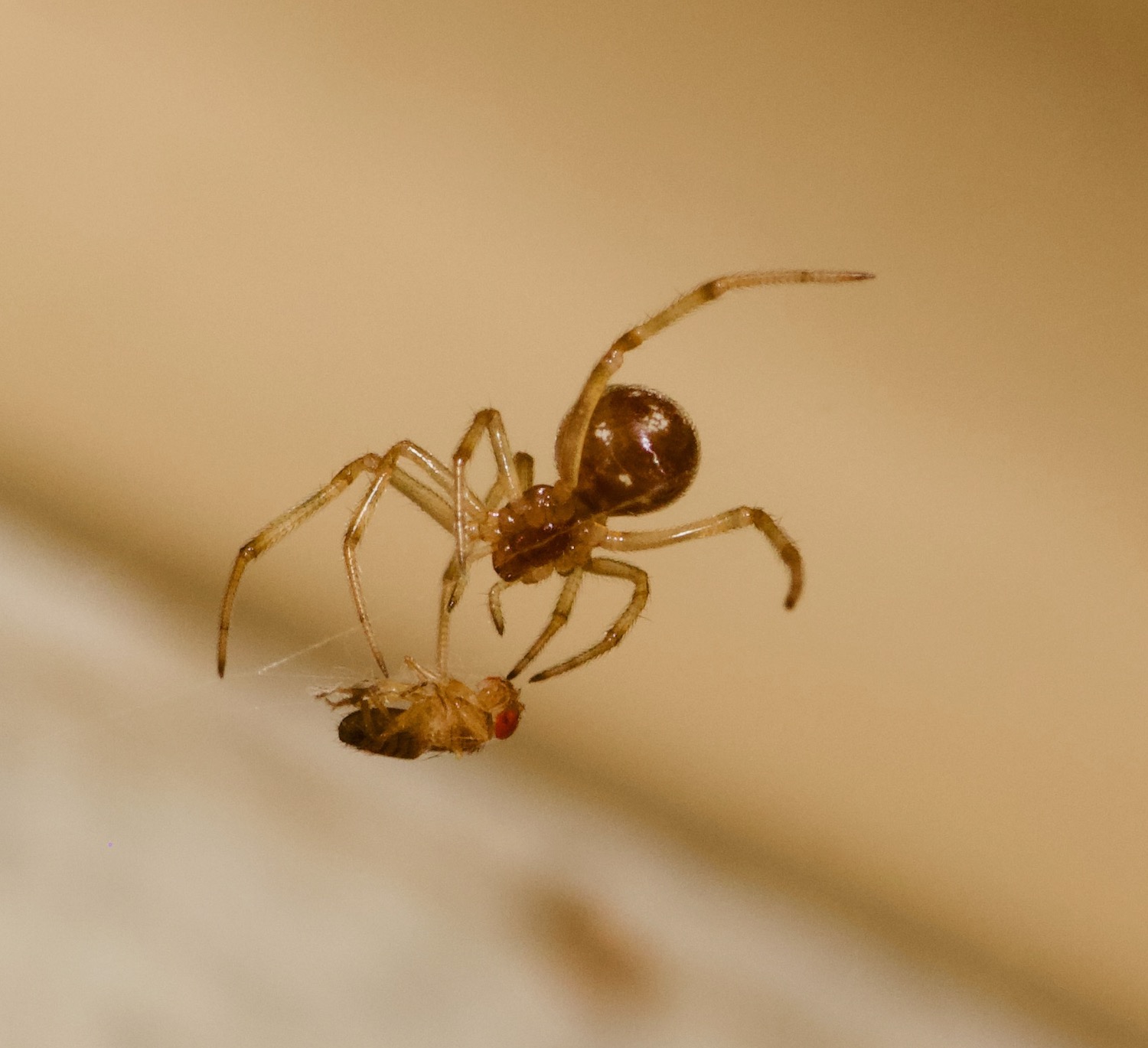
Feeding time for the spiders today

Apparently, I’ve been starving my poor babies, because I showed up with a big new menu item for lunch and those spiders were on it, pumping these waxworms full of venom and chowing down on maggoty soup. Yum!

A few details: the spider is named Selena, she’s from San Antonio, Texas, and her species is Steatoda triangulosa. The victim is a waxworm from a bait shop in Alexandria, Minnesota. All was recorded with a Canon t5i and a Tokina 100mm f/2.8 macro lens (hint: don’t use the autofocus on this, it’s slow and noisy, and doesn’t track little spiders well). Selena wasn’t special, all the spiders in my colony reacted with this kind of zeal to the plump bounty dropped in their laps.

Today on the Twitters…

You might want to look in on the official University of Minnesota Morris twitter account today, where Rob Denton is describing a day in the life of a new biology professor and discussing his weirdly sexual salamanders. Also a good idea: check out the Denton Lab instagram account to see pretty pictures of charismatic animals. I’m not talking about his students, although they are lovely, but all the cuddly slimy vertebrates.

There’s also a PZ Myers instagram account, but it’s just full of spiders. Somehow, people aren’t very appreciative of anything that can be described as “full of spiders”. It’s an injustice.

What happens when capitalists get their hands on innovation?

Does someone else recall how detested Bill Gates was in the 1970s and 80s? He really didn’t contribute anything to the home computing community other than avarice, trying to claim ownership of BASIC, for instance.

I watched it all happen, as computing got taken over by college dropouts whose goal was to snatch up and lock down and own all the potential that was emerging. Those guys aren’t legends of computer history, more like mediocre businessmen who got lucky and stole ownership. The real contrast is with Jobs, who was all flash and no substance, and Woz, who really is admirable and brilliant (seriously: his code for the drive controller was beautiful and elegant and clean, and blew me away when I started taking it apart).

And then…the monster leapt out and surprised me!

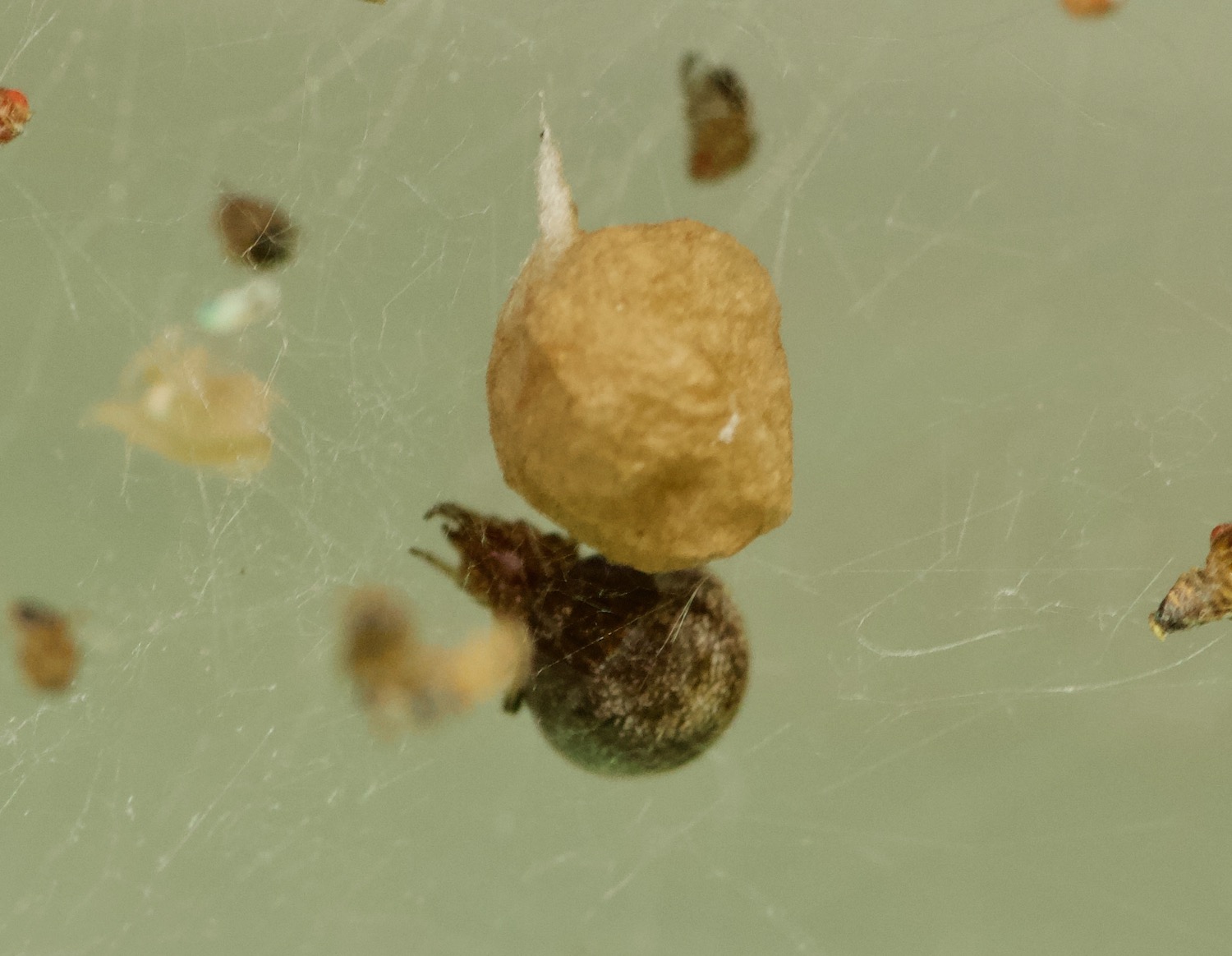
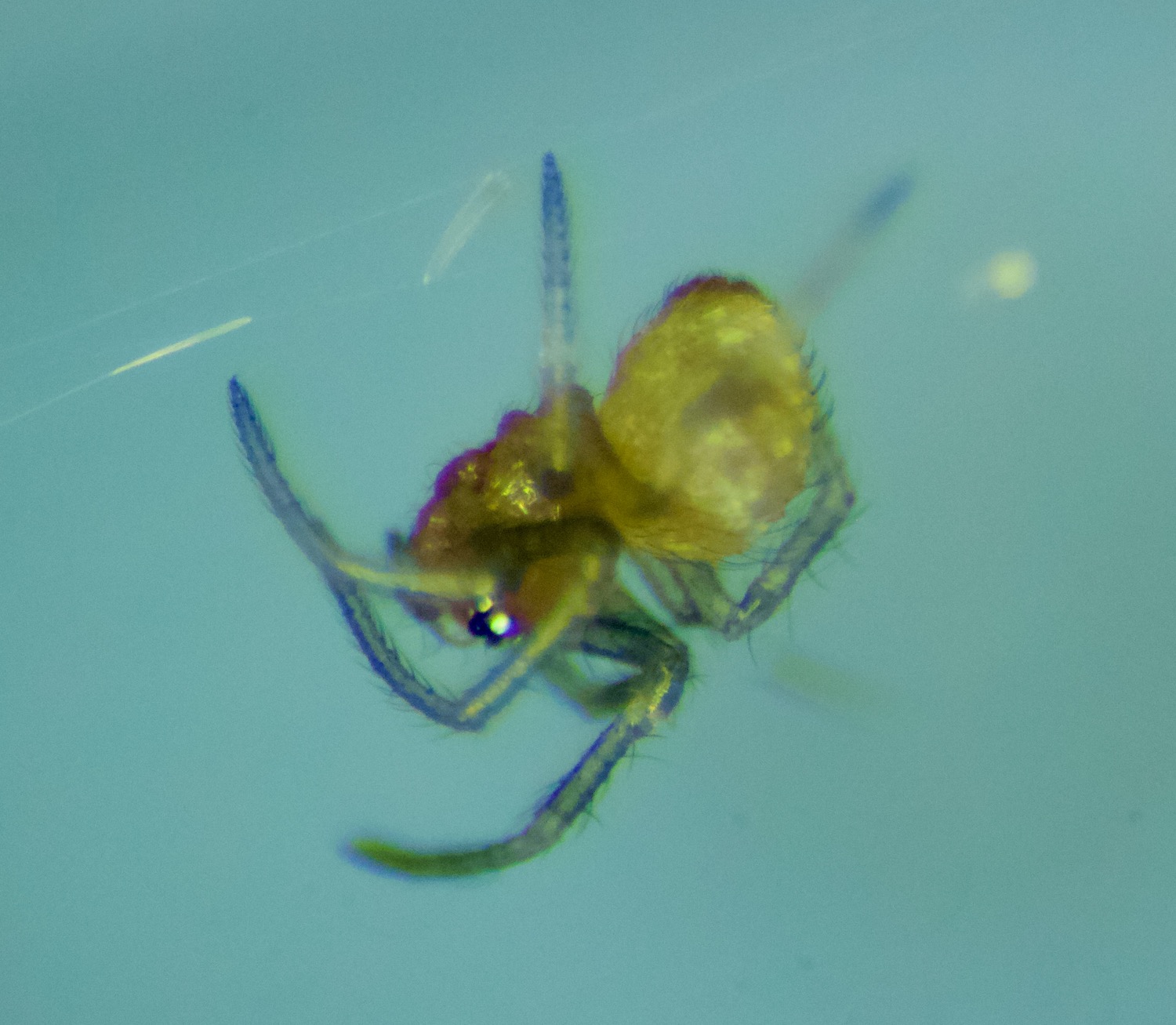
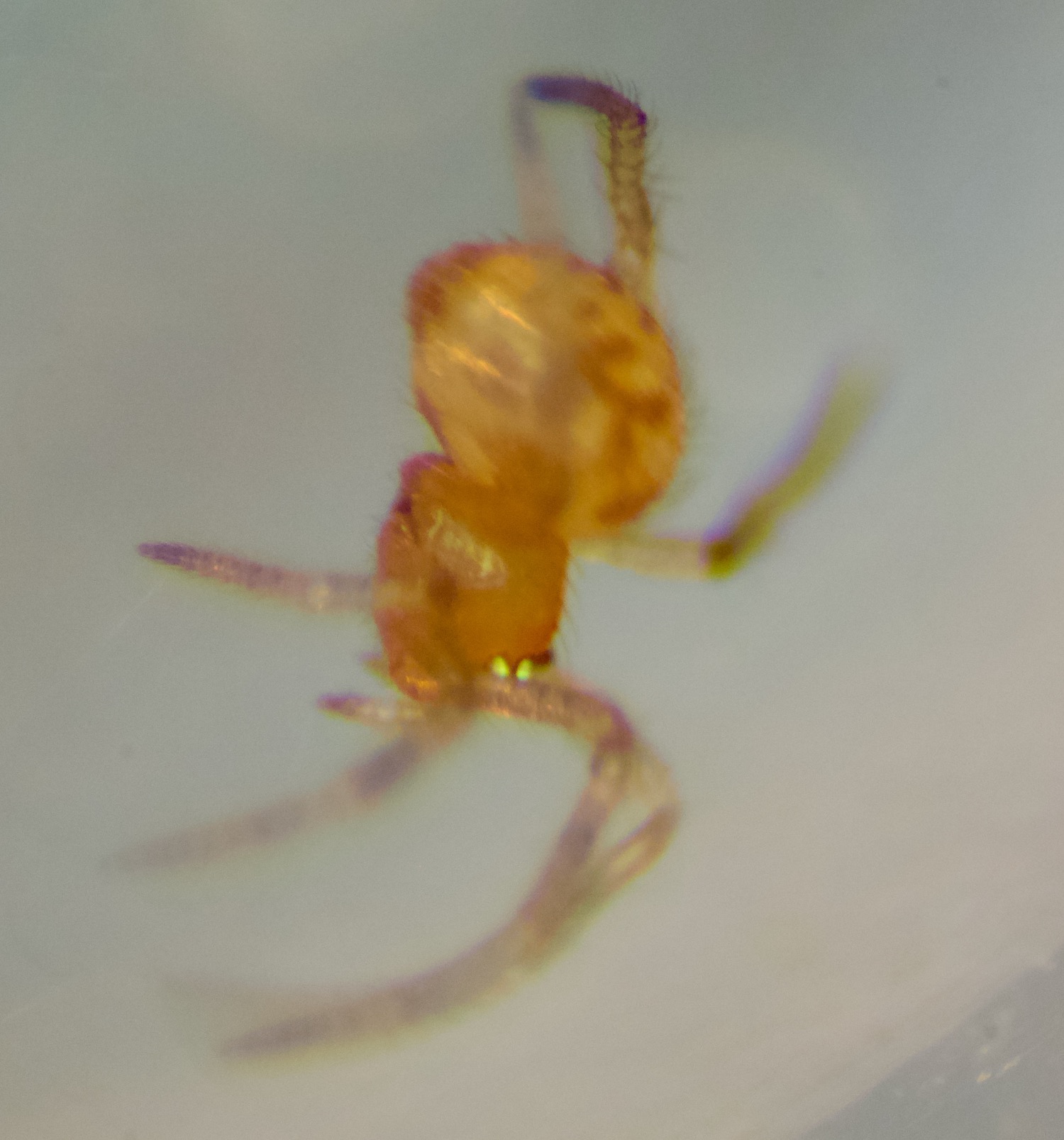
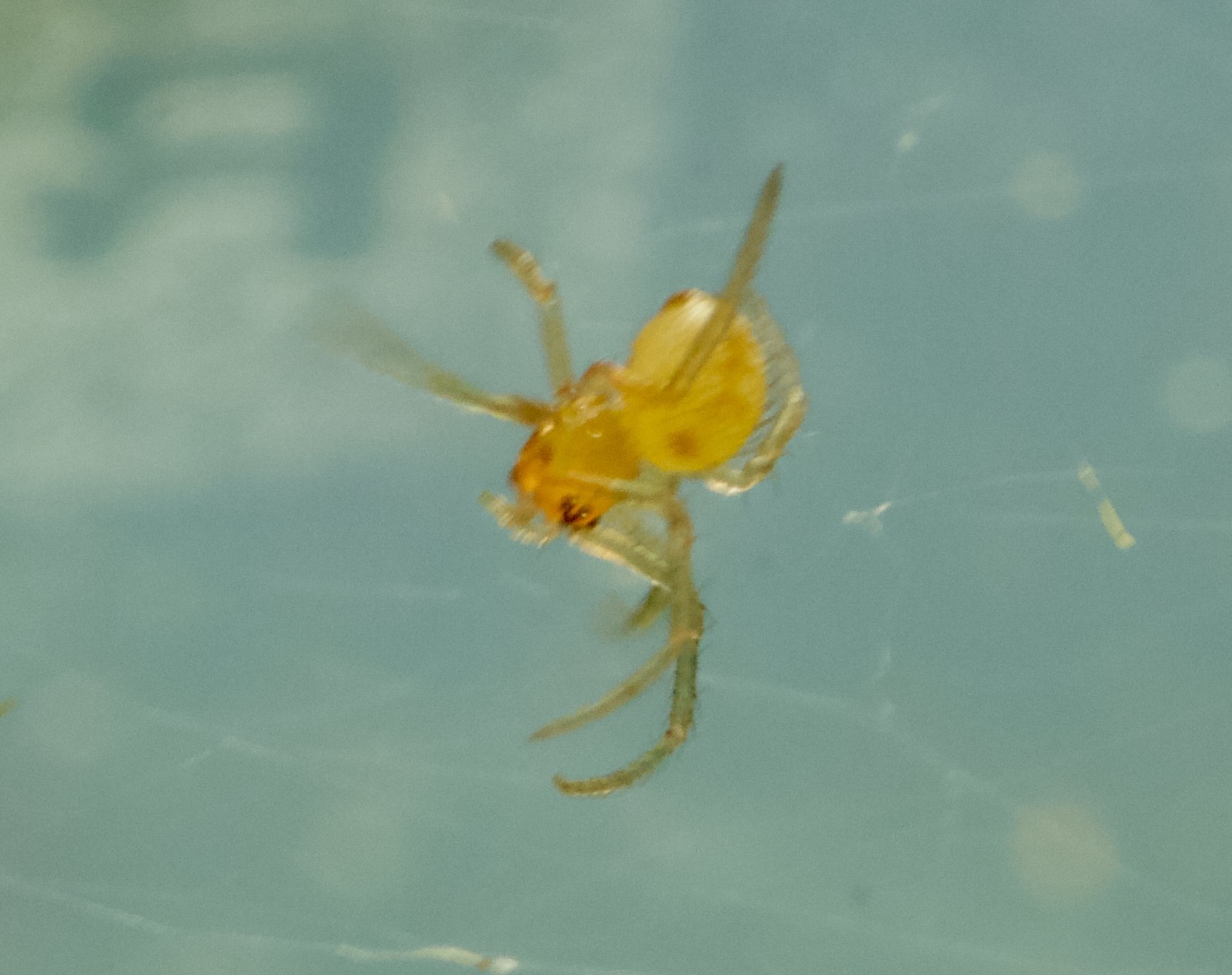
If this were a horror movie scenario, I’d be doomed. There I am, puttering around in the lab, feeding my pretties, when I notice that one of the egg sacs from Texas has hatched out, and there in the container was a small swarm of babies. “Oooh,” I cooed, and took them over to a clear spot on the bench so I could sort them out. I took the lid off and set it to the side — no worries with these little guys, they’re slow and content to just rest there on their web, and I took a few baby pictures.

Then…little did I know but this container also held the mama spider. She had been lurking, hanging from the lid, and I hadn’t even realized that there was a large adult in the container.

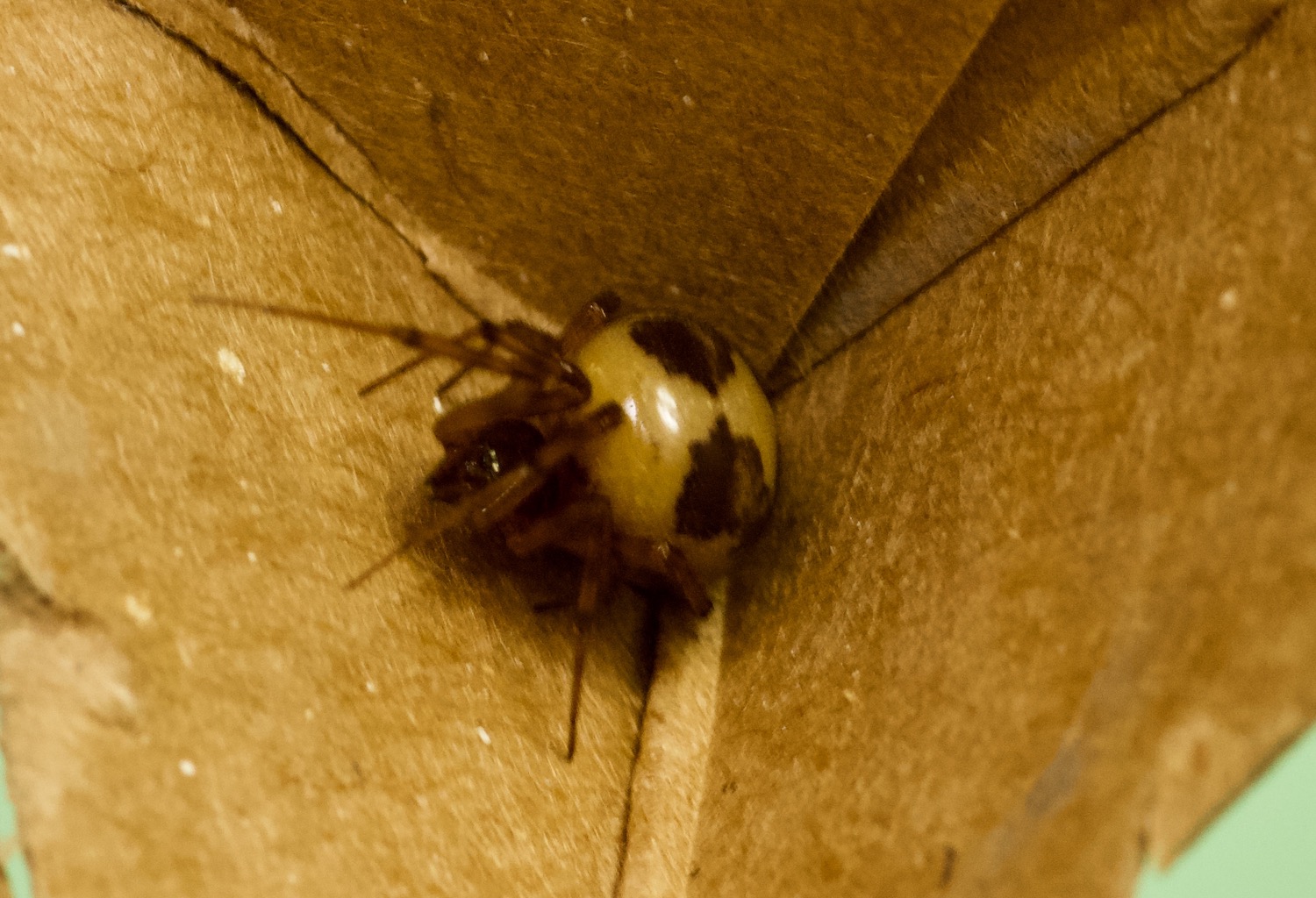
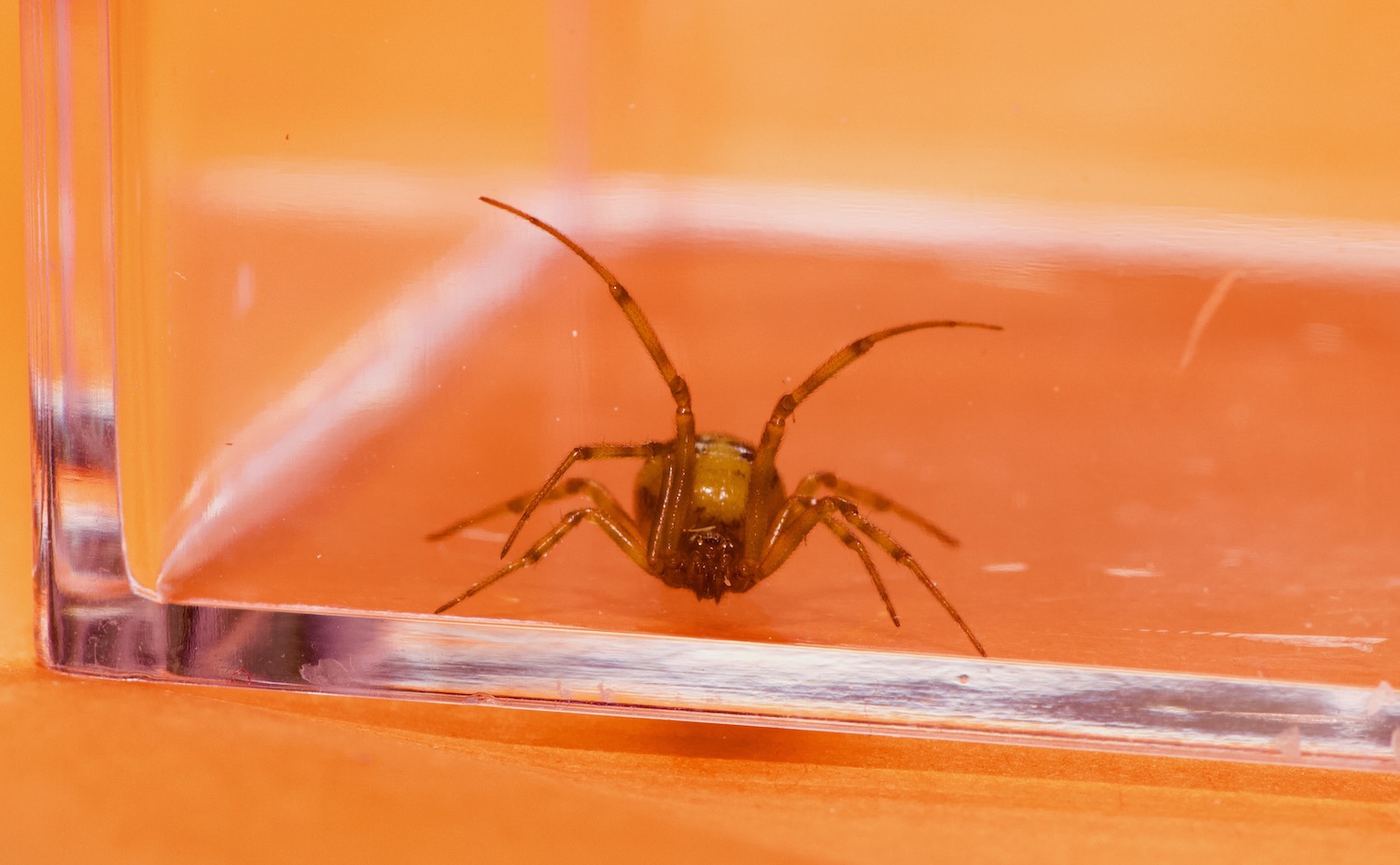
On the lid…that I had just mindlessly set aside without even looking at it. She crept out and pounced, leaping upon my exposed right hand, racing across it, probably looking for a good vein to rip into! That was the first I noticed her, an unexpected tickling across the back of my hand. She’s a big one, too, so I just scooped her into a handy plastic box. And there she is, looking a bit pissed off.

I named her Texanne, Texanne of the Texas triangulosas, and this was the best photo I could get while she was furiously skittering about. I’ve now moved her into a spacious cage with some flies to nibble on. Once she has calmed down, I’ll try to get some good photos of her abdominal pattern.

But yeah, now I’ve got a lot of Steatoda triangulosa, unexpectedly. That’s fine, they’re pretty and elegant, and seem to be doing well in the lab.

#SpiderSunday: Pinin’ for Texas

I got these new spiders from Texas last week, and they aren’t adjusting very well. Usually what the new gals do when I put them in a nice big roomy empty cage is that they start filling the space with webbing, pick a nice spot somewhere in the middle, and hang upside down, waiting for it to start raining flies. Not these spiders. There a few short patches of cobweb here and there, but mainly they sit huddled in a corner and don’t bother coming out. Compare Lantana today with Lantana last week — she seems to have scarcely moved.


I guess I can’t blame her. How would you feel if I picked you up in Texas and hauled you all the way up to Minnesota in November? It sounds cruel, even to me, and I prefer my northern state.

Yes, it’s snowing right now. But that’s outside! These spiders are all in a nice warm lab with a 14/10 light dark cycle!

Overcoming entomophobia

The kid hosting this YouTube video is rather annoying, but Gwen Pearson is wonderful, as always.

I wish I had a bug zoo, but my lab is focusing on a limited number of related species of spider, and they aren’t particularly huge. I did host a tour group of prospective students the other day, though, and 3 out of 4 seemed to like seeing my babies.

People sure attach a lot of importance to a variable developmental byproduct, don’t they?

You want some really good information about hymens and virginity? The Swedish Association for Sexuality Education provides it. It’s definitely a better source than some embarrassingly bad 1980s movie romp about eager teenagers trying to lose their virginity, that’s for sure.

Virginity – what does it mean?
Discussion of virginity revolves around whether a person has ever had sex. In most people’s minds, the main question is whether or not someone has had vaginal intercourse.

Virginity is a vague concept based on perceptions and myths, chiefly concerning female sexuality, that RFSU (or Scarleteen!) would not wish to endorse. For one thing, virginity is often associated with a heteronormative view of sex restricted to vaginal intercourse between man and woman (in other words, insertion of the penis into the vagina). For another, in many languages and cultures, virginity is synonymous with innocence, the opposite of which is guilt. There is no guilt involved in having sex, and no need to feel guilty about it. What’s more, such myths are used against women in particular; for instance as an excuse for spreading rumors and committing sexual assaults.

We sometimes receive questions about how to know whether or not you are a “virgin.” You are the only person who can decide that. Different people have different ideas about which sexual acts constitute a “loss of virginity.” Some people restrict it to vaginal intercourse, while others count other activities as well.

Is it possible to see or feel whether a woman has ever had sex?
No. Looking at a penis or a vagina, it’s equally impossible to tell whether that person has ever had sex. Neither a gynecologist nor a sex partner can tell whether you’ve had vaginal, oral, anal or manual sex (unless you have become pregnant or contracted a sexually transmitted infection). No one else can detect whether you’ve had sex.

Good to know. Unfortunately, now I’m torn between “Ha ha, you can’t tell if I’ve lost my virginity” and “Why the fuck should anyone care?”

Also interesting: the explanation for why humans (and other animals) have hymens in the first place.

When a female fetus is growing during pregnancy, her internal reproductive organs and her vagina develop separately from her external reproductive organs (the labia and so forth). The vagina starts out as a solid cord that runs from the body wall to the uterus. Between the fifth and seventh months of gestation, that cord slowly hollows out and turns into a tube. But it still doesn’t have an opening to the outside of the body — it ends at the body wall. Finally the body wall starts to disintegrate at the point where the vagina meets it and an opening forms in the body wall, and becomes the orifice (outlet or opening) of the vagina.

What the hymen is is whatever remains of that body wall cling to the inside of the opening of the vagina after the opening forms. It is the “leftovers” of the sheet of flesh that used to separate the internal genitals from the external ones before the vagina had an opening. The opening(s) in the center of the hymen are the entrance to the vagina.

I like to think of the hymen as a door frame mounted in a doorway that stands on the spot where “external” stops and “internal” starts. You can’t go in or out of that doorway without passing through the door frame. The hymen is exactly the same. It is part of the entrance to the vagina. Nothing can enter or exit the vagina without going through it.

Developmental byproduct theory for the win.

Why the Ocean Sunfish is a magnificent beast

Someone wrote this angry, misinformed rant about the Ocean Sunfish, and it’s now spreading all over facebook. It’s kind of a good example of how ignorance can be popular, if it’s loud and nasty enough. Here’s a short sample:

They are the world’s largest boney fish, weighing up to 5,000 pounds. And since they have very little girth, that just makes them these absolutely giant fucking dinner plates that God must have accidentally dropped while washing dishes one day and shrugged his shoulders at because no one could have imagined this would happen. AND WITH NO PURPOSE. EVERY POUND OF THAT IS A WASTED POUND AND EVERY FOOT OF IT (10 FT BY 14 FT) IS WASTED SPACE.

It’s appalling. The guy who wrote it seems to know nothing about biology, or evolution, or fish in general, or this species in particular…but he could assemble an angry screed driven by his lack of knowledge and his subjective dislike of this one animal. I think he has a future working for Fox News.

Fortunately, someone who is better informed has decided to correct him. It’s a long and detailed description of sunfish biology, well worth reading. Again, just a taste:

Many, many animals suffer from public misperception and bad PR. Previously I have discussed how Komodo dragons are misrepresented as incompetent hunters by media, and how Atlantic bluefin tuna are almost entirely seen as a luxury dish and not as the endangered predator it is. But there are animals that have it even worse. These are species which are wrongly labeled as being just plain useless, and they include today’s subject: the Ocean Sunfish, or Mola (Mola mola).

In this case, it’s almost entirely due to a Facebook rant (http://brobible.com/life/article/facebook-rant-ocean-sunfish-molamola/) that went viral. It’s now almost impossible to see a post on ocean sunfish without seeing that rant posted. Posted by Scout Burns, the original rant has been taken down….but its text is everywhere on the Internet on every social media site. More than a few people actually have stated they also genuinely hate sunfish due to reading that rant, or that they will also will throw rocks at one. People have gone as far as to edit the Wikipedia page on ocean sunfish to further reflect their opinions on this species: someone added that a number of sunfish migrated to North America to vote for Donald Trump during the 2016 presidential elections.

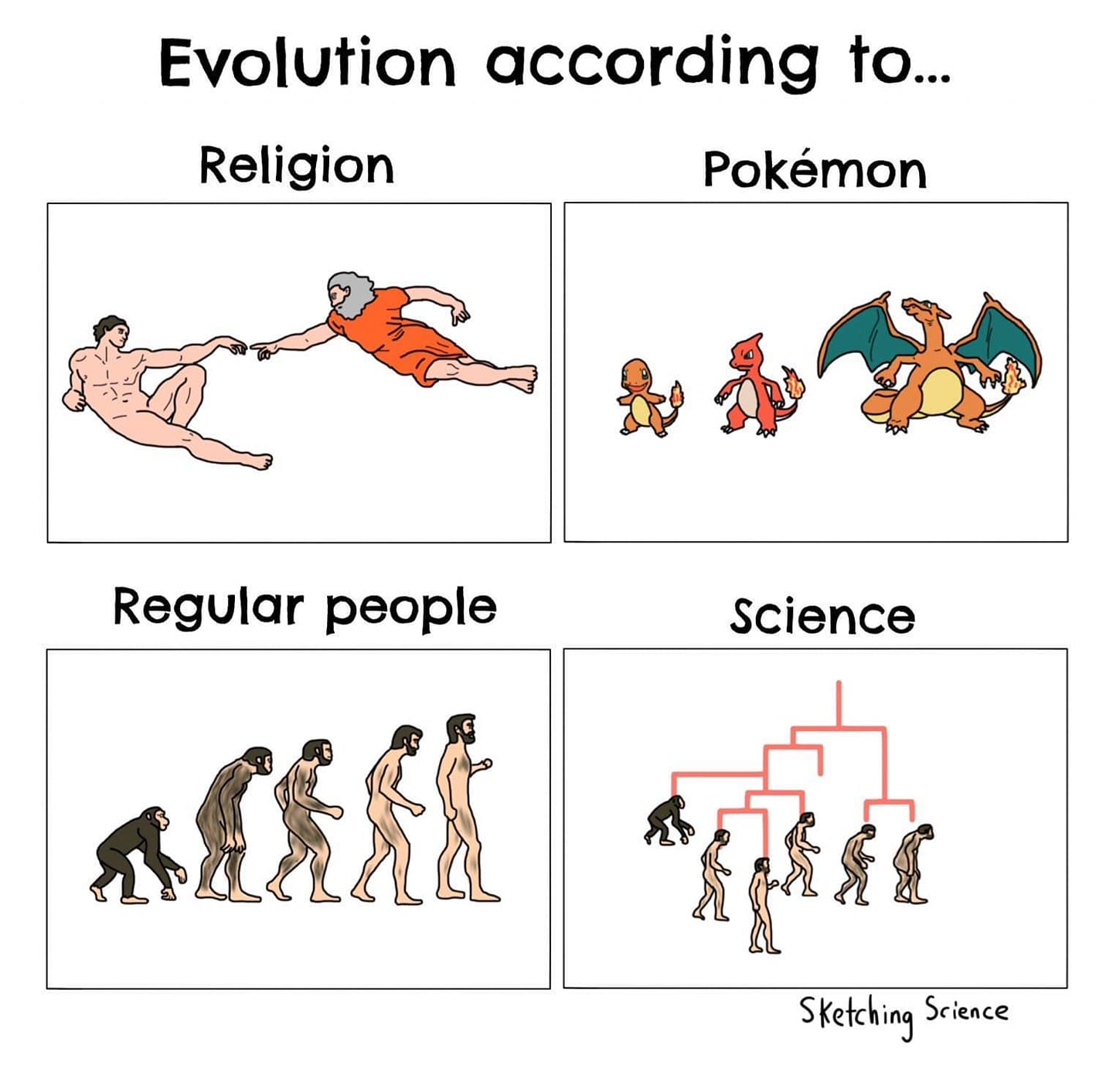
It seems to make sense at first: how can any animal that looks like a decapitated head can be competent at surviving? But this is a gross misunderstanding of what evolution is. Evolution has no standards except reproductive fitness, and the very existence of a species is proof enough that it’s not useless.

But there are worse problems with the rant. Almost everything about that rant is wrong. Most of the information on it is actually from outdated research, or outright unsupported by anything. Yet it is taken as fact by most of the people who read it.

So, having played advocate for two animals that were either dismissed as incompetent or ignored entirely, I think it’s about time I spoke up in defence of a not-really-useless fish that looks like an amputee.

Read the rest. It’s good stuff.