The skies were clear, the moon was bright, so I had to try taking a picture. Handheld. That’s my excuse, anyway.
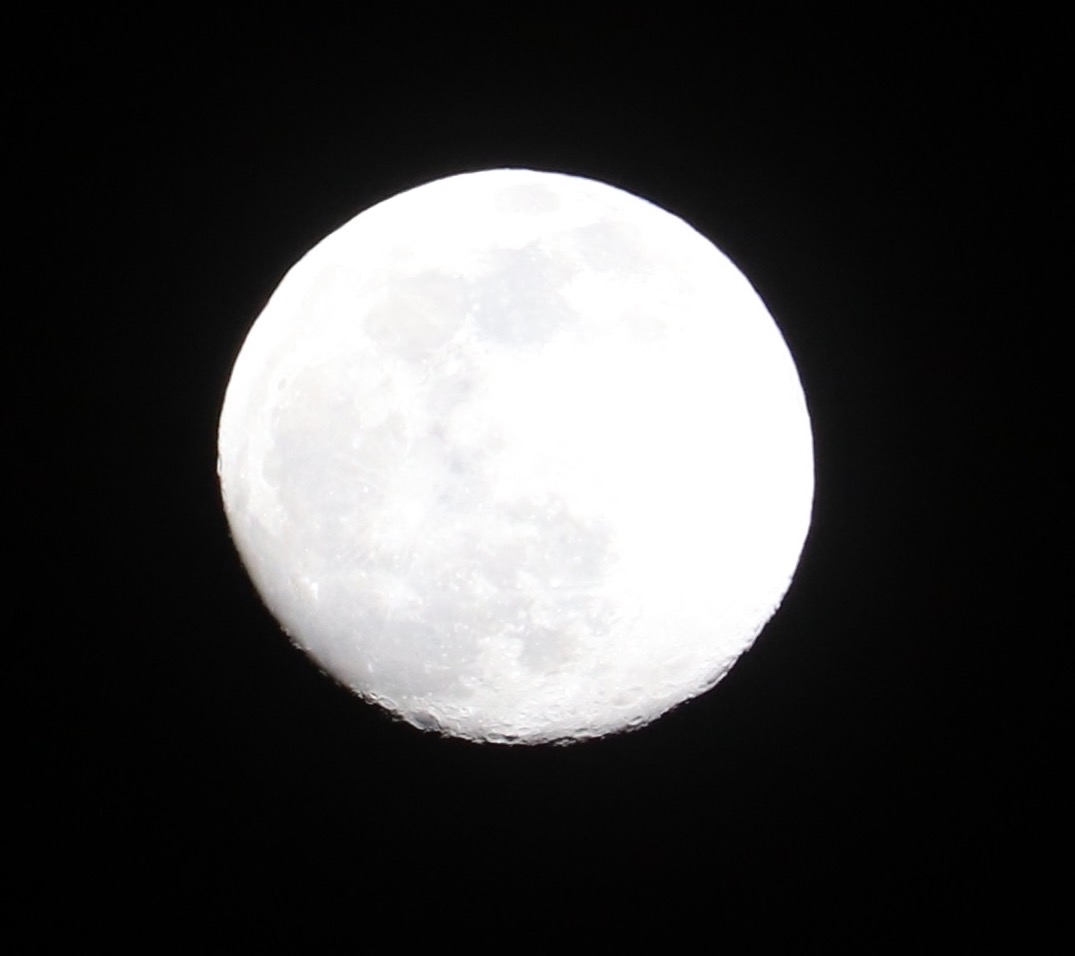
I can see craters!
Next time, tripod.

The skies were clear, the moon was bright, so I had to try taking a picture. Handheld. That’s my excuse, anyway.
I can see craters!
Next time, tripod.

I still occasionally post photos of my friendly neighborhood spider friends, but I’m avoiding putting them here. If you really, really like arachnids, you’ll have to join my Patreon to see my Breakfast at the Spider Ranch post. And if you really, really hate spiders, you don’t have to see them!

Hey, this is the same thing I tell everyone: spiders are mostly harmless, and they’re there whether you like them or not.
Spiders are not out to get you and actually prefer to avoid humans; we are much more dangerous to them than vice versa. Bites from spiders are extremely rare. Although there are a few medically important species like widow spiders and recluses, even their bites are uncommon and rarely cause serious issues.
If you truly can’t stand that spider in your house, apartment, garage, or wherever, instead of smashing it, try to capture it and release it outside. It’ll find somewhere else to go, and both parties will be happier with the outcome.
But if you can stomach it, it’s OK to have spiders in your home. In fact, it’s normal. And frankly, even if you don’t see them, they’ll still be there. So consider a live-and-let-live approach to the next spider you encounter.
The author of that article is also one of the authors of a paper I’m citing in something I’m working on now, in which he and colleagues did a thorough, room by room search for all arthropods in houses in a North Carolina region. One of their observations is that 100% of the homes had Theridiidae (common house spiders, like the Parasteatoda I’m studying) living in them. They’re kind of unavoidable. In my own much more limited survey (we only examined garages and sheds, and only arachnids, here in the harsher environment of Minnesota), we saw some similar results: almost all garages housed spiders. The one exception was eerily meticulous, everything stored away in tidy boxes, and no cobwebs or even dust. There are people who dust their garages! Unless you are that thorough, though, they’re there. And even if you are, they’ll sneak in — later that summer, we did find a few spiders in a shed on that same property. They looked terrified. Don’t worry, I didn’t rat out that they were there.
(Note: we were pretty strict about confidentiality, all locations are encoded in a file separate from the data on spider populations. You’d have to go through two sets of paper records matching addresses with spider counts to pin an identity on the houses with the most, or least, spiders.)
By the way, I have in mind proposing a workshop to Skepticon this year, an effort to counter arachnophobia. What I was thinking is a series of staged tables, where the beginning is something like 1) coloring pages of spider drawings, with explanations of anatomy; 2) a table of photos (maybe in trading card format?) of real spiders; 3) some small, caged spiders where we could observe feeding and courtship; and 4) a few harmless spiders, like Pholcidae, where people could actually let them clamber around their hands. Participants could ease in gradually and stop where ever they feel comfortable, and see people actually interact harmlessly with spiders.
What do you think? Would you actually participate in such a thing, if you had the opportunity? What number would you stop at?

Wired tries to defend SETI and UFOlogy. They argue that there are 3 branches of inquiry — exobiology, the search for extraterrestrial intelligence, and the study of UFOs — and each has their place in our battery of methods.
Aliens—hypothetical beings from outer space—fall into roughly three categories. They could be far-away microbes or other creatures that don’t use technology humans can detect; they could be far-away creatures that use technology earthlings can identify; or they could be creatures that have used technology to come to Earth.
Each of these categories has a different branch of research dedicated to it, and each one is probably less likely than the last to actually find something: Astrobiologists use telescopes to seek biochemical evidence of microbes on other planets. SETI scientists, on the other hand, use telescopes to look for hints of intelligent beings’ technological signatures as they beam through the cosmos. Investigating the idea that aliens have traveled here and have skimmed the air with spaceships, meanwhile, is the province of pseudoscientists. Or so the narrative goes.
The issue, the article argues, is that the boundaries of legitimate research have shifted over time and are culturally determined, not objective at all. There’s a continuum of legitimacy, and it’s entirely arbitrary that we place UFOs in pseudoscience, and don’t fund SETI, and think exobiology is valid and interesting. That is a good point, except that I think there is a solid criterion that is rooted in how we do science.
Here’s the deal: early in our training, we’re taught to keep an open mind — you use hypotheses to guide a line of research, but we must be prepared to find unexpected results and alternative explanations. We’re adapted to thinking, “My experiment to test my hypothesis should find X, but if it finds Y we’ll have to modify the hypothesis, and if the answer is Z, well, back to the drawing board, but gosh, that would be exciting.” Experiments are designed that give interesting results, and whether the results are compatible with our hypothesis or reject it are equally useful.
Exobiology fits the paradigm. We’re looking at other worlds with they hypothesis that life produces chemical signatures we can detect, and even if we don’t see them, we learn something about that alien planet. We gather data looking for biology, and if we don’t see it, we still have data on extraterrestrial chemistry. That’s the safe bet funding agencies look for, that we’ll learn something even if our preliminary hypothesis fails.
SETI doesn’t work that way. SETI is looking for specific patterns in extraterrestrial signals; they have a pre-set goal, rather than an open inquiry. Not finding a signal they are looking for is a literal failure that tells us nothing. That star isn’t transmitting anything useful? Abandon it, move on, look somewhere else. Over and over again. It also doesn’t help that all their hypotheses look like ad hoc dreck contrived to convince people that there might be someone out there, with infinitely bendable variables.
UFOlogy, on the other hand, is an extreme example of that latter phenomenon. We don’t see what we’re looking for — no little green men, no crashed spaceships — so they invent elaborate and often contradictory rationalizations. The evidence isn’t there, but they are determined to pretend that it is. It’s a kind of anti-empiricism where the accumulated data is irrelevant to the conclusion.
It’s as simple as asking, “What will we learn from doing the observation/experiment?” SETI’s answer is nothing, unless we find a one in a trillion possibility, then it’s the jackpot. UFOlogy’s answer is that they already know little green men exist, so we just have to photograph thrown pie plates until we’ve persuaded the establishment. Neither is good science.
Both SETI and UFOlogy are strongly susceptible to apophenia as well. They are trying to fit complex data to a prior expectation, so there’s a tendency to impose patterns on noise. Here’s a classic example: NASA has observed complex sand dune formations on Mars.
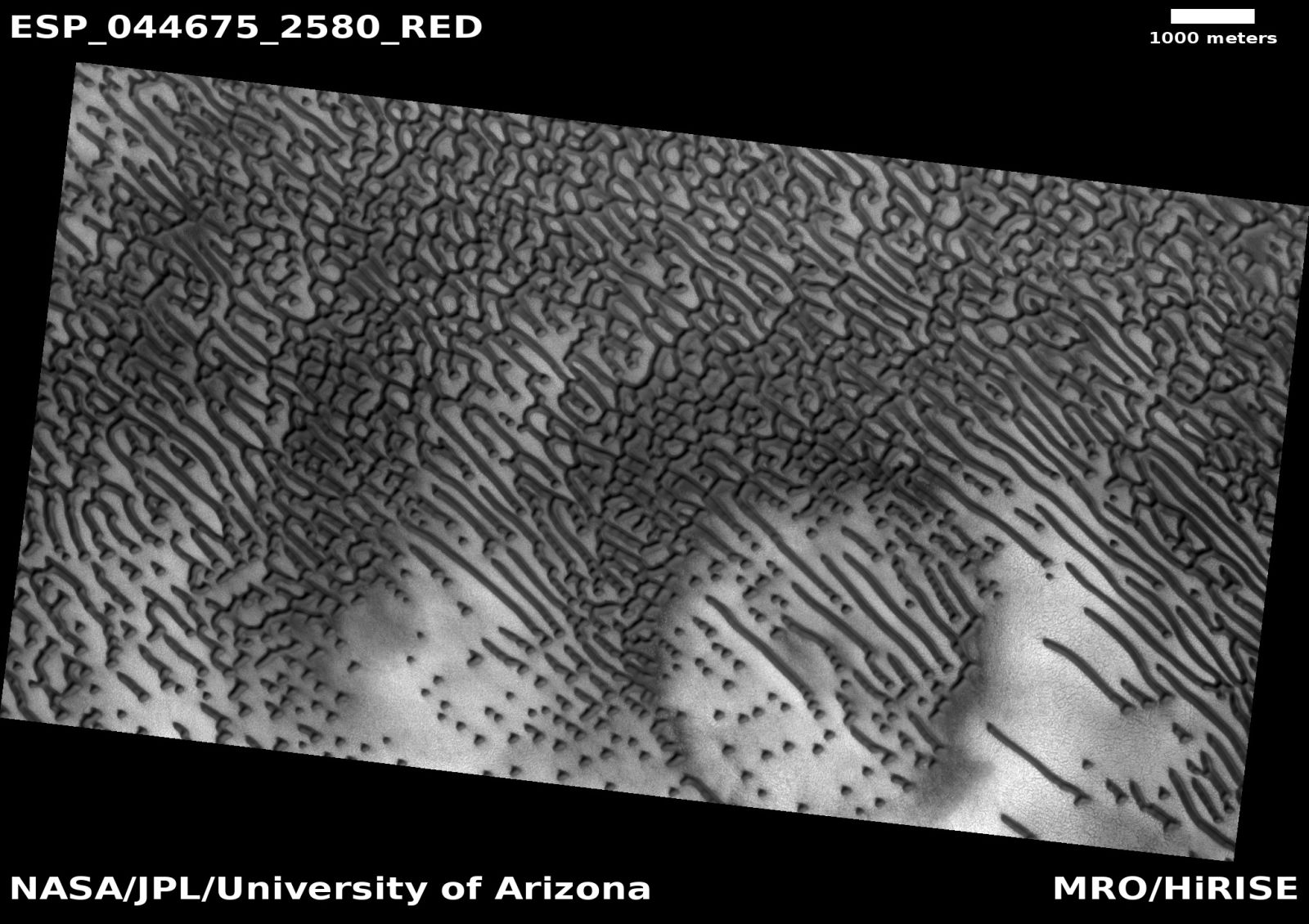
Cool. What causes it? These are windblown rills shaped by topography and prevailing, but changeable, winds that formed under more or less chaotic pressures, producing lines and bumps and branches.
But, if you’re looking for it, it could be a signal. Perhaps, if we ignore the physical mechanisms that made them, these dunes could be Martian handwriting. Or better yet, a Martian code.
Right. So someone, probably as a bit of lark, tried to interpret them as dots and dashes, and then translated them into Morse code (why ancient Martians would have used a code devised by a 19th century American is left as an exercise for the reader). The Martian dunes therefore announce to the universe these immortal words:
NEE NED ZB 6TNN DEIBEDH SIEFI EBEEE SSIEI ESEE SEEE !!
I’m sure that means something profound in the original Martian. Either that, or it’s a compressed recipe for cored cow rectums.
That’s the problem with SETI, though. The universe produces patterns all the time, and human brains strain to impose interpretable derivations on them — SETI will milk that for all the news and attention they can get, even if it is ultimately meaningless.
Meanwhile, UFOlogists already know that the aliens are living on Mars, and have trained Bigfoots raking the dunes to send secret messages to the fleet hovering invisibly in our atmosphere, and you ignore it at your peril, you fools.

How about something a little more cheerful?
I like the diversity simultaneous with recognizable, consistent morphology.


It has the potential to be a serious pandemic, but with a strong medical infrastructure, robust public health response, and a sensible, informed public, we can minimize…wait. What the heck…PANIC! Not over the virus, but over the ongoing dismantling of those very things vital to keep the citizenry as safe as possible.
Trump is making massive cuts in biomedical research.
Multiple organizations expressed shock and disappointment at Trump’s budget proposal, which adds $54 billion in defense spending but would slash nearly $6 billion from the National Institutes of Health, which funds most basic medical research in the country, as well as eliminate entirely dozens of other agencies and programs.
It would cut the overall Health and Human Services department budget by 18 percent, including the 20 percent budget reduction at NIH, and reassign money from the Centers for Disease Control and Prevention to states.
In response to concerns that we might not have enough doctors if a crisis arises, he has said that we’d just hire more doctors in that case. Doctors are not fungible. They require years of training, and their expertise requires constant maintenance.
Trump seems to think creating a task force and appointing a “czar” is a smart response. We already have experts in infectious disease at the NIH and CDC…you know, those agencies he is defunding. Appointing an ignoramus like Mike Pence, who has no qualification and has a history of botched public health management does not inspire confidence. Nor does having Ken Cuccinelli, Steven Mnuchin, and Larry Kudlow on the task force.
Also, this:
Patient zero behavior from the coronavirus czar pic.twitter.com/IXcBWMIyK5
— John Heilemann (@jheil) February 27, 2020
As for our informed public, Corona, the Mexican beer, has taken a substantial hit to their revenues because people are associating it with the virus.
Please note that the beer and the virus have nothing to do with each other.
We’re gonna die.

It is good news that the Smithsonian is making its archives of millions of images freely available — this is information ought to be in the public domain. Before you start drooling at the prospect of piles of free scientific art that you can use, the implementation is a bit rough. Sure, you can search for images of “spider” in the Smithsonian collection, but you’ll get back is a hodge-podge of imagery, most of which isn’t exactly polished, and the searches are difficult to refine. I mostly got photos of spider wasps, and black and white snapshots of broken, fixed specimens from the museum archives. General terms like “skull” give you a flood of miscellaneous imagery, some of which is neat or historically interesting; try to narrow it down to, for instance, “Neanderthal skull” and you get…nothing.It’s a work in progress, I guess.
It’s an excellent start, though. Just be warned that there isn’t much in the way of curation behind it and a lot of the images look like quick photos to go into a catalog of things that are buried deep in cabinets in the bowels of the museum.

Hey, gang! Thursday evening at 7pm we have a guest speaker, Dr Mona Hanna-Attisha talking in Edson Auditorium about her work. She’s one of the first people to discover how the water in Flint, Michigan was poisoned with lead (which, by the way, it still is), and she’s going to grace our little college with knowledge that evening. You should come. Why aren’t you coming? Don’t give me that old excuse that it’s far away — you have Google Maps, you can find us.

I put more spider photos on Patreon and Instagram. Today’s subjects are members of the tribe of Pholcus phalangioides who are dwelling in my basement. They seem to have undergone a population crash recently, though, probably because, while it’s warm enough in our house, they’re probably getting hungry at the lack of invertebrates to eat here in the depths of winter.

I said I’d stop flashing spider photos at you all, so really, it’s safe to come back here if you’re arachnophobic. I still occasionally indulge on the Patreon site, and I just added a few this morning (I’ll put them on Instagram shortly). My model was the lovely Danu, a Parasteatoda tepidariorum I caught at Skepticon in Missouri last August. My lighting setup was far short of ideal, though, so I’m going to have to work on that.
Yes, I still have those St Louis spiders in my lab, they’re doing fine, but in the absence of St Louis males, are not producing babies for me. I guess I’ll just have to go to Skepticon again this year and find some mates for them. Maybe if you go to Skepticon, I can draft you to help!