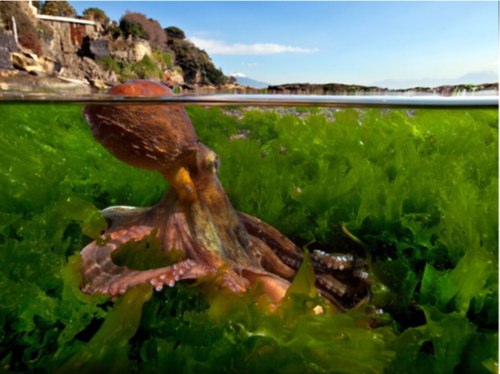
Game over, man. No cat video can ever be as awesome as this: two mimic octopuses mating.
It’s like watching a nest of snakes break out into a barroom brawl. It’s also the most erotic thing I’ve ever seen on the internet.
(Also on Sb)
Game over, man. No cat video can ever be as awesome as this: two mimic octopuses mating.
It’s like watching a nest of snakes break out into a barroom brawl. It’s also the most erotic thing I’ve ever seen on the internet.
(Also on Sb)
You think you’re safe because you’re terrestrial? Further evidence that the invasion is imminent:
Foolish humans, thinking it is “cute”. It was merely looking for a major artery before biting down.
(Also on Sb)
I said I didn’t want to say anything about free will, and I still don’t, but Massimo Pigliucci weighed in, and Jerry Coyne responded, and so did Sean Carroll, and of course I created a free will thread for everyone else to talk about it, so I guess there’s a fair bit of momentum behind it all.
I don’t understand why free will was getting all tangled up in indeterminacy vs. determinism, since that seems to be a completely independent issue. I’ll sum up my opinion by agreeing with Jerry Coyne:
Of course, whether the laws of physics are deterministic or probabilistic is, to me, irrelevant to whether there’s free will, which in my take means that we can override the laws of physics with some intangible “will” that allows us to make different decisions given identical configurations of the molecules of the universe. That kind of dualism is palpable nonsense, of course, which is why I think the commonsense notion of free will is wrong.
My mind is a product of the physical properties of my brain; it is not above them or beyond them or somehow independent of them. It doesn’t even make sense to talk about “me”, which is ultimately simply yet another emergent property of the substrate of the brain, modifying the how the brain acts. It is how the brain acts.
I think consciousness is a product of self-referential modeling of how decisions are made in the brain in the absence of any specific information about the mechanisms of decision-making — it’s an illusion generated by a high-level ‘theory of mind’ module that generates highly simplified, highly derived models of how brains work that also happens to be applied to our own brain.
(Also on Sb)
This video by Alexander Tsiaras is simultaneously lovely and infuriating; it’s a product of technology and science, and the narration is profoundly anti-science.
There are some technical issues that annoy me about the video — it’s a mix of real imagery and computer animation, and it doesn’t draw a line between what is observed and what is fabricated — but it’s visually stunning and otherwise fairly accurate.
But Tsiaras’s running commentary…it’s mystical airy-fairy glop. It takes awe and turns it into a celebration of ignorance.
It seems wasps can recognize wasp faces. I’ll have to stop making my speciesist remark that they all look alike to me.
(Also on Sb)
So you read that cool summary of how to build a molecular biology lab for $500. But wait, you don’t know what you’d do with the mobio toys! Here’s how to correct that: go to a workshop.
THE MICHAEL SMITH LABS AND ADVANCED MOLECULAR BIOLOGY LAB PRESENTS OUR MOLECULAR BIOLOGY WORKSHOPS 2012 WINTER/SPRING Session.
ONE WEEK VERSION (5 DAYS) – MOLECULAR TECHNIQUES WORKSHOPS
FEB 13 – 17, 2012 (CAN$1400)
DESCRIPTION: Recently updated: This intense 5 day workshop will focus on a myriad of different techniques used in the molecular manipulation of DNA, RNA and protein, as well as inclusion of exercises in some basic bioinformatics tools. Primarily aimed at researchers who are new to the area, familiar but require a quick updating, or would like more practical bench training.PHILOSOPHY: Whilst molecular techniques have evolved at a speedy rate over the last few decades, the underlying biochemical principles behind the vast majority of them has actually changed little. This workshop therefore combines opportunities to perform the latest, as well as commonly used older techniques, with particular attention to the chemical nuts and bolts behind them. In all, this allows the researcher to not only gain needed familiarity with the techniques, but also achieve a comfortable theoretical level to allow for both (1) that all important skill of troubleshooting, and (2) the often undervalued skill of judging the utility of “tricks” that aim to speed up, or lower costs of a given methodology.
TECHNIQUES COVERED: Various nucleic acid purification methodologies (silica bead, organic, and/or pI based), restriction digests, ligations, dephosphorylation assays, agarose gel electrophoresis, transformation (including electroporation), PCR, reverse transcriptase assay, real time qPCR, basic bioinformatics, (including blast tools), SDS-PAGE, Western blot analysis, Isoelectric focusing strips, and 2D protein gels.
Full details can be found at http://www.bioteach.ubc.ca/mb-workshops/#molecular
See? You can become a mad scientist for cheap nowadays.
(Also on Sb)
David Barton is a guy who makes a living lying about history…and now apparently he wants to add lying about science to his résumé. Here he argues that abortion and homosexuality are wrong because they are aberrations of nature.
The stupid burns white hot in that one.
It’s the naturalistic fallacy. You can’t derive what humans ought to do from what other animals do (and worse, what you imagine in your ignorance that other animals do). Other animals don’t worship the Bible or pray; therefore, it is wrong for humans to do so. At least, that’s the reasonable conclusion for Barton’s logic. We’ll also have to shed hats and shoes, stop cooking our food, and Barton will have to stop doing his clown act on TV…all human behaviors that are not shared with other animals.
It is simply not true that other animals don’t abort their young. Look at the Bruce effect; rodents will spontaneously terminate their pregnancies if exposed to a strange male. Lots of animals will spontaneously abort under stress, and it makes evolutionary sense: evolution, unlike fundamentalist Christians, favors the preservation of maternal life. It is wiser for a female to conserve her resources and bear offspring when she can afford the cost.
You want real horror stories? Look up maternal infanticide. It’s a continuation of that same evolutionary logic: if infants cost resources, and if the choice has to be made between preserving the life of the infant vs. the life of the mother (and usually, death of the mother leads to death of the infant anyway), animals will sacrifice the young first. It’s been seen in rodents, penguins, pigs, foxes, tamarins, you name it. It’s often even accompanied by cannibalism. If Barton wants to draw moral lessons for humanity from the animal kingdom, there you go.
Homosexuality is also common (here’s a list). Barton is making the common fundie Christian error, thinking sex is for reproduction and only for reproduction. As anyone with any sense knows, though, in humans and many other animals, sex is primarily for social bonding. Almost every single sexual activity in which you participate, even if it is with a member of the complementary sex in permanent relationship, is for fun and because it strengthens the relationship.
When you look at it that way, what’s surprising is how little homosexuality is going on — why are businessmen settling for a handshake and a golf game when they could really seal the deal? But then of course there are other factors, like maintaining some exclusivity of special relationships and the importance of distancing as well as intimacy in different classes of social behaviors. But you simply cannot make the blanket argument that homosexuality is unsupportable by evolution.
Also, because it’s the explanation I favor, not everything in evolution is finely tuned for optimal reproductive efficiency. I think homosexuality is common because evolution favors sexual behaviors first, and adding restrictions to limit sexual behavior to reproductive behavior a distant second.
Unfortunately, lying for favors and obstinately clinging to ignorance are typically human behaviors, too, so I can’t slam Barton with the argument that he’s an aberration.
There’s a study going around that’s getting a lot of press because of the palpably unjust conclusion that it says atheists are perceived as no better than rapists. I’ve read the paper, though, and I have to say that that’s a slightly misleading interpretation.
The paper is trying to specifically tease apart the causes of anti-atheist prejudice, and it does so with a series of tests. Their hypothesis is that there can be multiple reasons why someone could detest someone else, and they argue that, since religion is used as a test of whether someone is a member of the in-group, that religiosity is used as a proxy signal for trustworthiness.
In sum, according to the sociofunctional perspective, to understand prejudice against a given group, it is necessary to understand the threats that the group is perceived to pose. Independent theory and evidence indicates that under specific conditions, religious thinking promotes intragroup cooperation and trust, and that people use cues of religiosity as a signal for trustworthiness. Combined, these two perspectives suggest that distrust is central to anti-atheist prejudice, an insight that leads to a specific set of hypotheses regarding the nature of anti-atheist prejudice. Alternatively, another cause for hating atheists could be disgust or dislike — that their behavior inspires revulsion, or that atheists are simply unpleasant, unlikable individuals.
So let’s put it in context. This research did not establish a scale of personal attributes that ranked atheists, and found them comparable to rapists; it looked for causes, and used rapists as a category for comparison.
The kind of tests they did were surveys and examination of the likelihood of committing conjunction errors. The way they did this was to tell the subjects (who were all college students, by the way) a story like this:
Richard is 31 years old. On his way to work one day, he accidentally backed his car into a parked van. Because pedestrians were watching, he got out of his car. He pretended to write down his insurance information. He then tucked the blank note into the van’s window before getting back into his car and driving away. Later the same day, Richard found a wallet on the sidewalk. Nobody was looking, so he took all of the money out of the wallet. He then threw the wallet in a trash can.
Then the students were asked whether it was more probable that Richard was either 1) a teacher, or 2) a teacher and XXXX, where XXXX was either a Christian, Muslim, rapist, or atheist. Obviously and logically, the correct answer should always be 1, because the probability that the person will be a teacher and something else will always be lower than the probability that the person will be a teacher.
The answer they found was that people made this error about 29 times more often if XXXX was “atheist” rather than one of the religious groups, and that the responses were not significantly different between “atheist” and “rapist”. There was also a correlation between the likelihood of making the error and how important the subject rated god in their lives.
Don’t get hung up on the comparison with rapists. That was a category simply chosen because it would be unambiguously distrusted. They could have used “investment banker”, too, but then the comparison would be more difficult, because maybe a wealthy conservative college student wouldn’t consider that to be an untrustworthy occupation.
The point was not a comparison with rapists, but a comparison with other possible causes of anti-atheist prejudice. For instance, another group of subjects was told this story, as a measure of unpleasantness of character:
Richard is 31 years old. He has a rare inherited medical condition. This leads him to have dry, flaky skin and produce excess mucus. His skin often flakes off at embarrassing times, and he almost always has a dripping nose and phlegm in his throat. On his way to work one day, Richard was scratching his itchy shoulder. Some of the dry skin that flaked off caused him to sneeze, and some snot ended up on his tie. He failed to notice that the phlegm got on his tie. He wore this dirty tie through an entire work day.
Then they did another conjunction fallacy test, asking whether it was more probable that Richard was 1) a teacher, or a teacher and XXXX, where XXXX was Christian, Muslim, gay, or atheist. In this case, the result was that neither gays nor atheists were regarded as personally more unpleasant or unlikeable.
So the study has good news and bad news.
The bad news is that atheists really are not trusted by the public at large — we do not give off the positive in-group signals expected, so we get relegated to a kind of pariah status.
The good news, I guess, is the reasoning behind that. You’ll often see religious people rail against atheists and tell us how rude and awful and bad we are: take a look at the comments on this article on the study, for instance.
I think part of the issue is that some of the most visible, high-profile atheists we hear about (Dawkins, Hitchens) are vocally of the “THERE IS NO GOD AND IF YOU THINK THERE MIGHT BE YOU ARE AN IDIOT!1” variety. These are the atheists that get the press, so I can understand the source of the perception.
Or here:
I’ve never met an atheist that wasn’t an ass. I’m not saying they all are. Just those I have known.
They push harder than the Phelps’.
Those people have misinterpreted the study (or more likely, haven’t even read it). It’s actually saying the opposite: people don’t perceive atheists as being unpleasant, they see them as being outsiders. It is specifically tying the prejudice to a judgment about trust, not whether we’re icky rude nasty people.
The message I take away from it is not to avoid the assertiveness associated with the New Atheist movement — although it may highlight those in-group/out-group boundaries, that’s necessary. We aren’t trying to say we are exactly like theists, we need to demarcate those boundaries as part of establishing our identity. What the study does do, though, is affirm that those campaigns to establish the idea that we can be good without god, that we have high moral standards, are even more important, because they go directly to the issue of whether atheists are trustworthy members of the community.
Gervais WM, Shariff AF, Norenzayan A (2011) Do you believe in atheists? Distrust is central to anti-atheist prejudice. J Pers Soc Psychol.101(6):1189-206. Epub 2011 Nov 7.