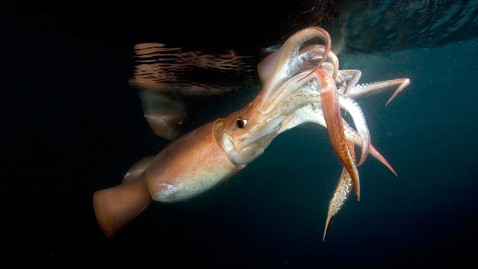
(via Reefwonders)
This is an abbreviated summary of my class lecture in developmental biology today. This was the first day of class, so part of the hour was spent on introducing ourselves and going over the syllabus, but then I gave a lightning fast overview of the history of developmental biology.
Classical embryology began with Aristotle, whose work was surprisingly good: he approached the problem of development with relatively few preconceptions and fairly accurately summarized what was going on in the development of the chick. Most of this old school embryology is descriptive and was really a narrow subset of anatomy, but there were a few major conceptual issues that concerned the old investigators, in particular the question of preformation (the plan of the embryo is laid out in the egg) vs. epigenesis (the plan of the embryo emerges progressively). Aristotle, by the way, was on the right side of this debate, favoring epigenesis.
In the 19th century, development was seen as a progressive process that paralleled the hierarchical organization of nature — that is, developmental biology, what there was of it, was coupled to the great ladder of being. This is not an evolutionary idea, but reflects the view that there was a coherent pattern of greater and lesser development that was part of a coherent divine plan for life on earth. The German ‘Natural Philosophers’ pursued this line of reasoning, often to degrees that now look ridiculous in hindsight. In contrast, there were developmental biologists like Karl Ernst von Baer who wanted nothing to do with a cosmic teleology but instead preferred to emphasize observation and data, and simple minimal hypotheses.
In the late 19th century, developmental biology split into two directions. One was a dead end; Ernst Haeckel basically lifted the explanatory framework of the natural philosophers, replaced divinity with evolution, and tried to present development as a parallel process to evolution. Von Baer had already demolished this approach, and despite a few decades of popularity Haeckelian recapitulation died as a credible framework for studying evolution in the early years of the 20th century. The other direction developmental biology took was Wilhelm Roux’s Entwicklungsmechanik, or experimental embryology. This was an approach that largely eschewed larger theoretical frameworks, and focused almost exclusively on observation and experimental manipulation of embryos. It was a successful discipline, but also divorced mainstream developmental biology from the evolutionary biology that was increasingly influential.
As examples of Entwicklungsmechanik, I discussed Roux’s own experiments in which he killed one cell in a two-cell embryo and saw partial embryos result, an observation that fit with a preformationist model, but more specifically a mosaic pattern of development, in which patterns of development were encoded into the cytoplasm or cortex of the egg. Those experiments were seriously flawed, however, because the dead cell was left attached to the embryo, and could have deleteriously affected development. The experiments of Hans Driesch were cleaner; he dissociated embryos at the four cell stage, cultured each blastomere independently, and discovered that each isolated cell developed fully into a complete, miniature larva.
Driesch, unfortunately, interpreted these results to imply that there was an entelechy, or guiding intelligence outside the embryo, and that the only conceivable explanation was the existence of purpose behind embryology. This was also a dead end; the modern explanation for the phenomena is that they regulated, that is, that cells determine their fate by interacting with one another, rather than some kind of cosmic plan. And that’s really going to be a major focus of this course: how do cells communicate with one another, how are genes regulated to set up coherent and consistent patterns of gene expression that produce the organized cell types we find in an adult multicellular plant or animal?
That set up the next lecture. Entwicklungsmechanik, while representing a solid and productive research program, quickly reached its limits, because what we really needed to examine were those patterns of gene expression rather than trying to infer them from observations of morphology. The big breakthrough was the melding of developmental biology and molecular biology — most of the modern developmental biology literature focuses on examining interactions between genes. So on Wednesday we’ll get another fast overview of the molecular genetics research program, and a bit of evo-devo.
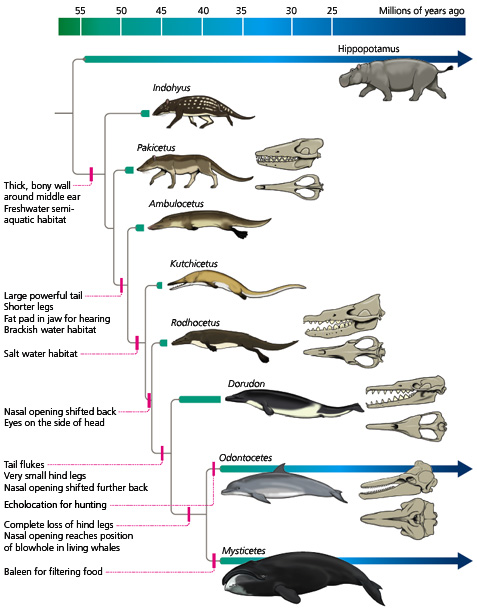
Share it with your kids: this is a clean and simple summary of evolution.
(via Skepchick.)
Many of you already know that Aaron Swartz, an online activist, committed suicide earlier this week. I didn’t know much about him, but now I’ve learned two things.
One, he was a victim of depression. I’ve never experienced this personally — at worst I can say I’ve been sad and stressed at time — but let’s be clear about something: depression is something altogether different. Swartz wrote about his depression, and got across a little bit about what it actually feels like. This is good communication.
Your face falls. Perhaps you cry. You feel worthless. You wonder whether it’s worth going on. Everything you think about seems bleak – the things you’ve done, the things you hope to do, the people around you. You want to lie in bed and keep the lights off. Depressed mood is like that, only it doesn’t come for any reason and it doesn’t go for any either. Go outside and get some fresh air or cuddle with a loved one and you don’t feel any better, only more upset at being unable to feel the joy that everyone else seems to feel. Everything gets colored by the sadness.
At best, you tell yourself that your thinking is irrational, that it is simply a mood disorder, that you should get on with your life. But sometimes that is worse. You feel as if streaks of pain are running through your head, you thrash your body, you search for some escape but find none.
Two, I’m outraged at the criminal abuse by the justice system that exacerbated his problems. The man was hounded to death, threatened with long prison terms by MIT and JSTOR, the journal archive service.
Aaron’s death is not simply a personal tragedy. It is the product of a criminal justice system rife with intimidation and prosecutorial overreach. Decisions made by officials in the Massachusetts U.S. Attorney’s office and at MIT contributed to his death. The US Attorney’s office pursued an exceptionally harsh array of charges, carrying potentially over 30 years in prison, to punish an alleged crime that had no victims. Meanwhile, unlike JSTOR, MIT refused to stand up for Aaron and its own community’s most cherished principles.
You might be wondering what awful crime he committed that justified arresting him and confronting him with a 50 year prison sentence: he downloaded scientific research articles and then made them available to others (Wait…apparently, he didn’t even share them, but just downloaded them via MIT’s protocols). Uh-oh. I’ve done this…just not on the scale of Swartz’s efforts. Swartz was committed to Open Access.
This is the problem: not that Swartz opened the door to scientific research, but that we’re laboring under an antiquated system of scientific information storage that privileges profit-making over open access to the results of publicly-funded research.
While carrying out some obscure and pointless ritual on the sea, an orthodox priest instead manages to catch the attention of something far more interesting.
Ph’nglui mglw’nafh Cthulhu R’lyeh wgah’nagl fhtagn.
I wake up this morning to discover Doonesbury telling me stuff I already know.
Yep, classes start for me tomorrow at 8am. I have a lighter load than the grueling mess last semester, and I also get to teach my fave class, developmental biology. No new paradigms this time, though — I think it worked fairly well the way I did it last time, with a mix of once weekly lectures and lots of class time dedicated to discussion and analysis. I’ll also be compelling my students to set up blogs and write about science publicly, so I’ll occasionally be linking to a lot of student work.
One thing I’m considering doing differently…I might post summaries of lectures and discussion topics here, if time allows. Public exposure of all the stuff that usually goes on behind the doors of the classroom? I don’t know if the world is ready for that.
I’m including the syllabus for my developmental biology course. Just in case you think I’m totally slacking with just one class, I’m also teaching a course called Biological Communications, a writing course that tries to get students to read and write in the style of the scientific literature, and am also doing individual studies with 5 students.
You know how it is. You’re getting down with your mate, all absorbed in the intimacies, and then one of those damned drones comes whispering up outta nowhere and aims a camera at your triple-X action. And the lights! It was all dark and cozy, but no, they gotta come in with all lights blazing, illuminating every mottle and dimple.
That’s what NOAA did to these poor Pholidoteuthis adami, catching them doing the deed.
I will say this for the squid: they know what’s important. They didn’t even flinch, but just kept at it. And look at them! They’re head to tail, and the male is doing it all upside down! I’m impressed. And inspired.
You’ve probably already heard the news: video of a living giant squid in its natural environment has been captured for the very first time.
The bad news: all we’ve got right now is teasing little snippets of the video. It’s a slightly disturbing use of science in that it’s getting sensationalized for commercial purposes: it’s going to be shown on the Discovery channel on 27 January at 8pm — a very strange outlet for a scientific discovery.
The good news: Steve O’Shea, the cephalopod expert, has seen it and offered his opinion.
I can assure you that you will not be disappointed when you watch the show. In press release and title they demonize the animal again, and there has been an outcry from those involved at their doing so (but I cannot and will not get drawn into the ‘behind the scenes’ politics of all of this), but when you see this animal, alive, full-grown, beautiful, well, demon it is not. It is the most exquisite thing you will see, and it is no fleeting glimpse either – you see a LOT for a LONG time, in full colour, full HD, complete focus.
I have probably said more than I should have; I am awaiting confirmation that we can talk about it, because this announcement caught us off-guard (we had no forewarning that it would be announced today).
27 January is a day you want to mark in your calendars!
OK, now that tantalizes me. I’ll alert you all on the 27th again, and you can pretty much guarantee I’ll be glued to the TV that night.
Here’s how we end our dependency on fossil fuels: once it gets hot enough, we won’t be able to pump gas anymore!
The country’s all-time record of 123.26 degrees Fahrenheit was set in 1960 at the Oodnadatta Airport in Southern Australia, but it’s already so hot that people can’t even pump gas. Nikki Staskiewicz and Angela Blomeley were stranded in Oodnadatta — which bills itself as “the driest town [in] the driest state of the driest country” in the world — when they tried to fill up their tank, only to find the fuel vaporizing in the triple-digit heat.
I think gasoline vaporizes at around 60°C…so that’s plausible if their car had been baking in the sun for a while. Watch out for sparks!
It looks like it’s getting a bit warm down under. They had to add new colors to the temperature spectrum.