Oh, no, the Science Communications Debate is starting up again

Here we go again, with communications experts lecturing scientists on how to better reach their audience. While we appreciate support, you’d think the communications experts would actually be good at the communications side…yet over and over again, they tell us the same old stuff and exhibit the same terrible habits they accuse scientists of having. The latest lecture on how to teach good comes from Slate and someone who runs a network of workshops to help scientists learn to reach the masses.

It’s an admirable goal, but almost certainly destined to fail. This is because the way most scientists think about science communication—that just explaining the real science better will help—is plain wrong. In fact, it’s so wrong that it may have the opposite effect of what they’re trying to achieve.

Wait…telling people they’re wrong and telling people how to be right doesn’t work, and may actually have a backfire effect? Gosh. But didn’t you just declare that the scientists are all wrong — and are about to tell us how to do everything correctly?

Please, please, please, O Communications Pundit, I wish that just once one of you would practice what you preach. I have been at conferences and have debated with people who pull this stunt: arrogantly tell science communicators to stop being arrogant, announce that we should stop just citing papers and they have the papers to prove that it’s ineffective, and rudely bring us up short by scorning what we’ve done, since scorn and rudeness never work.

I was just at a meeting about science education, run by scientists, and one of them got a good laugh (or groan) from us by asking if we’d ever been at a meeting to promote active learning and had a speaker do a straight-up lecture for an hour on the subject. Yes. Yes we have. It gets old. (This speaker then gave us a small set of problems and simple exercises to work on in small groups to illustrate how to teach about restriction enzymes and molecular cloning, so he didn’t make this mistake.)

The Communications Pundits then typically make another mistake: they hector the scientist with stuff they already know.

Before getting fired up to set the scientific record straight, scientists would do well to first consider the science of science communication. The theory many scientists seem to swear by is technically known as the deficit model, which states that people’s opinions differ from scientific consensus because they lack scientific knowledge. In 2010, Dan Kahan, a Yale psychologist, essentially proved this theory wrong. He surveyed over 1,500 Americans, classifying each person’s “cultural worldview” on a scale that roughly correlates with politically liberal or conservative. He then assessed each person’s scientific literacy with questions such as “True or False: Electrons are smaller than atoms.” Finally, he asked them about climate change. If the deficit model were correct, Kahan reasoned, then people with increased scientific literacy, regardless of worldview, should agree with scientists that climate change poses a serious risk to humanity.

That’s not what he found. Instead, Kahan found that increased scientific literacy actually had a small negative effect: The conservative-leaning respondents who knew the most about science thought climate change posed the least risk. Scientific literacy, it seemed, increased polarization. In a later study, Kahan added a twist: He asked respondents what climate scientists believed. Respondents who knew more about science generally, regardless of political leaning, were better able to identify the scientific consensus—in other words, the polarization disappeared. Yet, when the same people were asked for their own opinions about climate change, the polarization returned. It showed that even when people understand the scientific consensus, they may not accept it.

Uh, guy, I already know this stuff. I teach. I’m pedagogically aware. I read the educational literature. I tinker with my classes all the time to try and improve them. I assess. I started teaching in 1993, and I knew then that standing on a podium, hiding behind a lectern, and droning facts at a class wasn’t always, or even usually, an effective strategy. So try telling me something new.

Nowadays, when I hear a communications expert tell me that I believe in the “deficit model”, as they always do, I just shut down and walk away. This is a person who is trying to shoehorn me into their incorrect model of how science communicators work. Sorry, you’ve got nothing to teach me. You’re a communications failure.

This fellow does try to provide some positive suggestions, at least. Unfortunately, they’re also old and familiar ideas that I already know.

Is it any surprise, then, that lectures from scientists built on the premise that they simply know more (even if it’s true) fail to convince this audience? Rather than fill the information deficit by building an arsenal of facts, scientists should instead consider how they deploy their knowledge. They may have more luck communicating if, in addition to presenting facts and figures, they appeal to emotions. This could mean not simply explaining the science of how something works but spending time on why it matters to the author and why it ought to matter to the reader. Research also shows that science communicators can be more effective after they’ve gained the audience’s trust. With that in mind, it may be more worthwhile to figure out how to talk about science with people they already know, through, say, local and community interactions, than it is to try to publish explainers on national news sites. And they might consider writing op-eds for their local papers, focusing on why science matters to their particular communities.

“Appeal to emotions”…because everyone knows scientists are robots who’d rather emit mathematical symbols at an audience. How about if, next time you’re motivated to give advice, you recognize that most scientists are really smart people who know what they’re doing? We tailor our approach to our audience. When we’re at a scientific meeting talking to people in our field, we can spew out amazing streams of information-dense jargon, and know we don’t have to provide a lot of background. When we’re teaching a class of 18 year olds, we know we have to build a story from more basic foundations. When we’re on TV with a huge, mixed audience, we know we have to try and reach out with even more basic appeals to common interests.

This is not to say we’re all good at it. There are difficult skills involved in this process. But please stop treating science communicators as if they’re completely unaware of elementary human interactions. It’s condescending and stupid (cue communications expert to start lecturing condescencingly about how condescention puts off your audience).

Here’s an example of how science communicators actually work. CNN brought Bill Nye together with William Happer — Happer, as many of you already know, is a Princeton physicist who is astoundingly stupid on the matter of climate change, and ought not to be on television at all. Happer gets the first words in, and they are idiotic. Watch how Nye responds.

Happer makes this pronouncement.

There’s this myth that’s developed around carbon dioxide that it’s a pollutant, but you and I both exhale carbon dioxide with every breath. Each of us emits about two pounds of carbon dioxide a day, so are we polluting the planet? Carbon dioxide is a perfectly natural gas, it’s just like water vapor, it’s something that plants love. They grow better with more carbon dioxide, and you can see the greening of the earth already from the additional carbon dioxide in the atmosphere.

I sure wish communications experts would spend a little more effort looking at what bozos say, because they break all the rules the experts lay down, and they’re effective with their audiences. So there is Happer, with “Princeton” repeated over and over again in the background to give him authority, basically stating bald lies as facts, and looking far more robotic than Nye.

Now in response to what Happer said, I would have approached it rather differently than Nye: my first thought was “well, we make about a pound of poop every day, it’s perfectly natural, plants love it, but do we really believe more sewage would make the world a better place for humans?” You can see what Nye’s first thought was: he was thinking like an engineer, and wanted to discuss rates — there’s a whole lot of stuff he could have lectured on, relative rates of carbon dioxide production and fixation and sequestration, the balance of gases, etc., but he checked himself. I guarantee you that he knows that with the right audience, that kind of discussion would go over well, and he could probably also do a kids’ show all about that concept. But it wasn’t going to work on CNN, with an audience that had just smugly congratulated itself on hearing Happer’s idiocy affirming all their biases and ignorance.

So he switched gears, and you can even see it happening. He pointed out that Happer was an oddball, not representative of science at all, undermining his claim to authority. He criticizes CNN for having a crank on to represent a marginal view, poorly representing the consensus. He points instead to concerns about the economy. He briefly reminisces about his personal experience with Earth Day. He talks about how we’ll fall behind in competition with other nations. He invokes the US Constitution. He reminds everyone that the EPA was established by a conservative president, Richard Nixon.

Sir, with some respect, I encourage you to cut this out so we can all move forward and make the United States a world leader in technology. What we want are advanced wind turbines, advanced photovoltaics, advanced solar concentrated energy plants. And, everybody, if we were to do that, we would have at least 3 million new jobs in the United States that could not be outsourced. We would not need to have our military on the other of the world defending what people call ‘our oil.’ We could move forward and we could export this technology. We could be world leaders in this instead of wringing our hands and cherry picking data and pretending that this problem that’s obvious to the scientific community is somehow not obvious to you.

Every effective science communicator does this. And then the communications ‘experts’ will come along and complain that they spent too much time trying to correct ignorance, that damned ‘deficit’ model they love to invoke, if anyone makes any effort to explain why Happer was wrong.

You need it all: emotion, appeals to common interests, criticism of bad ideas and bad actors, and the facts. I swear, if these clowns had their way, I’d be teaching genetics by spending 14 weeks explaining why the students ought to care and be motivated, and when I got to briefly explaining a monohybrid Mendelian cross in the 15th week, they’d jump on me for wasting time trying to correct a ‘deficit’.

Neuralink and the delusional world of Muskians

I know, I’m getting a reputation as that guy who hates Elon Musk (I don’t, I hate hype), but his latest is just too much bullshit. He has bought a company called Neuralink, which has the goal of creating brain-machine interfaces (BMIs). OK so far. These interfaces are cool, interesting, and promising, and I’m all for more research in this field. But Musk gets involved, and suddenly his weird transhumanist-wannabe fanboys start hyperventilating. I double-dog dare you to read this puff piece, Neuralink and the Brain’s Magical Future. It begins roughly here, with the claim that Musk is going to build a Wizard Hat to make everyone super-smart:

Not only is Elon’s new venture—Neuralink—the same type of deal, but six weeks after first learning about the company, I’m convinced that it somehow manages to eclipse Tesla and SpaceX in both the boldness of its engineering undertaking and the grandeur of its mission. The other two companies aim to redefine what future humans will do—Neuralink wants to redefine what future humans will be.

The mind-bending bigness of Neuralink’s mission, combined with the labyrinth of impossible complexity that is the human brain, made this the hardest set of concepts yet to fully wrap my head around—but it also made it the most exhilarating when, with enough time spent zoomed on both ends, it all finally clicked. I feel like I took a time machine to the future, and I’m here to tell you that it’s even weirder than we expect.

But before I can bring you in the time machine to show you what I found, we need to get in our zoom machine—because as I learned the hard way, Elon’s wizard hat plans cannot be properly understood until your head’s in the right place.

I dared you to read it, because I’ll be surprised if anyone can plow through it all: it goes on for almost 40,000 words (I know, I pulled it into a text editor and confirmed it), and that doesn’t count all the crappy little cartoons scattered through out it. When the author says you cannot properly understand it without putting your head in the right place, he means you have to start with sponges and be lead step by step through a triumphalist version of 600 million years of evolutionary history, which is all about a progressive increase in the complexity of brain circuitry. It’s an extremely naive and reductionist perspective on neuroscience and intelligence that presumes that all you have to do is make brains bigger and faster to be better, and that computers extend the “bigger” part but are limited by the speed of interfaces, so all we have to do is improve the bandwidth and we’ll be able to battle the AIs that Musk thinks will someday threaten to rule the world.

All the verbiage is a gigantic distraction. It’s virtually entirely irrelevant to the argument, which I just nailed down for you in a single sentence…without bogging you down in a hypothetical history of flatworms and a lot of simplistic neuroscience. He summarizes Elon Musk’s glorious plan in yet another crude cartoon:

It is accompanied by much grandiloquent noise and promises of planetary revolutions, but what needs to be asked is “How much of this is real?”. The answer is…pretty much none of it. We are currently in the little blue ball at the lower left labeled “starting point”, and Musk has bought a company that is doing tentative, exploratory research on building BMIs (I guess that this whole field is new enough that they are all, by default, “cutting edge”). Everything else in the diagram is complete fantasy. Elon Musk has bought a company, and is cunningly trying to inflate its value by drowning the curious in glurge, techno-mysticism, and making shit up, which, because he has this mystique among young male engineers, will probably succeed in making him more money and fame, without actually doing anything in the top two thirds of that cartoon.

I do rather like how the third step is “BREAKTHROUGHS in bandwidth and implementation”. You could replace it with “And then a miracle occurs…”, and it would be just as meaningful.

Let’s add a little more reality here: Musk has a BS in physics and economics, and started a Ph.D. in engineering, which he dropped out of. He has no education at all in biology or neuroscience.

Another shot of reality: he’s buying this company in collaboration with Peter Thiel’s venture capital company. You remember Thiel, right? Wants to prolong the life of old rich people by transfusing them with the blood of the young? Libertarian acolyte of Ayn Rand who is now advising Trump on policy? If you think this is a recipe for a post-Singularity paradise, looking at the people backing it ought to tell you otherwise.

So why are these filthy rich people getting involved in this nonsense? Let’s ask Elon.

Fear and ignorance, like always.

They’ve imagined a huge, shadowy existential risk which does not exist yet — you might as well drive your decisions by the possible threat of invasion by Mole People from Alpha Centauri (oh, wait…they also fear aliens). They don’t know how AIs will develop or what they’ll do — nobody does — and they lack the competencies needed to guide the research or assess any risks, but they’ve got a plan for generating all the benefits. These guys are as terrifying to me as the Religious Right, and for all the same reasons.

They have fervent worshippers who will vomit up 40,000 words based on inspiration and wishful thinking, and then wallow about in the mess. It’s possibly the worst science writing I’ve encountered yet, and I’ve read a lot, but still, take a look at all the commenters who want it to be true, and regard grade-school and often incorrect summaries of how brains evolved to be informative.

Science in America

Neil deGrasse Tyson has a few words for you.

I agree with all of that. My concern is that we’re dealing with an industry — exemplified by creationism and climate change denial — that has built up a body of well-funded propaganda which allows their believers to rear up and say, Well, we are citizen scientists who have our own facts, and we say that the Earth is 6000 years old and global warming is just a natural cycle. They aren’t going to be impressed by published, verified facts about the natural world when they have something even more significant to them: validation of their biases, consilience with their holy book, resentment and paranoia about those damned ivory tower eggheads.

Tyson will reach the people who already support good science, and that’s important in sustaining resistance to ignorance. But I fear he will not change the minds of the dumbasses who currently hold the reins of power. All that we can do is work to throw them down. And that is a political solution to an existing situation in reality.

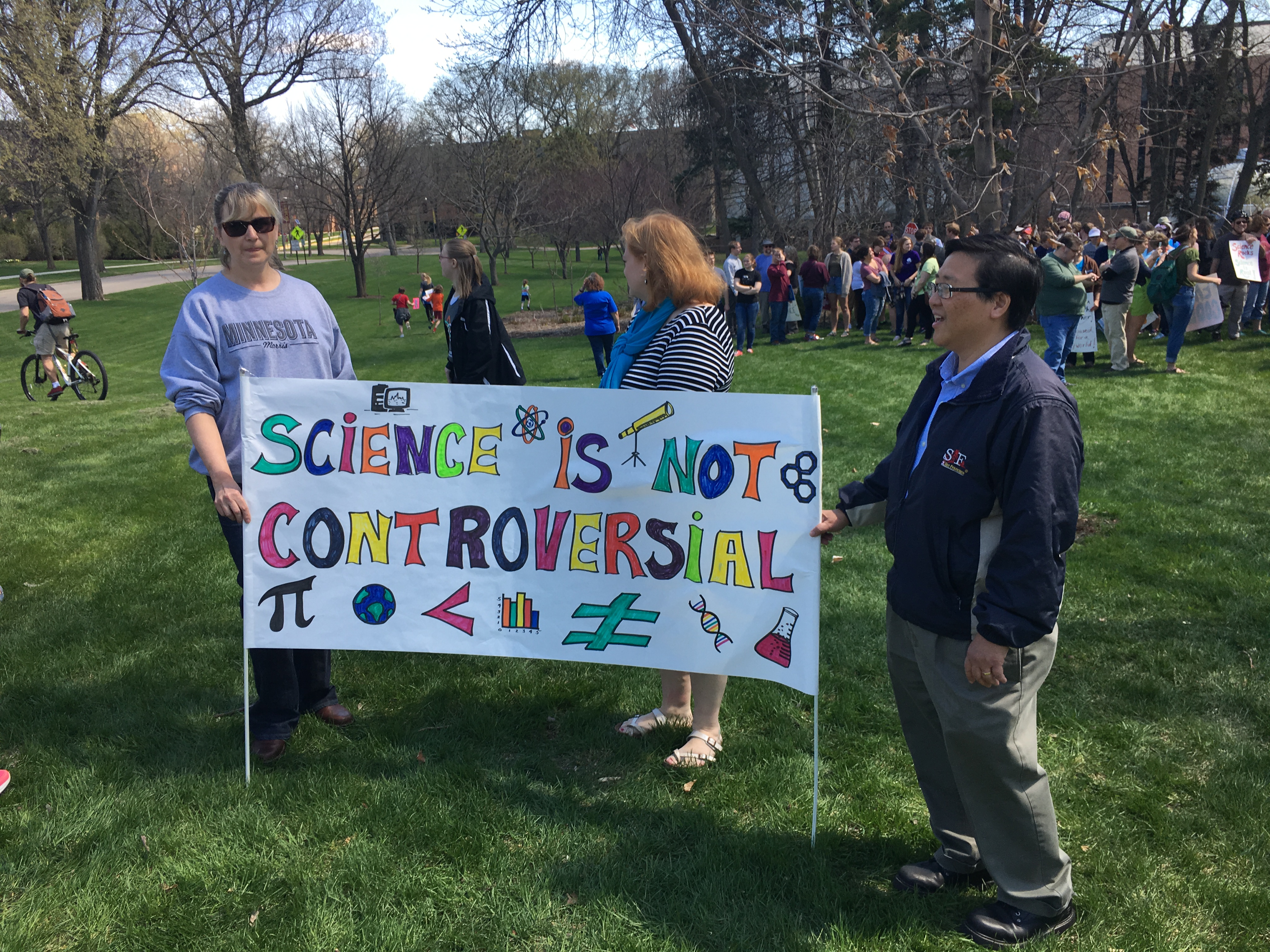
The Science March and partisanship

[Guest post from Sam Roy]

There is a lot of talk on the March for Science being “non-partisan” and above “politics.” Three points on this:

  • When science is under attack by the powers-that-be, the defense of science is a political act, and we should not shy away from this.

    What this regime has unleashed is potentially catastrophic in its consequences for humanity. Humanity confronts a warming planet, with rising sea levels, melting glaciers and extreme weather events causing droughts and famine; it is nothing short of a crime against humanity to accelerate this by denial of global warming, by muzzling of climate scientists, by de-funding this research, approving fossil fuels and oil pipelines, and effectively undermining any global response to this crisis. Humanity confronts increased incidence of global pandemics; it is nothing short of a crime against humanity to de-fund public health research. Let’s not forget Trump’s inhumane, mean-spirited and chauvinistic response to the doctors and nurses who went to Africa to deal with the Ebola crisis, tweeting, “The “US cannot allow EBOLA infected people back” and they “must suffer the consequences.” Imagine what his policies and response will be to the next pandemic outbreak!

  • The March for Science should be non-partisan, if that is to mean NOT favoring the “Democrats” over the “Republicans”.

    Let’s not forget that not a single prominent Democrat has come out and boldly proclaimed that evolution is a fact – all life on planet Earth evolved from common ancestors over nearly 3.5 Billion years. Democrats have constantly conciliated with Christian fascists and Biblical literalists who have waged well-funded and deceptive campaigns to undermine the teaching of evolution in schools. They did not oppose Betsy deVos, the Christian Fascist Secretary of Education, on this front despite her well-known and historic efforts to impose this worldview on society, denying generations of children the science of evolution and the scientific method. To rely on the Democrats to “save” and “defend” science is a fool-hardy enterprise.

  • But the March for Science should be Partisan – In the Name of, and For Humanity!

    The March for Science has a wonderful celebratory spirit in sharing science with the world.

    At the same time, let’s recognize that this regime – the Trump/Pence regime – is a fascist regime, posing existential threats to humanity, including with nuclear brinksmanship. Some say it may be true but it’s not useful or too scary or too polarizing. Imagine if some didn’t raise the alarm about AIDS, when the powers-that-be refused to even acknowledge it – because it’s not useful or too scary or too polarizing. Imagine if they knew in 1933 what we know now about Hitler and the Nazis. Let’s call scientific reality for what it is, let’s not make this mistake – for the sake of humanity.

    The terror unleashed on millions of immigrants in this country by this regime is very real, and is happening – right now! The world’s most devastating bomb short of nuclear was dropped – last week. Today they threaten an unbelievably catastrophic war against Korea. Imagine what harm this regime can do over the next few days, weeks and months with its levers of power, bludgeoning truth and repressing dissent as it carries out its horrors.

    We need to drive out this regime – at the soonest possible moment.

The gospel according to St Ray

Deja vu, man. Transhumanism is just Christian theology retranslated. An ex-Christian writes about her easy transition from dropping out of Bible school to adopting Ray Kurzweil’s “bible”, The Age of Spiritual Machines.

Many transhumanists such as Kurzweil contend that they are carrying on the legacy of the Enlightenment – that theirs is a philosophy grounded in reason and empiricism, even if they do lapse occasionally into metaphysical language about “transcendence” and “eternal life”. As I read more about the movement, I learned that most transhumanists are atheists who, if they engage at all with monotheistic faith, defer to the familiar antagonisms between science and religion. “The greatest threat to humanity’s continuing evolution,” writes the transhumanist Simon Young, “is theistic opposition to Superbiology in the name of a belief system based on blind faith in the absence of evidence.”

Yet although few transhumanists would likely admit it, their theories about the future are a secular outgrowth of Christian eschatology. The word transhuman first appeared not in a work of science or technology but in Henry Francis Carey’s 1814 translation of Dante’s Paradiso, the final book of the Divine Comedy. Dante has completed his journey through paradise and is ascending into the spheres of heaven when his human flesh is suddenly transformed. He is vague about the nature of his new body. “Words may not tell of that transhuman change,” he writes.

I’ve never trusted transhumanism. There’s a grain of truth to it — we will change over time, and technology is a force in our lives — but there’s this weird element of dogmatism where they insist that they have seen the future and it will happen just so and if you don’t believe in the Singularity you are anti-science. Or if you don’t believe in Superbiology, whatever the hell that is.

Anyway, read the whole thing. I’m currently at a conference at HHMI, and we’re shortly going to get together to talk about real biology. I don’t think the super kind is going to be anywhere on the agenda.