
That’s a good idea: when other countries do something better than we do, we should learn from them, try to emulate their successful parts, and avoid their failures. Here in the United States of America, though, our citizen’s bizarre and obstinate fixation on American “exceptionalism” holds sway, and suggesting that another country, like say Norway, has some better ways of doing things is regarded as unpatriotic, just shy of treachery. In a recent debate, Bernie Sanders might well be the only one able to suggest that we could learn from Denmark (but he doesn’t follow through), while Clinton rejects the thought with a smug “We are not Denmark”, and I would love to hear the squeals and shrieks if the Republican menagerie were asked to contemplate the idea, but it’s something we should take more seriously. We should try to understand what the Scandinavian countries are doing better.
What is it, though, that makes the Scandinavians so different? Since the Democrats can’t tell you and the Republicans wouldn’t want you to know, let me offer you a quick introduction. What Scandinavians call the Nordic model is a smart and simple system that starts with a deep commitment to equality and democracy. That’s two concepts combined in a single goal because, as far as they’re concerned, you can’t have one without the other.
Right there, they part company with capitalist America, now the most unequal of all the developed nations, and consequently a democracy no more. Political scientists say it has become an oligarchy, run at the expense of its citizenry by and for the superrich. Perhaps you’ve noticed that.
In the last century, Scandinavians, aiming for their egalitarian goal, refused to settle solely for any of the ideologies competing for power—not capitalism or fascism, not Marxist socialism or communism. Geographically stuck between powerful nations waging hot and cold wars for such doctrines, Scandinavians set out to find a middle path. That path was contested—by socialist-inspired workers on the one hand, and by capitalist owners and their elite cronies on the other—but in the end, it led to a mixed economy. Thanks largely to the solidarity and savvy of organized labor and the political parties it backed, the long struggle produced a system that makes capitalism more or less cooperative, and then redistributes equitably the wealth it helps to produce. Struggles like this took place around the world in the 20th century, but the Scandinavians alone managed to combine the best ideas of both camps while chucking out the worst.


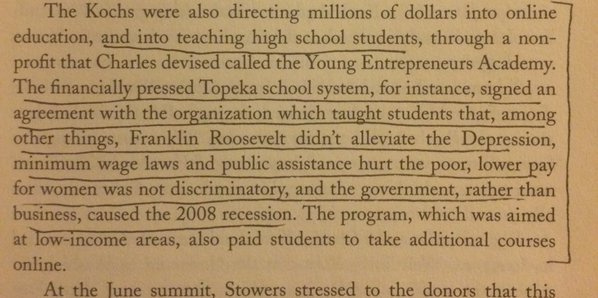
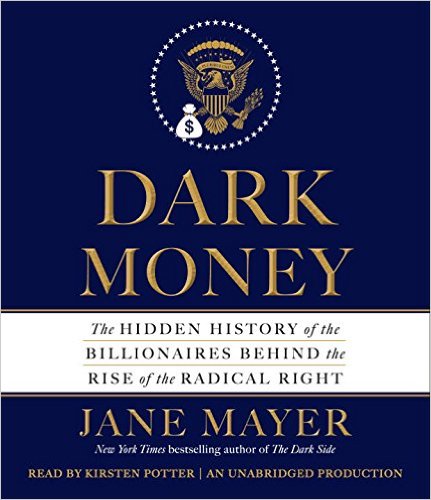
 by Jane Mayer. Now I’m wondering how masochistic I am to want to read it. Talk me out of it, or so help me, I’ll download that Necrokochicon to my iPad and suffer the consequences.
