An insider’s perspective on Dover

Via Ron Sullivan, who posted a link on the Great Blue Evil, an amusing story about a visit to Big Bend National Park in which the ranger in residence turns out not to be from around there:

Bob Hamilton 65, is a retired biology teacher and high school principal from Carlisle, Pa. He works six months a year in Big Bend and five more in Yellowstone.
I ask him where he was principal. He says York. I ask what school. He says Dover.
My eyes must’ve been wide as dinner plates. My insides roiled with barely contained glee.
My unexpressed response: No shit!
What I say: “The infamous Dover High School?”

That’s this Dover, the school district in Pennsylvania where creationists pressured the local Board of Education to introduce “Intelligent Design” into the high school biology curriculum in January 2005. Parents sued the Board, which subsequently got its collective ass handed to it in court. The judge’s 139-page opinion on the case called the change in curriculum “breathtakingly inane,” for instance.

Apparently, the inanity was taking people’s breaths for a few years before 2005:

Hamilton, who retired as principal of Dover High School in 2002, stood on the ground floor of Dover’s Intelligent Design era. He saw the storm brewing.
“Don’t quote me on this, but I knew that board was going to get us in trouble,” he said.
There was no doubt I was going to quote him on this. I think he realized this. I hope so, anyway.
“There are great kids in the community,” he says. “The kids in the community in no way reflect the ideas coming out of that school board. None of those people had any connection to the kids.”
According to Hamilton, then-school board president Donald “Daddy” Bonsell used to haunt his office and harangue him on behalf of the burgeoning wingnut conspiracy. Bonsell badgered Hamilton to do his part to get Intelligent Design into the Dover curriculum.
“He came in one day, and finally I told him, ‘OK, I’ll put Intelligent Design into the curriculum … if you start a petition and get all the local ministers in the community to sign it saying they’ll allow the teaching of evolution in Sunday school,’” Hamilton says.

I like the fact that this guy “retired” by continuing to teach kids about science on the National Park Service’s dime. Good for him.

And a complementary view from Ars Technica

When I agreed that many so-called ‘controversies’ don’t warrant a debate, I wasn’t saying that we shouldn’t cover them…just that they should be addressed appropriately, as fringe issues. The last thing we would want is media silence on, for instance, creationism! Ars Technica has a good piece on why we mustn’t be quiet about weird political positions.

Through the years I have received countless e-mails and have read hundreds of article comments imploring Ars to keep "political" stuff off the site. Such entreaties most commonly occur in relation to our scientific coverage of climate change or evolution, but also when we cover biological and anthropological matters of gender and sex. (They also come to a lesser extent when we cover the inherently political world of intellectual property, where, coincidentally, there are far fewer facts—but that’s outside the scope of this editorial.)

What those petitioners do not realize is that in asking us to be silent, they require that we take a politicized stance. Intentional silence is support for the status quo, and as such, it’s inherently political. Note that I’m speaking of intentional silence or avoidance, purposely not covering a topic so as not to bring light to it. Inasmuch as our editorial mission is, in part, to cover the issues relating to science and technology that are most challenging to our culture, it is unthinkable for us not to cover these issues. To reiterate, not covering them would be just as "political" as covering them.

This is also why I ignore or mock people who complain that “The movement has been co-opted by people with an agenda”everyone has an agenda. Demanding silence on topics you don’t like is a symptom of having an agenda.

It needs to be said

David Hone has a good piece on what constitutes an appropriate subject for debate, and how the media fails.

The truth however, is near inevitably that there is only a very small minority making a disproportionate noise about their case. There is no debate over evolution, or the dinosaurian origin of birds, or that HIV leads to AIDS, or that climate is changing, or a great many others. That there are real, accredited scientists who do not think this is the case is not in doubt (sadly). But that this represents a real schism in the scientific community, that large numbers of researchers take these positions and that it occupies a significant amount of scientific research, or that there is good evidence for that position is certainly incorrect. One or two people arguing a point (and often doing so primarily in the media) does not make a debate.

This for me seems like the opposite of what good journalism should be. Surely the point is to provide a representation of the true state of affairs rather than spin (even if unintentionally) the fact that there is disagreement as something that is effectively 50:50, when it’s 99.9:00.1 or less. This can be humorous from an insider’s position when one sees the media triumph a paper as ‘reigniting the debate over x’ when in truth the researchers have looked at the paper, noted an obvious flaw or that it simply rehashes old and incorrect arguments or data, and carried on. The flipside of this is where there really is a scientific debate, in which case the debate is not reignited at all, but merely still going on, it has merely come to the attention of the press and public again which is not the same thing at all.

At least I have noticed over the years a decreasing tendency for newspapers to try to couple every discovery about evolution with a quote from some creationist somewhere, so I think the situation is slowly improving.

Frontiers in taxonomy

There are days when having a glass desk is a serious health hazard, because I run the risk of serious facial lacerations when I read certain things.

Take this extremely well-intended article at Care2.com:

Human-accelerated climate change is a disaster waiting to happen. We’ve already seen the superstorms and drought it can create. Although we can work to slow climate change, there’s no way to stop it completely. This reality means adaptation will once again become the most important strategy for survival.

One thing’s for sure: the Earth will continue to exist as it has for eons. The question is, what will be left behind to inhabit it? Below are five species known for their resilience and ability to survive in adverse conditions. They are the most likely to survive a climate change disaster.

If you’re going to write one of those web-traffic pandering List Posts — not a criticism: I’m writing one this weekend as it pays the bills — that’s not a bad topic to tackle. True, the fact that the article starts this way might cause an anticipatory eyeroll:

Survival of the fittest. This basic tenant of evolution explains why the dodo bird no longer exists and why humans have opposable thumbs.

I’m trying to imagine what a basic tenant of evolution looks like. Maybe a Sphenodon. She’s paid her rent on time since the Pleistocene, comes from a good family, never made noise or caused trouble. You know the type.

That said, if I start making fun of people for typos there’s about a decade and a half worth of mine online people can choose from.

And it’s a great idea for a post. What species are likely to survive the disastrous climate change we’re almost certainly facing in the next decades? Human-adapted pests, probably, like rock doves a.k.a. pigeons, Rattus norvegicus, German cockroaches, but those stories have been written over and over again. How about wild species? Western sagebrush, maybe: that complex of subspecies in Artemisia tridentata that’s only just gotten settled in the Intermountain West, and is busily evolving new regional strains since the end of the Pleistocene? Or invasive exotics in the wild? That’s be a good if not precisely new topic.

Nope. Here are the five “species” listed:

  1. Trees in the Amazon
  2. “Wolves and coyotes”
  3. Ants
  4. Algae
  5. Cockroaches.

We can call “species” 2 and 5 near misses: wolves and coyotes comprise two closely related species, and while there are about 4,500 species of cockroaches and five commonly found in human dwellings as pests, the author mentions one in particular, the American cockroach. Though that’s not the one you usually think of as surviving Armageddon.

But those others. “Trees in the Amazon” as a species? really? There’s not a single place on the planet you could have picked where there are more tree species. One estimate of species diversity for trees in the Amazon basin put the likely number of species in the Brazilian section alone as above 11,000.

There are an estimated 22,000 species of ants. The author says this, almost:

There are approximately 20,000 different species of ant, with colonies of millions located all over the world. They were here long before humans, and the odds are good that they’ll be here long after.

One has to wonder what the author thinks the word means, if a species can be made up of more than 20,000 species. “Taxon,” maybe? Hard to say.

And “algae.” The author says:

Once of the few species that has been around since the beginning of evolution (remember the primordial slime?), there are over 200,000 varieties [of algae] known to man.

A chance to use the word “species”  correctly, almost, but the author opts for “varieties” instead.

This is an inconsequential article and the author meant well. It’s a good thing to get people to think about. And Care2’s editors, if they have any over there, are really the people to blame here, if I were blaming rather than observing.  Which I’m not. Really.

But to quote the celebrated environmental scientist Rush Limbaugh, “words mean things.” Maybe it’s just PTSD from having spent most of my adult life editing prose by environmental activists. I may well have had a big red button pushed. But if you’re writing about saving the natural world, you need to know at least a little bit about the natural world. And when you write about threats to biodiversity, knowing the actual definition of the word that represents the basic unit of biodiversity is a good idea.

Lest you end up calling “algae” a species.

Fake eagles don’t sound like that

A-lHXbXCAAAAxTg

Probably also faked: the sweater looks completely ‘shopped. Via Ed Lam.

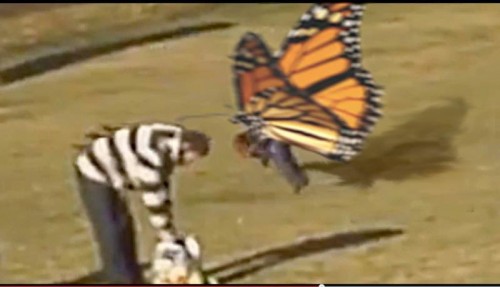
I held forth on the fake eagle video thing at some length over here at KCET yesterday, but there was something I didn’t mention there that irked me about the hoax: in the recap part, where the “amazing footage” of the “eagle” “catching” the “child” gets “replayed” in slow “motion,” the filmmakers dubbed in a bit of sound effect right at the moment where CGI talon hit virtual toddler.

And of course it was a red-tailed hawk call. It always is, It doesn’t matter what bird of prey is in a film: the SFX guys will always dub in a red-tailed hawk call. 

Not that the red-tail sound was a dead giveaway: during the 45 minutes or so in which I was somewhat taken by the hoax in I was prepared to grant that perhaps the videographers just did a clumsy, misguided dubbing job, for much the same reason that nature YouTubers always seem to want a horrible music track to cover up their occasionally interesting footage. But it was the same kind of mistake as inflating a CGI osprey to eagle size and calling it a golden and expecting birders to believe it for a second.

In case you’ve never seen a bird of prey represented in video and have no idea what I’m talking about, here is a red-tailed hawk’s call:

By way of comparison, here’s what golden eagle vocalizations sound like:

Bald eagles have calls you might well mistake for a gull’s:

[Update: in comments, otrame offers a more characteristic adult bald eagle call.]

Almost without exception, the red-tailed hawk call is what the sound engineers will use. I do know of one such exception. In the 2010 remake of Clash Of The Titans, which I suspect most people here watched solely for the Kraken and the releasing thereof, there was a scene where Zeus and Perseus were having a difficult father-son moment. Perseus is recalcitrant, whereupon Zeus transforms himself into an eagle and flies away. And that eagle doesn’t “keeeer” — he peeps. Like a golden. Honestly, that one moment of verisimilitude was worth the preceding hour. I was impressed that they got that one detail right. Though the Kraken did disappoint.

Exemplary efforts like Clash Of The Titans aside, it seems like there’s a secret world law governing natural sounds in TV and film that requires all raptors sound like red-tailed hawks. All rats squeak incessantly. Horses whinny while chewing placidly. Tropical rainforests in Africa and South America always have kookaburras in them. And as soon as you start to pay attention to how things actually sound in the real world, that kind of mistake unsuspends your disbelief pretty damned quickly. It’s a bit like having a scene where John Wayne is leading a wagon train westward to Oklahoma City, and they pass the Tetons on the way.

It’s the natural world version of illiteracy, and it makes those of us who know a few things wince.

Thank you, teachers

Victoria Soto, age 27, apparently died yesterday while trying to get her students into a safer spot in their classroom at Sandy Hook. She stood between the murderer and her students, and he killed her.

This is Soto right here.

[Updated to add: Andrew Revkin shares more on Soto’s colleagues Kaitlin Roig  and Maryrose Kristopik: “Kaitlin Roig locked her students in the bathroom and kept them safe, while Victoria Soto was trying to do the same when she came face-to-face with the gunman and was shot, execution style. Maryrose Kristopik barricaded her music students in a closet, while the gun man fought to get in.” Roig and Kristopik survived, thankfully.]

I spent a little time thinking about Soto and her colleagues this morning. I’ve known quite a few grade school teachers over the years. Until 2009, I was married to one. And I realized as I was thinking about Soto that there’s not a single one of those grade school teachers I’ve known, my ex- emphatically included, who I could imagine doing anything but jumping between the gunman and his or her students.

I know that’s an argument from incredulity. I know teachers are human beings, and human beings freeze up when they’re frightened. But I’ve also seen the sacrifices grade school teachers make on days the media don’t notice. Over and over, day in and day out, with no hope of any relief outside of leaving the job.

And for this they get to be one of the most denigrated groups of professionals in the United States, targeted every single goddamn year for one “reform” after another, vouchers from the fundies and charter schools from the liberals,  forced by law to take every spark of individuality and interest out of their curricula and then blamed when their students lose interest, resented their pensions and their health care by people who then blame them when their kids turn out to be apathetic.

Once the media horror dies down about Soto and her co-workers’ sacrifices, I guarantee you this: public school grade school teachers will go right back to being the despised class. “Union thugs.” “With three-month vacations.” “Teaching kids their ABCs.” All the idiotic, ill-informed, right wing anti-intellectual myths will rev up again as if nothing had happened. And in the meantime the people the Fox pundits despise will go on teaching kids to read and do math and treat each other with respect.

In other words, it’s not really that much of a jump to imagine all the teachers I know instinctively taking a bullet to protect their kids. To a first approximation, every single one of them does the same thing every waking moment, giving up their lives by increment to give their students a chance at a better life.

I don’t at all mean to trivialize the sacrifice Soto and her colleagues made by comparing it to, say, having to buy pencils on your own dime because the Republicans cut your district’s budget even further. What I’m saying is that given the kind of peson who chooses to remain in the profession despite all the sacrifice and opprobrium because they want to help kids, Soto’s tragic sacrifice isn’t in the least surprising. It’s what teachers do.

So I just thought I’d take a moment to thank those of you reading this who are, or who have been, grade school teachers for your routine heroism. We don’t recognize it enough.

[Read more…]

Another reason to love Washington state

They now have a law encouraging tolerance of marijuana.

Police spokesman Jonah Spangenthal-Lee wrote on the SPD Blotter that officers will be advising people to take their weed inside.

Or as Spangenthal-Lee put it: "The police department believes that, under state law, you may responsibly get baked, order some pizzas and enjoy a ‘Lord of the Rings’ marathon in the privacy of your own home, if you want to."

OMG. That sounds soooo good right now. I should fly back home for Christmas.

It’s a good idea. It’s depressing that it’s necessary.

There’s a funding campaign going on to raise money for DrinkSavvy. It’s a clever idea to address a dismal problem.

What it is is a simple plan to sell drinking straws and cups that contain a material that responds with a color change to the presence of GHB, ketamine, or rohypnol — date rape drugs. I wish I lived in a world where that wasn’t necessary (well, actually, I do live in a world where it isn’t really necessary for my personal safety; I understand though that some of you live in that dangerous world where people might try to drug you to nullify your lack of consent.)

You know, the existence of this product is evidence for the validity of the Schrödinger’s Rapist argument.

The Ebert Solution

I agree with Roger Ebert: he has a suggestion for how we can improve American education.

What I think we need are smaller classrooms, better pay for teachers, and an emphasis on fundamentals rather than frivolity. Although I am in favor of physical education, I believe most school sports foster a flawed culture. The news that Allen, Texas, has constructed a high school stadium costing $60 million filled me with incredulity. What does that have to do with education? I was much cheered by the new documentary “Brooklyn Castle,” about how a team from an inner city junior high school won the national high school chess championship, and didn’t need a stadium at all. They were coached by a couple of great teachers.

Defining “frivolity” is tricky: are geometry and basic writing skills serious, while teaching Shakespeare is frivolous? I think there should be an emphasis on acquiring essential skills like reading and arithmetic before graduation, but there’s also a place for enthusiastic teachers communicating the joys of a specialty. Of course, I think that would naturally emerge if we had adequately funded and staffed schools.

As for the $60 million high school football stadium: there are some school district administrators who ought to be fired for irresponsible behavior, and a lot of parents who voted for that monstrosity who ought to be ashamed. But they’re probably too ignorant because of their deficient, sports-soaked educations to be aware of it.