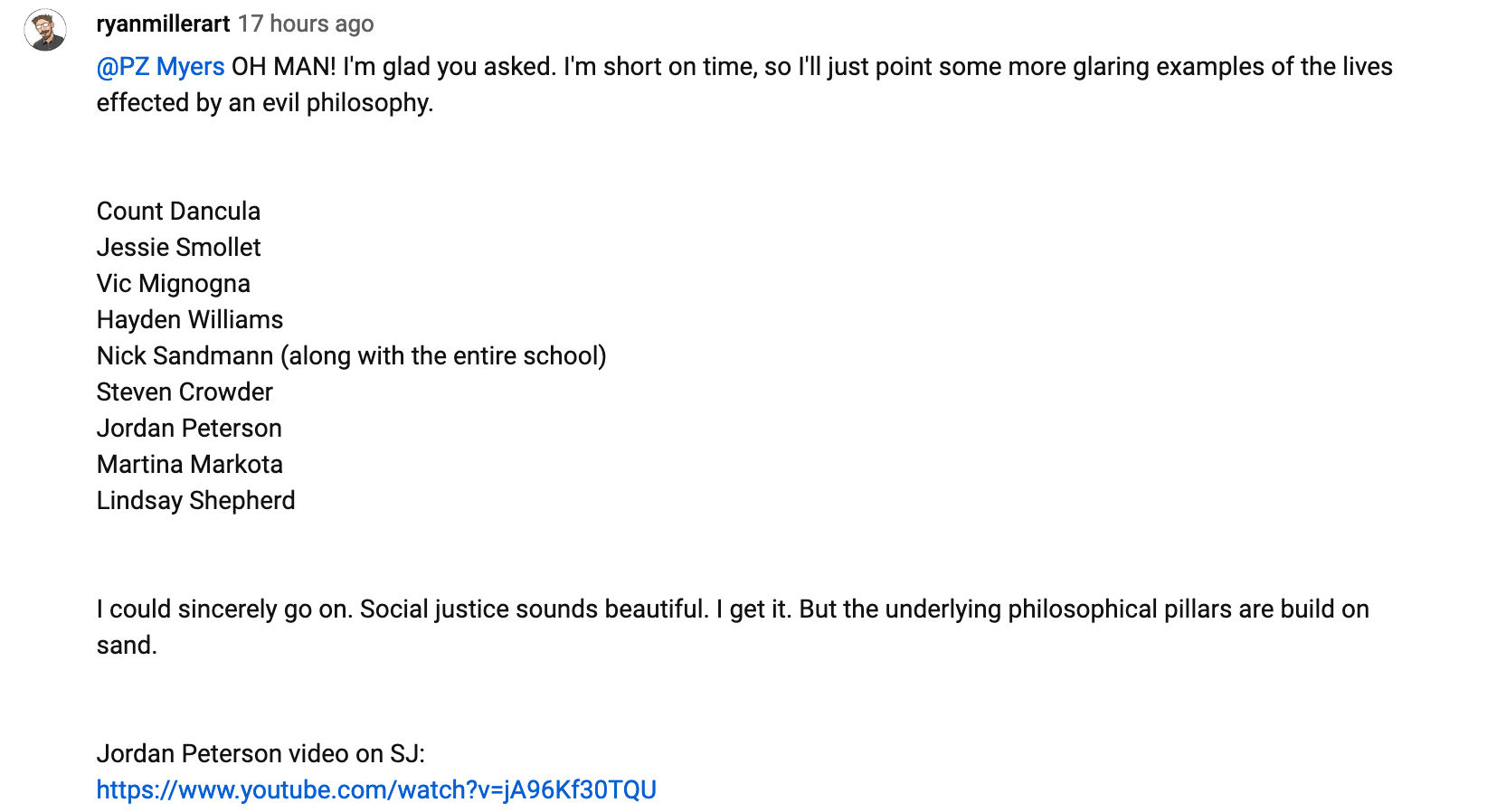
Good atheists of the world, unite and speak out

Adam Lee says a lot of things about the atheist movement I’ve said before — the deplorable leaders, the avid adoption of alt-right ideology, the islamophobia and misogyny, the dominance of awful people over YouTube atheism. He ticks off all the same check boxes I do.

But one thing different is that he ends on a note of optimism. I think he makes an important point here that I’m typically too exhausted to care about anymore — it’s not all bad and hopeless.

It can’t be denied that many prominent atheists, as well as some of the louder and most vehement voices in the community, have supported Alt Right ideology and White male supremacy. However, many of the larger atheist and secular groups have gone in the opposite direction and are quietly engaged in serious work on social-justice and intersectional issues. Organizations like the American Humanist Association, the Freedom from Religion Foundation, and the atheist charity Foundation Beyond Belief have a solid record of supporting women’s equality and reproductive justice, promoting the voices of people of color, and supporting non-church-based charitable programs in underserved communities worldwide.

These groups and others like them have recognized that society is diversifying, and so must the atheist movement. To remain narrowly focused on the issues of greatest concern to White men, and no others, would lead the secular community into an ideological dead end. To actively scorn the concerns of women and people of color isn’t just morally abhorrent, but self-eradicating. As for atheists, there are strong currents pulling the movement in both directions. Which one will win out, and how that victory will reshape the movement’s priorities, are very much open questions.

It’s true — some of the best, most inspiring people I’ve met have been atheists, and they do sometimes end up in leadership positions in good organizations, too often with little fanfare. Part of the problem here is that it’s easy to be loudly aghast at the scattered assholes with loud voices, and overlook the majority who share decent progressive values. While religious people are also mostly good, there’s always this one commonality they hold: an intellectual and emotional commitment to raving lunacy, proudly held. When I would attend atheist conferences, one of the biggest reliefs was finding oneself in a community where the superstitious foolishness of religious gatherings was gone, and it was a welcome absence.

We just went looking for other bad ideas in our groups, and we let them taint that joy, rather than simply casting them into the void, where they belong.

One other factor I have to mention is that the villains of atheism were passionately dedicated to making sure their views, and only their views, were allowed to be expressed. I had a conversation with a conference organizer who was feeling me out to see if I’d be willing to speak at their event, and I was…but they then explained that it was a tentative invite, because while the majority of the committee were eager to get me, there was this one guy (there’s always one guy) who hated me and was going to raise a big stink. I never heard from them again. Which was fine…I don’t feel a right to a platform.

But that’s what’s been happening: a few loud voices can dominate the discourse, and the tolerant Left tends to avoid the whole idea of “domination”, while the intolerant Right embraces it. It leads to an asymmetry that influences our perception.

In addition, the bad voices are willing to lie, cheat, and steal to secure that dominance. Just look at our Republican party. Or look at YouTube, where the name of the game is fooling the Algorithm, and using endless sock puppet accounts to generate an illusion of overwhelming numbers. Those assholes have built an amazing Potemkin village to subvert any principle of democracy or merit.

It’s hard because I’m so goddamn tired of the game any more, but I have to try and remember there is a virtue to godlessness, and a majority of good people in atheism. It’s just been subverted by an unscrupulous minority.

Oh, jeez, it’s like a disease

Can you handle another tale of men getting sucked into the heady arrogance of YouTube “logic”?

“Our relationship started normally: We went for walks, saw films, went out for dinner. Most of the ‘arguments’ we’d have would be where to go out on a date. When I moved in with him after graduation, the arguments were about who would do the washing up or the cooking that night,” she says. By the end of their relationship in September, though, she found herself having to not only try to get Craig to do his share of the laundry, but to justify why people should be allowed to speak languages other than English in public, why removing taxes for tampons isn’t unfair, and more bizarrely, why being a feminist isn’t the same as being a Nazi.

“Nearly all the arguments came from YouTube videos he was watching,” Sarah tells me. “Because he’d work at night, he’d spend the day on the internet. He’d be watching them, and send them to me throughout the day on WhatsApp, over email, anywhere really.” During one work meeting in 2016, she received videos from him about a “migrant invasion into Britain, orchestrated by Angela Merkel and Barack Obama,” which showed Libyan refugees getting off a boat carrying large bags and shouting, “Thank you, Merkel!” played over dark orchestral music. Other videos supported Donald Trump’s proposed ban on Muslim immigrants, diatribes on feminism “threatening traditional families” and “scientific evidence” suggesting that white people have higher IQs than black and South Asian people.

The article is a series of anecdotes about similar cases: these gentlemen start getting triumphal about reason and logic and evidence, and end up misusing reason and logic and evidence to rationalize hatred. So many of these stories sound exactly like what atheists were able to recognize as cult-like behavior, once upon a time.

Here’s a simple clue: you can be absolutely right about the nonexistence of god and the abuses of religion, and not be 100% right about everything else. That’s a logical truth, too.

Panglossian Naziism

This article, The Magical Thinking of Guys Who Love Logic, strikes a chord. You’ve probably all noticed the reverence the most irrational, horrible, repulsive people hold for “logic” and “reason” — it’s a common affliction in the atheist community.

Danskin points out that, even when their beliefs skew towards the bizarre and conspiratorial, people on the online right often identify as “rationalists.”

This will be unsurprising to those who often engage with the wider online right, whether it is with someone who identifies as alt-right, libertarian, conservative, as a fan of the “Intellectual Dark Web,” or even “moderate” or “centrist” (turns out a lot of people online are self-identifying as moderate while also believing in conspiracies about “white genocide”). Although their beliefs may not be identical, there are common, distinct patterns in the way they speak (or type) that one can’t help but notice.

Specifically, these guys — and they are usually guys — love using terms like “logic.” They will tell you, over and over, how they love to use logic, and how the people they follow online also use logic. They are also massive fans of declaring that they have “facts,” that their analysis is “unbiased,” that they only use “‘reason” and “logic” and not “emotions” to make decisions.

Oh god yes. It’s particularly bad on YouTube — search for “logic” or “reason” in the names of channels there, and you’ll turn up a collection of insufferable cocky snots who actually have no particular credentials or life experience that qualifies them to be experts in rationality, other than their own self-declared commitment to the ideology of holy reason. It’s also a wholly evangelical belief, and the people who convert to it are intolerable.

The men interviewed in the piece, once sweet and caring, started changing after going down a rabbit hole of extremist political content on YouTube and involving themselves in radical right-wing online communities. Convinced of their absolute correctness, these men became at first frustrated, then verbally abusive once they realized their female partners did not always agree with their new views. Any dialogue attempted by these men was not made — at least as far as their partners could tell — with the goal of exchanging views and opening themselves to being challenged. Their goal was to assert their beliefs as fact; to teach their partner the truth, as a Christian missionary might put it. Every woman interviewed in the article — including those who were more formally educated than their boyfriends — makes reference to their former partners belittling their intelligence and rationality. These men were certain that they were the smart ones, that they had correctly assessed the “facts” with “logic,” and that if their womenfolk did not accept this without question, they were simply too dumb to understand.

The article mentions one of the early events that led me to question my involvement with atheism at all.

Perhaps the nadir of the movement was 2011’s “Elevatorgate,” in which a prominent New Atheist woman mentioned that a man had behaved inappropriately to her at an atheist convention and advised other men to avoid this situation in future, and lots of atheist men promptly lost their shit. An over-the-top reaction to women speaking out against harassment is not unique to this movement; for every article praising #MeToo, there seems to be another from a Very Concerned Man who worries that everything is going too far and he’s afraid to even TALK to women now!

But I suspect the reason the reaction to Elevatorgate was so vitriolic was not just about general sexism, but also about the threat it posed to the New Atheist sense of moral superiority. It was much less fun for them to reckon with say, the complex social structures within the skeptic community, and the way that might affect the movement, than it was to make fun of some hick who couldn’t get his head round evolution. Those were the people who had some learning to do — for the New Atheists themselves, there was nothing more to learn. If people from marginalised groups within the movement started speaking about issues which involved listening and learning, or self-reflecting on one’s biases… well, that was unacceptable, since it would require wider reading and understanding of issues that were not immediately accessible or aesthetically pleasing to many New Atheist men.

I don’t think Rebecca Watson would like to be labeled a New Atheist now. Neither would I. That’s the movement that undercut itself by pretending that rationalizing prior prejudices is exactly the same as “logic”.

I am not saying that logic and reason and rationality are bad things, far from it. I’m saying that the Red Pill, Ben Shapiro, Atheism is Unstoppable crowd have stolen those words and abused them. For a beautiful example, look to Jordan Peterson, who uses logic to excuse Nazis.

Footage emerged this week, from a podcast recorded last year, of the professor discussing the conditions that led to the Holocaust. There was the normal equating of fascist and Antifa, on account of the latter’s “proclivity to violence” (as if violence were a moral constant); there was discussion of Hitler’s bravery during the First World War, as well as the revelation that “[he] was very sensitive to disgust”. According to Peterson (and I’ve no reason to doubt him), Hitler used Zyklon, an easy version of the gas used in the gas chambers at Auschwitz, to clean rats from German factories – and this, along with the economic instability in post-Versailles Germany, to Peterson’s mind, is evidence that the Holocaust was a logical progression.

That the Holocaust followed a series of logical progressions is, in a sense, true: if one were to reverse-engineer the Final Solution, each step would appear to follow rationally from the one before.

Watch it.

The problem is that he treats history as an inevitable logical progression of events. Horrors of WWI + Postwar Economic Hardship → Holocaust. It’s like math. Perfectly “logical”. Germany was in the grip of an ineluctable rational progression, it was inevitable. We are therefore led to the conclusion that picking a scapegoat and murdering them for unconnected phenomena is a forced choice, and the Germans had to bow to the pressure of history, as we might now have to bow to the decision to imprison and kill brown-skinned immigrants. Therefore, the alt-right is justified.

But anti-semitism is an irrational belief built on centuries of myth, bigotry, religious dogma, and xenophobia, and he fails to note that many of the decisions leading to the Holocaust were bad or not at all necessary. Congratulations, red-pilled buckos, your hero has just argued that the illogical is logical.

I must also point out that if you look at creationist arguments, it’s quite common to hear them declare that atheism or evolution are illogical. If the magic word “logic” can be invoked on both sides of the argument, isn’t it obvious that you have to do more work than saying you’re logical in order to make your case?

Are you thinking of trusting the internet?

Don’t. I stumbled across this on Quora, a site that seems to specialize in collecting uninformed questions from ignorant people, and allowing other ignorant people to provide misinformation.

You may notice that it has 513 views. It also had about 40 upvotes, meaning 40 people read this and came away thinking they’d learned something.

It’s very confusing. So, if I’m planning a cannibal meal, and a right-handed person eats my left-handed victim, does everything just pass through (great if you’re trying to lose weight!), or does it turn all my dinner guests left-handed?

No, I never heard of him before

I got an email bringing this guy, Owen Benjamin, to my attention and asking if I’d ever heard of him.

No, I had not.

Now I have, and I regret it greatly. He’s a conspiracy theorist who is a fan of Jordan Peterson, thinks we never landed on the moon, that the arguments for a flat earth are reasonable, and that evolution is false. Watch this excerpt in which he brags incessantly about his high IQ, greater than that of any scientist, and then bumbles about claiming that macroevolution couldn’t have happened.

Warning: this video brings on an “expert” to debunk him, and that “expert” is Jean-François Gariépy, a lousy fascist/racist white-ethnostate crusader who doesn’t understand evolution, either. It’s generally a hot mess of ugly.

I had to resocket my jaw after watching that, so I figure it’s only fair that I inflict him on everyone else, too. Jeez, but YouTube is a hothouse for growing the worst people on Earth.

David Klinghoffer thinks Science had to gang up on Behe

For even more fun, David Klinghoffer has written his own criticism of the Science review. His take is even more petty and ridiculous: he thinks science is having a panic attack over the book, because they got three scientists to write the review.

So here we have Science, the most prestigious technical science journal published in the United States, getting out ahead of the release of Darwin Devolves, recruiting a National Academy of Sciences member and two lesser scientists, the latter known primarily for their critiques of intelligent design (Swamidass) or complaints about the “poor design” of the human body (Lents).

Lesser scientists? What does that make Behe?

I guarantee you that Lenski does not think of his colleagues as lesser, and that the Science editors did not recruit a group to triple-team Behe because he’s so darned scary and tough. It’s much more likely that a trio of colleagues were discussing the book, and each contributed cogent criticisms, so they got equal billing in the write-up. That’s how real science works, when it works well — collaborative groups contributing to the work.

Behe might not be aware of this because he’s been ostracized by real scientists, and he only bounces ideas off fellow ideologues at the Discovery Institute, who tend to get horny over anything critical of evolution, no matter how ridiculous. The collaborative nature of science might be difficult for the DI pundits to comprehend.

Oh, and even us lesser scientists are quite capable of seeing how bad Behe’s arguments have always been.

Michael Behe declares victory after being stomped flat

Behe is crowing over the Science review of his new book. The man is deeply delusional.

…the overwhelmingly important point to notice right up front is that the reviewers (Lenski plus Josh Swamidass over at Peaceful Science and John Jay College biologist Nathan Lents) have absolutely no response to the very central argument of the book. The argument that I summarized as an epigraph on the first page of the book so no one could miss it. The one that I included in the title of a 2010 Quarterly Review of Biology article upon which the book is based. The one for which I chose the most in-your-face moniker that I could think of (consistent with the professional literature) to goad a response: The First Rule of Adaptive Evolution: Break or blunt any gene whose loss would increase the number of offspring. The rule summarizes the fact that the overwhelming tendency of random mutation is to degrade genes, and that very often is helpful. Thus natural selection itself acts as a powerful de-volutionary force, increasing helpful broken and degraded genes in the population.
And they had no response! That’s because there is in fact nothing that can alleviate that fatal flaw in Darwinism.

So the central claim of his book is that sometimes, gene loss can be adaptive, something that no competent evolutionary biologist would consider a remarkable claim. Of course, they would disagree with his implication that that is the only process allowed or that no mutation could increase complexity or that novel functions can not increase the fitness of an individual. Contrary to Behe’s laughable claim that Lents, Swamidass, and Lenski had no response to his central tenet, they did: they pointed out that he ignores the various ways evolution proceeds (it’s not just by “breaking” genes), and that he runs away from the evidence of clear examples of mutations that increase complexity.

Behe is skeptical that gene duplication followed by random mutation and selection can contribute to evolutionary innovation. Yet there is overwhelming evidence that this underlies trichromatic vision in primates, olfaction in mammals, and developmental innovations in all metazoans through the diversification of HOX genes. And in 2012, Andersson et al. showed that new functions can rapidly evolve in a suitable environment. Behe acknowledges none of these studies, declaring an absence of evidence for the role of duplications in innovation.

Because they politely pointed out instances where his First Rule of Adaptive Evolution falls flat on its face without explicitly saying it’s wrong by name, Behe thinks they didn’t respond to it — I guess he needs it said literally. So here, I’ll help, I’m not very polite. Behe’s First Rule of Adaptive Evolution is stupid and wrong, isn’t a real rule, and we have multiple examples that refute it, which Behe doesn’t comprehend, because he’s an ignoramus about evolution.

Behe…yeah, he’s over and done with

When Michael Behe published Darwin’s Black Box, there was a loud “Huzzah!” from the creationists — they had new buzzwords, like “irreducible complexity”, for the first time in 50 years, and they had a scientist with a legitimate Ph.D. to cite as an authority claiming evolution couldn’t happen. The “science” was crap, but it was a strong rhetorical play, and we had to respond vigorously to it. It was garbage, but all the back-and-forth enhanced Behe’s reputation. I read it thoroughly and contributed to online discussions about the fallacies in it.

Then he came out with a second book, The Edge of Creation, and the creationists all went “huzzah?”, because there was nothing new in it, no spark of rhetorical flourish they could use in debates, but there was an implication that caused them worries. Behe was claiming you could see the hand of the Designer in ongoing processes, and that It was actively engineering diseases and parasites to kill us right now. Whoops. It was still garbage, but it didn’t trigger a surge of creationist activity that needed refutation. I skimmed it, threw it aside, ignored it.

Now he has a third book, Darwin Devolves, where he returns to the same old stagnant, tainted well and says the same old things, and it’s only going to inspire the die-hard Behe fanchildren, and isn’t going to challenge any scientists at all. I’m not going to pick up a copy. Not going to read it. Not going to critique it. Everything has already been said, he has nothing new that we need to refute, and he’s nothing but yet another crackpot…just one who has a tenured position at a legitimate university, even if he is something of a pariah to his colleagues.

But because he got creationists excited 20 years ago, someone had to suffer through his book for Science magazine, and the sacrificial victims are Nathan Lents, Joshua Swamidass, and Richard Lenski, who write that a biochemist’s crusade to overturn evolution misrepresents theory and ignores evidence.

Behe is skeptical that gene duplication followed by random mutation and selection can contribute to evolutionary innovation. Yet there is overwhelming evidence that this underlies trichromatic vision in primates, olfaction in mammals, and developmental innovations in all metazoans through the diversification of HOX genes. And in 2012, Andersson et al. showed that new functions can rapidly evolve in a suitable environment. Behe acknowledges none of these studies, declaring an absence of evidence for the role of duplications in innovation.

Behe asserts that new functions only arise through “purposeful design” of new genetic information, a claim that cannot be tested. By contrast, modern evolutionary theory provides a coherent set of processes—mutation, recombination, drift, and selection—that can be observed in the laboratory and modeled mathematically and are consistent with the fossil record and comparative genomics.

Deja vu, man. These are exactly the complaints everyone made about Darwin’s Black Box: he didn’t seem to understand modern evolutionary theory, he ignored the multiple mechanisms of evolutionary change, he blithely pretended the evidence against his thesis didn’t exist, and he just sailed on, smug in his ignorance. Nothing has changed. His formula is the same. The same counter-arguments still apply.

Let’s all just ignore this rehash, OK?

The rifts were widening everywhere

How interesting — Arun reports that the history of atheism in India was pretty much like it was here. A surge of interest sparked by The God Delusion (say what you want about Dawkins, that was an influential book), with an emergent split as one group saw social justice as an essential component of the movement, while another group “expressed abhorrence to the word feminism and propagated the myth that women are inherently irrational”, leading to a current divided movement.

I suspect it’s a reflection of a fault line that was there all along, and not at all unique to atheism. All you have to do is look at the American electorate and see a division that is somewhat independent of religious ideas.