“Facts, not emotion”

What would you, as a manager, do with Clifford Currie, a civilian contractor working in an Army hospital? There is a huge pile of documentation that shows he is unstable, unreliable, and hostile. There were months of reports piling up.

Army investigators reviewed more than 1,000 pages of documents, including witness statements, law enforcement case files, and email correspondence. Though some names and specific details were redacted, statements from 25 witnesses supported Blanchard’s claim that she’d warned her supervisors — and anyone else who would listen — that she felt Currie was a threat.

The hospital’s chain of command knew that Currie “exhibited erratic behavior and risk indicators,” and that he “had multiple angry outbursts, acted ominously, and actively intimidated” Blanchard, the report said.

Two weeks before the assault Blanchard said that she met with her supervisors, and pleaded: “Please, don’t leave me there as a sitting duck,” but was told to “come back with facts, not emotion,” she told Task & Purpose. “I went back to my office and I just cried, because I just felt so hopeless.”

The report noted that Currie was the subject of 53 complaints from patients between 2013 and 2016 — 31 of which occurred in 2016 while Blanchard was his supervisor. According to the report, three of the patient complaints described Currie as “being hostile.”

The military did nothing. Then Currie walked in on Katie Blanchard, poured gasoline on her, and set her on fire. It was a sudden, violent act, but there’d been obvious signs and multiple warnings that this guy was going to snap. She survived, with serious scarring and pain, and she sued the Army for needlessly putting her life in danger. Guess what happened next? They have a rule that says the military can’t be sued!

On April 18, 2019, the Army denied Blanchard’s claim for damages, citing the Feres Doctrine — a 1950 Supreme Court precedent which bars service members and their families from suing the military for injury or death brought on by their service. The claim, which Blanchard’s attorneys provided to Task & Purpose, included the names of 14 people within her chain of command who were allegedly warned by her that Currie posed a threat.

“Come back with facts, not emotion”. That sounds so familiar, the kind of thing skeptics and atheists would say all the time. Sometimes the emotions are the facts, and you have to have policies to deal with them…or you end up with women burning in their office chairs.

The J-F Gariépy/Epstein connection

One among the long list of “scientists” sponsored by Jeffrey Epstein was, to my initial surprise, Jean-François Gariépy, but then after I thought about it, I realized they were perfect for each other. If you’re unfamiliar with JF, as he’s called, his RationalWiki page is informative. He’s one of those alt-right YouTubers with an extraordinarily creepy history — he’s a Jew-baiting advocate for a white ethnostate, and he has a thing for sexual relationships with young women with severe intellectual disabilities. He’s just a terrible, horrible person all around.

But he also has some science credentials — he was a post-doc in a neuroscience lab.

Jean-François Gariépy (1984–) (usually called JF or JFG), is a French-Canadian alt right YouTube talker who promotes race realism, ethnostates, and other reactionary views. From 2012 to 2015, he was a postdoctoral researcher in neuroscience at Duke University, but was allegedly fired due to sexual misbehavior, although he claims that he left on his own accord.

Gariépy rose to prominence as a paid co-host of Andy Warski’s YouTube show. After getting into a spat with Andy over antisemitic comments made by a guest, Gariépy left the Warski show, and started running his own show called “The Public Space”, where he frequently invites guests associated with white supremacy, such as David Duke and Richard Spencer.

He parlayed that connection into a gift from Jeffrey Epstein.

Gariépy was a postdoctoral researcher in neuroscience at Duke University in 2014 when his nonprofit, NEURO.tv, received $25,000 from Epstein to make a series of YouTube interviews with experts in psychology, neuroscience, and philosophy. The project is still the lead item on the dormant website of the Jeffrey Epstein VI Foundation.

Since posting the NEURO.tv videos, Gariépy has gained a following as a far-right YouTuber whose recent guests have included the white nationalist Richard Spencer. In 2018, the Daily Beast described Gariépy’s child custody battle, in which his ex-wife alleged a history of abusive behavior toward women. Gariépy denied the allegations.

“I am a white heterosexual male libertarian who believes in freedom, sovereignty and self-determination for all people including mine,” Gariépy told BuzzFeed News by email. He also railed against “false allegations by females.”

Dang. No one ever gave me $25K to play on the internet, but then, I have a strict policy of not taking money from rapists or pedophiles. That seems to greatly limit funding sources, I guess.

What I specifically found interesting though, is that Gariépy requested additional money from Epstein to write a book. He did not get that funding, but he did write the book! It’s called The Revolutionary Phenotype, and the description sounds kind of nuts.

The Revolutionary Phenotype is a science book that brings us four billion years into the past, when the first living molecules showed up on Planet Earth. Unlike what was previously thought, we learn that DNA-based life did not emerge from random events in a primordial soup. Indeed, the first molecules of DNA were fabricated by a previous life form. By describing the fascinating events referred to as Phenotypic Revolutions, this book provides a dire warning to humanity: if humans continue to play with their own genes, we will be the next life form to fall to our own creation.

It’s an interesting combination. He’s clearly endorsing some kind of Intelligent Design, so maybe the Discovery Institute would like to take him on as a Fellow. He sounds exactly like their kind of guy.

The other part, though, is the anti-genetic engineering stuff, which is odd to hear from a “scientist”, but then, as a white racist, maybe he’s also concerned about the purity of his germ plasm.

I’m not motivated enough to find out, though. If anyone (non-racist, non-rapist, non-pedophile, that is) wants to donate $25,000 to me, however, I’ll grab a copy and read it and post a review here. I should warn you, though, that just looking at his book online has sent me a barrage of targeted ads for other books about the “Jewish Question” and white genocide and other such trash, so I’m already thinking it may not be worth it.

Nukes on the brain

Our know-nothing president has wondered why we haven’t stopped hurricanes by dropping a nuke on them. Why he thinks that would work is a mystery. Hurricanes are energetic phenomena (the heat release of a hurricane is equivalent to a 10-megaton nuclear bomb exploding every 20 minutes), so adding more energy, even if it is a relatively small amount compared to the total energy of the storm, doesn’t make sense.

That hasn’t stopped his sycophants at Fox News from cheerleading the idea.

“You’re going to say this is crazy,” Kilmeade said. “But I always thought, is there anything we can do stop a hurricane?”

“I don’t think an atomic bomb is the way to do it,” co-host Steve Doocy noted.

“Okay, maybe that wouldn’t have been my first option,” Kilmeade opined. “But I always think about that. With all the progress we’re making with driverless cars and Instagram, could we possibly stop a hurricane?”

I thought Doocy was the stupid one, but I guess they take turns. Somebody tell me what the connection is between driverless cars, Instagram, and stopping hurricanes with nuclear explosions, because I don’t see it. I guess some people just see technology as one big mish-mash that inevitably leads to solutions for every problem they have. Hey, they can make electric can openers, so why can’t they cure cancer?

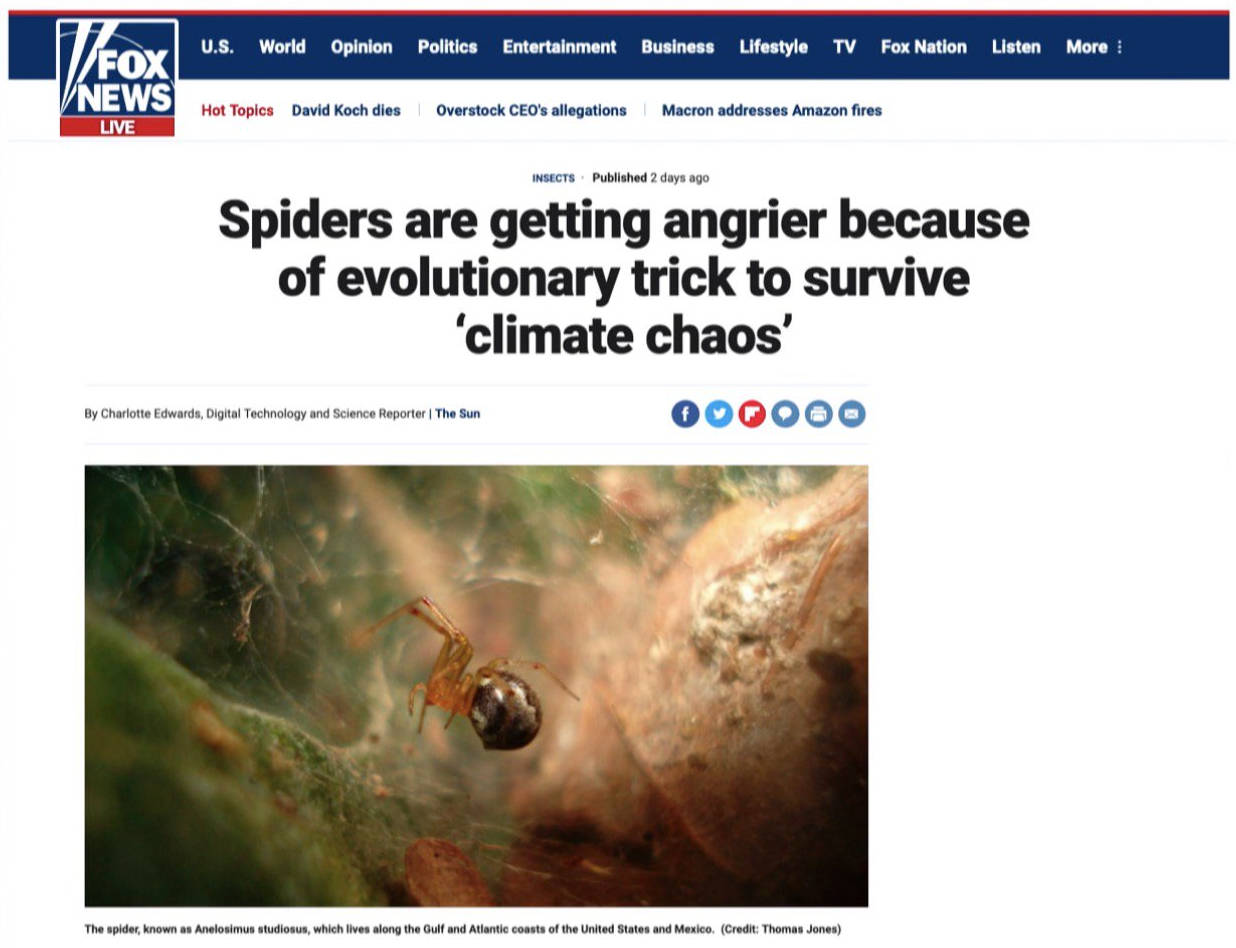
They should think more about the unintended consequences, too. Nuke the hurricanes, and you’ll just make the spiders mad and radioactive.

Meanwhile, Elon Musk had some more brain diarrhea and has decided we ought to nuke Mars. His idea is that because Mars is too far away from the sun, we provide it with miniature suns, close up and personal, with lots of bombs going off above its atmosphere.

“Nuke Mars refers to a continuous stream of very low fallout nuclear fusion explosions above the atmosphere to create artificial suns. Much like our sun, this would not cause Mars to become radioactive,” the entrepreneur [is “entrepreneur” a synonym for “loon” now?] tweeted yesterday (Aug. 20).

“Not risky imo & can be adjusted/improved real-time. Essentially need to figure out most effective way to convert mass to energy, as Mars is slightly too far from this solar system’s fusion reactor (the sun),” he added in another tweet, responding to someone who asked about the risks associated with this terraforming plan.

Remember that figure, that an Earthly hurricane is pumping out the equivalent of 10 megatons of energy every 20 minutes? That’s how much energy is in an atmosphere. He’s got a vague notion of that — he says he wants to send a “continuous stream” of nukes to Mars — but he hasn’t thought about the cost or any of the consequences. Furthermore, imagine that he manages to divert a substantial fraction of the world’s economy to this radically expensive plan (funny how the primary objection from Republicans to mitigating climate change on Earth is that it would be too expensive and wreck our economy, while this guy is scheming to wreck the world’s economy by warming an uninhabited planet) and actually raises the temperature of Mars a degree or two. Then what? It’s a dead world, it’s going to take more than a slight temperature rise to make it habitable, and good luck convincing colonists to move to the desert you’ve been nuking for decades.

I’m only going to tentatively favor this plan if it also involves seeding Mars with angry, radioactive spiders.

It’s not going to happen, it’s not going to work if it did happen, and all this is is a desperate ploy by Elon Musk to a) get attention, and b) sell stupid t-shirts.

My connection to Jeffrey Epstein

Blake Stacey had to remind me.

It’s kind of a wacky roundabout connection, but there it is. I was sued by a crackpot name Stuart Pivar for $15 million (It happens. I’m getting more than a little tired of the bullshit) because I’d pointed out that this guy’s self-published pseudoscientific book, Lifecode, was complete garbage. He didn’t like that, and he had lots of money — he was some kind of rich septic tank magnate — so he blustered and threatened and threw lawsuits at me, which he eventually dropped at the last minute when I didn’t back down. It was unfortunate, too, because I’d just done a couple of interviews with major newspapers when he withdrew, taking with him all interest by the press in the story.

Now Mother Jones interviewed Pivar about Epstein, in one very strange rambling conversation (at the end he threatens to sue over the interview if it is at all misleading, so I suspect MJ decided to go with a literal, complete transcript of everything Pivar said). And there’s my name! Yikes!

Some evidence of the tension between Pivar and Epstein is lying in public view. In August 2007, Pivar sued a science blogger named P.Z. Myers and Seed Media Group, which hosted his blog, alleging defamation. Myers had lit into Pivar’s work, calling him “a classic crackpot.” In his complaint, Pivar made a point of mentioning by name two prominent members of SMG’s board: Jeffrey Epstein and Ghislaine Maxwell. The lawsuit was later dropped.

I should have known — Seed Media Group was based in NY, was tightly focused on connecting science and media, and of course Epstein and his crony, Maxwell, would have been attracted to it, and it could well have been the recipient of Epstein money. So yeah, some of those blogging fees I was paid back then could have been stained with the Epstein taint, although I knew nothing about him at the time, never met him, and darn, never got invited to fly on the Lolita Express or visit his private island for sexy times. So while you might be able to draw a connection between us, my name would be in tiny print with only a thin red thread to tie us together.

Of course, when you read the Pivar interview, you have to take into account the fact that he really is a delusional kook. He says this, for instance, which is kind of nuts.

I’m a scientist, and I saw all the incredible, wonderful things he did for science, which nobody’s managed to have the intellect to understand.

In Pivar’s case, no, we did understand his “science”, and it was trash.

By the way, one additional thing I have to bring up is that lately a number of the scientific associates linked to Epstein have been slinging a bit of mud as a distraction. In particular, they’ve tried to accuse the late Stephen Jay Gould of also being guilty of playing around with Epstein. Unfortunately for them, and the New York Times’ reputation for fact checking, Gould has a rock solid alibi.

That’s really dirty pool, NYT. You should be ashamed.


An additional fact: Seed definitely got some funding from Epstein!

Now have to go wash my hands.

When did we become jaded?

Orac writes about an anti-vaxxer, Austin Bennett, who walked up to a California senator on the street and shoved him because he was insufficiently appreciative of his conspiracy-theory ravings. That that movement is working itself up towards more violence is troubling (they’re following the trajectory of the anti-choice movement, right down to screaming that they’re killing to protect the children), but what also bothers me is that the rhetoric is so unhinged. He has a collection of Austin Bennett videos at the link, and I listened to bits and pieces of a few of them, and my god, he’s nuts. In the one in which Bennett shoves Senator Pan — he’s so shameless, Bennett recorded it and posted it on YouTube — and Orac summarizes it neatly.

Bennett encounters Sen. Pan around the 9 minute mark, and he shoves him around the 9:50 mark. The rest of the video reveals a profoundly scary guy ranting about chemtrails, toxins, and taking action right into the camera. I have to give Sen. Pan a lot of credit. I’m not sure I could have remained as calm as he did if someone like Austin Bennet came up alongside me and started ranting about aluminum, toxins, and chemistry. Before Bennett encountered Sen. Pan, he spent nearly a solid nine minutes ranting about chemtrails, the wickedness of the world, and a variety of other disturbing religious things.

A disordered kook can ramble on for years with increasingly disturbing, weird, unhinged from reality ideas, and we let it go on and on, gathering momentum, acquiring followers, and we do nothing until after it crosses the line into violence. I am not saying contrarian ideas should be suppressed somehow, but I’m just thinking that if this guy cares so much about chemistry and toxins and immunology, maybe he should put his effort where his mouth is and actually get educated on those subject…and maybe if he’s unwilling to invest in learning that ought to be at the forefront of our conversation about him. It’s the same with the creationist I encounter — their understanding is an inch deep, they’ve grabbed onto a few sciencey-sounding buzzwords and a tiny number of rhetorical points, and they repeat them tediously. It’s enough to persuade people who are even more ignorant.

Fortunately, creationists haven’t resorted to much violence. The anti-vaxxers are working themselves up to it.

The patriarchy has deep roots, it’s going to hurt to dig them out

Jeanette Ng won the John W. Campbell Award for Best New Writer, and this is how her speech began:

John W. Campbell, for whom this award was named, was a fascist. Through his editorial control of Astounding Science Fiction, he is responsible for setting a tone of science fiction that still haunts the genre to this day. Sterile. Male. White. Exalting in the ambitions of imperialists and colonisers, settlers and industrialists. Yes, I am aware there are exceptions.

Welp, that set a few people’s hair on fire, but she’s right. Corey Doctorow agrees.

I think she was right — and seemly — to make her remarks. There’s plenty of evidence that Campbell’s views were odious and deplorable. For example, Heinlein apologists like to claim (probably correctly) that his terrible, racist, authoritarian, eugenics-inflected yellow peril novel Sixth Column was effectively a commission from Campbell (Heinlein based the novel on one of Campbell’s stories). This seems to have been par for the course for JWC, who liked to micro-manage his writers: Campbell also leaned hard on Tom Godwin to kill the girl in “Cold Equations” in order to turn his story into a parable about the foolishness of women and the role of men in guiding them to accept the cold, hard facts of life.

So when Ng held Campbell “responsible for setting a tone of science fiction that still haunts the genre to this day. Sterile. Male. White. Exalting in the ambitions of imperialists and colonisers, settlers and industrialists,” she was factually correct.

It reflects my experience as a reader of science fiction, too. I got hooked on this stuff as a boy in the 1960s, and initially read all the old classic authors — Asimov, Clarke, etc. — and was fascinated with all the robots and spaceships and hyper-advanced gadgetry that they wrote about, but failed to notice that they weren’t very good at writing about people. Then I stumbled onto New Wave writers, and Ursula Le Guin, and Joanna Russ, and all these other amazing writers who had escaped the orbit of the John W. Campbell school, and discovered that the JWC stable tended to be not-very-good writers, period, because that wasn’t what he cared about, which is a strange characteristic for an editor.

Also, when I finally discovered Heinlein in my mid-teens, I freakin’ hated his books. They were long-winded exercises in self-indulgent misogyny. I don’t think he needed JWC’s coaching to be an asshole, he was one naturally.

Here’s another take on Campbell.

Ng’s assessment of Campbell is undoubtedly informed by Campbell’s personal politics and beliefs and those who have written about him. Campbell argued that African-Americans were “barbarians” deserving of police brutality during the 1965 Watts Riots, as “the “brutal” actions of police consist of punishing criminal behavior.” His unpublished story All featured such racist elements that author Robert Heinlein, who built upon Campbell’s original story for his own work titled Sixth Column, had to “reslant” the story before publishing it. In the aftermath of the Kent State massacre, when speaking of the demonstrators murdered by the Ohio National Guard, Campbell stated that “I’m not interested in victims. I’m interested in heroes.” While difficult to presume where Campbell’s beliefs would place him in modern politics, it is apparent that Campbell would disagree with many of the beliefs held by modern America.

I’ve read enough Campbell to guess he’d be cheering for Trump — the pseudoscientific racist genetics, the anti-immigration stuff, the contempt for anyone who rocks the boat, he’d definitely be a Trumpkin.

Doctorow continues.

Not just factually correct: also correct to be saying this now. Science fiction (like many other institutions) is having a reckoning with its past and its present. We’re trying to figure out what to do about the long reach that the terrible ideas of flawed people (mostly men) had on our fields. We’re trying to reconcile the legacies of flawed people [Harlan Ellison, fantastic writer, not such a nice person] whose good deeds and good art live alongside their cruel, damaging treatment of women. These men were not aberrations: they were following an example set from the very top and running through fandom, to the great detriment of many of the people who came to fandom for safety and sanctuary and community.

It’s not a coincidence that one of the first organized manifestation of white nationalism as a cultural phenomenon was within fandom, and while fandom came together to firmly repudiate its white nationalist wing, these assholes weren’t (all) entryists who showed up to stir trouble in someone else’s community. The call (to hijack the Hugo award) was coming from inside the house: these guys had been around forever, and we’d let them get away with it, in the name of “tolerance” even as these guys were chasing women, queer people, and racialized people out of the field.

Those same Nazis went on to join Gamergate, then take up on /r/The_Donald, and they were part of the vanguard of the movement that put a boorish, white supremacist grifter into the White House.

He’s talking about the Rabid Puppies, but I don’t think SF fandom was specifically responsible. We saw exactly the same phenomenon in skepticism/atheism with Elevatorgate and the slymepit. It’s everywhere. It’s like we entered the 21st century and scumbaggery blossomed everywhere. Arthur Clarke could predict geosynchronous satellites, sure, but he completely failed to anticipate the effect of selectively amplifying the voices of arrogant white male dudes, as SF, and science, and atheism, and everything had been doing for decades. What we’re seeing now is the effect of a patriarchal culture being shaken up, and the reactionaries fighting back.

This stuff matters. It’s deeper than any fandom, and it reflects a world-wide pattern of necessary change as the old order resists its slow, painful demise. Ng brings it right back to reality.

So I need say, I was born in Hong Kong. Right now, in the most cyberpunk in the city in the world, protesters struggle with the masked, anonymous stormtroopers of an autocratic Empire. They have literally just held her largest illegal gathering in their history. As we speak they are calling for a horological revolution in our time. They have held laser pointers to the skies and tried to to impossibly set alight the stars. I cannot help be proud of them, to cry for them, and to lament their pain.

Yes. The fascists and capitalists and corporate goons and colonizers have been running the world for a few centuries now, and it’s time to overthrow the old order. There will be great pain in the churn.

I’ve been saying this for decades!

As Matthew Herron points out,

The intelligent design blogs I read, when they’re not busy vilifying “Darwinists”, spend much of their time extolling the super-duper complexity of life, but here’s the thing: no one is arguing that life isn’t complex. To my knowledge, no biologist has ever argued that, and if they have, they’re wrong. As Strassmann and Queller point out, Darwin and Paley both proposed explanations for complexity, and one of those explanations turned out to be right. As much as its advocates want it to be, complexity is not evidence for intelligent design.

When Intelligent Design creationists play at being scientists (Hi, Stephen Meyer, you boring fraud you), this is all they do, parrot articles that explain the bewildering complexity of the cell, as if that means it must have been designed. That’s all Behe does, is natter on about how complicated biology is, and then make an unfounded leap from “it’s too complex for me to understand” to “therefore, the god who designed it must be really smart”, not addressing the issue at hand…was it designed at all?

Then all of their fans chime in at any criticism of the ID argument with repetitions of the “It’s really complex” claim, which is totally fucking irrelevant. It seems to impress the rubes, though.

If you care about secular America…

You might want to join this project. Dr. Juhem Navarro-Rivera gives an introduction to his Secular Voices panel at Skepticon (a five hour long video? That’s the entire afternoon/evening lineup — Juhem is just in the first hour, don’t be afraid).

Or, in short:

Understanding the secular vote in 2020

This project will help develop a a unique panel of nonreligious Americans who will answer monthly surveys during the 2020 campaign to learn more about the politics of this important, growing, and not well-understood group.

He’s looking for volunteers to contribute their opinions (Hey! You can do that!) to build a picture of the scattered, splintered secular community and their views on politics. Most of the polling work is done by outsiders who don’t even know what questions to ask of godless people, so this is going build an informed perspective from the inside. It’s currently a work in progress, sign up to help shape the story.

Skepticon: the rifts are full of lava!

James Croft reviews Skepticon, and the Deep Rifts it exposes.

Skepticon 11 couldn’t have been more different. This year, of all the main presenters, there wasn’t a single white man – in their place, instead, a queer and colorful array of social justice warriors, exploring topics like intersectionality, race and racism, and secular ritual. The participants, too, were notably more diverse, with more women and genderqueer people than I have even seen at a skeptics event.

This is a marked shift in a relatively short time: something has happened to organized secularism, such that its priorities and population have rapidly changed. Today, there is a deepening rift between two wings of the movement, and the changes in Skepticon demonstrate this perfectly. The new rift in the secular community, it seems to me, parallels one deepening in the culture at large: it is between those who are on board with contemporary social justice culture, and those who are not.

In the community of skeptics, this rift is filled with lava: there is an incredibly intense animosity between those on different sides, and the divide seems impossible to cross. I think I know why this is. The USA, being deeply religious and deeply wedded to certain forms of woo, tends to dislike those who reject religion and supernaturalism. Thus people who value the fact that their beliefs are the result of rational scrutiny are treated as if they are wrong or even immoral, driving them to find community with like-minded skeptics. (I have observed that in the countries and regions where religion and supernaturalism are strongest, so is organized skepticism – one drives people to the other.)

This community is to them a safe space. For the mainly cishet white men who originally found their home in organized skepticism, it was a place where they could feel valued, welcomed, and smart despite holding views which were not always esteemed in wider society. There they could say what was really on their mind. They could rail against the stupidity of creationism and the dangers of dogmatism. They could relax, and be themselves, and be celebrated for being themselves. It was a place to celebrate skepticism qua skepticism, without the disapproval they experienced in the wider world. Safe spaces are intoxicating and beloved: sometimes they are the only place where those people can live into the fullness of themselves.

Yet organized skepticism was never safe for everybody. Those spaces, while affirming skeptics qua skeptics, consistently failed to address the issues which make wider society unwelcoming to everyone who isn’t a cis straight white man. Skeptic events had problems with sexual harassment. They invited mainly cishet white male speakers. They focused on issues which were of interest and importance to cishet white males (as well as a small selection of other issues where the connection with religion was particularly clear). Thus the movement was mainly a playground for white cishet men.

Yeah, I’ve noticed. I can’t take credit for noticing, though, because I was stunned by the abrupt emergence of the split in the community — I remember blithely assuming that of course atheists and skeptics would find common cause with oppressed minorities everywhere and gladly welcome them into the fold (they were already there!), because they were constantly preaching about how the godless were discriminated against. I was shocked at the vehement anger that greeted my early suggestion that there was more to atheism than not believing in a god, and it took a couple of years for what Croft summarizes here to sink in, while that community and I were mutually alienating ourselves.

It’s clear with hindsight that there was a cishet white male skepticism, and a whole ‘nother branch of diverse skepticism, and I was a traitor to the former. Man, that lava burned when crossing it.