Pro-Reason Across Minneapolis

We have a pair of new billboards in Minneapolis, placed by Minnesota Atheists, that are sure to spark furious debate.
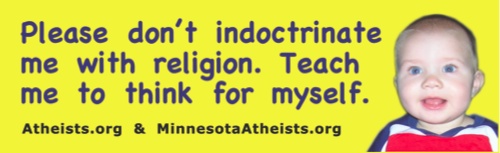
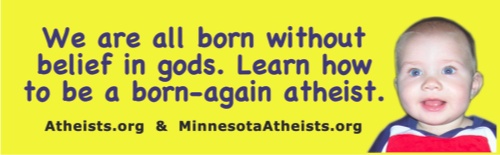
I know what you’re thinking: COMIC SANS?!?? How could they? (Do atheists ever consult with professional graphic designers before doing these things, I wonder…)

Otherwise, though, these are nice, clear, positive messages that at the same time are sure to piss some people off, and also hit people in that same emotional frame that I see all the time in theists’ billboards. There might be some people driving along who initially mistake them for Pro-Life Across America billboards, and then their heads will explode as the message sinks in.

For shame, London School of Economics

The London School of Economics has decided to replace critical thinking as a common element of a university education with simpering, po-faced homilies that ban satire and ridicule. It’s a sad situation; their student union is stamping their collective feet and demanding that the local atheists remove a cartoon that portrays Jesus and Mohammed at a bar. To their credit, the atheists seem to be the only ones standing up for principle.

The London School of Economics Student Union (LSESU) has instructed the London School of Economics Student Union Atheist, Secularist and Humanist Society (LSESU ASH) to remove cartoons featuring Jesus and Mohammed from their Facebook page. LSESU ASH is not complying with the instruction and has appealed to LSESU to withdraw it.

The reactions have been amazing. Would you believe the student union called an emergency meeting, and are now tarring the portrayal of Jesus and Mo as “racist” and “bullying”? It’s absurd. This is a university, for dog’s sake — it’s precisely the place where ideas of all sorts get openly criticized, with far more ferocity than an innocuous caricature of two religious figures at the pub. And yet these pompous wankers who claim to defend religious freedom are all about silencing criticism.

Are there any grown-ups at the LSE? Any of them going to stand up and slap the ridiculous edicts of the student union down?

Why I am an atheist – cliffman

First, a complete lack of religious experience – I’ve never heard the voices of angels, nor felt the hand of the god upon me. Had a brief time in Sunday school as a child, but the stories never made any sense to me. Had people dear to me die in my presence, never felt any spirits wandering about.

Second, a good education. I’ve always preferred the explanations provided by science.

Third, reading the news, and reading history. I think the existence of the Pope pretty well proves the non-existence of the christian god, at least the biblical version.

And finally, my life is complete and happy without talking sky fairies.

cliffman

Quantum is just a metaphor

Could Chopra be any more muddled? First he claims that “quantum” is just a metaphor, and then he accuses all those fundamentalist physicists of hijacking his word and using it wrongly.

Quantum physics is a very specific discipline that currently has no direct applicability to medicine — every time Chopra opens his mouth and uses the word inappropriately, he’s committing quackery.

Why I am an atheist – BCskeptic

I am an engineer and I work in a science field, in particular that of astronomy instrumentation development. I became atheist some years ago when an atheist colleague and I started talking about religion. I argued the points that “you can’t get something from nothing”, and “what’s the point of it all then”, quite for vociferously for ~3 hrs and then went home.

I thought a lot about what I was arguing, and also the contradiction I was living. In my career, I lived everything “evidence-based”, but in my personal religious life it was faith-based. Although, even though I prayed and all that, I was never, I don’t think, a 100% hard-core believer.

I realized that I was living a life of intellectual hypocrisy, that it lacked integrity, and that I couldn’t live like that anymore. Truth mattered to me more than comfort, and the science I had learned since working in the astronomy field made the notion of the existence of an elusive supernatural deity quite frankly ridiculous.

I went to work the next day, and declared to my colleague, “that’s it, I’m atheist”. And I’ve never looked back. There is simply no evidence to support the existence of a god or gods, and in fact all of the evidence is contrary to that existence. I feel free to think and question what I like, and no longer have a ‘target’ on my back. I find that socializing with religious people is like socializing with people who really believe Santa Claus exists. Much (although not all) of my family, including my daughters and my wife’s family are highly religious. I find there is a barrier there to true communication; really getting to know people and what they are like and think at a deep level is off the discussion list, because of religion. With my family who is not religious (and they are quite well educated as well), some deep and interesting discussions occur, as happens as well with my atheist colleagues.

It came with a price, though. I believe turning atheist was the major contributing factor to my divorce, which happened a few years later. A very painful and expensive process! But now I’m with someone who is atheist as well, and life couldn’t be better. I have read many books in the meantime, starting with ‘On the Origin of Species’, many of Dawkins’ books (reading ‘God Delusion’ was like savouring a delicious meal), Harris, Hitchens, books on psychology, books on morality, and now blogs. I also believe I have a much deeper appreciation of our/my existence, the Universe, and all of the complexity and wonder involved. Life is good. Life as I know it is exceedingly rare and precious. And life is finite and must be enjoyed to its fullest. That’s what I try to think of and do every day.

BCskeptic
Canada

Good hair turns out to be a poor science educator

The requirements to be a TV weather presenter are fairly slack: an undergraduate degree with some training in meteorology is preferred, but not required, and the main skills seem to be looking presentable with nice hair, being able to dance with a green screen, and being glib and cheerful. So I guess it’s not surprising that the “scientists” leading the charge against global warming are climate-denier TV weathermen. That link takes you to a long list of quotes from various television weather personalities — including a couple from Minneapolis — who all deny reality and use their position as frontmen pretending to be scientists to delude the public. Take a look and see if your local television station has a conspiracy nut doing the weather.

Another interesting aside in that article is that all of the current Republican candidates for president are climate change deniers. Every single one. Huntsman was the only exception, and he’s out.

That prompted me to look at the two front-runners positions on evolution.

Mitt Romney, the conservative establishment candidate, is a theistic evolutionist. He argues that evolution was the tool god used to create humans (“How?” I always wonder — evolution isn’t a railroad track in which you can put a car at one end and expect it to arrive at the other). He also opposed teaching intelligent design creationism while governor of Massachusetts, which is good news — I wonder if it’ll be used in attack ads against him? So on this one narrow issue, Romney is tolerable. On everything else the corporate plastic robot would never get my vote.

Newt Gingrich is the crackpot tea party candidate and is getting progressively wackier as the campaign goes on. While he made more vaguely moderate statements about evolution a few years ago, now that he’s courting the ignorant wackaloon vote, he’s sounding more like a member of the Insane Clown Posse.

I think we can safely say that no Republican should be allowed anywhere near the reins of government. They’re anti-science through and through.

(Also on Sb)

The Brine Shrimp gambit

How adorable! A dodgy fellow has invented what he thinks is a new get-out-of-jail-free card, called the brine shrimp gambit. It’s an excuse of the form, “I’m talking about X (brine shrimp), and you’re accusing me of Y (animal abuse), therefore you lose.” It doesn’t seem to matter that no, I am actually talking about X, and you’re just trying to displace the criticism to something completely different so you can skip off without thinking about your claims. I have seen versions of this many times.

The most common example occurs when I criticize religion to someone’s face, and they immediately protest, “Oh, no, I don’t believe in that kind of religion. You’re thinking of the Fred Phelps kind of religion.”

Sorry, no. I’m quite aware of the distinction between crazy fundy evangelicals and your average, run-of-the-mill Christian who believes in silly fantasy stories. I despise Karen Armstrong almost as much as I do Fred Phelps, but for different things. I am actually jumping down your throat for your worship of evil, tiny, nasty little brine shrimp; I have not mistaken them for, say, a squadron of cats or intervening angels.

And yes, when you tell me you love black people and would even let one use your bathroom, it is not inflating a brine shrimp into a sea monster to point out that you’re being a racist. Similarly, if you defend a gender-biased selection of event speakers because, you say, you didn’t think of those other notable women you could have invited, then you are being sexist.

Just watch. You’ll be seeing the Brine Shrimp gambit pulled many times in the future, and every time it will be used as an escape hatch to justify lesser injustices by pretending it could have been worse. Add another bullet to the arsenal of silencing tactics.


Now I’m seeing it everywhere. Here’s an example from Newtie.

You really see this problem on the heels of the South Carolina primary, which Gingrich won mainly by running around insinuating racist arguments without saying them out loud, and then when he was called on it, his supporters took umbrage because they’ve put so much work into avoiding saying the N-word.

That’s a perfectly executed Brine Shrimp gambit.

Why I am an atheist – Jemima Cole

There are a lot of reasons why I’m an atheist. The idea of worshipping a god who seems to have all the evils and psychological problems of a North Korean dictator, who would send me to an eternity of torture for thinking the wrong thing, who demands total, eternal devotion and praise from his supporters, and would then show those he had saved images of me being tortured for their delight (it’s Catholic doctrine, fact fans!) … well, what a bastard. Fuck that God. Every Earthly equivalent of ‘Heaven’ only exists in dictatorships. God’s Palace sounds just like Saddam’s – all gleaming marble and gold taps. Day to day life in Heaven sounds like a perpetual Soviet Victory Parade. None of the things I value in life seem to exist in Heaven. I like to elect my leaders, I like freedom of speech and freedom of religion.

But that doesn’t mean that god doesn’t exist.

For me, as I judge the competing truth claims of religion and atheism, the most compelling reason for me to be an atheist is that religion is consciously untrue. That, in other words, priests and believers lie.

We see it reported all the time on this blog. The first time some creationist says something crazy about junk DNA or how evolution is just a theory … well, it’s common or garden ignorance. Not their fault, we all have to learn things some time.

The second time they say it, it’s a lie. The third time, it’s a policy to lie.

The Catholic Church, to pick just one example, routinely lies. Did you know there are holes in condoms that let AIDS out? Did you know Hitler was an atheist and that the Catholic Church fought Hitler with all its might? Read the Cloyne Report and see that Bishop Magee prepared two reports about child abuse – one for the police, another for the Vatican. Oh, but the Vatican can’t be expected to know what some local priest is up to … he was the man that found Pope John Paul I’s body. He was private secretary to that Pope and to John Paul II.

Conscious, repeated lies. Not mistakes.

Another aspect of the same phenomenon is the double standard. Priests declare moral relavitism is a scourge of society, that there’s good and there is evil and nothing inbetween, that they can show you the difference and that if you even *think* bad thoughts, you’re guilty of them. Then they cover up another priest raping an eight year old, deliberately withholding evidence from the police. When they are caught, they play the ‘well … everyone’s human. It’s all trumped up by the media. Did you know that this stuff happens all the time’ card. Pick one. To me ‘is raping a child bad?’ is not a moral conundrum, it’s not a time to pick at definitions. If my best friend raped a child, I would phone the police, I would tell them everything I knew, and I would have no moral qualms about it. I don’t believe in moral absolutes. I do know that raping a child is wrong. If some smarmy theologian wants to pick as that as ‘intellectually inconsistent’, please, please let’s discuss that in comments. I double dare you.

It goes further than the Catholic child abuse scandal. Beyond the almost identical Mormon abuse scandals, or the Scientology abuse scandals, or … well, the list goes on.

If an atheist accidently credits the wrong loony idea to the wrong branch of one Christian sect, they’ll get a long, patronizing speech about how we’re woefully ignorant of theology, that the Holy Church of the Ratfucker Jesus might believe that, but the person you’re talking to is from the Sacred Chapel of Christ Ratfucker.

Then they’ll take the credit for all religion ever. ‘What has my religion done?’ a Protestant will say, ‘why … just look at the Sistine Chapel’. ‘How dare you insult the 90% of people on this planet who believe in God?’. Let’s accept that 90% of people in the world are religious for sake of argument. The majority of those people aren’t even monotheists, let alone Christians, let alone Protestants, let alone Sacred Christ Ratfuckers.

Meanwhile … talk to someone who’s been trained at a seminary. Training to be a priest is, from the accounts I’ve been told, very simply being taught how to lie. The comforting lie, the ‘things to say to the people who’ve read the Bible and spotted that it doesn’t say the things you say it does’, the lies necessary to keep the institution from external scrutiny. Priests understand that what they teach isn’t what they believe – they have ‘a more nuanced’ understanding. That there are a lot of things they have to keep vague, very simple questions they must not allow to be asked (‘who does the Bible says is going to Heaven?’, to pick one). Always, always, it’s ‘avoid a straight answer’.

Jesus said some wise things. One of them was “A sound tree cannot bear evil fruit, nor can a bad tree bear good fruit”. Truth does not come from lies. Creationists lie. The Vatican lies. Anglican theologians explain that the bits in the Bible that are true are true, the rest are metaphors. They don’t even *understand* truth, in other words.

So, a simple question to believers: if they’re telling the truth, why do your holy men lie to you so frequently and so consistently?

Jemima Cole

A little classy conversation for your Sunday morning

Sit down with a nice cup of tea and listen to 30 authors talk about gods.


1. Sir Arthur C. Clarke, Science Fiction Writer
2. Nadine Gordimer, Nobel Laureate in Literature
3. Professor Isaac Asimov, Author and Biochemist
4. Arthur Miller, Pulitzer Prize-Winning Playwright
5. Wole Soyinka, Nobel Laureate in Literature
6. Gore Vidal, Award-Winning Novelist and Political Activist
7. Douglas Adams, Best-Selling Science Fiction Writer
8. Professor Germaine Greer, Writer and Feminist
9. Iain Banks, Best-Selling Fiction Writer
10. José Saramago, Nobel Laureate in Literature
11. Sir Terry Pratchett, NYT Best-Selling Novelist
12. Ken Follett, NYT Best-Selling Author
13. Ian McEwan, Man Booker Prize-Winning Novelist
14. Andrew Motion, Poet Laureate (1999-2009)
15. Professor Martin Amis, Award-Winning Novelist
16. Michel Houellebecq, Goncourt Prize-Winning French Novelist
17. Philip Roth, Man Booker Prize-Winning Novelist
18. Margaret Atwood, Booker Prize-Winning Author and Poet
19. Sir Salman Rushdie, Booker Prize-Winning Novelist
20. Norman MacCaig, Renowned Scottish Poet
21. Phillip Pullman, Best-Selling British Author
22. Dr Matt Ridley, Award-Winning Science Writer
23. Harold Pinter, Nobel Laureate in Literature
24. Howard Brenton, Award-Winning English Playwright
25. Tariq Ali, Award-Winning Writer and Filmmaker
26. Theodore Dalrymple, English Writer and Psychiatrist
27. Roddy Doyle, Booker Prize-Winning Novelist
28. Redmond O’Hanlon FRSL, British Writer and Scholar
29. Diana Athill, Award-Winning Author and Literary Editor
30. Christopher Hitchens, Best-Selling Author, Award-Winning Columnist