Neandertals were monsters!

Danny Vendramini is a man with a vision…but absolutely no knowledge or competence. He has invented out of whole cloth a bizarre hypothesis that Neandertals were super-predators who hunted modern humans for food and sex. To support this weird contention, he builds up a tissue thin set of speculations, all biased towards this idea that Neandertals were giant, hairy brutes who looked like bipedal chimpanzees, and that were intent on raping and eating people.

If it sounds like the plot for a cheesy SyFy channel horror movie, you shouldn’t be surprised: Vendramini is not a scientist, but he is a “theatre director, TV producer and award-winning film director and scriptwriter“. He has no training in comparative anatomy, ecology, or evolutionary biology, and it shows.

He has written a book titled Them+Us. Here’s the promotional video. Prepare to simultaneously laugh and stand aghast at the abuse of science.

I’m just going to take apart one claim out of this mass of nonsense. He commissioned “one of the world’s foremost digital sculptors”, Arturo Balseiro, to reconstruct a Neandertal skull to meet his requirements. Poor Balseiro! He’s not going to be well regarded in scientific circles after selling out this badly.

One of his hilarious claims is that all other reconstructions have been biased because they’ve been done to make Neandertals look human — but, don’t you know, Neandertals are primates, so they should be made to look like other primates.

Contemplate that last sentence. Humans are apparently not primates, and the analog for reconstruction should not be modern humans, their closest relative, separated by a mere 100,000 years, but a random gemisch of miscellaneous apes and monkeys, separated from Neandertal for over 6 million years.

To support this unlikely comparison, he superimposes a Neandertal skull on the profile of a chimpanzee, and declares that they fit perfectly.

There are a few problems with this reconstruction. To get the slope of the skull’s face to align with that of the chimpanzee, he has completely ignored the position of the foramen magnum, at the base of the skull. In the image to the right, the Neandertal’s spine would be erupting out the front of his trachea. Note also the little details, like this orientation requiring that the chimp’s ears be yanked down to be coming out of his neck, and how the chimp’s neck has to be mostly filled with the bowl of the occiput. It doesn’t fit. It doesn’t fit at all.

You can also look at a chimpanzee skull and compare it to that of a Neandertal (strangely, an obvious comparison that he doesn’t bother to make on his web page). They don’t look anything alike, except in the general sense that they’re both apes.

But ignore all that! TV producer knows better.

The Neandertal skull above is actually the La Ferrassie specimen, the very same individual Vendramini uses to reconstruct his version of a Neandertal. And here it is, in all its ridiculous creature-feature glory.

After all that complaining about how those scientists impose their human biases on all the other Neandertal reconstructions, Vendramini just decides on the basis of no evidence at all that they had to have been as hairy as a gorilla, with cat’s eyes because they hunted at night.

It’s all ludicrous, pseudo-scientific bullshit.

We have standards, too

The other day, I wrote about this unfortunate case of a cancer researcher at UC Davis who was abused by his university for criticizing another department’s poor health advice. I said that that’s one of the things you have to protect with academic freedom: the right of scientists to make informed criticisms of others’ work.

Now I’m getting squeaked at by Casey Luskin of the Discovery Institute, who protests that I don’t give that same freedom to creationists.

So Myers doesn’t really believe in academic freedom — he only defends the freedom of scholars to agree with him. But without the liberty to dissent, the whole idea of “academic freedom” is pretty meaningless.

Scientists are supposed to use their intelligence, expertise, and knowledge to make evidence-based criticisms of claims. Since creationists lack all three characters, as well as having a dearth of evidence, it doesn’t apply. Academic freedom does not mean you are given carte blanche to make wild claims without an expectation that you’ll provide scientific reasoning behind them, and the thing is, in the UC Davis case, the cancer researcher was knowledgeable and discussed the best evidence.

There’s more to being an academic than having unfettered freedom, you know.

Why I am an atheist – Evan I.

Growing up I had a vague notion that we were created by a supreme being. I never really probed the existence question, so the “creator” answer suited my brian just fine then. However, the idea of God was something that wasn’t reinforced in my house. We never went to church, prayed or kept any religious symbols. What I did have reinforced, on the other hand, was the wonderful altruistic care of my parents. My upbringing was enough to let me know how rational, humane beings ought to treat one another.

[Read more…]

Another douchebag: Marty Klein

Ladies, aren’t you used to this yet? Marty Klein is a sex therapist who writes for Psychology Today; he’s also a dishonest hack who will distort the facts to make his case.

You may remember that strange incident in which Elyse of Skepchick was working at a conference, and out of the blue, was handed a card offering group sex by a pair of strangers. Klein has taken that story and turned it into a tale of a prude squawking hysterically at a kindly offer by a pair of friends. It’s one of the more egregious manglings of a story I’ve seen in a long time.

What I find particularly outrageous, though, is that Klein is exactly like Ken Ham: nowhere in his fractured fairy tale does he include a single link to the actual participant and witness to the story, where readers might have discovered how he lied, and of course his article doesn’t include comments, where readers might correct him.

How about some good news to cheer you up on a Monday morning?

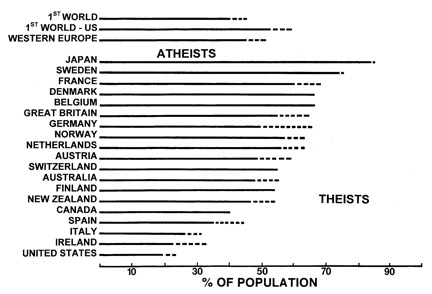
Gregory Paul has been looking at trends in the International Social Survey Program (ISSP) and other polling data. We’re behind in some countries (I’m looking at you, USA), ahead in others, but the overall trend is good: atheism is winning out around the world.


(Note: These are predominantly ISSP results. Solid lines indicate atheists from absolutist to marginal, empty spaces to the right are theists from marginal to absolutist, and results for western and eastern Germany are combined proportional to their populations. Differences between the 1998 and 2008 ISSP results are indicated by dashed segments.)

We’re growing!

It appears that Ameroatheists have expanded by 10 million since the turn of the century—representing about a million a year, and about a third of overall population growth, to a total of 60 million out of more than 300 million. Atheism has made large gains among the young, while congregation size has dropped by as much as a fifth. Even so, the ISSP results confirm that the United States is still the most theistic prosperous democracy—yet not nearly as theistic as some Second and Third World countries.

A multinational waxing of atheism and waning of theism seems to be occurring, and may well be universal in Western countries. The increase in Western atheism appears to be continuing a long-term trend that probably started in the 1800s, if not earlier, and has accelerated since World War II with no signs of slowing down, if the ISSP results are correct. Losses in theism have occurred in both Protestant and Catholic nations, albeit with the latter somewhat more resistant to losses. In most Western nations, the religious right is already weak, and in the few where it is a strong minority, it is losing ground. Demographically driven by a growing loss of piety among youth, the rise of secularism in the advanced democracies is in accord with the socioeconomic dysfunctionality hypothesis that predicts and observes that improving levels of financial and economic security in middle class majorities strongly suppresses interest in supernatural deities.

That last bit is what worries me. Atheism thrives on economic stability; religion prospers when people are desperate and ignorant. Here in the US, the theocratic party, the Republicans, have no interest in keeping the majority in good economic shape — they’d like to destroy the social safety net and increase economic inequity. I see an awfully strong correlation there between religiosity and economy-wrecking.

The thesis that popular secularism is dead, or at least dying, is clearly false. In the most advanced and successful nations, it is religion that is in the demographic ICU. Also entirely discredited is the premise that religion is universal to the human condition, like language—while theists vary from constituting nearly entire populations to less than a third, verbal skills are nearly uniform across the board. Demographic extrapolations that suggest fast-reproducing fundamentalists are on a statistical course to outgrow low-fertility secularists are proving flawed because they fail to account for mass nonchalant conversion due to modernity.

Yes! I have never been concerned about all the people moaning about how the fundies and Muslims are outbreeding us — I see them as busily making minds that will be ripe for reason and knowledge.

Why I am an atheist – Christopher Bonds

I am an atheist primarily because I know of no evidence for any gods. I think that gods were invented by the human mind at some point in our evolutionary development. It was probably at the time when human intellect began to develop concepts arising from the elementary awareness of cause and effect, which I think behaviorists call conditioning. Some things happened seemingly randomly or without explanation or cause. When humans came up with the idea that events in nature could bring good or bad fortune to them, they probably attributed them to some unseen forces or power. Memory played a role as well. One thing that certainly helped develop the idea of spirits is the power of memory of persons close to us who died but whose presence lingers. In times when it was hard to distinguish what was going on in our heads from the events of the external world, memories and ghosts and spirits must have seemed quite real. Although we have evolved culturally since our first appearance as a species, our brains seem to be built pretty much the same was as our earliest H. sapiens ancestors. The reasoning function of the prefrontal cortex is a Johnny-come-lately. It seems to have progressed in fits and starts, but over centuries it has given us science, the best tool we have for understanding ourselves and the universe in which we live. Science has not as yet found any evidence for the existence of gods. Today’s struggle between faith and reason is really a battle between the more modern part of our brains and the more archaic areas that evolved to help us survive in a vastly different and more hostile environment.

[Read more…]

A conversation about TAM

A subset of Freethoughtbloggers and the Queen Skepchick got together on Google+ to discuss the recent contretemps. The people who participated were me, Al Stefanelli, Daniel Fincke, Greg Laden, Ian Cromwell, Jason Thibeault, Ophelia Benson, Rebecca Watson, and Stephanie Zvan.

Here’s how I introduced it:

The latest controversy to embroil freethoughtblogs is over the James Randi Educational Foundation’s big yearly meeting, The Amazing Meeting, or TAM for short. After DJ Grothe, the president of the JREF, announced his concern that, despite the fact that he’d done a fine job of making the roster of speakers well balanced, at roughly half and half men and women, the registration of women in the meeting was significantly down from last year. What to do?

Well, he could have asked big boosters of TAM, like Skepchick and Freethoughtblogs, to rally together and help get more women involved, as Skepchick has done every year. Instead, in a bizarre twist, he basically accused Rebecca Watson and a certain blog network, ours, of scaring women away with our horrible stories of sexual harassment. He also denied that sexual harassment had ever occurred, a story that has been steadily unraveling over the last few weeks.

Then, to make matters worse, a number of poorly informed people have been ranting that we, that is people like Rebecca Watson and Stephanie Zvan, want to “harm TAM” — another weird claim that ignores the history of our involvement with skeptical and atheist meetings.

So the point of our session today is to clear the air, get our position expressed, and maybe vent a little frustration.

Creationism is a marketing game

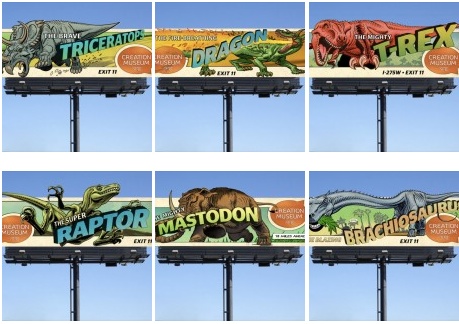
And they know it. Ken Ham has started a new billboard campaign for the creation “museum”, with a variety of different designs, all featuring prehistoric* creatures as draws to get kids and family to attend. Here are some examples:

Notice what’s smart about them? They’re focused, featuring an element that they clearly know is a key draw, dinosaurs; they’re eye-catching; they’re professionally designed and have thematic unity; and the Creation “Museum” knows that good marketing is a way to get people to come in to their propaganda mill. You know they invested a good chunk of money in this effort.

So now Ken Ham is openly gloating about his wonderful billboards.

…just like everything else we do at the Creation Museum, they are done professionally—first class!

To make matters even worse, he goes on sneer at the feeble efforts of real museums, and to mock several atheist billboard campaigns, posting examples of some of the worst. And the sad thing is — and you won’t hear me saying this very often — Ken Ham is right. Real museums are strapped for cash, and most of their money is going into curating scientific collections and paying scientists to do work for them, while atheist organizations are actually small time compared to the multi-million dollar operating budget of a commercial enterprise like the Creation “Museum”.

Ham doesn’t have a clue about any of the things real museums do. When an NCSE spokesperson says he wishes more science museums could engage in this kind of promotion, Ham whimpers defensively.

You mean our government-funded (using our tax money) Smithsonian would not have a marketing budget as big as the marketing budget of the Creation Museum? And what about all the other secular museums (no doubt most are funded by our tax dollars) such as the Chicago Field Museum and New York Natural History Museum—and the many, many others!

The Smithsonian, the AMNH, and the Field Museum are not about marketing! They’re institutions doing science. Ham is confused in thinking that his freak show exhibit and monument to bunkum is anything like those places. He does not have a museum, he owns a sideshow attraction!

The article reveals Ken Ham’s ignorance in so many ways. He really doesn’t understand the difference, and he doesn’t comprehend why scientists might be worried about his campaign.

As of writing this blog post, an Associated Press article about our new dinosaur billboards has appeared on many news sites, including ABC News and the Washington Post. The AP article and many blogs indicate that secularists are concerned about them. Isn’t it amazing that they are so worried about one Creation Museum. Think of all the hundreds of secular museums and thousands of secular schools, colleges, and universities where evolution and millions of years are taught as fact—and the secularists are really worried AiG’s Creation Museum! That shows how insecure they really are. Secularists just can’t stand it when information they have censored from the public is being disseminated by us. And they don’t want people thinking for themselves; they want them to swallow their anti-God religion!

Those billboards and his “museum” are not disseminating censored information. Information about creationism is freely available all over, and gets routinely spread in a common American institution, church. We are worried because Ken Ham is spending buckets of money disseminating slickly-produced lies, while scientists are trying to do science. Lies are cheap and easy; the truth is harder to come by. That he follows the cheap and easy route means he has more money to sink into public relations.

We’re not worried that Ken Ham has some uncomfortable truth that he’s getting across to people. We’re worried that he’s an effective charlatan.

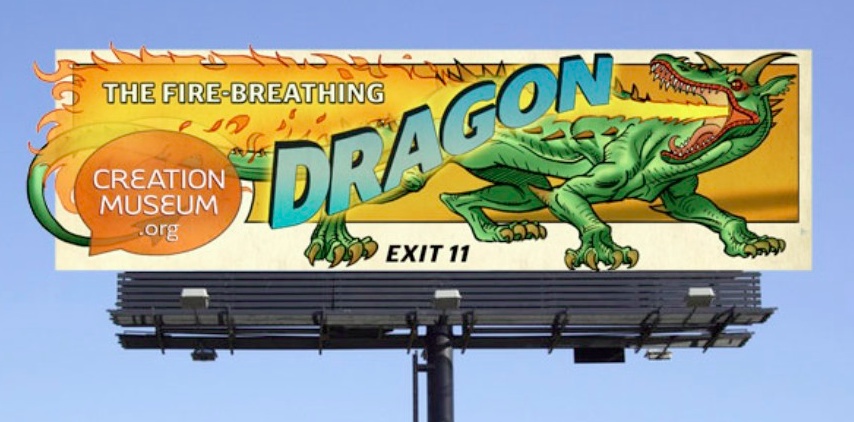
And really, it’s easy to see what a lying fraud he is. Did you notice one of the billboards in that montage above?

Yeah. Ken Ham claims that fire-breathing dragons were real.

*Well, actually, if Ken Ham were right, these are historic creatures that lived within the last 6,000 years.

Why I am an atheist – W.P.

How did I become an atheist? I grew up in a traditional Protestant family; went to Sunday school weekly. I could just never buy the silly stories I was fed every week. A talking, burning bush? A world-wide flood? (they hadn’t even discovered the western hemisphere yet!) A virgin birth? Wine to water or walking on water? By the time I was a teen, I was very skeptical. Then I was introduced to R.W. Emerson. His essays and his ties to transcendentalism showed me that I wasn’t the only one uncomfortable with traditional Christianity (too bad I’d never heard of Robert Green-Ingersoll until just a few years ago). Well, then I went off to college to study biology, archaeology, paleontology and the like. I added some courses on the Bible and the Humanities for good measure. That darn critical thinking just pounded those last nails into the coffin of my Christian upbringing.

I met and married a very secular guy (outdoors, with a J.P.) and now we have 3 little secular humanist tots. I discuss religion with them but steer them toward the path of science and constant questioning. Will they run off and join a cult someday, or worse–becomes Mormons?? Maybe…”god”, I hope not.

W.P.
United States