I am so over the skeptical movement

I am so over Ben Radford. I thought he was obtuse before. Now I’m convinced that he’s simply an idiot. He attempts to rebut my criticisms.

Myers admits that I’m technically correct that Ensler’s statistics are not exactly right, but claims I’m being “hyperskeptical,” and states that “One billion women have been victims of ‘homicide, intimate partner abuse, psychological abuse, dating violence, same-sex violence, elder abuse, sexual assault, date rape, acquaintance rape, marital rape, stranger rape and economic abuse,’ confirmed by statistics that Radford cites. One billion women. Radford’s hyperskepticism is so fierce that he objects to Ensler using 3 general words – raped, beaten, violated – instead of 26 more specific words, but is willing to overlook the horrific truth that she is correct and one billion women will suffer for their sex in their lifetime.”

Except that I didn’t; Myers misread it. I actually didn’t write the “one billion” figure that Myers misquotes me as saying; that was Ensler’s number. What I actually wrote (check it yourself) was that “one-third of women [have been victims of] homicide, intimate partner abuse, psychological abuse, dating violence, same-sex violence, elder abuse, sexual assault, date rape, acquaintance rape, marital rape, stranger rape and economic abuse.” (One in three women is not the same as one billion if you do the math, though perhaps that’s just my hyperskepticism.)

I was not saying he was technically correct. I was saying that the figure he’s carping about is actually right, and that his complaints are empty. I did not realize that he’d respond by proudly declaring his innumeracy: I’m sorry, but 1/3 of 1/2 of 7 billion people is actually about one billion.

Worse yet, he then goes on to piously plead that people need to heed the principle of charity in their arguments (I’ve noticed that it’s usually the people who most need charity who are begging for it.) Then — get ready for it — he turns around and writes this appalling piece of ham-handed dreck. Yeah, right. Fuck the principle of charity. No charity for you, Radford.

I’m so over Harriet Hall’s t-shirt. She’s been going on and on, circling around the drain to somehow defend it. It’s simple: she wore it to spite some people she clearly doesn’t like, and to get praise from other people who don’t like Rebecca Watson and the Skepchicks. It’s really that easy. Just admit it and move on. I know it’s hard to admit that you’re that petty, but it would end all this nonsense, and it would be honest. Get over it; the wordy excuse-making is getting embarrassing. Besides, Amanda Marcotte has Hall’s number.

I’m so over Reap Paden. Dear god, he’s so obsessive he’s made another creepy video that says far more about him than me.

The one thing I’m happy to do is publicize these dumbass arguments. Why is it that people who attach themselves to a movement that prides itself on having rationality as its raison d’etre are so godawful pathetic at making a case for themselves?

ENCODE gets a public reaming

I rarely laugh out loud when reading science papers, but sometimes one comes along that triggers the response automatically. Although, in this case, it wasn’t so much a belly laugh as an evil chortle, and an occasional grim snicker. Dan Graur and his colleagues have written a rebuttal to the claims of the ENCODE research consortium — the group that claimed to have identified function in 80% of the genome, but actually discovered that a formula of 80% hype gets you the attention of the world press. It was a sad event: a huge amount of work on analyzing the genome by hundreds of labs got sidetracked by a few clueless statements made up front in the primary paper, making it look like they were led by ignoramuses who had no conception of the biology behind their project.

Now Graur and friends haven’t just poked a hole in the balloon, they’ve set it on fire (the humanity!), pissed on the ashes, and dumped them in a cesspit. At times it feels a bit…excessive, you know, but still, they make some very strong arguments. And look, you can read the whole article, On the immortality of television sets: “function” in the human genome according to the evolution-free gospel of ENCODE, for free — it’s open source. So I’ll just mention a few of the highlights.

I’d originally criticized it because the ENCODE argument was patently ridiculous. Their claim to have assigned ‘function’ to 80% (and Ewan Birney even expected it to converge on 100%) of the genome boiled down to this:

The vast majority (80.4%) of the human genome participates in at least one biochemical RNA- and/or chromatin-associated event in at least one cell type.

So if ever a transcription factor ever, in any cell, bound however briefly to a stretch of DNA, they declared it to be functional. That’s nonsense. The activity of the cell is biochemical: it’s stochastic. Individual proteins will adhere to any isolated stretch of DNA that might have a sequence that matches a binding pocket, but that doesn’t necessarily mean that the constellation of enhancers and promoters are present and that the whole weight of the transcriptional machinery will regularly operate there. This is a noisy system.

The Graur paper rips into the ENCODE interpretations on many other grounds, however. Here’s the abstract to give you a summary of the violations of logic and evidence that ENCODE made, and also to give you a taste of the snark level in the rest of the paper.

A recent slew of ENCODE Consortium publications, specifically the article signed by all Consortium members, put forward the idea that more than 80% of the human genome is functional. This claim flies in the face of current estimates according to which the fraction of the genome that is evolutionarily conserved through purifying selection is under 10%. Thus, according to the ENCODE Consortium, a biological function can be maintained indefinitely without selection, which implies that at least 80 − 10 = 70% of the genome is perfectly invulnerable to deleterious mutations, either because no mutation can ever occur in these “functional” regions, or because no mutation in these regions can ever be deleterious. This absurd conclusion was reached through various means, chiefly (1) by employing the seldom used “causal role” definition of biological function and then applying it inconsistently to different biochemical properties, (2) by committing a logical fallacy known as “affirming the consequent,” (3) by failing to appreciate the crucial difference between “junk DNA” and “garbage DNA,” (4) by using analytical methods that yield biased errors and inflate estimates of functionality, (5) by favoring statistical sensitivity over specificity, and (6) by emphasizing statistical significance rather than the magnitude of the effect. Here, we detail the many logical and methodological transgressions involved in assigning functionality to almost every nucleotide in the human genome. The ENCODE results were predicted by one of its authors to necessitate the rewriting of textbooks. We agree, many textbooks dealing with marketing, mass-media hype, and public relations may well have to be rewritten.

You may be wondering about the curious title of the paper and its reference to immortal televisions. That comes from (1): that function has to be defined in a context, and that the only reasonable context for a gene sequence is to identify its contribution to evolutionary fitness.

The causal role concept of function can lead to bizarre outcomes in the biological sciences. For example, while the selected effect function of the heart can be stated unambiguously to be the pumping of blood, the heart may be assigned many additional causal role functions, such as adding 300 grams to body weight, producing sounds, and preventing the pericardium from deflating onto itself. As a result, most biologists use the selected effect concept of function, following the Dobzhanskyan dictum according to which biological sense can only be derived from evolutionary context.

The ENCODE group could only declare function for a sequence by ignoring all other context than the local and immediate effect of a chemical interaction — it was the work of short-sighted chemists who grind the organism into slime, or worse yet, only see it as a set of bits in a highly reduced form in a computer database.

From an evolutionary viewpoint, a function can be assigned to a DNA sequence if and only if it is possible to destroy it. All functional entities in the universe can be rendered nonfunctional by the ravages of time, entropy, mutation, and what have you. Unless a genomic functionality is actively protected by selection, it will accumulate deleterious mutations and will cease to be functional. The absurd alternative, which unfortunately was adopted by ENCODE, is to assume that no deleterious mutations can ever occur in the regions they have deemed to be functional. Such an assumption is akin to claiming that a television set left on and unattended will still be in working condition after a million years because no natural events, such as rust, erosion, static electricity, and earthquakes can affect it. The convoluted rationale for the decision to discard evolutionary conservation and constraint as the arbiters of functionality put forward by a lead ENCODE author (Stamatoyannopoulos 2012) is groundless and self-serving.

There is a lot of very useful material in the rest of the paper — in particular, if you’re not familiar with this stuff, it’s a very good primer in elementary genomics. The subtext here is that there are some dunces at ENCODE who need to be sat down and taught the basics of their field. I am not by any means a genomics expert, but I know enough to be embarrassed (and cruelly amused) at the dressing down being given.

One thing in particular leapt out at me is particularly fundamental and insightful, though. A common theme in these kinds of studies is the compromise between sensitivity and selectivity, between false positives and false negatives, between Type II and Type I errors. This isn’t just a failure to understand basic biology and biochemistry, but incomprehension about basic statistics.

At this point, we must ask ourselves, what is the aim of ENCODE: Is it to identify every possible functional element at the expense of increasing the number of elements that are falsely identified as functional? Or is it to create a list of functional elements that is as free of false positives as possible. If the former, then sensitivity should be favored over selectivity; if the latter then selectivity should be favored over sensitivity. ENCODE chose to bias its results by excessively favoring sensitivity over specificity. In fact, they could have saved millions of dollars and many thousands of research hours by ignoring selectivity altogether, and proclaiming a priori that 100% of the genome is functional. Not one functional element would have been missed by using this procedure.

This is a huge problem in ENCODE’s work. Reading Birney’s commentary on the process, you get a clear impression that they regarded it as a triumph every time they got even the slightest hint that a stretch of DNA might be bound by some protein — they were terribly uncritical and grasped at the feeblest straws to rationalize ‘function’ everywhere they looked. They wanted everything to be functional, and rather than taking the critical scientific view of trying to disprove their own claims, they went wild and accepted every feeble excuse to justify them.

The Intelligent Design creationists get a shout-out — they’ll be pleased and claim it confirms the validity of their contributions to real science. Unfortunately for the IDiots, it is not a kind mention, but a flat rejection.

We urge biologists not be afraid of junk DNA. The only people that should be afraid are those claiming that natural processes are insufficient to explain life and that evolutionary theory should be supplemented or supplanted by an intelligent designer (e.g., Dembski 1998; Wells 2004). ENCODE’s take-home message that everything has a function implies purpose, and purpose is the only thing that evolution cannot provide. Needless to say, in light of our investigation of the ENCODE publication, it is safe to state that the news concerning the death of “junk DNA” have been greatly exaggerated.

Another interesting point is the contrast between big science and small science. As a microscopically tiny science guy, getting by on a shoestring budget and undergraduate assistance, I like this summary.

The Editor-in-Chief of Science, Bruce Alberts, has recently expressed concern about the future of “small science,” given that ENCODE-style Big Science grabs the headlines that decision makers so dearly love (Alberts 2012). Actually, the main function of Big Science is to generate massive amounts of reliable and easily accessible data. The road from data to wisdom is quite long and convoluted (Royar 1994). Insight, understanding, and scientific progress are generally achieved by “small science.” The Human Genome Project is a marvelous example of “big science,” as are the Sloan Digital Sky Survey (Abazajian et al. 2009) and the Tree of Life Web Project (Maddison et al. 2007).

Probably the most controversial part of the paper, though, is that the authors conclude that ENCODE fails as a provider of Big Science.

Unfortunately, the ENCODE data are neither easily accessible nor very useful—without ENCODE, researchers would have had to examine 3.5 billion nucleotides in search of function, with ENCODE, they would have to sift through 2.7 billion nucleotides. ENCODE’s biggest scientific sin was not being satisfied with its role as data provider; it assumed the small-science role of interpreter of the data, thereby performing a kind of textual hermeneutics on a 3.5-billion-long DNA text. Unfortunately, ENCODE disregarded the rules of scientific interpretation and adopted a position common to many types of theological hermeneutics, whereby every letter in a text is assumed a priori to have a meaning.

Ouch. Did he just compare ENCODE to theology? Yes, he did. Which also explains why the Intelligent Design creationists are so happy with its bogus conclusions.

Where’s the solidarity?

Atheists are publicly chastised by Naima Washington.

solidarity

It is a sad fact that people of color, particularly African American nonbelievers, are alienated within the secular community. Among the ‘faith’ communities, even those with the most racist and sexist doctrines, continue to do whatever it takes (and make no apologies) as they aggressively recruit and make space in their communities for people of color. Based on their disinterest in any recruiting efforts, the leadership of the secular community is apparently very proud of the fact that they, on the other hand, have few people of African descent in leadership positions as well as very few members. While there is no genuine intent or concerted plan to change this situation, many attempt to explain this phenomena by claiming that black folk are just too addicted to religion; otherwise, those of us who aren’t addicted to religion are either nominal or closet atheists, and therefore, need not be taken seriously. During the past 25 years, I belonged to many secular organizations; it was indeed a challenge to remain in them.

There is some effort to incorporate black Americans into atheist organizations; it’s not an active antipathy, but more an oblivious neglect. To make atheism relevant to black Americans will take, I think, structural changes: we need to openly recognize that issues of importance to the black community cannot be set aside as non-atheist issues.

It’s that nagging gate-keeping problem again. We need to realize that atheism and skepticism are universal ideals, not narrow ways to address a particular subset of questions. And it really is all about the questions: too many atheists think atheism is simply the answer, without doing the hard work of negotiating the human problems…and they get defensive when anyone tries to tell them that there are many concerns out there — social justice, feminism, black civil liberties, to name a few — that belong on the godless table. The current infighting that some people are moaning about is actually an example of the resentment of those holding the status quo: how dare we suggest that atheism has implications beyond just disbelieving in god and religion? How dare we try to expand the scope of atheism when we haven’t eradicated religion yet? How dare we suggest that the way to expand our base is to also consider the more pressing concerns of other people beyond our traditional white middle class conventionalities?

And so we watch the opportunities pass by, because our current constituencies simply don’t comprehend that women or black Americans or any other second-class group might be interested in something other than talking about how stupid the Bible is. Sometimes silence is as self-defeating as hostility.

When African American atheists attempt to expand their visibility and participation in the secular community by organizing with other nonbelievers—especially those who have been historically ignored by the leadership of the secular community—to publicly celebrate their freedom from religious dogma; when we ask everyone in the secular community to celebrate along with us, and we set aside one day out of the entire year to do so, there’s a problem! Last year, some very intelligent and insightful atheists declared efforts to organize a Day of Solidarity for Black Non-believers as segregation! Those same people are otherwise dead silent about the segregation, hostility, and alienation directed towards black atheists within the secular community year-round.

I didn’t see anything local to Morris happening on the Day of Solidarity (this Sunday, the 24th). I checked Minnesota Atheists to see if they had plans to honor the day this weekend, and no, they have nothing. Again, it’s not because their is an antipathy to black issues: it’s more of an absence of awareness. And hell no, the problem isn’t the black community, it’s the existing atheist community that seems unwilling to reach out.

Can we fix this? I don’t know. We might all start by looking locally to see if there are any Day of Solidarity events going on around you, and join in.

Jacquelyn Gill has a good question

From Jacquelyn’s fine blog The Contemplative Mammoth, a bit of context:

You’re enjoying your morning tea, browsing through the daily digest of your main society’s list-serv. Let’s say you’re an ecologist, like me, and so that society is the Ecological Society of America*, and the list-serv is Ecolog-l. Let’s also say that, like me, you’re an early career scientist, a recent graduate student, and your eye is caught by a discussion about advice for graduate students. And then you read this:

too many young, especially, female, applicants don’t bring much to the table that others don’t already know or that cannot be readily duplicated or that is mostly generalist-oriented.

I’m not interested in unpacking that statement beyond saying that “don’t bring much to the table that others don’t already know” is basically a really sexist way of saying that they female applicants “are on par with or even slightly exceed others.” There is abundant evidence that perception, not ability, influences gender inequality in the sciences– it’s even been tested empirically.

What I am interested in is why other people in my community don’t think those kinds of comments are harmful and aren’t willing to say something about it if they do.

And then the question:

After the sexist comments were made, some did in fact call them out. This was immediately followed up with various responses that fell into two camps: 1) “Saying female graduate students are inferior isn’t sexist” (this has later morphed into “she was really just pointing out poor mentoring!”), and 2) “Calling someone out for a sexist statement on a list-serv is inappropriate.” Some have called for “tolerance” on Ecolog-l; arguably, more real estate in this discussion has gone into chastising the people who called out Jones’ comments. These people are almost universally male. To those people, I ask:

Why is it more wrong to call someone out for saying something sexist than it was to have said the sexist thing in the first place? 

That is a really good question.

[Updated to add:] Apologies to Jacquelyn for misspelling her name at first. Need moar coffee.

The Amazing Meeting coming up again

pz_randi

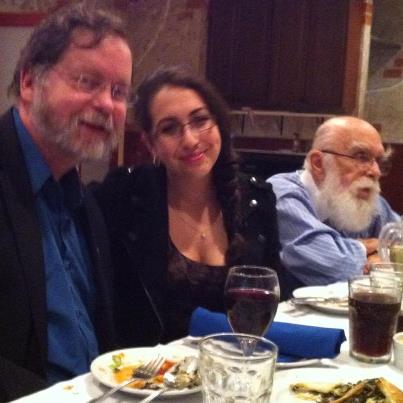
I had dinner with the Amazing Randi this weekend — see, I have proof! — and I was reminded what a pleasant and entertaining fellow he is. I also remembered that this is the time of year when they announce their annual fundraising event, The Amazing Meeting, to be held in Las Vegas on 11-14 July.

They have a couple of excellent speakers this year. Susan Jacoby is their keynote speaker (you can also see her at Women in Secularism), and evolutionary biology is well-represented by Jerry Coyne and Massimo Pigliucci — it would be great if they talked about biology, but it would also be worth seeing to have Coyne address the ‘scientific’ skeptics with his arguments about the incompatibility of science and religion, or for the two of them to butt heads over science and philosophy.

I’ll have to miss it again. I’m mostly staying right here in Minnesota through July and August, playing the game of administrator of our undergraduate research program. Jebus, I’m getting responsible in my old age.

Scientific morality: an example

Every once in a while, I hear these stirrings from scientists that there can be an objective morality, and that by following reason and evidence we can achieve great advances in ethics and reduce human suffering. I agree, in part. I think reason and science are the only ways we can implement our goals effectively, and that we should be empirically assessing our progress and making changes as necessary in a rational way. But — and this is a huge exception — science is not sufficient. Scientists are flawed, and while you can use science to optimally reach a particular goal, setting that goal in the first place is not determinable by scientific methods.

As a useful corrective to the scientific optimists, I suggest you read Francis Galton’s Memories of My Life, and try to do so with an open mind. That’ll be hard to do, because he says things that we now regard as repugnant, that we learned with hard lessons in the 20th century, lessons he did not experience. I think if Galton had lived through that period, he would have adjusted his opinions accordingly; charitably, I think I can safely assume from his writings that he had a sincere concern for improving the state of humanity, and that all that he proposed would have been for the betterment of individuals.

Man is gifted with pity and other kindly feelings; he has also the power of preventing many kinds of suffering. I conceive it to fall well within his province to replace Natural Selection by other processes that are more merciful and not less effective.

Try to keep that in mind when you read these quotes from his chapter on “Race Improvement”. He’s a scientist with only the highest aspirations for others. But he’s also a flawed scientist with imperfect knowledge, and a human being with a heavy freight of prejudices. He doesn’t realize that he’s paving the road to Hell with his intentions.

Here are the words of an upper middle class Victorian gentlemen who proposes to judge people and determine the value of other lives.

The most common misrepresentations now are that its methods must be altogether those of compulsory unions, as in breeding animals. It is not so. I think that stern compulsion ought to be exerted to prevent the free propagation of the stock of those who are seriously afflicted by lunacy, feeble- mindedness, habitual criminality, and pauperism, but that is quite different from compulsory marriage. How to restrain ill-omened marriages is a question by itself, whether it should be effected by seclusion, or in other ways yet to be devised that are consistent with a humane and well-informed public opinion. I cannot doubt that our democracy will ultimately refuse consent to that liberty of propagating children which is now allowed to the undesirable classes, but the populace has yet to be taught the true state of these things. A democracy cannot endure unless it be composed of able citizens; therefore it must in self-defence withstand the free introduction of degenerate stock.

Note what he considers both undesirable and heritable: Poverty. Crime. Intelligence. He can glibly divide humanity into classes, some of which are “undesirable”. He is looking for humane ways to prevent undesirables from propagating.

He has high moral aims! Keep that in mind; if it were actually true that poor people birthed children who were genetically determined to be poor, shouldn’t we do something about it? Of course, he’s not thinking it through: he can’t legitimately claim that poverty is biologically heritable (it sure is environmentally influenced, though!) and he certainly doesn’t seem to comprehend that poverty is a consequence of an unequal distribution of resources.

He’s also incredibly unaware of his own peculiar biases, biases that leap out to the more modern eye.

Most notabilities have been great eaters and excellent digesters, on literally the same principle that the furnace which can raise more steam than is usual for one of its size must burn more freely and well than is common. Most great men are vigorous animals with exuberant powers and an extreme devotion to a cause. There is no reason to suppose that in breeding for the highest order of intellect we should produce a sterile or a feeble race.

So “great men” are big-bellied men? Where is cause and effect here? Where is the evidence?

One of the dangers of science is that sometimes individuals get so captivated by that heady feeling of success and progress — and let’s not get carried away too far in the other direction, science definitely works and is a far better tool for understanding than any other process — that they forget the limitations, and assume that there every thought is pure and vindicated by scientific triumphalism. Francis Galton seems to have forgotten the meaning of the word humility. Your every opinion is not the same as scientifically-evaluated fact.

Speaking of arrogance and bias:

I may here speak of some attempts by myself, made hitherto in too desultory a way, to obtain materials for a “Beauty-Map” of the British Isles. Whenever I have occasion to classify the persons I meet into three classes, “good, medium, bad,” I use a needle mounted as a pricker, wherewith to prick holes, unseen, in a piece of paper, torn rudely into a cross With a long leg. I use its upper end for “good,” the cross-arm for “medium,” the lower end for “bad.” The prick-holes keep distinct, and are easily read off at leisure. The object, place, and date are written On the paper. I used this plan for my beauty data, classifying the girls I passed in streets or elsewhere as attractive, indifferent, or repellent. Of course this was a purely individual estimate, bat it was consistent, judging from the conformity of different attempts in the same population. I found London to rank highest for beauty; Aberdeen lowest.

I should like to see a complementary set of prick-holes made by the women he so judged, who were then given the opportunity to evaluate the beauty of Francis Galton. Further, I’d like to see a pair of assessments, the first made before the women were told what he’d been doing, and the second after. I think it would be apparent that far from being objective scientific measurement, this was an appalling exercise in subjectivity.

BertillonMugShot

There’s also the bias of the chosen parameters: women were judged for beauty, their most salient characteristic, while Great Men were judged by the size of their guts.

And here’s the dangerous part: that a person can then claim that their views are blessed by Science and Darwin’s Law of Natural Selection. You can’t argue with me; I have the authority of Science, no matter how racist or sexist my views might be.

I venture to offer an explanation of this apparent anomaly which seems perfectly satisfactory from a scientific point of view. It is neither more nor less than that the development of our nature, under Darwin’s law of Natural Selection, has not yet overtaken the development of our religious civilisation. Man was barbarous but yesterday, and therefore it is not to be expected that the natural aptitudes of his race should already have become moulded into accordance with his very recent advance. We men of the present centuries are like animals suddenly transplanted among new conditions of climate and of food; our instincts fail us under the altered circumstances.

My theory is confirmed by the fact that the members of old civilisations are far less sensible than those newly converted from barbarism, of their nature being inadequate to their moral needs. The conscience of a Negro is aghast at his own wild impulsive nature, and is easily stirred by a preacher; but it is scarcely possible to ruffle the self-complacency of a steady-going Chinaman.

Now if you accept these prejudices as true, we cannot avoid Galton’s rational conclusion.

It is known that a considerable part of the huge stream of British charity furthers by indirect and unsuspected ways the production of the Unfit; it is most desirable that money and other attention bestowed on harmful forms of charity should be diverted to the production and well-being of the Fit. For clearness of explanation we may divide newly married couples into three classes, with respect to the probable civic worth of their offspring. There would be a small class of “desirables,” a large class of “passables,” of whom nothing more will be said here, and a small class of “undesirables.” It would clearly be advantageous to the country if social and moral support as well as timely material help were extended to the desirables, and not monopolised as it is now apt to be by the undesirables.

Pretend that there actually was a class of “undesirables,” people destined to be rotten wastrels who would increasingly drain society of its worth (further, suppose they are the poor rather than, say, investment bankers). You could legitimately argue that Galton’s solution is a good one. Wouldn’t that be a dilemma for all us godless liberals; we’d have a logical solution to a real problem, that would require a most illiberal course of action to reach an advantage for our country.

But of course, being a scientist doesn’t mean one is right. Declaring a course of action to be beneficial for society ought to be met with questions about “beneficial for who?” Premises for a claim that seem to do nothing but mirror common social prejudices ought to be questioned, and one good use for science is to test those claims…and perhaps finding that those foundations are rotten ought to be grounds to deny that the authority of science is backing up one’s actions.

And even if every claim was true, it doesn’t necessarily narrow our course as much as some would claim.

Anyway, whenever someone announces that science tells us that particular path is the one true path, or that their arguments are unassailable because they are Scientific, I always turn to high-minded scientist Francis Galton. Imagine a society that tried to actually implement his ideas…oh, wait. Imagine? Read a history book.

I get email: explosive beginnings

sheldon_car

I still do get lots of letters from creationists. Their general tone is usually one of smugness: they’ve got a “gotcha” question they can’t wait to unload on an evilutionist.

dear prof pz myers

can an explosion(big bang)+time= a car?

yours

א ב

Why do you ask a yes/no question about something as complex as the origin of the universe? I can tell from how you chose to ask this question that you aren’t actually interested in the answer, but only want a binary response in which you can either get a “no,” in which case you’ll preen and claim you’ve got me to agree that natural causes are impossible, or you’ll get a “yes,” in which case you’ll fall back on your ignorant intuition and tell me that that is impossible. You aren’t sincere, and you aren’t curious, and you are not an honest seeker after the truth.

Your question is also badly formed; I can’t answer yes or no because it’s phrased in such a way as to reveal your false assumptions. You are equating your colloquial understanding of an explosion to a cosmological event, the Big Bang, and also making an implied demand for a complete causal chain covering a period of 13.8 billion years. A bit presumptuous, don’t you think, that you feel you can dash off a thoughtless question and expect a persuasive answer on a difficult topic?

It’s a commonplace cliche that a teacher will tell a class that there’s no such thing as a stupid question. The teacher is lying. I’ve run across many stupid questions, and you, sir, have written one. It’s not even amazingly stupid or creatively stupid or newly stupid; it’s mundanely stupid. It’s the stupidity of a parrot squawking what, to it, are nonsense syllables, and expecting a cracker for its effort. Further, it’s not a parrot repeating fragments of the speech of great philosophers or scientists, but a parrot fed on nothing but an aural diet of the mumblings of benighted fools.

So, I’m sorry, but I’m unimpressed. Try harder. Try thinking for a change.

As for the meat of your question, the cosmological expansion of the universe in the first instant of its beginning was something a little more profound and substantial than an “explosion”. The phrase “Big Bang” is shorthand, a metaphor, for a process that is seen in a rich data set of observations and that can be encapsulated in the language of physics and math. You’re clearly a religious person: ask your rabbi about “metaphors”. They’re used even in your holy books, and you’ll find yourself led to even more ridiculous conclusions about the nature of the universe if you follow every one of them strictly literally.

But if we generalize your question and ask whether explosions can lead to greater complexity and even greater organization, the answer is yes. A better example of such a phenomenon that better fits your casual understanding of the meaning of the word “explosion” is the aftermath of supernovae. The reactions that occur in the hearts of stars are part of a process called nucleosynthesis, in which smaller atoms are fused (it’s why these are called fusion reactions) to produce larger atoms; from a starting point of hydrogen stars build up larger atoms, like carbon and iron. And then at the end of their lifetime, the stars literally explode, dispersing those large elements in vast clouds that condense under the influence of gravity to form new stars and planets.

So yes, the iron in your car was forged in a star and scattered to our planet in an explosion. The carbon of which automotive engineers and factory workers are made was also assembled in a star that exploded.

The second term in your equation, time, is also an attempt to trivialize a phenomenon. Yes, “time” built us. But by time, of course, more sensible people mean a complex set of historical interactions and natural processes that were necessary for change to occur. Why do you regard it as something insignificant? We could say that you were the product of a messy eruption of fluids and cells from your mother and father plus “time”…but do you consider your embryonic development, your growth as a child and adolescent, your education (which, I’m sorry to say, was actually where you were shortchanged), your experiences and years of thoughts (shallow as they were), are simply reducible to a four-letter word?

Can ovulation/ejaculation+time=you?

Only in the most trivial and unhelpful sense. Just like your question.

Nice picture. Even nicer smackdown.

Look, it’s the Burgess Shale!

burgess26

The photograph was taken by Callan Bentley, a geologist who posts lots of lovely images. The Discovery Institute was prowling the web looking for good illustrations for their latest piece-of-crap book by Stephen Meyer, and they asked him if they could use it. He sent them a very civil reply.

Hello Andrew,

Thanks for your interest.

I hold the Discovery Institute in the lowest regard, and it sounds like the new book will be a further perversion of reason in the name of pseudoscience. As a science educator, I could never support such an effort! I will not grant reproduction rights to any of my photos or drawings to any creationist effort such as the one you describe here.

Best wishes for your good health, and the speedy demise of the sham institution that employs you.

Callan Bentley

There were a few more extremely instructive exchanges. The DI lackey dragged out the usual arguments:ID is science, the Galileo gambit, conspiracy theories, etc., but no evidence, which is kind of the minimal expectation we have for something we’re going to call science. It’s a wonderful reply, you should go read it…well, you’ll enjoy reading it, but creationists need to read it. And understand it. Which is probably too much to ask.

By the way, we now learn that the latest effort from hack philosopher Stephen Meyer is going to be called Darwin’s Doubt: The Explosion of Animal Life and the Case for Intelligent Design, and will be the usual nonsense about how a 15 million year long transition in evolutionary history is a problem for evolution. I’m just hoping it’s less padded with fluff and extravagant egotistical back-patting than the last one he wrote.