Speaking of taking ten steps backward for every step forward in improving the public understanding of science, here’s a name for you: Michio Kaku. Is he trying to become the Dr Oz of physics or something?
Oh, no. Not again. It’s another arrogant wanker insisting that atheism is a religion, too, and of course, making dumbass arguments to do it. And here they are:
Atheists are, in fact, some of the most religious people.
First, they have a functioning God under whom they are subservient (normally it’s science or rationality, but mainly themselves), and that idea of God informs the way they live and interpret their lives. It informs their biases and determines their values, and governs any sense of morality or ethics they adhere too, or ignore.
So, if you believe in yourself or trust empirically determined facts about the universe, why, that’s exactly the same as believing in gods, therefore we’re all religious. Having any sense of morality is exactly the same as religion, even if it is a secular morality.
We’re not dealing with the most discerning intellect here, are we? Everything in the world is the same gray porridge to him; bicycles and elephants are all just objects, you know, so when people try to tell me they’re different, I’m going to say NO, and I will keep one in my garage and I will attach my pump to its toenails to inflate it and I will find a place to attach this spoke wrench.
The second argument is hilarious: keep in mind that this is a commentator on Fox News.
Once that’s all settled all that’s left is the preaching.
And they preach all the time.
This new breed of atheists is obsessed with the idea of God. They write books, deliver speeches, comment-bomb the evangelical blogosphere and generally rant on ad nauseam about the ills of believing in God.
So when anyone goes on a rant about the ills of liberalism on Fox, it means they really are a liberal themselves? I’ve tuned out that channel for so many years, but I guess I’ve been missing out on some great progressive discussions then.
Maybe, just maybe, we’re obsessed with how religion poisons our culture with endemic stupidity. I’m planning to cite Johnnie Moore, the author of the rant about atheism (oh, hey…I guess that makes him an atheist, too!) as a perfect case study in the future.
Another point he makes is that Richard Dawkins was defeated in a debate with Rowan Williams. It’s true, I looked it up: the audience voted 2:1 in favor of the Anglican priest.
Welp, I guess I gotta give up this atheism thing since a majority of people in England believe in god. Oh, wait…they don’t. It’s kind of evenly split right now.
So I guess I should adopt a faith because Dawkins had an off day?
If you read the summary of the debate, it was about whether religion had a place in modern society, and I thought this young person made a telling point about Dawkins’ performance:
One second year student told TCS: "He did not address the motion. His points focused only on debating whether religion is true, and ignored the question of whether it has a place in modern society."
Heh. Yes. I guess that’s quite perceptive. To some people, it’s completely irrelevant whether a claim is true or false, and they are quite happy to build a society around a lie.
I’m not one of those people. I guess I need to stay an atheist.
(via The Zingularity.)
I wish I’d seen Adam Merberg’s excellent takedown of Allan Savory’s TED talk on “greening the deserts” before I wrote my own. Merberg provides a history of Savory’s career that’s remarkably detailed for its relative brevity, with a couple of damning quotes by Savory, including this one:
You’ll find the scientific method never discovers anything. Observant, creative people make discoveries. But the scientific method protects us from cranks like me.
Merberg offers perhaps the best summation of both Savory’s attitude and the pseudoscientific impulse I’ve seen:
Savory argued at TED that Holistic Management “offers more hope for our planet, for your children, and their children, and all of humanity.” What Savory does not tell us is that there is the distinct possibility that if we try to implement those ideas, we will fail. In this case, he will tell us that we misunderstood his ideas. How comforting it will be to know that his ideas were correct, as they always have been!
Also of interest, Merberg offers a sampling of credulous responses from people who pride themselves on being skeptical, including this one:
Moral progress in climate change: reversing desertification by increasing herds of animals-TED talk by Alan Savory on.ted.com/Savory
— Michael Shermer (@michaelshermer) March 4, 2013
In Shermer’s defense, it may be that suspension of credulity isn’t really a guy thing.
One of the more interesting parts of Merberg’s piece is his conclusion, where he directs certain uncomfortable questions at TED:
In December, TED responded to concerns that independent TEDx authorized events were “dragging the TED name through the mud” by sending a letter to “the TEDx community” warning that bad science could lead to revocation of the TEDx license. The letter also included some advice for identifying bad science. I can’t help but think that Savory’s work should have raised concerns for anybody familiar with that list. At the least, Savory’s work “has failed to convince many mainstream scientists of its truth,” much of it “is not based on experiments that can be reproduced by others,” it comes from an “overconfident fringe expert,” and it uses imprecise vocabulary to form untested theories.
Of course, TED has no contractual incentive to apply the standards it sets for TEDx organizers to its own talks. However, the letter emphasizes that “your audience’s trust is your top priority,” and I think it’s fair to ask what TED did to respect that trust in this case. Did they research the science behind Allan Savory’s ideas? Are they satisfied that his talk amounts to “good science”? If Savory’s talk had run at a TEDx event, would that event’s license have been revoked? Now that TED has reined in TEDx, perhaps its next move should be to look in the mirror.
After that debate between Tzortzis and Lawrence Krauss that was overshadowed by the disgraceful anti-egalitarian exhibition of Muslim misogyny, iERA is now trying a new tactic: they’re releasing tiny snippets of the debate that they believe they can spin into anti-Krauss sentiment. Here’s a perfect example, Krauss’s reply to a question about the morality of incest.
The audience gasped when Krauss said it’s not clear to him that incest is wrong, and then he went on to argue that there are biological and societal reasons why incest is not a good idea, but that he’d be willing to listen to rational arguments for sexual and emotional interactions between siblings, for instance…not that he’d encourage such behavior. It’s a nuanced and complicated reply in too short a time, but otherwise, he’s not wrong.
But you know what Tzortzis is thinking: this is a perfect clip to play to the dogmatic mob, his people, who don’t do complicated and nuanced, and don’t care about rational arguments, only absolute dictates.
I’d add two other arguments that might sink in.
One is that religions also rationalize incest. Here’s the Protestant Christian example:
Since Eve was made from one of Adam’s ribs [Genesis 2:21-22], she would have been a clone of Adam and, had there been any genetic mutation in Adam, this would have been reproduced in Eve and expressed in their offspring. However, we may reasonably conclude that there were no mutations, and the very first commandment given to them was “to be fruitful and multiply” [Genesis 1:28]. However, the business at the tree of the knowledge of good and evil took place long before there were any children.
The account then continues where God confronted the guilty pair at the tree, but they did not confess their guilt or plead for forgiveness [Genesis 3:1-13]. God then cursed the serpent, imposed reproductive difficulties upon Eve and “cursed the ground for [Adam’s] sake” [Genesis 3:17]. From that moment, everything that Adam – and mankind since – ate had grown in the cursed ground. Cell by living cell, Adam began to very slowly change from his initial state of eternal perfection to mortal imperfection, and he finally died at the age of 930 years [Genesis 5:5]. Nevertheless, Adam and Eve’s immediate offspring would have been very close to physical perfection while brother-sister marriages were the only unions possible! Further, according to the genealogies given in Scripture, pre-flood longevity was about the same as that for Adam, so families were very large compared to those of today. Brother-sister unions were not only unavoidable, but they undoubtedly became traditional and expected.
Catholics make a similar argument.
Incest was not a problem for the immediate descendants of Adam and Eve. It became a problem when the deterioration of the gene pool meant that there was an increased likelihood that the offspring of the unions of near relatives would inherit physical or mental problems. Adam’s immediate descendants inherited perfect or nearly perfect genes, so the unions of near relatives were not a problem. Besides, near relatives were the only people who existed.
it is a known fact that legislation differs from one Shari’ah to another, while the principles and beliefs remain the same in all of them. So, making of portraits was allowed in the Shari’ah of Sulayman (peace be upon him) but is prohibited in our Shari’ah. Similarly, making prostration of salutation was permitted in the Shari’ah of Yusuf (peace be upon him) but is illegal in ours. Also, war booty was prohibited for nations before us but it is completely legal for us. The Qiblah of people before us used to be towards Bayt Al-Maqdis, but for us it is towards Ka’bah. In a similar way, marriage between brothers and sisters was permitted in the Shari’ah of Adam (peace be upon him) as opposed to those that came afterwards. The following is a clarification on the issue by Haafidh Ibn Katheer, who said:
Allaah allowed Adam (peace be upon him) to marry his daughters to his sons for necessity. Every couple used to have a boy and a girl. Hence, he married the girl of one couple to the boy of another. This is said by Suddi regarding what has been narrated by Abu Maalik and Abu Salih, from Ibn ‘Abbas, by Murrah from Ibn Mas‘ood and by other companions of the Prophet (peace be upon him) that Adam did not have (in his grandchildren) a baby boy unless it was accompanied by a girl, so he married the male of a couple to the female of another, and the female of a couple to the male of another
So apparently their absolute moral prohibition against incest isn’t quite so absolute after all. A good Muslim can fuck his sister if Allah tells him to.
But the other example I’d give is current, and it’s done all the time. Ever looked at a purebred Arabian horse’s pedigree? It’s an incestuous nightmare, and it’s encouraged — it’s even regarded as a good thing to reinforce good stock with a moderate amount of inbreeding.
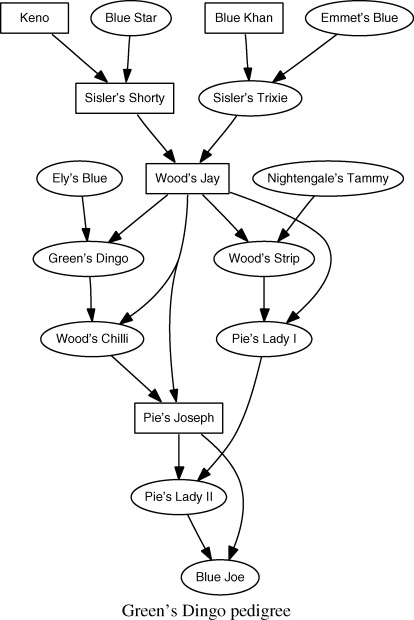
Here’s an example of a horse pedigree. Notice what’s going on?
Look at Pie’s Joseph, for instance. He is the product of a breeding between Wood’s Jay and Wood’s Jay’s granddaughter, Wood’s Chili.
Pie’s Joseph was then bred with his own niece, Pie’s Lady I, and they had a daughter, Pie’s Lady II. Pie’s Joseph was than bred to his own daughter to produce a son, Blue Joe, who is also his grandson.
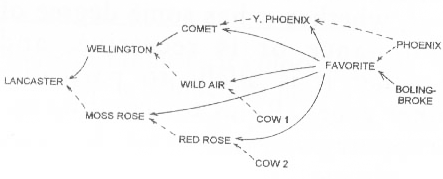
Let’s not even get into cows and pigeons. Here’s a quick glimpse at the sordid sex life of Favorite:
Are you squicked out yet? You shouldn’t be. This stuff is going on on farms all over the world. The biological prohibition isn’t quite as strong as you might think — if you want extremes of a phenotype, as you might in agriculture, trying to achieve selective homozygosity for specific traits might actually give you an advantage.
We tend to not want that kind of result in human crosses…although, if you think about it, an unscrupulous nation could embark on a breeding program for athletic ability that would benefit from a multi-generation pattern of incest…
But this all highlights a common problem: get into a debate with fanatics and ideologues like the iERA mob, and they will actually hold it against you if you actually consider the complexities of reality. We like both complexity and reality; how can you argue with someone who comes in with a bias that what you regard as virtues are sinful, and demands that the universe fit itself to their false simplicities?
Oh, boy. The Intelligent Design creationists are all excited about a new paper that purports to have identified an intelligent signal in the genetic code.
Here’s a new paper that can be added to the growing stack of intelligent-design articles in peer-reviewed journals. Even though the authors do not use the phrase “intelligent design,” their reasoning centers on the detection of an intelligent signal embedded in the genetic code — a mathematical and semantic message that cannot be accounted for by a natural cause, “be it Darwinian, Lamarckian,” chemical affinities or energetics, or any other.
I’ve read the paper by ShCherbak and Makukov, and by golly, the Discovery Institute flack really has accurately summarized the paper: it does explicitly and clearly claim to have identified evidence of design in the genetic code! That’s newsworthy in itself, that the creationists can accurately summarize a scientific paper…as long as the results conform to their ideological expectations.
Unfortunately, what they’ve so honestly described is good old honest garbage.
Here’s the short summary of what they do: they jigger the identities of the amino acids coded for by each codon into a number, a nucleon sum. What is that, you might ask? It’s determined by adding up the number of protons and neutrons in the amino acid, which is simply the mass number of the compound. Further, you can distinguish the amino acid into it’s R group, and the atoms that make up the peptide chain proper, which he calls the B group, for standard block. The mass number of the B group is always 74, except for proline, so he transfers a hydrogen from the R group to the proline B group to bring it up to 74, and by the way, did you notice that 74 is two times 37, which is a prime number? Now if you take all the three-digit decimals with identical digits (111, 222, 333…999), and sum their digits (111=3, 222=6, 333=9, etc.) you get the quotient of the number divided by…37!!!1!!
Are you impressed yet? This is simply numerology, juggling highly derived quantities that have little to do with functional properties of the molecules to come up with arbitrary numerical relationships, and then claiming that they’re somehow significant. They also play games with the sums of the mass numbers of just the R groups for certain codons, adding or subtracting the B number, finagling things until they get numbers that are evenly divisible by their magic prime number of 37, etc. It’s pure nonsense through and through.
But every once in a while, something sensible emerges out of the murk. Here’s the logic of their argument:
To be considered unambiguously as an intelligent signal, any patterns in the code must satisfy the following two criteria: (1) they must be highly significant statistically and (2) not only must they possess intelligent-like features, but they should be inconsistent in principle with any natural process, be it Darwinian or Lamarckian evolution, driven by amino acid biosynthesis, genomic changes, affinities between (anti)codons and amino acids, selection for the increased diversity of proteins, energetics of codon-anticodon interactions, or various pre-translational mechanisms.
(1) is simply saying that there must be a pattern of some sort — if the code were purely random assignment of arbitrary nucleotides to each amino acid, it wouldn’t be much of a sign — it would suggest that the sequence is noise, not signal. (2) is the really hard part, the one where you’d have to do a lot of work: you’d have to show that natural processes did not contribute to the pattern. They do not do that. They can’t do that. They take a different and curious tack.
They literally argue that because organizing the code by their nucleon sums makes no sense and has no reasonable functional consequences…therefore it must be an artificial and intentional feature. I’ve heard this argument before. It’s called the Chewbacca defense. Ladies and gentlemen, think about it: that does not make sense! If nucleon numbers show a mathematical pattern of any kind in their relationship to codons, you must accept the existence of a designer.
However, if we can show a natural property that leads to the organization of the genetic code, then I’m afraid their argument evaporates. Even more so than building an argument on the Chewbacca defense, that is.
There’s a very good discussion of the genetic code in Nick Lane’s book, Life Ascending: The Ten Great Inventions of Evolution, and I’ll briefly summarize it.
First, there is a pattern to the genetic code! No one has ever denied that; it’s obviously not the case that amino acids are randomly assigned to trios of nucleotides. Here’s the code:
Let’s look at one amino acid, glycine (Gly), down in the bottom right corner. The genetic code is degenerate: that means that most amino acids have multiple combinations of nucleotides that can specify them. Glycine’s codes are GGU, GGC, GGA, and GGG. Do you see a pattern? The code is actually GG_, where the third position has a lot of slack or wobble, and any nucleotide will do. We see similar cases where just the first two nucleotides are sufficient to specify leucine, valine, serine, proline, threonine, alanine, and arginine. Even with the other amino acids, there are some constraints; CA_ can identify histidine or glutamine, but if the third letter is a pyrimidine (U or C), you get histidine, while if it’s a purine (A or G), you get glutamine. There are patterns all over the place here! So of course ShCherbak and Makukov could find evidence of significant organization.
But there’s more. There are other rules associated with this pattern.
In the synthesis of these amino acids, biochemistry typically modifies a raw starting material. The first letter of the codon says something about the biosynthesis of the associated amino acid.
If the first letter is:
• C, then the amino acid is derived from alpha-ketoglutarate.
• A, then the amino acid is derived from oxaloacetate.
• T, then the amino acid is derived from pyruvate.
• G, then the amino acid is derived in a single step from simple precursors.
The second letter of the codon is correlated with chemical properties of the amino acid.
If the second letter is:
• A, then the amino acid is hydrophilic.
• T, then the amino acid is hydrophobic.
• G or C, the amino acid has an intermediate hydrophobicity.
Wait…so there’s a pattern to the genetic code, and that pattern is associated with the physical properties of the amino acids? Why, that makes sense. Chewbacca is routed! The most likely origin of the code lies in likely catalytic properties of dinucleotides; pairs of nucleotides in ancient organisms were initially functioning as proto-enzymes before they were incorporated into strings of coding information. At least that provides a historical physico-chemical route to the particular code we now have that does not require weird numerological masturbation.
It’s rather pathetic that the Discovery Institute thinks this is a beautiful piece of science. It’s not. It’s nonsense. But look how the DI spins this story:
How will evolutionists respond to this paper? It’s hard to see how they could dismiss it. Maybe they will try to mock it as old Arabian numerology, or religiously inspired (since Kazakhstan, which funded the study, is 70% Muslim). Those would be unfair criticisms. The authors have Russian names, certified doctorates, and wrote in collaboration with leading lights in the West. Or perhaps critics could argue that the authors hail from a foreign country whose name has too many adjacent consonants in it to take them seriously.
No, it appears the only way out for Darwinists would be the “Dawkins Dodge.” You may remember that one from the documentary Expelled, where Dawkins admits the possibility of panspermia for Earth, so long as the designers themselves evolved by a Darwinian process.
What’s most notable about this paper is the similarity in design reasoning between the authors and the more familiar advocates of intelligent design theory. No appeals to religion or religious texts; no identifying the designer; just logical reasoning from effect to sufficient cause. The authors even applied the “design filter” by considering chance and natural law, including natural selection, before inferring design.
If Darwinists want to go on equating intelligent design with creationism, they will now have to take on the very secular journal Icarus.
I didn’t even consider the religious or ethnic basis of this study; it didn’t come to mind at all. It is clearly simple stupid numerology, though. Look at the rationale given for all of the conclusions, which consist entirely of mathematical manipulations of arbitrary derived properties of the molecules, to arrive at a claim of prime number significance.
We certainly don’t need to invoke panspermia. Nothing in the genetic code requires design. and the authors haven’t demonstrated otherwise.
I am most amused by the cute parallelism of claiming surprise that the authors of this paper use “design reasoning” similar to that used by American Intelligent Design creationists. They’ve been slinging this slop for decades; why be impressed that another set of Intelligent Design creationists in Kazakhstan are using the same tired tropes?
I’m also not impressed with the failure of implementation of their logic. OK, they have a ‘design filter’ that they apply, but so what? Their methods failed to recognize a well-known functional association in the genetic code; they did not rule out the operation of natural law before rushing to falsely infer design.
And that last bit…I don’t care what journal it was published in. The prestige of a journal does not confer infallibility, and even the best of journals will occasionally publish crap. They will be especially likely to publish garbage when they stretch beyond the expertise of their reviewers. Icarus is a journal of planetary science that publishes primarily on astronomy and geology. This particular paper conveniently falls between the cracks — it’s a weird paper full of trivial arithmetical manipulations for arcane purposes with no scientific justification for any of its procedures. I don’t know how it got accepted for publication, other than by boring the reviewers with its incomprehensible digit fiddling.
One last thing: don’t rush to claim a secular purpose behind this work. It’s already been appropriated by freaky strange religious fanatics and lovers of the bible codes. You can’t blame shCherbak directly for this weirdo’s interpretations, but certainly he isn’t far from his temperament.
The facts presented on this site, when combined with those now revealed to us by shCherbak, constitute invincible evidence of the truth of the Judeo-Christian Scriptures, and of the Being and Sovereignty of their Divine Author.
Yeah, numerology. Nothing but wanking over tables.
Larry Moran has more — it turns out that Uncommon Descent and Cornelius Hunter also liked this paper. Flies are drawn to shit, I guess.
What? TED vectoring pseudoscience? Unpossible! In one recent particular instance, though, a TED talk firmly grounded in bullshit — literal and figurative — is gaining a mortifying amount of traction with people who really should know better.
The lecturer is Allan Savory, who for the last couple decades has been pushing his own brand of Maverick Science despite hidebound opposition from “scientists” with their “peer review” and their “evidence” and their “reproducible results.”
Savory’s thesis: every desert in the world is caused by insufficient grazing. We know this because of reasons. All those desertified former grasslands in Africa and the Middle East that have been turned to dusty parking lots by cattle and sheep and goats just didn’t have enough livestock on them to churn up the soil, shit everywhere, and then move on to the next patch of land in a rotational grazing approach.
Savory’s approach can work in theory, on marginal grassland with very close monitoring and if your management goals do not include protecting species that are intolerant of cattle. Can work. Doesn’t necessarily. And that’s irrelevant to actual deserts, yet Savory wants to push his approach onto ancient desert landscapes anyway.
The biggest problem for me, as I point out this morning at KCET, is that Savory doesn’t distinguish between actual deserts — stable, diverse yet fragile habitats — and ruined grasslands. He conflates “desertification” — a term that needs to be abandoned — with actual deserts, then misrepresents the basic science of desert ecology, for instance calling cryptobiotic crusts a “cancer.”
None of this is a surprise to anyone who has followed Savory over the last few decades. Same shit, different day. But TED has helped him go viral, and there are people who are taking him at his word to an embarrassing degree. Even though he says stuff in the talk like “There is no other option” but to follow his program, a phrase that should cause any sane person to back away slowly with her hand firmly protecting her wallet.
But environmentally concerned people, even here in California, show a disturbing willingness to believe any negative shit they hear about the desert. The TED audience laps Savory’s crap up to a disheartening degree.
Anyway, I debunk what I can of Savory’s crap here at KCET. What I can given time and space, that is. It’s only a 13-minute video and one could write a book about the wrongness.
Rosa Rubicondor does an excellent job ripping apart The Argument From Incredulity. You’ve heard it a thousand times, the bug-eyed creationist announcing that he just can’t believe the universe popped into existence from nothing, that malaria resistance evolved without a helping hand from a really smart superguy, that complexity can increase in the absence of intelligent design.
Also, it’s illustrated with a perfect Scenes from a Multiverse cartoon.
For years I’ve been an enthusiastic cheerleader for the atheist movement, and I still am. I think it’s important for humanity to move beyond this childish and destructive crutch of superstition.
But at the same time I find myself constantly dismayed at the difficulty of moving atheism beyond the same old cliques, of making it a human movement rather than a well-off white guys’ movement. And why we can’t find room for good atheists like Melissa McEwan, who left her patriarchal church.
More than a decade later, I found movement atheism online. I was never one to evangelize my lack of god-belief, nor broadcast hatred of religion or its adherents, so that part of the movement was not a draw. But I did fancy the possibility of community around something that has been an axis of marginalization for me in some parts of my life.
I found the same inequality, manifesting in different ways.
There were precious few visible atheist leaders: The most prominent male atheists were very enamored with one another, and not particularly inclined to offer the same support to women, via recommended links and highlighted quotes and inclusion in digital salons about Important Ideas. They wondered aloud where all the female atheists are, and women would pipe up—"Here! Here we are! We’re right here!"—only to then go back to the status quo, with explicit or implicit messaging that women just weren’t working as hard as they are, just aren’t as smart as they are, or else they’d be leaders, too.
There was the exclusion from conferences, the sexist posts, the sexual harassment, the appropriation of religious and irreligious women’s lived experiences to Score Points and the obdurate not listening to those women when they protested.
In fact, female atheists’ protests were greeted much the same way with which my protests had been met in my patriarchal church. Silencing. Demeaning. Threats.
Read the whole thing. But I have to say that the closing paragraph is a real punch in the gut.
I would say I felt exactly as welcome in movement atheism as I did at my Missouri Synod Lutheran Church, but that would be a lie. No one at St. Peter’s ever called me a stupid cunt because I disagreed with them.
We will fail if we can’t change this.
What can I do better?
Haven’t you? Or perhaps you’ve all assumed the answer is obvious.
Sadly, I don’t have any surprises to spring — the answer is actually rather predictable. They’re agin’ it. They do concede that suffrage was OK, and they think it’s acceptable for women to vote — how liberal of them, and it only took them a century to come around — but all that 2nd and 3rd wave feminism destroyed the family!
So what’s the problem here?
Does history hold a bias against women? Members of the radical feminist movement seem to think so. Radical feminism has had incredibly destructive effects on marriage and the family—and its influence has also been felt on the church. Evangelical feminism teaches an egalitarian view of marriage and roles in the church, to the point where passages that clearly teach male headship are reinterpreted, explained away, or ignored altogether. As a result, many men are abdicating or being forced out of their God-given roles as heads of their households and as leaders in the church. The negative effects of this kind of postmodern thinking have led to serious attacks on the authority of God’s Word.
They don’t really address the issues they bring up…anti-feminism is more or less a fait accompli. As you can see hinted above, they deny any real oppression of women — ladies, your role as a helpmeet is valuable and just perfect for you! The real problem is that feminism erodes male authority. And if you weaken male authority, you weaken the authority of scripture, which says that males are the authority and therefore you weaken male authority, which weakens scripture…hey! Extinction vortex! Goodbye, fundamentalists!
I wish.
Now why would feminists want to diminish godly authority? Easy. They hate men.
Most evangelical feminists would profess to believe in the authority and inerrancy of Scripture, setting them apart from many other forms of feminism. However, their method of interpreting and applying Scripture leaves something to be desired. What is at the heart of a reluctance or even outright refusal to refer to God as “he” and “father”? What drives the redefinition and dismissal of passages of Scripture that promote male headship in marriage and leadership in the church? Grudem concludes, “At the foundation of egalitarianism is a dislike and a rejection of anything uniquely masculine.”
When it comes right down to it, creationist and atheist MRAs are all kind of similarly stupefied and bovine when it comes to recognizing the legitimacy of women’s right to autonomy. Why aren’t they helping me stand at the head of the church, the godly men are wondering, and why aren’t they making me a sammich, the godless ones marvel. Women are so good at performing those subservient tasks, why don’t they appreciate the opportunities to do more and more and more?
Nature made them that way. Or god did. Follow your natural/divine purpose, as revealed to me.
In the bowels of an ugly review of AC Grayling’s latest book, Jonathan Rée makes a familiar accusation against ‘militant’ atheism (just the use of his modifier is a grand tell, isn’t it?). It’s that atheists are fundamentalists who see all of religion as fundamentalist, in a classic act of projection.
Militant atheism makes the strangest bedfellows. Grayling sees himself as a champion of the Enlightenment, but in the old battle over the interpretation of religious texts he is on the side of conservative literalist fundamentalists rather than progressive critical liberals. He believes that the scriptures must be taken at their word, rather than being allowed to flourish as many-layered parables, teeming with quarrels, follies, jokes, reversals and paradoxes. Resistance is, of course, futile. If you suggest that his vaunted “clarifications” annihilate the poetry of religious experience or the nuance of theological reflection, he will mark you down for obstructive irrationalism. He is, after all, a professional philosopher, and his training tells him that what cannot be translated into plain words is nothing but sophistry and illusion.
Aside from being a thoroughly tin-eared statement of Grayling’s position — the man loves the metaphors and poetry himself — it’s completely wrong about us atheists in general. We certainly do see the differences between the varied approaches to religion, and we certainly do not confuse them or misapply criticisms valid against one branch to a branch to which they are irrelevant. I think he’s gotten confused because of all the varieties of religious thought, we despise them all…but I assure you, we despise each one uniquely for its own treasured inanities.
Part of the problem, of course, is of the believers’ own making. We use this word ‘religion’ to apply to so many different kinds of beliefs, and they love it that way: it makes the confusion universal, and creates a great blinking billowing smoke screen of noise and lights and chaos under which nonsense can thrive.
But let me take a moment to cut through the ambiguities in one way and propose one simple distinction that might help resolve these uncertainties about what atheists are criticizing. I propose that there are two very broad categories of popular theologies. I am not claiming that these categories are complete or perfect or absolute, just that you can go a long way towards recognizing the kinds of arguments your opponent is making if you identify which way they are thinking, and that you can at least make it clear to the other that you aren’t trying to accuse a Baptist of being an Anglican, or vice versa.
My two categories are crunchy theology and squishy theology.
Crunchy theology is rigid, absolute, inflexible, and clear cut. Crunchy theology proponents like to tell you exactly how the universe works: you will go to hell for abortion, masturbation, gay sex, and believing in evolution. They have a definitive dogma that changes every few decades, but even so, when they adopt a set of propositions, they will tell you that it has always been this way since the first century AD. A crunchy religious person votes Republican because that’s what Jesus would do.
Famous crunchy religious people: most of them, but they include people like Albert Mohler, Ken Ham, Shmuley Boteach, Ayatollah Hassan Sanei. I say “most” of the famous ones, because crunchy theologians are the ones who shout out their theology the loudest, and are the quickest to define themselves by their faith.
We atheists despise them because they are wrong. They will happily assert the most errant nonsense in defiance of all reason and evidence simply because it must be true, or the whole house of cards that constitutes their dogma will fall apart. The book of Genesis must be literally true, because if there were no Adam and Eve and no fall, then Jesus’ sacrifice would be meaningless.
Squishy theology is evasive, ambiguous (and reveling in it!), and well-meaning but dishonest. They are confident that people are good and that the universe is loving and beautiful, and that religion’s role is to provide a framework for gentle moral guidance and an appreciation of God’s creation. Squishy priests are like the docents at an art museum; they want you to really, really love everything, and for the right reasons. They’re offended if you don’t love God and Jesus because…because…because you’re supposed to, and Jesus loves you, so how can you be so mean and deny him? But you can love him in your own way, of course.
Famous squishy religious people are Karen Armstrong, Norman Vincent Peale, the Dalai Lama (sometimes, at least publicly), the religion columnists at the Huffington Post. Also, probably, most of the ordinary believers you know.
We New Atheists detest them because they’re dishonest pollyannas. They’ll skirt around conflicts between their beliefs and reality, preferring to divert the argument into a pursuit of red herrings (for example, accusing atheists of treating Karen Armstrong as synonymous with Terry Jones, rather than facing the vacuity of Armstrong’s beliefs). Look, most of the Western ones are Christian — they’re asking us to believe in the divinity of an ancient Jewish carpenter. But can they come right out and admit that? No. We point out that what they’re asking us to accept as reasonable doctrine is fundamentally absurd and silly, and they defend themselves by accusing us of denying poetry and metaphor and art (see: Rée, Jonathan). They love to call themselves “spiritual” (an undefinable, meaningless term) and claim atheists are missing out on feelings of awe and belonging.
Squishy theology even has some appeal to some atheists, like Jonathan Rée, who hold vaguely charitable feelings towards the ol’ church, because their wonderfully dodgy approach to the truth allows such atheists to avoid confronting any incompatibility between belief and actuality. It’s a fine refuge for people who don’t want to think too hard about what faith actually says.
So really, Jonathan Rée, I know the difference. I think you’re a foolish apologist for bogosity because you’re a coward who hides behind magical metaphors (to which I always ask, “metaphor for what?”), not because you believe Abraham had a strong position on the age of the universe. I will happily tailor my arguments against religion to be appropriate to your goofy beliefs in the beneficence of lies.
For instance, your blatant denial of valid knowledge…
The distinction between believers and unbelievers may be far less important than Grayling and the New Atheists like to think. At any rate it cuts right across the rather interesting difference between the grim absolutists, such as Grayling and the religious fundamentalists,
Wait, wait…I have to stop him there. Has Rée even read Grayling’s books, or met the fellow? Grayling is a soft-spoken, friendly gentleman who is happy to discuss nuance — he’s a freakin’ philosopher. “Grim absolutist” is about the most absolutely wrong-headed description of Grayling I’ve ever read.
OK, carry on.
who think that knowledge must involve perfect communion with literal truth, and the sceptical ironists – both believers and unbelievers – who observe with a shrug that we are all liable to get things wrong, and the human intellect has a lot to be modest about. We live our lives in the midst of ambiguities we will never resolve. When we die our heads will still be filled with a few stupid certitudes mixed in with some more or less good ideas, and we are never going to know which are which. There is no certainty, we might say: so stop worrying about it.
That we lack absolute certainty — a position that those scientific-minded New Atheists happily endorse — does not imply an absence of probablies. We can examine the evidence of reality and see that no, the universe almost certainly doesn’t love us; no, there is almost certainly no life after death; no, your favorite Jewish laborer or Arab merchant almost certainly wasn’t a prophet with divine favor, because there is no reasonable evidence for any of those claims. And further, the people who argue otherwise do not have any special access to evidence, no particular authority on supernatural matters, and are completely unable to provide replicable, confirmable support for their claims.
So I would agree that both atheists and theists (squishy and crunchy!) will die believing in things that are wrong. But that does not mean that we can’t discern in this life what things are almost certainly false.