The argument from eyelid development

This is a new one for me. Earlier today I was summoned on Twitter to address an assertion by a creationist, @jarrydtrokis. I was slightly boggled.

He was baffled by eyelid development. It seems he thinks it requires…intelligent design!.

… Here’s one for you to ponder :) Eye lids in the womb… How are they formed? #IntelligentDesign?

Wait, what? What’s mystifying about eyelid formation?

The section of skin in the middle dies… How does it know to do that? And in a perfectly straight line???

Oh. It forms a straight line. Whoa. And he claims to have done research to get the answer.

The research I’ve done shows the scientists are at a loss for an explanation….

Gosh. I can do research, too. It’s easy to explain, with pictures even.

The eyelids separate in a straight seam because of how they got that way. The eyelids form by expansion of two epithelial sheets from above and below that meet in the middle. When you see how the eyelids develop, it’s easy to see how they separate in a straight line later. This is a series of images over the course of about a day in mouse development. In the first, you can see the eye sans eyelid, but ringed by epithelia. In the second, you can see that epithelium growing, expanding in a sheet over the eye. In the third, the sheet is beginning to close in a line over the middle, and in the fourth it has completely closed, but leaving a seam or scar in a straight line across it.

mouse_eyelid_sem

Wait, you say inquisitively, I’d like a closer look at that seam. Can you show me what is going on postnatally, as the eyelids separate? Sure can.

mouse_eyelid_tem

The first panel is 5 days postnatal in the mouse; the eyelids are still fused. But you can see a difference in the histology of the junctional region (J), and a depression at the arrowhead (you can also see the layers of keratin there). There’s something different in this area.

In the second panel, 10 days postnatally, the depression at the junctional region is deepening and you can see a stratum granulosum (SG) at the seam, while you can also see hair follicles (HF) forming in the adjacent portions of the lid.

The third and fourth panels are at 12 days, and now the keratin layers have extended into the depression from both the inside and outside, completing the separation of the two lids.

Now @jarrydtrokis might be tempted to say that Jesus did the separating, but that’s only true if Jesus is a polypeptide called epidermal growth factor, or EGF. EGF is a molecule that triggers growth and differentiation of keratinocytes, and it turns out that if you treat baby mice with EGF it accelerates the rate of eyelid separation.

I’m sorry, @jarrydtrokis, but your argument from ignorance wasn’t very persuasive, and your talents at ‘research’ are rather pathetic, since the paper describing all that was trivial to find. But then, isn’t this always the case with creationists? There are none so blind as those who will not see.


Findlater GS, McDougall RD, Kaufman MH (1993) Eyelid development, fusion and subsequent reopening in the mouse. J Anat. 183(1):121-9.

Frans de Waal disappoints me

It’s just sad. He has a long article in Salon making the same tired complaints every religious dingbat throws around.

Militant atheism has become a religion

Prominent non-believers have become as dogmatic as those they deride — and become rich on the lecture circuit

I know, the title and subtitle were probably written by an editor, but they do actually reflect the content. It’s really nothing but de Waal complaining that atheists are just as dogmatic as religious fundamentalists, and throwing about half-baked theories about why this is so.

Why are the “neo-atheists” of today so obsessed with God’s nonexistence that they go on media rampages, wear T-shirts proclaiming their absence of belief, or call for a militant atheism?

What exactly is a “media rampage”? He doesn’t give any examples, nor can I think of any. Is putting up a billboard a “rampage” now? Perhaps appearing on a talk show and disagreeing with the more numerous and more vocal theists is now rampaging. And what about T-shirts is so shocking? I have T-shirts proclaiming m
affection for squid, Pink Floyd, hot sauce, and various universities. Are they religions now, too?

What does atheism have to offer that’s worth fighting for?

When high-ranking politicians declare that global climate change because the Bible says it can’t happen; when lobbyists are constantly attacking the educational system to eradicate any mention of that faith-defying evolution stuff; when screaming true believers insist that every fertilized egg has a soul and therefore women’s reproductive choices must be blocked…de Waal has to ask?

And then there’s his inane hypothesis.

It [reducing the difference between vocal athiests and quiet ones is an issue of privacy] may one day help to test my thesis that activist atheism reflects trauma. The stricter one’s religious background, the greater the need to go against it and to replace old securities with new ones.

Uh, Dawkins and Hitchens: brought up Anglican. Weak tea right there. Harris: brought up in a secular home with a Jewish mother and Quaker father. I don’t know Dennett’s religious background; there’s no hint of a strict faith upbringing, though. I know I’m not one of the luminaries de Waal is thinking of, but I come from a very liberal Lutheran background…tea not much stronger than good ol’ etiolated Anglicanism.

de Waal: brought up Catholic.

Well, gosh, it sure didn’t take much effort to blow up that dumbass idea.

I will say one thing, though: he doesn’t actual make the claim that atheists are getting rich on the lecture circuit. Maybe the editor who slapped that on there should get fact-checked?

As one of those nasty atheists who does a fair bit of lecture touring, I have to mention that I must be doing it all wrong — all rumors to the contrary, I don’t really make any money doing it, and individual places that give me a bit of an honorarium are actually just subsidizing those places where my expenses put me at a small loss. Some of the big names do better because lecture tours are opportunities to leverage book sales, and having a popular book is a way to justify larger lecture fees…but no, claiming that one gets rich on the lecture circuit is really putting the cart before the horse.

And even those who do well on lecture fees aren’t really getting rich. Frans de Waal should know this, as a popular scientist and author: is he making a fortune on his reputation? Is he doing even a tenth as well as, say, an investment banker? I suspect lecture fees are a comfortable bonus, but not a recipe for great wealth. And shall we accuse him of getting rich off of his apes?

We need a sociologist of science…or a philosopher

There’s another paper out debunking the ENCODE consortium’s absurd interpretation of their data. ENCODE, you may recall, published a rather controversial paper in which they claimed to have found that 80% of the human genome was ‘functional’ — for an extraordinarily loose definition of function — and further revealed that several of the project leaders were working with the peculiar assumption that 100% must be functional. It was a godawful mess, and compromised the value of a huge investment in big science.

Now W. Ford Doolittle has joined the ranks of many scientists who immediately leapt into the argument. He has published “Is junk DNA bunk? A critique of ENCODE” in PNAS.

Do data from the Encyclopedia Of DNA Elements (ENCODE) project render the notion of junk DNA obsolete? Here, I review older arguments for junk grounded in the C-value paradox and propose a thought experiment to challenge ENCODE’s ontology. Specifically, what would we expect for the number of functional elements (as ENCODE defines them) in genomes much larger than our own genome? If the number were to stay more or less constant, it would seem sensible to consider the rest of the DNA of larger genomes to be junk or, at least, assign it a different sort of role (structural rather than informational). If, however, the number of functional elements were to rise significantly with C-value then, (i) organisms with genomes larger than our genome are more complex phenotypically than we are, (ii) ENCODE’s definition of functional element identifies many sites that would not be considered functional or phenotype-determining by standard uses in biology, or (iii) the same phenotypic functions are often determined in a more diffuse fashion in larger-genomed organisms. Good cases can be made for propositions ii and iii. A larger theoretical framework, embracing informational and structural roles for DNA, neutral as well as adaptive causes of complexity, and selection as a multilevel phenomenon, is needed.

In the paper, he makes an argument similar to one T. Ryan Gregory has made many times before. There are organisms that have much larger genomes than humans; lungfish, for example, have 130 billion base pairs, compared to the 3 billion humans have. If the ENCODE consortium had studied lungfish instead, would they still be arguing that the organism had function for 104 billion bases (80% of 130 billion)? Or would they be suggesting that yes, lungfish were full of junk DNA?

If they claim that lungfish that lungfish have 44 times as much functional sequence as we do, well, what is it doing? Does that imply that lungfish are far more phenotypically complex than we are? And if they grant that junk DNA exists in great abundance in some species, just not in ours, does that imply that we’re somehow sitting in the perfect sweet spot of genetic optimality? If that’s the case, what about species like fugu, that have genomes one eighth the size of ours?

It’s really a devastating argument, but then, all of the arguments against ENCODE’s interpretations have been solid and knock the whole thing out of the park. It’s been solidly demonstrated that the conclusions of the ENCODE program were shit.

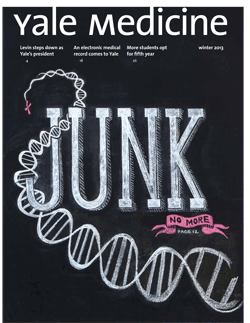
yalejunk

So why, Yale, why? The Winter edition of the Yale Medicine magazine features as a cover article Junk No More, an awful piece of PR fluff that announces in the first line “R.I.P., junk DNA” and goes on to tout the same nonsense that every paper published since the ENCODE announcement has refuted.

The consortium found biological activity in 80 percent of the genome and identified about 4 million sites that play a role in regulating genes. Some noncoding sections, as had long been known, regulate genes. Some noncoding regions bind regulatory proteins, while others code for strands of RNA that regulate gene expression. Yale scientists, who played a key role in this project, also found “fossils,” genes that date to our nonhuman ancestors and may still have a function. Mark B. Gerstein, Ph.D., the Albert L. Williams Professor of Biomedical Informatics and professor of molecular biophysics and biochemistry, and computer science, led a team that unraveled the network of connections between coding and noncoding sections of the genome.

Arguably the project’s greatest achievement is the repository of new information that will give scientists a stronger grasp of human biology and disease, and pave the way for novel medical treatments. Once verified for accuracy, the data sets generated by the project are posted on the Internet, available to anyone. Even before the project’s September announcement, more than 150 scientists not connected to ENCODE had used its data in their research.

“We’ve come a long way,” said Ewan Birney, Ph.D., of the European Bioinformatics Institute (EBI) in the United Kingdom, lead analysis coordinator for ENCODE. “By carefully piecing together a simply staggering variety of data, we’ve shown that the human genome is simply alive with switches, turning our genes on and off and controlling when and where proteins are produced. ENCODE has taken our knowledge of the genome to the next level, and all of that knowledge is being shared openly.”

Oh, Christ. Not only is it claiming that the 80% figure is for biological activity (it isn’t), but it trots out the usual university press relations crap about how the study is all about medicine. It wasn’t and isn’t. It’s just that dumbasses can only think of one way to explain biological research to the public, and that is to suggest that it will cure cancer.

As for Birney’s remarks, they are offensively ignorant. No, the ENCODE research did not show that the human genome is actively regulated. We’ve known that for fifty years.

That’s not the only ahistorical part of the article. They also claim that the idea of junk DNA has been discredited for years.

Some early press coverage credited ENCODE with discovering that so-called junk DNA has a function, but that was old news. The term had been floating around since the 1990s and suggested that the bulk of noncoding DNA serves no purpose; however, articles in scholarly journals had reported for decades that DNA in these “junk” regions does play a regulatory role. In a 2007 issue of Genome Research, Gerstein had suggested that the ENCODE project might prompt a new definition of what a gene is, based on “the discrepancy between our previous protein-centric view of the gene and one that is revealed by the extensive transcriptional activity of the genome.” Researchers had known for some time that the noncoding regions are alive with activity. ENCODE demonstrated just how much action there is and defined what is happening in 80 percent of the genome. That is not to say that 80 percent was found to have a regulatory function, only that some biochemical activity is going on. The space between genes was also found to contain sites where DNA transcription into RNA begins and areas that encode RNA transcripts that might have regulatory roles even though they are not translated into proteins.

I swear, I’m reading this article and finding it indistinguishable from the kind of bad science I’d see from ICR or Answers in Genesis.

I have to mention one other revelation from the article. There has been a tendency to throw a lot of the blame for the inane 80% number on Ewan Birney alone…he threw in that interpretation in the lead paper, but it wasn’t endorsed by every participant in the project. But look at this:

The day in September that the news embargo on the ENCODE project’s findings was lifted, Gerstein saw an article about the project in The New York Times on his smartphone. There was a problem. A graphic hadn’t been reproduced accurately. “I was just so panicked,” he recalled. “I was literally walking around Sterling Hall of Medicine between meetings talking with The Times on the phone.” He finally reached a graphics editor who fixed it.

So Gerstein was so concerned about accuracy that he panicked over an article in the popular press, but had no problem with the big claim in the Birney paper, the one that would utterly undermine confidence in the whole body of work, did not perturb him? And now months later, he’s collaborating with the Yale PR department on a puff piece that blithely sails past all the objections people have raised? Remarkable.

This is what boggles my mind, and why I hope some sociologist of science is studying this whole process right now. It’s a revealing peek at the politics and culture of science. We have a body of very well funded, high ranking scientists working at prestigious institutions who are actively and obviously fitting the data to a set of unworkable theoretical presuppositions, and completely ignoring the rebuttals that are appearing at a rapid clip. The idea that the entirety of the genome is both functional and adaptive is untenable and unsupportable; we instead have hundreds of scientists who have been bamboozled into treating noise as evidence of function. It’s looking like N rays or polywater on a large and extremely richly budgeted level. And it’s going on right now.

If we can’t have a sociologist making an academic study of it all, can we at least have a science journalist writing a book about it? This stuff is fascinating.

I have my own explanation for what is going on. What I think we’re seeing is an emerging clash between scientists and technicians. I’ve seen a lot of biomedical grad students going through training in pushing buttons and running gels and sucking numerical data out of machines, and we’ve got the tools to generate so much data right now that we need people who can manage that. But it’s not science. It’s technology. There’s a difference.

A scientist has to be able to think about the data they’re generating, put it into a larger context, and ask the kinds of questions that probe deeper than a superficial analysis can deliver. A scientist has to be more broadly trained than the person who runs the gadgetry.

This might get me burned at the stake worse than sneering at ENCODE, but a good scientist has to be…a philosopher. They may not have formal training in philosophy, but the good ones have to be at least roughly intuitive natural philosophers (ooh, I’ve heard that phrase somewhere before). If I were designing a biology curriculum today, I’d want to make at least some basic introduction to the philosophy of science an essential and early part of the training.

I know, I’m going against the grain — there have been a lot of big name scientists who openly dismiss philosophy. Richard Feynman, for instance, said “Philosophy of science is about as useful to scientists as ornithology is to birds.” But Feynman was wrong, and ironically so. Reading Feynman is actually like reading philosophy — a strange kind of philosophy that squirms and wiggles trying to avoid the hated label, but it’s still philosophy.

I think the conflict arises because, like everything, 90% of philosophy is garbage, and scientists don’t want to be associated with a lot of the masturbatory nonsense some philosophers pump out. But let’s not lose sight of the fact that some science, like ENCODE, is nonsense, too — and the quantity of garbage is only going to rise if we don’t pay attention to understanding as much as we do accumulating data. We need the input of philosophy.

War on Easter?

I’ve been slacking. I haven’t been fighting the War on Easter with the fervor I should. Bill O’Reilly has identified our open hostility to Easter already.

Gosh, I didn’t realize that our assault on Easter was a linchpin of our plan to get abortion on demand and free drugs, or I would have engaged in the battle earlier.

I was also amused by O’Reilly’s statement that “Easter is a good holiday, you don’t have to believe in Jesus…” Does he realize that that is a wonderfully secular statement?

Hooray! We’ve already won! Check your mailboxes for your free packages of cocaine and marijuana!

(via Kick!)

It’s nice to see someone willing to live by their own advice

All the scientists and naturalists out there crying foul on behalf of the desert need to hang their intellects up for a moment and spend some time in their hearts for a while.

I get the best rebuttal yet to my piece taking down Allan Savory’s “green the deserts by filling them with cows” pseudoscience.

(And remember, when you hang your intellects up for a moment, to heed Joan Crawford’s timeless counsel.)

The Creationist State of the Nation

See? I told you that in addition to being a creationist, Ken Ham is also one of those far right culture warriors.

During the conference, I spoke on the state of the nation and said that we are observing Romans chapter 1 playing out in the USA right now. I have heard many people say that if America keeps murdering children in their mother’s wombs (over 50 million babies since the Roe v. Wade Supreme Court decision in 1973) and eliminating God from the culture (as by and large has been done in public schools and in the culture as a whole with the removal of crosses, nativity scenes and Ten Commandment displays from public places), then God will judge this nation. Well, I suggest that America is already under judgment, and a sign of this judgment is the increasing homosexual behavior (and the “gay” marriage issue) in the nation, reflecting that God is turning the culture over (as Romans 1:24 and Romans 1:26 describe).

I also declared at last week’s conference that the state of the nation actually reflects the state of the church. Frankly, I believe it is largely the church’s fault that the culture, from a Christian perspective, is collapsing and is coming under judgment. For example, there is so much rampant compromise in the church with its increasing acceptance of millions of years and evolution. This has led to generations of children in our church doubting and subsequently disbelieving the Bible. Today, two-thirds of them are walking away from the church by the time they reach college age. It only takes one generation to lose a culture, and we are seeing this happen before our very eyes.

The church is not influencing the culture in America as it once did. That is mostly due to the fact that the culture has invaded much of the church. Much of the church’s “salt” has become contaminated. And we know what God’s Word says about such contamination: it destroys.

But it’s not just happening in America! Our Western nations—once dominated by Christian thinking—are embracing sinful acts, such as abortion and homosexual behavior, and is now calling these evils “good.”

If you want to know where America will be in the not-too-distant future, look at the United Kingdom and the rest of Europe. The churches there are largely spiritually dead (though I rejoice in the small pockets of Christian life there). All across Europe, countless church buildings have been turned into stores, nightclubs, temples, etc. Sadly, America is on the same path.

Happily, America is on the same path. But right now he and Pastor Phelps and every tinpot preacher with a load of hate to deliver sound a lot alike, don’t they?

You can understand why they cling to something as gallingly stupid as young earth creationism: they see it as all of a piece, that the eternal salvation of their children and grandchildren is dependent on not just accepting the liberal Christian view that belief in the divinity of an ancient Jewish carpenter is necessary to appease an omnipotent and rather wrathful cosmic father. Think about it: that’s a rather petty and trivial thing to hang such an essential gift upon, so there must be more. And the more that they’ve accepted is the costly sacrifice of giving up science, hating gay people, forcing their women into domestic servitude, and demanding non-stop official public piety.

Of course, I can’t help but notice that most of the people forced to make the sacrifices are not the family patriarchs.

But this is also why it is not enough to just educate people about evolution. For most people, science is just this hard, boring thing that they take for granted that someone else will do; they aren’t going to be at all impressed with accusations that they’ve abandoned science or even common human decency. They are serving an almighty LORD. They believe they have the biggest, baddest, strongest, most demanding boss of them all.

The teaching of evolution in the schools is just one tiny symptom of the real problem, and that’s why I argue that to defeat this one aspect that annoys me personally and directly, we need to confront and diminish the nasty head of the beast: religion. Tear it down, and then we’ll be able to pursue real knowledge unfettered.

And as a wonderful glorious additional bonus, we also get greater equality and a reduction of prejudice. I have no illusions that eliminating religion will lead to paradise, though — more like, eliminating religion will knock down one more major barrier to progress.

Apparently, I need to clarify myself

Melissa McEwan has written two more posts on misogyny in atheism. They’re both good and highly recommended, but I have to clarify something.

McEwan takes exception to something I wrote.

And then there were the atheist men, in most cases ostensibly sympathetic to my position, who piped up to let me know that I wasn’t talking about them, that they were one of the Good Ones. Even Myers linked to my list with the curious line: “Melissa McEwan has some Advice to Atheist Men. The long list sounds very good, but I do have one reservation: none of it is exclusive to atheists or men. I think it’s more Advice for Decent Human Beings.”

I’m not sure why my “long list” (of 18 suggestions) would engender reservations simply because it is not “exclusive to atheists or men,” unless one is keen to deflect accountability for being part of the group being urged to decency.

And one commenter interpreted that to a remarkably vicious degree.

Where the HELL does Meyers get off asking for advice and then saying “oh, well that doesn’t apply to me.” Uh yeah. It does.

So let me clarify. I was not saying I disagreed with the list in any way. I was not saying that McEwan was not talking about us ‘good atheists’. I was not trying to deflect accountability away from atheists. Most importantly, I was not saying it doesn’t apply to me — a bizarre charge, since I most certainly aspire to belong to the category of decent human beings, and I would hope that being decent human beings would be one of the goals of all atheists.

It was a reservation that wasn’t really a reservation — it was an appreciation of the universality of the suggestions, and a comment that the title of McEwan’s post was not adequate to describe the usefulness of the content.

I would definitely hope that more atheists would pay attention to her work.

Why I am a happy atheist

One reason is that we’re winning. Christian web sites are full of articles complaining about how young people are leaving the church; Ken Ham even wrote a whole book about it. Here’s an example of the genre from someone called Marc5Solas.

The statistics are jaw-droppingly horrific: 70% of youth stop attending church when they graduate from High School. Nearly a decade later, about half return to church.

Half.

Let that sink in.

There’s no easy way to say this: The American Evangelical church has lost, is losing, and will almost certainly continue to lose OUR YOUTH.

I let it sink in, and for some reason I just can’t stop grinning — a nice wicked devilish grin. Yes, yes, yes, the church is increasingly archaic, and it even helps when people make lists of everything that is wrong with the church, because they aren’t seeing beyond the problems. It’s lovely. Just keep hemmoraging, godly institutions, I’m happy to stand back and watch you bleed out…although I wish you’d stop thrashing about, you’re doing some damage in your death throes.

10. The Church is “Relevant”:

He’s actually complaining that the church tries hard to adapt to modern culture — it’s a typical conservative view that the old ways were better. It ignores the fact that religion always changes: the 19th century Catholic and Baptist religions were different than the 20th. But that wouldn’t fit with their pretense of holding eternal truths.

But hey, churchies, please do insist on locking yourselves into antique dogmas. I’m all for it!

9. They never attended church to begin with:

This one is related to #10. All them newfangled singalongs and pizza parties and hep cat stuff are distracting — make the kids sit and listen to a sermon for two hours, that’ll root ’em in the church.

8. They get smart:

My favorite! It’s those atheists who treat kids as intelligent questioning people that suck them in. Yay us! I mean, damn us. How dare we.

7. You sent them out unarmed:

To counter those atheists, the church has to get back to theological basics. Yeah, right. One problem there: that’s exactly what drove me away from the church, was learning what kind of bullshit I was expected to believe.

6. You gave them hand-me-downs

We’re back to the old-time religion whine. Kids are told to express their feelings, but those are lousy evangelical tools. Teach them the traditional stuff.

Please. Please do.

5. Community

Another complaint about the fuzzy wuzzy touchy feely modern church. Jeez, this guy really hates anything that deviates from his specific version of the faith.

4. They found better feelings:

More complaints about subjective faith over the virtues of dogma. I think he’s really padding his list of 10…so far it’s really about 2.

3. They got tired of pretending:

Christ, I’m so bored. It’s more of the same.

2. They know the truth:

More. Of. The. Same. Jebus. Now he’s complaining that kids taught this “god is love” stuff don’t have a proper appreciation of the fact that ‘god is law.’

1. They don’t need it:

Has he ever considered that maybe kids leave the church because the yahoos running it are boring as fuck? Yet again he’s complaining that an alternative liberal church let’s people find their way out of the rigid trap he thinks they ought to build.

Now you see why we atheists should be happy. Not only are young people abandoning that stupid mess of nonsense called church, but the priests are crankily sawing off the branch they’re standing on. May the whole rotten mess collapse soon.