Stasia Bliss: Disgraceful phony, fraud, and quack

Stasia Bliss is the Senior Editor of Health and Science at The Guardian Express on-line Newspaper. Keep that in mind. Senior Editor of Health and Science.

We encountered Ms Bliss yesterday, when I was criticizing that ghastly Newagey article on cystic fibrosis that she authored, and which the Guardian Express later withdrew. She babbled some nonsense about genes from host tissue somehow migrating into lung transplants, and then went on about how cystic fibrosis, a genetic disease, is somehow caused by bad emotions. It was total garbage, through and through.

Remember, she is the Health editor for this online newspaper, and her head is full of pseudoscientific quackery.

She’s also supposedly the science editor. She’s full of shit there, too. You must read her piece on DNA and evolution. She knows nothing about biology — she’s reduced to spewing nonsensical crap right from the beginning.

Inside each and everyone of our cells is an amazing blueprint containing all of the information to create you again. Scientists have identified 2 strands of these amazing building block storage containers of life and call them DNA or Deoxyribonucleic acid, the molecules containing all the genetic information and instructions for your being. So, what about these other strands which scientists have not identified as useful…the one’s commonly called ‘junk’ DNA and now refer to softly as noncoding DNA? Did you know that somewhere around 98% of all human DNA fits into the category of noncoding DNA? Only 2% accounts for the genetic functions and life-building codes we are familiar with. We do know that some of that 98% has functions such as translation regulation of protein-coding sequences, but what is the rest for? Is it possible our DNA contains within it codes for our evolution as a species? Is it possible that by activating our noncoding DNA we would start to experience reality very differently?

Your first clue that she doesn’t have the slightest grasp on the concepts is when she tries to tell you that there are 2 strands called DNA that contain all the genetic information, and there’s…these…other strands? That are junk DNA? WTF?

I want to give her a test. A very simple test that I’m confident that she would fail miserably.

Draw the 2 strands of DNA. Just a rough sketch, no deep details needed, I’ll even grade generously. Show me that she knows what the hell she’s talking about when she says “strands”. And then I’ll ask her to point on the sketch to where the junk DNA lies.

This isn’t hard, and I’m not expecting a lot. For example, James Watson was asked to give a simple drawing of what he thought was an important formula or principle, and here’s what he came up with.
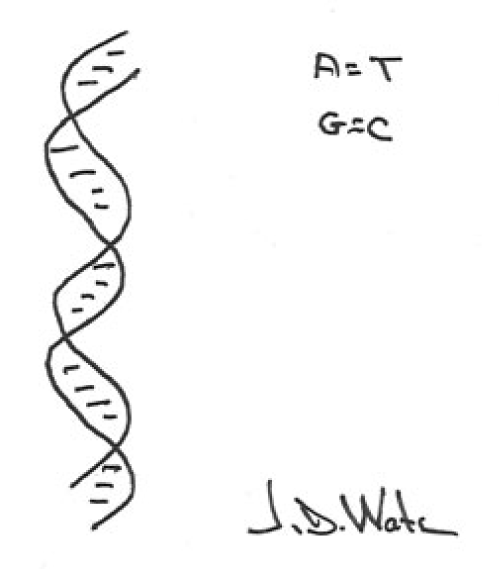
watsonDNA

See? Easy! I don’t think Stasia Bliss could do it. Especially when you consider the next paragraph of her essay.

Many mystics, philosophers and spiritual teachers agree that the key to our evolution as a species lies within our DNA. If all strands of DNA were active, we would have 12 strands. According to some, each strand correlates with a different dimension of consciousness, or a different perspective by which we can experience this reality. Those who study and practice DNA activation techniques say the 2 basic DNA strands keep us at a very dense, physical structure and perspective of reality, but as we activate more DNA, our bodies change to become less dense and more ‘full of light.’ This state can be recognized in beings known in spiritual and religious traditions as ‘ascended masters’ with glowing halos and radiant skin. As evolution in consciousness occurs, and DNA ‘turns on’ it is speculated that this would mean a transformation from a carbon-based matter body, to a silica-based, and finally a crystalline liquid-light pre-matter state body, where the body would glow with light. According to sources, most of us have approximately 3-3.5 strands activated, allowing for the experience of only three dimensions of reality.

Hey, did you just feel something sticky and damp? Sorry. That was my brains, blood, bile, and colon contents exploding forcefully and spewing debris through my screen, up the ethernet line, out in a misty cloud of pulverized organic matter contaminating the interwebs, settling into your ports and dribbling out onto your keyboard. Sorry.

First order of business, Stasia: FUCK mystics, philosophers and spiritual teachers. You’re supposed to be a goddamn science editor, and these are your vaguely cited sources? Some mystic somewhere, who you can’t even name?

For that sin alone, Bliss ought to be fired. She is grossly unqualified for a position with that title.

At the end: “According to sources”. WTF again? According to who? She is unqualified to have a position in journalism, period. Fire her.

Next test: Draw a picture of 12 strand DNA. I double dog dare you. Be prepared: a squiggle like Watson’s above is only a preliminary answer, and if you manage to make up something coherent at that level, I will also drill down further and ask about the interactions of the nucleotides in your model.

I’ve encountered this “12 strand DNA” bullshit before: it’s a money-making scam from a quack who promises to show you how to activate your psychic powers if you buy his videos. It’s a fucking fraud. And here’s Stasia Bliss parroting it as if it’s reasonable science.

If this is symptomatic of the Guardian Express’s attitude towards science, that they’d hire this wretched incompetent buffoon to be their science editor, I hope their bankruptcy is imminent. It’s disgraceful.

An atheist goes to church: Federated Church of Morris

Today I attended the Federated Church of Morris. I’ve actually been here many times before in a different capacity — it’s where my district goes to vote (but that’s a different bag of worms to complain about). It also has a reputation as the most liberal church in Morris, so this is where a lot of the believing faculty go, and I suspect most of the registered Democrats in town.

So I was not at all surprised at all of the effete decadence I saw going down in there.

First, the service starts at the odd hour of 9:30 — they just have to be out of phase with the rest of the town. One of the notable things I saw at the other churches was their remarkable punctiliousness, with every service starting precisely on the hour, and ending exactly one hour later. Not the Federated Church; they were a little more casual with their time, starting 5 minutes late, and the service went on for an hour and a quarter. I know, you’re already shocked, but the worst is yet to come.

Unlike the other churches, we were asked to stand once at the beginning (and then, only “if you are able”) and once at the end. I could spend the whole dang hour and a quarter with my butt firmly pressed against my seat (And, of course, the pews were padded, but then that seems to be par for the course here in degenerate Morris). My knees did not get a workout in this place at all.

The pastor is a woman, and the opening hymn even included a line about “Mother God”. The church isn’t even organized traditionally. There was a central altar, and the pews were arranged in the round around it. Or, should I say, since there were 5 banks of pews, they were arranged rather pentagonally…or perhaps [duh-duh-DUUUUHH!!] pentagrammatically.

So, anyway, so far it seems to be my kind of place. Thumbs up on ambience and clientele and hosts. What about the content?

And that, alas, was all too typical. Hymns, prayers, and invocations of some dude named Jesus all over the place; readings from some stodgy old book; a list of prayer recipients we were supposed to remember. Somebody has been giving the pastor lessons in good pedagogy, because rather than lecturing at us, she called for active participation from the audience. If only the interactions had been interesting! We had a blank page in the papers we were handed at the beginning, and she asked us to come up for names for their god — and so people were offering up happy pablum, like “love” and “service” and “parent” and so forth. I was coming up with names that I would not have wanted to utter in the respectful atmosphere of a church, so it’s a good thing she didn’t call on me. I think the nicest things floating around in my head were “nothing”, “ghost”, and “nonsense”, and even those would have been disruptive to use. So I kept silent.

Don’t ever say I don’t know how to be polite!

Unfortunately, despite the well-meaning attitudes of this congregation, all I heard was a lot of mumbo-jumbo. I’m afraid that even the mildest of Christian habits, praising a non-existent god, is as nonsensical to me as going to a charismatic church and seeing people twitching on the ground, chanting “FALAFA DOOBA SHADA BAKA LAKA ZALA FA NA”. It left me cold, bored, and wondering what the heck people got out of this repetitive fantasy. It’s sad. I think they were all good people, but they have this need to dress up humanitarian good-heartedness with goofy old legends, and for some, I’m sure, the goofiness is the point. But I can’t share that view.

So I’m hanging this project up. The Federated church would have been the high point of my experience, I’m sure — these are my kind of people, except for the religion thing — and it would all be downhill from here. There was still our local biblical literalists, the Apostolic Christian Church, and the Morris Assembly of God, and the Kingdom Hall, but those folks be batboinking nuts, and I think I could only get a worse opinion of religion by visiting those. So that’s enough. I’ve had a charitable sampling of local faith.

Also, I’ve got to tell you — church services are goddamned boring. I think that’s how the tediously dull game of football got to be such a big sport in this country — they only had to be less boring than church.

Taking a hatchet to Hitchens

I saw with some trepidation an article by an atheist that rebukes the man: the title is “Christopher Hitchens’ lies do atheism no favors“. I felt that trepidation because there really are very good reasons to criticize Hitchens: his politics were vile, he was a cheerleader for war, his ‘solutions’ for problems in the Middle East were little more than excuses for genocide. He had the capacity to be thoughtful and interesting and deep, but when it came to world politics, he was a madman waving a gun. Someone could write a strong, well-researched criticism of Hitchens that would actually have a lot of weight, and it could overshadow the fellow’s virtues (and, by the way, I think we should recognize that he was not a saint, and that like every one of us, he had his flaws).

But I shouldn’t have worried. The author, Curtis White, basically writes an apologia for religion, and goes after Hitchens for…not respecting faith enough. Seriously? Yeah, seriously. This guy is an atheist who thinks the great theological circle-jerk is a beautiful ballet.

As critics have observed since its publication, one enormous problem with Hitchens’s book is that it reduces religion to a series of criminal anecdotes. In the process, however, virtually all of the real history of religious thought, as well as historical and textual scholarship, is simply ignored as if it never existed. Not for Hitchens the rich cross-cultural fertilization of the Levant by Helenistic, Jewish, and Manichaean thought. Not for Hitchens the transformation of a Jewish heretic into a religion that Nietzsche called “Platonism for the masses.” Not for Hitchens the fascinating theological fissures in the New Testament between Jewish, Gnostic, and Pauline doctrines. Not for Hitchens the remarkable journey of the first Christian heresy, Arianism, spiritual origin of our own thoroughly liberal Unitarianism. (Newton was an Arian and anti-Trinitarian, which made his presence at Trinity College permanently awkward.) Not for Hitchens the sublime transformation of Christian thought into the cathartic spirituality of German Idealism/ Romanticism and American Transcendentalism. And, strangely, not for Hitchens the existential Christianity of Kierkegaard, Dostoevsky, Karl Jaspers, Paul Tillich, Martin Buber, and, most recently, the religious turn of poststructural thought in Jacques Derrida and Slavoj Žižek. (All of these philosophers sought what Žižek calls Christianity’s “perverse core.”) And it’s certainly not that he didn’t have the opportunity to acknowledge these intellectual and spiritual traditions. At one point he calls the story of Abraham and Isaac “mad and gloomy,” a “frightful” and “vile” “delusion,” but sees no reason to mention Kierkegaard’s complex, poetic, and deeply felt philosophical retelling of the story in “Fear and Trembling”. In this way, Hitchens is often as much a textual literalist as the fundamentalists he criticizes.

I think I wrote about this before. It’s a red herring: when we ask for evidence of a god, the apologists point to a whole bunch of people wrangling at daunting length about the interpretation of holy writ and say, “See? There. They couldn’t possibly be arguing about nothing at all, now could they?” I wish this would sink in, that someone making an intricate paean to the ineffability of nothing is not evidence of anything other than the human brain’s immense capacity for masturbatory self-reference.

And then the screed continues this trend with the credulous claim that the Bible actually is a solid historical document, contra Hitchens.

This case has been well made by others, if mostly in places far more obscure than Hitchens’s privileged position on the New York Times best-seller list. For example, William J. Hamblin wrote a thorough and admirably restrained review (“The Most Misunderstood Book: Christopher Hitchens on the Bible”) in which he held Hitchens to account for historical howlers of this kind:

In discussing the exodus, Hitchens dogmatically asserts: “There was no flight from Egypt, no wandering in the desert . . . , and no dramatic conquest of the Promised Land. It was all, quite simply and very ineptly, made up at a much later date. No Egyptian chronicle mentions this episode either, even in passing. . . . All the Mosaic myths can be safely and easily discarded.” These narratives can be “easily discarded” by Hitchens only because he has failed to do even a superficial survey of the evidence in favor of the historicity of the biblical traditions. Might we suggest that Hitchens begin with Hoffmeier’s Israel in Egypt and Ancient Israel in Sinai? It should be noted that Hoffmeier’s books were not published by some small evangelical theological press but by Oxford University—hardly a bastion of regressive fundamentalist apologetics. Hitchens’s claim that “no Egyptian chronicle mentions this episode [of Moses and the Israelites] either, even in passing” is simply polemical balderdash.

Hamblin is thorough, patient, relentless, but also, it seems to me, a little perplexed and saddened by Hitchens’s naked dishonesty and, in all probability, by his own feeling of impotence. You can hardly blame him. Criticism of this character would have, and surely should have, revealed Hitchens’s book for what it is … if it hadn’t been published in The FARMS Review of the Neal A. Maxwell Institute for Religious Scholarship at Brigham Young University. Hitchens need never have feared the dulling of his reputation for intellectual dash and brio from that source.

No, Hitchens was quite right. There is no archaeological evidence for the dramatic events of the Exodus. The stories of a vast and powerful rising Hebrew kingdom are all mythologizing and self-aggrandizement. I’m sure Hamblin was quite saddened by the criticism of the self-serving Biblical archaeological community. He probably wept when he read Avalos’ The End of Biblical Studies.

I see no “historical howler” in Hitchen’s comment. The people who argue for the historicity of the Bible are religious apologists who read their interpretation of the faith into the historical record, who ignore evidence of the minor significance of the Jewish tribes of that era, and who constantly inflate trivial anecdotes into evidence of empires. It’s a discipline tainted by people who go into it solely to make excuses for their faith.

This is not to say that the Jewish people didn’t exist, or that they were never enslaved in Egypt, or that they never invaded Palestine — merely that the stories in the Bible are grossly exaggerated and untrustworthy.

White does make one justifiable argument, that Hitchens tended to sweep all Eastern religions into the same rubbish bin, and was rather too casual in lumping them all together. I think it’s valid to say Hitchens was not an expert on Eastern philosophy…but then the responsibility falls on his critics to explain exactly why we should grant an Eastern religion greater credence than something a two-year old babbles? And why then, isn’t the atheist author of this piece now adopting the superior ethical philosophy of ancient Tibetans?

And finally, White goes galloping off to attack secular reasons for moral behavior.

Hitchens’s second metaphysical claim has to do with conscience. He counters the claim that without religion we would have no ethics by saying that conscience is innate. He writes, “Human decency is not derived from religion. It precedes it.”

Well, as Hitchens likes to say, this is “piffle.” After all, what is a conscience? Does it light up on a brain scan when we think virtuous thoughts? And if it is innate (and just what exactly does it mean to be innate?) why was Crassus’s crucifixion of six thousand Spartacans lined up along the Appian Way from Rome to Capua in 71 BCE thought by the people of Rome to be an expression of Roman vertù and a very good reason to honor Crassus with a full triumphal procession back into the city? Are we to imagine that the citizens of Rome threw garlands in the path of the conquering hero against their better judgment? Are we to imagine that after the celebration the citizens were stung by conscience and were unable to sleep at night? Or did Crassus merely confirm for Rome that it was what it thought it was, a race of masters?

White does not understand at all. Humans are plastic, with some innate biases. If you raise a child with love and encourage them to love others, they will (well, usually — we’re also too complex to be programmed simplistically). If you raise them with hate, they grow up hating. If you bring them up believing that slaves are a less worthy other, they will feel no guilt if you murder them en masse. Romans were recipients of life-long propaganda about the virtue of Rome…just as Americans now are raised with a lifelong faith in the superiority of their way of life. And there are all kinds of indoctrination systems out there.

Religion is one. It’s not the only one, obviously. Religion is just something that raises people to unquestioningly accept the superiority of a system of beliefs — not just about ethics, but about the nature of the universe. And it’s a system that is demonstrably false. It’s also a useful tool for obedience that is often coopted by other beliefs — American exceptionalism, for instance, is also all tangled up in Christianity.

I have no religion, and after meeting many people who were sincere in their beliefs, I realized that I never did — as a child, I was going through the motions, but never believed in any deity, nor even felt fear or concern or love for one. I acquired that basic human decency not from religion, but from family and friends, being brought up in an almost totally religion-free home that regarded fairness and justice towards others as an important value.

And that’s what Hitchens meant: ethical behavior is independent of religion, which merely claims against all evidence to be the wellspring of human decency. He does not imply in any way that freedom from religion automatically gives you good values, but that the causes of those values precede the nonsense your church layers upon you. And further, when you look at what religion effectively teaches — deference to authority, gullibility, guilt and fear — it’s true, religion really does poison everything.

Misandry In Teh Animule Kingdom!!!!7!

Misandry, polyandry, whatever. I know it’s some kind of -andry. Hordeling Ron Sullivan and her partner in crime Joe Eaton have been spending a lot of time in the San Joaquin Valley of late, and Joe has a new post up on Ron’s blog riffing on their recent frequent sightings of Swainson’s hawks. It turns out that the hawks engage in behavior that completely undermines the traditional institution of marriage as Gahd intended:

Polyandry, it seems, is not that unusual in buteos and related hawks. It’s more or less standard for the Galapagos hawk, which genetic studies indicate is the Swainson’s closest relative. (The i’o or Hawai’ian hawk is also near kin. Swainson’s is typically a long-distance migrant, with most of the population traveling from the North American plains to the Argentine pampas every year. You can see how accidental colonization of remote islands might happen.) Polyandrous mating groups also occur in the more distantly related Harris’s hawk. The advantage? Male raptors often provide prey for their incubating mates and nestlings. A female with two male providers would have a better chance of successfully fledging her brood.

The MRAs were right all along: it’s all about the child support. How dare those ladyhawks go against biology? Don’t they understand about gathering berries?

Anyway, it’s a good post by a longtime favorite natural history writer. And the post title proves that Parentheses Matter.

Speaking of people writing good stuff at the Coyot.es Network, we’ve added two new blogs over there: “InyoOwnWay” by Owens Valley biologist Mike Prather and “Miracle or Mirage?” by renewable energy maven Patrick Donnelly-Shores. We’ve got another new addition pending once she answers her email.

Cystic Fibrosis is all your fault

Cystic Fibrosis is a serious genetic disorder caused by the inheritance of a defective transporter protein. It leads to an accumulation of mucus and fluids in the lungs that can cause progressive scarring and damage to the tissue, and eventually loss of so much lung function that respiration is inadequate, and the victim dies. It’s a terrible disease, and it’s in the news today because a ten year old girl just received a lung transplant to deal with CF.

If you want to learn more or do more, read the Cystic Fibrosis Foundation website. That’s a reasonable source of public health information.

But do not read the Guardian Express.

The Guardian Express has published an article that suggests lung transplants aren’t the best option for CF. I just want to say…lung transplants are a last-ditch effort when no other recourse is available; nobody would suggest casually getting a transplant when other precedures are available for amelioration and maintenance. You get a lung transplant when your lungs are on the verge of failing to function.

So this article is talking nonsense from the title onwards. And then you discover why they’re arguing against transplants.

The problem is, after receiving a lung transplant, the new lungs do not have CF, but Cystic Fibrosis still exists in the sinuses, pancreas, intestines, sweat glands and reproductive tract, which may find their way to the new lungs eventually.

Let that sink in. CF is a genetic disease. This article is giving out medical advice, written by an author who thinks genes migrate out of the sweat glands into the lungs.

And what does this author suggest in lieu of a transplant? Oregano oil, yoga, rubbing essential oils on your skin, and herbs.

You may be thinking this all sounds terribly ineffective in the face of a disease that destroys the tissues of the lungs. But you’d be wrong. It’s an emotional disease, believe it or not.

According to metaphysics and those who study the relationship between our emotions and the body have found a correlating belief for nearly every physical manifestation in form. Often these beliefs are passed down to us from our parents and we aren’t even aware we are carrying them. In those with what is known as cystic fibrosis, this could be the case – as more often than not, individuals are born with this condition.

Louise Hay, a famous proponent for linking emotional causes to physical ailments has written several books on the subject (You can Heal your Life; Heal your Body) after healing herself from serious health problems by addressing her thoughts and emotions. The correlation she places for those suffering with cystic fibrosis is that they have a ‘thick belief that life won’t work for them.’ In order to combat or heal this belief, she offers the daily affirmation: “Life loves me and I love life. I now choose to take in life fully and freely.” If this is a condition you or someone you love is dealing with, perhaps it would be beneficial to look at the emotions behind the dis-ease. We are a whole being, not just a body, and when we can address our problems more holistically we have a greater chance at success.

Holy crap … I thought the article was a solid wall of garbage until that point, but when they stoop to victim blaming and telling people that cystic fibrosis is a “choice”, I suddenly find myself sympathizing with those people who believe in a Hell, because I want this person to go there.

But don’t worry! They include a disclaimer at the end!

(Information in this article is not intended to diagnosis, treat or cure and is not medical advice, but rather the researched opinion of the journalist. Please discuss options with your health care professional)

The article is full of medical misinformation and medical advice. The disclaimer fools no one, Stasi Bliss, you ignorant fraud.

It’s not just this one author, though. The Guardian Express regularly publishes tripe, such as this one about “Organ Transplants Cellular Memory Proves Major Organs Have Self-Contained Brains?”.

Organ transplants cellular memory is a premise which exemplifies that our brain is not the only organ that stores personality traits and memories because major organs may have self-contained brains. This is not a new theory because imaginative writers have already written about this concept in the 17th century, which is long before organ transplants were even believed possible.

In our modern culture, cellular memory was first studied in heart transplant recipients when the patients displayed strange cravings, change in tastes, cravings and mild personality. Major organs like the heart, liver, kidney, and even muscles are known to contain large populations of neural networks, which are self-contained brains and produce noticeable changes. Acquired combinatorial memories in organ transplants could enable transferred organs to respond to patterns familiar to the organ donors, and it may be triggered by emotional signals. Science discovered evidence that nervous system organs store memories and respond to places, events, and people recognized by their donors.

When your ideas are supported by 17th century fiction, you have a problem. They do cite one contemporary source: Gary Schwartz, the life-after-death charlatan from Arizona.

This Silverman guy seems to be saying a lot of the right things

He did an interview at Netroots Nation that was pretty darned good. Ophelia has already covered Silverman’s comments about feminism, but I also liked his general comments about secular politics.

I think we’re going to see a growth of atheism, it’s going to be an exponential growth. And driving that, of course, is going to be the young people. Approximately 30 percent of the under-30 crowd are non-religious. That’s a big market, that’s a big voting bloc. And as that 30 percent of the under-30 ages, and it becomes 30 percent of the under-40 market — assuming no growth — and 30 percent of the under-50 market in another 20 years, I think we’re going to see an inevitable shift from a “You have to be religious to get elected,” to a “Why are we even talking about God when we’re talking about politics.” And I think that’s the question we have to bring in. Why do we talk about God when we talk about politics?

Exactly. What possible relevance does religion and god have to politics? Politics is the art of working out what’s possible in our real world; the diverse delusions about what happens in a fantasy world full of dead people is incredibly unimportant to those concerns. Let the religious go to church and play “let’s pretend” all they want, but please leave the wishful thinking behind when it’s time to buckle down to real work.

Announcing…FtBConscience

This blog network has decided to put on a show. We go to conferences a lot, we have conversations with all kinds of atheists, we have things to say and we know you do, too, so we have decided to put on our own conference, with our themes and interests. And because we’re a blog network, we’re entirely comfortable with doing it all in our pajamas, so we propose to do this entirely with the technology our readers have on hand already: the internet. And further, we’re going to do it entirely for free — if you can get on the internet, you can access the talks and panels. If you can type, you can converse with everyone in our chat room.

A conference for atheists with a conscience

An Online Conference
19-21 July 2013

FtBCon is a free, online conference organized by the Freethought Blogs network. It will take place on July 19-21 and will focus on social justice, technology, and the future of the freethought movement. Without travel, registration, or hotel costs, FtBCon will be accessible to freethinkers around the world. Conference sessions will be held through Google+ hangouts, and attendees will have the opportunity to interact with each other in chat rooms and to submit questions to moderators.

We are currently assembling our schedule. If you or your organization are interested in participating, submit your session ideas for consideration by e-mailing PZ Myers with a proposal.

See that last bit? The event is a month away, and our schedule is filling up, but we also want to make this a participatory event that draws out your voices. If you’re part of a group that you’d like to see represented, if you have something valuable to say that fits into our overall theme, contact me soon and we’ll see if we can fit you into our programming grid.

There is a long list of scheduled speakers at FtBCon.org. Want to listen to them? Want to join them? Come right here to FreeThoughtBlogs on 19-21 July.

Now that we have the formula, we have but to implement it

I decided I didn’t believe in gods when I went through Lutheran confirmation classes and realized what a load of codswallop it all was. That’s not easy to repeat with other people; the other side has many tried and true techniques to win people over to their culty silliness. We’ve all heard about love-bombing, and the thing is…it works on some people. But you know us atheists, we just can’t do the love thing, we’re all coldly rational and satanically ruthless in our criticism. But Jonny Scaramanga describes how he was weaned from fundamentalism, and suddenly, our strategy is clear.

Then, on my 19th birthday, someone bought me a vodka and Coke. And this was brilliant, because it just tasted like awful Coke. I could drink awful Coke. I already did when I went to my step-gran’s house and she produced a bottle that had been sitting open, in direct sunlight, for a month.

The discovery of vodka and Coke, which meant that I could go to the pub and join in, changed everything. I immediately started going to a Wednesday night rock club, where a double vodka and Coke was about £2. Because I’d never drunk in my life, I could get absolutely hammered for less than a tenner. And I did. A lot.

The first time I went clubbing, a girl took it upon herself to sit in my lap, before leading me to the dancefloor and kissing me passionately. This was the future.

OK, got it. Cheap alcohol, check. Rock music, check. Dancing, check. Kissing, check.

This is the solution. We can do this. If every one of you atheists carries out this procedure on one Christian each this weekend, we can double our numbers by Sunday morning. By my conservative estimate, if we repeat that every week, we’ll have deconverted the entire population of the US by late August. And it’s all stuff we do all the time anyway!

Man, all the time we’ve wasted with arguing when we could have just been partying…

Aren’t “Superman” and “physics” incompatible?

This afternoon, at 3pm EDT, James Kakalios, Sean Carroll, and E. Paul Zehr are going to do a live chat about the Science of Superman. I’d say it needs MOAR BIOLOGISTS except just the physics of that movie alone ought to fully occupy the panel.

I’m a little afraid that the movie will get praised (it provides so many “teachable moments”!) rather than reamed out, but we’ll see.

Darn UK show-offs

The Girl Guides, which is the original name for the Girl Scouts, have just made an amendment to their policies to be inclusive to non-believers.

Girlguiding UK has announced a new version of its Promise – ‘the core expression of values and the common standard that brings everyone in guiding together’ – which is inclusive for the first time of those who don’t believe in any god. The British Humanist Association, which responded to Girlguiding consultation and met with Girlguiding in the course of their work to reformulate the Promise, has welcomed it.

The new formulation will have Guides promise to ‘be true to myself and develop my beliefs’, in place of the previous formulation to ‘love God’. It is the twelfth amendment to the Promise in guiding history, but the first version to open guiding up fully to non-religious girls.

It’s not clear in the article whether this change will translate to the American Girl Scouts, although they stopped discriminating against atheist girls 20 years ago — but I think they still have to promise to “serve God”. I know the Boy Scouts had to be dragged with great drama and breast-beating into allowing gay kids to enroll, and still reject atheist boys.

But good work, Girl Guides. Now we just need to fix America.