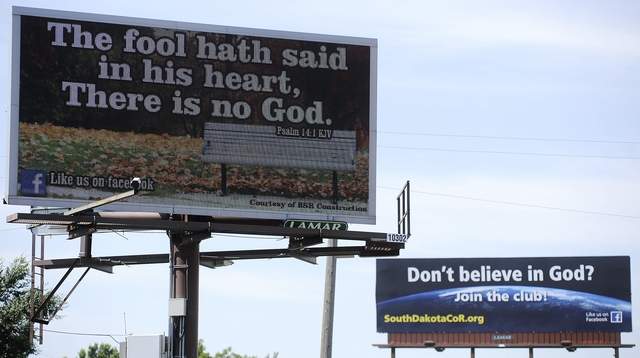
Some Christian named Scott Klusendorf responded to my interview on Issues, etc., largely by distorting my position, misunderstanding what I said, and pretending to be a better authority on developmental biology than I am. I’ve copied a quick and sloppy transcript of parts of it from another Christian.
I guess I have to get used to the idea that if you give an interview to Christians, whether it’s the Missouri Synod of the Lutheran Church or Ray Comfort, they’re going to use it as an opportunity to make an incomprehending hash of whatever you say. (Apparently, they’re milking me hard: they had another 2 hour interview in which a theologian argues against me, but I haven’t bothered to listen.)
Myers: I could imagine a culture where a child doesn’t have the right to life until they are 5-years old
Mod: Myers is an atheist. He believes that standards of conduct are variable depending on what is dominant in a culture. Since cultures vary by time and place, and none is objectively right or wrong, then a 5-year limit for personhood is as valid as any other standard that might evolve. There is no way to judge between cultures against some objective standard
That’s correct. There is no magic objective standard to say when an organism is a person. We rely entirely on cultural perspectives to define when we grant that organism the rights and privileges of a full member of the culture. This does not imply that I personally approve of societies that treat a newborn as expendable, only that it’s clear that there is no objective or scientific boundary. We always rely on an arbitrary definition.
Mod (to Klus): Myers says that the unborn is a “piece of meat”. It’s not a person until well after birth. Do only atheists believe this?
Klus: No others hold them. But what is more interesting is that he just asserts his views, he never argues for them. He says that pro-lifers lie when debating this issue
Yes, anti-choicers lie. I didn’t go into detail on that because it was a short interview, but here’s one plain example: they claim life begins at conception. That’s nonsense no matter how you look at it. There is continuity of life for about 4 billion years; every human life comes from living gametes. The fertilized zygote cannot be legitimately called a “person” — it has none of the attributes of a conscious being, like awareness. As I have said repeatedly, personhood, consciousness, humanity, whatever you want to call it, emerges gradually over the course of development; it is not a magic zap that occurs instantaneously and allows you to say one moment, it’s not alive/human, the next moment it is.
Mod: (to Myers) What is the unborn?
Myers: It’s a piece of tissue that will develop into a human being over time
Mod: (to Myers) What is it 5 minutes before it’s born?
Myers: It’s fetus, it’s not a baby
Klus: The development stages of a human are all stages of development of the same entity, as even Peter Singer and David Boonin admit
Mod: He made a distinction between before birth and after birth
Klus: Yes, and that contradicts what he says later when he says there are no sharp boundaries
No it does not contradict my statements. Development is a continuous process of change. Continuous. A conceptus is different than a 3 month old embry is different from an 8 month fetus is different from a teenager, even if they are the same developing organism. The boundaries we confer on this process are arbitrary.
Klus: Myers is confusing parts with wholes. The skin cells on my hand are part of a larger human being. The embryo is not part of a larger human being, they are a whole human being, directing its own development
Klus: Myers also makes the claim that embryos are constructed piece by piece from the outside. But the science of embryology is clear – the embryo develops itself.
Say what? I have never claimed any such thing. There are autonomous processes in development; in mammals like us, however, there is also an extended dependency on the parent. You can’t say either of those things: embryos are not externally constructed, and they also do not develop entirely on their own.
It’s like these people have a pathological need to slice everything into absolutely rigid boundaries and are incapable of comprehending a gradual process.
Mod (to Myers): Is the unborn a person?
Myers: Personhood develops gradually. A newborn baby is not a person. A baby’s brain is still forming so it’s not a person. There is no specific moment when a baby becomes a person. It is culturally determined. Our society says it’s birth. Some people say viability. Either of those are acceptable to me
Mod: (to Myers): So drawing the line between unborn and born is arbitrary?
Myers: Yes it is
These guys have a really rough time grasping this simple idea. Yes, it’s arbitrary. Different cultures draw the line in different ways. Would it help them to read their Bibles, in which inducing an abortion is not regarded in the same way as committing murder? Even their own religious tradition draws a different line than they do!
Let’s watch their argument get really offensive:
Klus: He is separating human beings into classes: persons and non-persons. This has resulted in injustices, historically speaking. E.g. – with American Indians
Klus: He says that a human being becomes a person when their brain is fully developed, but even teens don’t have fully developed brains
Klus: Look at this scientific evidence from PBS about NIH research which shows that brains still developing in teens and it causes them to make poor decisions
Klus: If development gives us value, then those with more of it have more of a right to life than those with less
Klus: This point was made by Lincoln in his debates about slavery, when he warned his opponent that someone with lighter skin could enslave him
Wait. So if we decide that a blastula is not a fully developed human being, then that can be used to legitimize enslaving black people? Why? Are they making the implication that they are less fully developed than white people? Who is walking around with “more development” than other people?
Look, if you’ve made the cultural decision that newborn babies have a right to live, you’re done: you cannot now say that American Indians or black people or teenagers are lesser than a newborn white baby. There is no difference in the developmental status of different human races. How do these people even make such an argument without realizing the fundamental racism of their assumptions?
Mod (to Myers): How do you decide these life issues?
Myers: We use the notion of “greater good”
Mod (to Myers): that’s a culturally determined notion?
Myers: Yes. The greater good here is that we maximize the security and happiness of most people in the society. Women are persons, so we favor their rights.
Klus: His response begs the question. He is assuming that the unborn are not human persons. He talks about the need for women’s rights. Are unborn women included in those who have rights?
You know, they did this constantly through the show, using this bizarre phrase, “Unborn X”. There are no unborn women. It’s as nonsensical as looking at a tree and saying it is an unbuilt house, or calling a cow an uncooked hamburger. A house is not a tree and a cow is not a meat patty; we give them different names to reflect their very different state.
We should give “unborn women” all the deference and protections we provide for nonexistent women, or imaginary women, or fantasy women, that is, none. Perhaps if these fellows were more respectful of the rights of real women, they wouldn’t be saying these stupid things.
I also have to add another thing to my statements. It’s not just the notion of greater good, but also of empathy. I can see that women and teenagers black people and babies and kids with Down syndrome and other adult men have an inner world, goals and ideas, and I can empathize with them — I no more want harm to come to them than I do to myself. I want to live in a society that defends them, because I want to live in a society that defends me.
An embryo has none of those elements of self-awareness that make it a relatable conscious being. I do not want to live in a society that fetishizes a gastrula over my wife or daughter.
Klus: If cultures decide who is and who is not a person, then he cannot oppose cultures that say that Jews are not persons, or that women are not persons
Klus: He admits that he cannot oppose cultures that think that children of age 5 are not persons, and can be killed
Really? I did? I don’t think so. Hey, look, there’s an example of a “pro-lifer” lying!
I said I could imagine cultures that defer granting personhood until a baby reaches a certain age. That’s actually fairly common; Victorian Europe, for instance, exhibited a marked reticence about the status of newborns, with individuals often waiting a year or more to give them a name, because infant mortality was so high. I can easily imagine a culture that thinks Jews are not persons — I just have to crack a history book.
And I certainly can oppose infant mortality and Nazis. I can recognize that those are symptoms of an unhealthy society that I would not want to live in, and that they do great harm to conscious, living persons.
Mod (to Myers): You call that kind of society “brutal”, why do you say that?
Myers: It’s my personal preference because I like my own kids
Mod (to Klus): Respond to that
Klus: He has no argument, just his own opinion. He cannot oppose any society that things that it is OK to traffic, kill, etc. 5-year-olds
Klus: He says that he has a personal preference. That is an interesting fact about his psychology, but he has no argument
I was not making an argument there. I did not think I had to — I assumed the interviewer and the audience would all share my personal views that kids are good people.
If I’d been asked a little more, like about why I like my kids, I could have gone deeper. My kids were not possessions. They were not things I liked like my iPad or my fluffy pillow — they were people I respected because they had personalities and interests of their own, and one of the things you quickly appreciate (if you’re not a psychopathic quiverful Christian who sees children as tools to deploy) is that they really are thinking, reacting, learning, growing human beings. Again with the empathy! They deserve protection because they do have attributes like autonomy and curiosity and affection and many others that are of human value.
Klus: In an atheistic worldview, human beings at any stage are cosmic accidents
Klus: How do we get any kind of intrinsic value and human rights out of an atheist worldview? I don’t see how you can
At last, something they get right, sort of. You can’t derive intrinsic human rights from an atheist view. There aren’t any. Values and rights are emergent properties of communities of people. Note: that does not say that values and rights don’t exist, it says that they are generated by the interactions of individuals in a group, and not imposed from above.
Klus: Even a woman’s absolute right to an abortion is not grounded by atheism
That’s actually an interesting and complex point. It’s true; atheism in and of itself says nothing about how human beings should treat other human beings. The absence of a caretaker god does not say you couldn’t build a patriarchal atheistic society that held women and other races as chattel. Or a Libertarian atheist society built on Ayn Rand’s hideous values. Or an inward-looking nationalistic and secular society that had no problem with maintaining its security by raining bombs down on every other nation on earth.
Atheism is only the start; it frees you from destructive traditions and throws off the shackles of dogma. The next part is the hard part: you have to think consciously about how you want civilization to operate, and you have to make commitments to other values, like humanism.
Atheism does not tell me women have rights. That I can look at women with eyes unfogged by superstitious nonsense and see that they are my equals tells me that women have rights.
Mod (to Myers): What do you think of the pro-life movement?
Myers: I’m a developmental biologist. The pro-life movement is lying to people. An embryo is not a person. “Personhood implies much more than being a piece of meat with the right number of chromosomes in it”. The primary issue in abortion is women’s autonomy. It is entirely the woman’s decision
Klusendorf: You have to present arguments to prove that pro-lifers are lying. There are pro-abortion scholars who have arguments, he isn’t one. He only has assertions, opinions and preferences.
Klusendorf: What if a woman gets pregnant solely in order to take a drug during pregnancy in order to have a deformed child. Myers has no argument against that
“Pro-lifers” consciously make claims that are false, and yes, I have made arguments against the anti-choice position, many times. That Klusendorf thinks a brief wide-ranging interview contains the entirety of my position is his problem.
As I said at that link,
We don’t have to revere every block of rough marble because another Michaelangelo could come along and sculpt it into something as wonderful as his David; we don’t have to treasure every scrap of canvas because the next Picasso is going to use it for a masterpiece. The value isn’t in the raw materials, but in the pattern, the skill, the art put into it. Similarly, those cells are simply the raw clay that the process and time will sculpt into something that is worth love and care.
Which is more important, the pigments or the painting? Even worse, do you think the pigments are the painting?
And speaking of non-existent arguments, the transcriber cut off a lot of the absurd details Klusendorf made up at the end. He went on at painful length: what if a woman got pregnant just so she could take a drug that made the fetus limbless? What if she refused to give birth by taking drugs that kept the fetus small and held it inside for 70 years?
Yeah, you’re damn right I have no argument against that. Because they’re the bizarre hypotheticals of a bigoted ideologue who’s incapable of recognizing women as conscious moral agents on their own, and is reduced to fighting against nonexistent, imaginary women who do random freakish things during their pregnancy for no reason at all.
But then, I guess that’s what you’d expect of a guy who believes in “unborn women” — no attachment to reality at all.


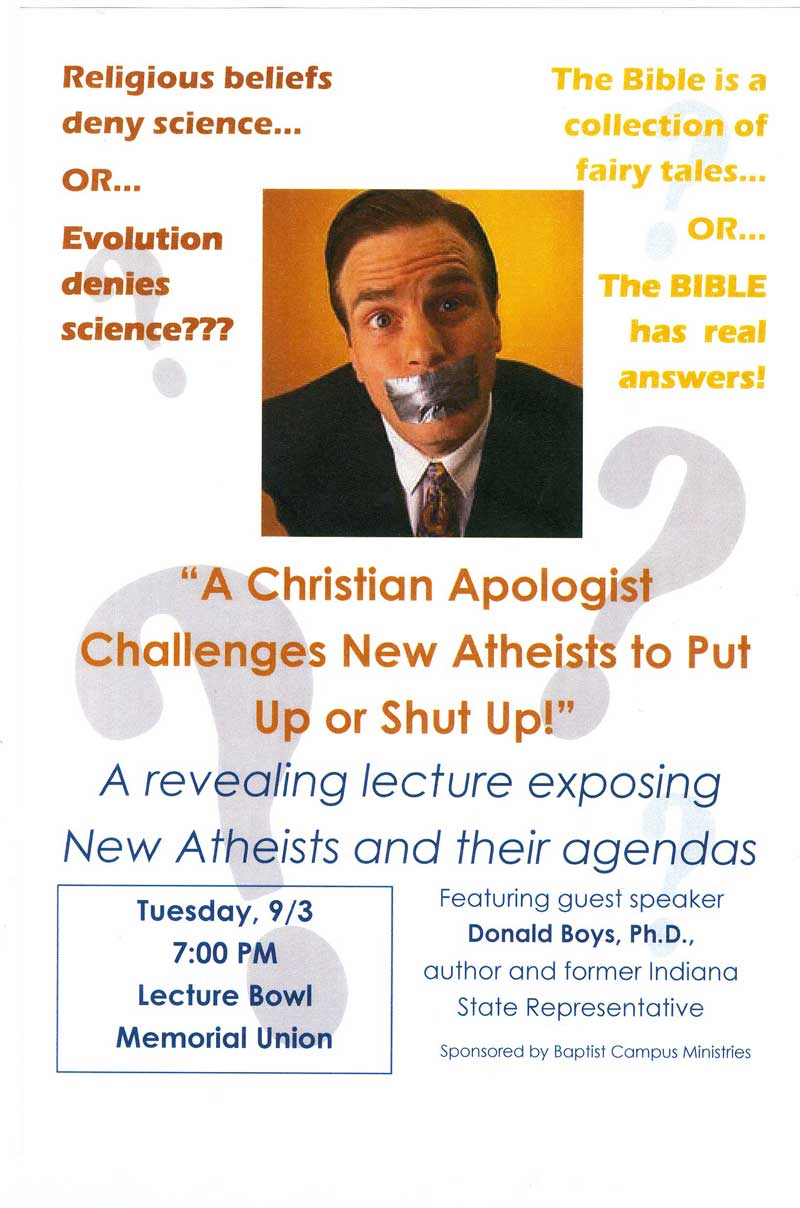

 instead.