Validating religious symbolism…with a poll

This is a cross in Middleboro, Massachusetts. It’s on public land in the town.

middleborocross

Would you believe that the people of the town stupidly looked at that and decided there was no conflict at all between a great big Christian symbol that says OBEY WORSHIP and secular government? None at all. Let’s just pretend that that is a secular message.

They have a poll, of course. It was apparently going very much the wrong way yesterday, but Cuttlefish has had his minions shredding it. I’m just coming along to administer the coup de grace.

What’s your take on the Middleboro cross?

It’s a religious symbol that has no place on public property 53%

It’s an appropriate expression of religious freedom 46%

How can smart atheists be bamboozled by Joseph Atwill?

Atwill is this guy who claims to have evidence that Jesus wasn’t real: Christianity was a cunning product of a Roman imperial conspiracy, intentionally designed to placate those troublesome Jews, and he claims to have a Roman confession that he’ll reveal next week.

I think a few too many atheists are seeing “Scholar Says Jesus Was Fake” and are not thinking any more deeply than that. The whole idea is ridiculous.

The Roman idea of social engineering was to plant a legionary fortress, or retire a bunch of legionaries, into an area that they wanted to pacify. Incorporating regional gods into their pantheon by synonymizing them, sure; far-fetched long-term plans that would require centuries to mature into a tangible result, no.

Has there ever been a religion that was created by a government that actually caught on? Most religions die young; they have a very low success rate. It’s not a smart investment — it’s like buying a lottery ticket. If Romans had been in this game of inventing religions to win over the natives to Romanism, we’d see more examples of failures than long term success.

What would you think of a conspiracy theorist who announced that Joseph Smith had been a secret government agent with the mission of persuading a large number of people to settle that barren Utah territory? Or that L. Ron Hubbard was J. Edgar Hoover’s boy, part of a plan to provide an alternative to the Communist Party for impressionable youth? There are always people to whom a conspiracy theory is attractive, but more rational people would just laugh at the very idea.

Finally, as Russell Glasser points out, real scholars don’t spring the evidence on their audiences by press release or by public lecture — it is first reviewed by independent scholars for authenticity.

If you’re one of the many atheists who gleefully forwarded this to me or credulously mentioned it on twitter…hello, there. I see you’ve already met the good friend of so many half-baked wackos in the world, Confirmation Bias.


Richard Carrier demolishes Atwill in detail.

How cute

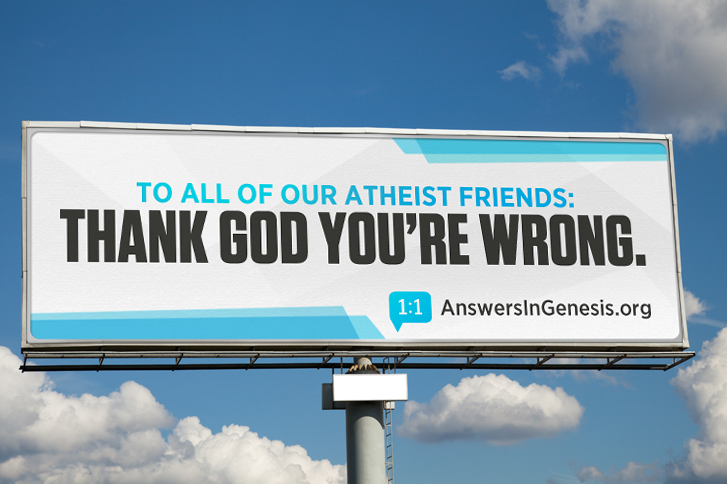
Answers in Genesis has gotten in the billboard business, just in time for Christmas.

To all of our atheist friends: THANK GOD YOU'RE WRONG

To all of our atheist friends: THANK GOD YOU’RE WRONG

To which I can only say…but I’m not wrong, there’s no god to thank, so why are you talking to yourselves so publicly and loudly? It’s a bit embarrassing, actually.

Just in case you think you’re talking to us, I’m sorry — that message isn’t going to change our minds in the slightest.

Isn’t there a dank dark hole you should be crawling into somewhere?

A hopeless muddle

James May, one of the presenters on Top Gear, is trying his hand at providing a little science education. I want to say…please stop. Here he is trying to answer the question, “Are humans still evolving?” In the end he says the right answer — yes they are! — but the path he takes to get there is terrible.

It’s little things that make me wonder if anyone is actually editing his copy. For instance, he helpfully explains that you, the viewer, were produced by your parents having sex. Then he says:

That’s how evolution is driven: by reproduction. But is that still true?

Uh, yes? We haven’t stopped reproducing, so we should be able to stop right there then.

But no, he continues on. He tries to explain evolution, and does manage to verbally describe natural selection correctly as differential survival and reproduction, but it’s illustrated with a pair of goats with telescoping necks. That doesn’t help. He’s describing Darwinian selection and showing it as Lamarckian — it’s a very mixed signal. And as we’ll see, he still seems to be thinking like will and experience drive evolutionary changes.

And do I need to mention that he doesn’t seem aware of processes other than selection in evolution? You need to realize the importance of drift to answer the question of whether evolution is continuing in humans, especially when you’re prone to say glib nonsense like “humans have turned the process of natural selection on its head,” whatever that means.

He also claims along the way that Darwin “tracing this evolutionary process backwards proved that all life came from a common source.” No, he didn’t. A hypothesis is not proof. He found morphological evidence for the relatedness of some groups, but the evidence for common ancestry of all forms wouldn’t really become overwhelming until the molecular evidence linked animals and plants and mushrooms and bacteria together.

By the time he gets around to talking the details of human evolution, we’re mired in a hopeless mess. Apparently, one reason we’re still evolving is that “certain characteristics will improve your chances of breeding” but then he helpfully explains that “its not as if ugly and stupid people don’t get to have children”. So which is it? Is natural selection selecting away for chiseled abs, or whatever he regards as a significant advantage, or isn’t it? And if people he judges as unattractive are having children, that driving force of evolution, then isn’t that undermining his understanding of the process?

And please, if you can’t even get selection straight in your head, please don’t try to explain population structure. He has a weird discursion in which he explains that “the genetic mutations that drive evolution can be most commonly found in a small gene pool” and then somehow tries to argue that we’re “too cosmopolitan,” that the fact that people from all over the world can now intermarry somehow “cuts down on those mutations.” I have no idea what he’s talking about. I suspect he doesn’t either.

Then, as evidence that we have been evolving, he points to big screen TVs as proof that we’re smarter than Stone Age people. Great — we now have a new IQ test. Just measure the dimensions of the individual’s TV. It’ll probably work about as well as regular IQ tests.

He tries to get to specific traits: lack of wisdom teeth is evidence of human evolution, apparently. Never mind that the changes are recent and mixed, and that it’s more likely a plastic response to changes in our diet than a trait that’s been selected for specifically. It’s a very bad example, unless he’s going to argue for selection for people with fewer teeth in their jaws. Do you typically count your date’s molars?

His ultimate proof that humans are evolving is the appearance of lactose tolerance in adults. That is pretty good evidence, I’ll agree…but he messes it up completely.

10,000 years ago, before anybody had had the bright idea of milking a cow, no human could digest the lactose in milk beyond childhood. But now, after a hundred years of drinking cream and milk and squeezy cheese in a can, 99% of people can.

He doesn’t even get the numbers right. North Europeans have a frequency of lactose tolerance of about 90%; in South Europeans it is about 30%, and less than 10% in people of Southeast Asian descent. This is not a largely lactose tolerant world.

And of course, his explanation is screaming nonsense. We are not lactose tolerant because we’ve been drinking milk; we’ve been drinking milk because we’re lactose tolerant. It is not a trait that appeared in the last century.

Why is this guy babbling badly about evolution? Did he have any informed, educated scientists to consult who could tell him not to make such a ghastly botch of it all?

There’s a reason we need good science journalists

It’s because the bad ones are appalling hacks. Here’s an ad for The Sun looking for a scientist to give them the answer they want.

Media outlet: The Sun Freelance journalist: Matthew Barbour Query: Further to my last request, I also now urgently need an expert who will say tattoos can give you cancer. We can plug any relevant organisation, give copy approval, and pay a fee. Please get back to me asap if you can help.

Media outlet: The Sun

Freelance journalist: Matthew Barbour

Query: Further to my last request, I also now urgently need an expert who will say tattoos can give you cancer. We can plug any relevant organisation, give copy approval, and pay a fee. Please get back to me asap if you can help.

May I suggest that Matthew Barbour ought to be drummed out of journalism, and that any “expert” who is cited in his article promoting lies for cash ought to be similarly ridiculed?

If anyone sees this article appear, let me know.

Are we done with Bigfoot yet?

Yeah, I think it’s over. Ketchum’s group — you know, the one that collected possum hairs and sequenced random garbage and called it Bigfoot — now is airing a Bigfoot video, supposedly the best evidence yet. You be the judge.

They spent half a million dollars gathering that, and they couldn’t even hand the camera over to someone who knew how to focus.

Flying witches and Africans

Leo Igwe has an op-ed on an African problem.

Some months ago, the aviation authorities in Swaziland issued a statement which surprised many people around the globe. They warned that high-flying witches would be penalised. High-flying witches? Be penalised?

Swaziland Corporate Affairs Director Sabelo Dlamini actually said, “A witch on a broomstick should not fly above the [150-metre] limit.” Wow!

Of course, on hearing this directive one may think it was something made up by someone bent on discrediting Africa’s last absolute monarchy. Far from it, it was a policy statement from the aviation authorities in Swaziland to regulate ‘witch-flights’ in this 21st century.

He concludes by setting a goal for Africans.

We must break the spell of ignorance that hangs over Africa. Fearful ignorant minds wasting precious resources fighting imaginary witches in winnowing baskets must be replaced with educated, honest people administering the forward progress of an emerging continent with real needs.

Are the authorities in Swaziland and Zimbabwe listening to the future calling?

I hesitated to post this, because it’s all too easy to turn this into a vindication of racist bigotry. But let me remind you that here in mighty America, we have white people claiming to have fought demons, legislators denying global climate change because a god promised not to ever flood us again, and of course, the perennial insistence that we must swear an oath to an invisible boogey man to take public office.

So I have to revise Igwe’s suggestion a little bit: We must break the spell of ignorance that hangs over humanity.

Stones, glass houses, etc.

John Bohannon of Science magazine has developed a fake science paper generator. He wrote a little, simple program, pushes a button, and gets hundreds of phony papers, each unique with different authors and different molecules and different cancers, in a format that’s painfully familiar to anyone who has read any cancer journals recently.

The goal was to create a credible but mundane scientific paper, one with such grave errors that a competent peer reviewer should easily identify it as flawed and unpublishable. Submitting identical papers to hundreds of journals would be asking for trouble. But the papers had to be similar enough that the outcomes between journals could be comparable. So I created a scientific version of Mad Libs.

The paper took this form: Molecule X from lichen species Y inhibits the growth of cancer cell Z. To substitute for those variables, I created a database of molecules, lichens, and cancer cell lines and wrote a computer program to generate hundreds of unique papers. Other than those differences, the scientific content of each paper is identical.

The fictitious authors are affiliated with fictitious African institutions. I generated the authors, such as Ocorrafoo M. L. Cobange, by randomly permuting African first and last names harvested from online databases, and then randomly adding middle initials. For the affiliations, such as the Wassee Institute of Medicine, I randomly combined Swahili words and African names with generic institutional words and African capital cities. My hope was that using developing world authors and institutions would arouse less suspicion if a curious editor were to find nothing about them on the Internet.

The data is totally fake, and the fakery is easy to spot — all you have to do is read the paper and think a teeny-tiny bit. The only way they’d get through a review process is if there was negligible review and the papers were basically rubber-stamped.

The papers describe a simple test of whether cancer cells grow more slowly in a test tube when treated with increasing concentrations of a molecule. In a second experiment, the cells were also treated with increasing doses of radiation to simulate cancer radiotherapy. The data are the same across papers, and so are the conclusions: The molecule is a powerful inhibitor of cancer cell growth, and it increases the sensitivity of cancer cells to radiotherapy.

There are numerous red flags in the papers, with the most obvious in the first data plot. The graph’s caption claims that it shows a "dose-dependent" effect on cell growth—the paper’s linchpin result—but the data clearly show the opposite. The molecule is tested across a staggering five orders of magnitude of concentrations, all the way down to picomolar levels. And yet, the effect on the cells is modest and identical at every concentration.

One glance at the paper’s Materials & Methods section reveals the obvious explanation for this outlandish result. The molecule was dissolved in a buffer containing an unusually large amount of ethanol. The control group of cells should have been treated with the same buffer, but they were not. Thus, the molecule’s observed “effect” on cell growth is nothing more than the well-known cytotoxic effect of alcohol.

The second experiment is more outrageous. The control cells were not exposed to any radiation at all. So the observed “interactive effect” is nothing more than the standard inhibition of cell growth by radiation. Indeed, it would be impossible to conclude anything from this experiment.

This procedure should all sound familiar: remember Alan Sokal? He carefully hand-crafted a fake paper full of po-mo gobbledy-gook and buzzwords, and got it published in Social Text — a fact that has been used to ridicule post-modernist theory ever since. This is exactly the same thing, enhanced by a little computer work and mass produced. And then Bohannon sent out these subtly different papers to not one, but 304 journals.

And not literary theory journals, either. 304 science journals.

It was accepted by 157 journals, and rejected by 98.

So when do we start sneering at science, as skeptics do at literary theory?

Most of the publishers were Indian — that country is developing a bit of an unfortunate reputation for hosting fly-by-night journals. Some were flaky personal obsessive “journals” that were little more than a few guys with a computer and a website (think Journal of Cosmology, as an example). But some were journals run by well-known science publishers.

Journals published by Elsevier, Wolters Kluwer, and Sage all accepted my bogus paper. Wolters Kluwer Health, the division responsible for the Medknow journals, "is committed to rigorous adherence to the peer-review processes and policies that comply with the latest recommendations of the International Committee of Medical Journal Editors and the World Association of Medical Editors," a Wolters Kluwer representative states in an e-mail. "We have taken immediate action and closed down the Journal of Natural Pharmaceuticals."

Unfortunately, this sting had a major flaw. It was cited as a test of open-access publishing, and it’s true, there are a great many exploitive open-access journals. These are journals where the author pays a fee — sometimes a rather large fee of thousands of dollars — to publish papers that readers can view for free. You can see where the potential problems arise: the journal editors profit by accepting any papers, the more the better, so there’s pressure to reduce quality control. It’s also a situation in which con artists can easily set up a fake journal with an authoritative title, rake in submissions, and then, perfectly legally, publish them. It’s a nice scam. You can also see where Elsevier would love it.

But it’s unfair to blame open access journals for this problem. They even note that one open-access journal was exemplary in its treatment of the paper.

Some open-access journals that have been criticized for poor quality control provided the most rigorous peer review of all. For example, the flagship journal of the Public Library of Science, PLOS ONE, was the only journal that called attention to the paper’s potential ethical problems, such as its lack of documentation about the treatment of animals used to generate cells for the experiment. The journal meticulously checked with the fictional authors that this and other prerequisites of a proper scientific study were met before sending it out for review. PLOS ONE rejected the paper 2 weeks later on the basis of its scientific quality.

The other problem: NO CONTROLS. The fake papers were sent off to 304 open-access journals (or, more properly, pay-to-publish journals), but not to any traditional journals. What a curious omission — that’s such an obvious aspect of the experiment. The results would be a comparison of the proportion of traditional journals that accepted it vs. the proportion of open-access journals that accepted it… but as it stands, I have no idea if the proportion of bad acceptances within the pay-to-publish community is unusual or not. How can you publish something without a control group in a reputable science journal? Who reviewed this thing? Was it reviewed at all?

Oh. It’s a news article, so it gets a pass on that. It’s also published in a prestigious science journal, the same journal that printed this:

This week, 30 research papers, including six in Nature and additional papers published online by Science, sound the death knell for the idea that our DNA is mostly littered with useless bases. A decade-long project, the Encyclopedia of DNA Elements (ENCODE), has found that 80% of the human genome serves some purpose, biochemically speaking. Beyond defining proteins, the DNA bases highlighted by ENCODE specify landing spots for proteins that influence gene activity, strands of RNA with myriad roles, or simply places where chemical modifications serve to silence stretches of our chromosomes.

And this:

Life is mostly composed of the elements carbon, hydrogen, nitrogen, oxygen, sulfur, and phosphorus. Although these six elements make up nucleic acids, proteins, and lipids and thus the bulk of living matter, it is theoretically possible that some other elements in the periodic table could serve the same functions. Here, we describe a bacterium, strain GFAJ-1 of the Halomonadaceae, isolated from Mono Lake, California, that is able to substitute arsenic for phosphorus to sustain its growth. Our data show evidence for arsenate in macromolecules that normally contain phosphate, most notably nucleic acids and proteins. Exchange of one of the major bio-elements may have profound evolutionary and geochemical importance.

I agree that there is a serious problem in science publishing. But the problem isn’t open-access: it’s an overproliferation of science journals, a too-frequent lack of rigor in review, and a science community that generates least-publishable-units by the machine-like application of routine protocols in boring experiments.

How can we be better than the fundamentalists?

Fellow atheists! We have truth on our side, and science as a powerful tool. The other side is full of lunatic ideas and stupidity; they cripple our country with their corruption of education and denialism. We are unstoppable. We shall be eventually be victorious.

So, wait, if their ideas are so plainly bogus and repressive, why do people still join fundie churches and throw money at charismatic con artists? Are they crazy or stupid? No, maybe not — maybe it’s because atheists aren’t recognizing some important aspects of the human condition.

A few years ago one of my friends had a birthday party, and he invited all the homeschool families he knew to his party. It may seem odd to an outsider to have young children at his 20th birthday party, but it was not the least bit weird to me (parties with my family are the same way; there were as many kids under 13 at my 18th birthday party as there were teens). But after an entire evening of playing board games with people of all ages, washing dishes together, and praying for each other, one of my public school friends (the only person who had attended public school at the party) said to me, “That was so much fun. I never experienced this in my life.” She explained that she never had an evening playing board games with children of all ages. In fact, she never went to someone’s house and had them pray for her either. It was foreign to her, but she liked it.

Fundamentalism offers that kind of community. Yes, the community creates pain and breaks sometimes, but it’s still community that often attracts people to fundamentalism.  I was looking through photos of my teen years earlier this week, and every photo of me has a child in the picture. Our community valued children.

The other end of fundamentalism has been a lot of pain: a lot of guilt over purity culture, a lot of culture shock, a lot of shame from never living up to expectations. The purity culture and anti-feminist culture let me down. It didn’t keep its promise. In the end, it didn’t make us closer together as a family, and it didn’t make us better than secular families. I’m not defending fundamentalism, except to say this.

Quit saying fundies are just crazy-no-brainers while secularists are enlightened and free thinkers.

Fundamentalist ideas are crazy-no-brainers, but sane, intelligent, ordinary people sign up for them all the time. Maybe we ought to pay a little more attention to the rational reasons people follow irrational ideas.

That bit about every photo from her teen years including children in it struck me as significant…and you don’t have to be fundamentalist to have that. I grew up in a great big messy extended family with swarms of cousins and brothers and sisters and aunts and uncles and grandparents, and religion hardly ever came up (except maybe with some eyerolling at a couple of wacky branches of the family that went Mormon and John Birch), so it can be a secular experience. But my own kids got far less of that, constantly getting ripped up and moved to strange distant cities at the commands of the peripatetic academic life style.

We’d like to believe that the triumph of secularism is inevitable — how can we fail when we’re going up against such nutty ideas? — but maybe it isn’t, if we neglect social and community and family ideals and pander only to nerdy asocial guys in tech.

We really need to wake up to the reasons normal people find value in weird religions.

Ex-Muslims of North America

While I was in Washington DC a while back, I got to talk with Sarah Haider for a bit. She’s one of the leaders of the Ex-Muslims of North America, and they are trying to build up a greater profile — slowly and cautiously, though, because as she explained to me, there are a lot of non-ex-Muslims who want to infiltrate their group and expose their membership for apostasy. So if you’re an ex-Muslim who is in the closet about it, and you’re looking for a group that takes sensible precautions to protect their membership, you might want to reach out to EXMNA. I was very impressed with their professionalism and thoroughness.

I also wanted to mention this other aspect of their work. Sure, there are Muslim fanatics they have to be on the guard against, but also they’re imbedded in an unfortunately xenophobic culture that has turned all Muslims, even the ex kind, into boogeymen; and then there are the apologists who go too far the other way and pretend that hard-line Islam is benign and must be sheltered.

These days, there is a stark polarity that exists in media, academia and public life when it comes to discussions about Islam and Muslims. There are those who propagate racist, bigoted and xenophobic ideas against Muslims, against anyone who comes from a Muslim background, and even against people who are not Muslim at all (e.g. Sikhs). These types of people (the bigots) tend to treat all Muslims (or all those perceived to be Muslim) as a monolith, a horde without internal differences or dissent. On the other hand, there are those who react to the bigoted, xenophobic types by trying to justify the violent parts of Islam and the harsh actions of some Muslims. This second type (the apologists) often shields Islam and Muslims from any and all critique and scrutiny, even the kinds of critique and scrutiny they themselves apply to other ideologies like Christianity, Capitalism, Communism, and others.

I don’t envy them the narrow tightrope they have to walk, but these are people doing it as well as possible. Check out Ex-Muslims of North America. Don’t expect them to embrace you immediately, though — they’re understandably wary.