Bringing back Salt Lake memories

In anticipation of the American Atheist conference next week, many ex-Mormons marched and sent in resignation letters to the LDS leadership. The timing was key.

David Silverman, president of the American Atheists, said the Mormon church has too much influence on people’s lives, especially Utahns’. Officially leaving the church during General Conference sends a message, he said.

"They’re doing it during the General Conference to make a statement, and that statement is that they feel oppressed here in Salt Lake City, where the Mormon church governs so much of not just the Mormons’ lives but everybody else’s lives," Silverman said. "It’s not fair. It’s a violation of the separation of church and state, but it’s also a violation of religious freedom."

They did it during the General Conference? Risky. It might have gotten completely ignored.

When we lived in Salt Lake City, I remember the General Conferences as the times when a news blackout fell over the state. The local newspapers would all run big front page stories on the most tedious pablum: “SENILE OLD MAN SPEAKS FOR TWO HOURS ON HOW WE SHOULD BE NICE”. The LDS leadership was (is) all these older conservative fellows in the same dark suits who took themselves very seriously, and all the news organizations were expected to report in detail everything that was said…not that they ever said anything of any interest or importance whatsoever. It was the time of the year that felt closest to living in North Korea — although, of course, the LDS church never subscribed to purging undesirables with flamethrowers. No violence, just state-enforced veneration of the blandest boringest bureaucrats of the church.

Most of the time, you could ignore the Mormon leadership, especially if you were living in SLC, which was about half Gentile. Not during the General Conference. Even then, though, what was most striking wasn’t the actual leadership, which was facelessly tedious, but that there were so many devout Mormons who would reverently worship every word dripping from the White Geezers at the top. It was weird; it was the time of year when the pod people would start speaking synchronously.

No! Not the list of stumpers again!

There’s a common tactic used by creationists, and I’ve encountered it over and over again. It’s a form of the Gish Gallop: present the wicked evolutionist with a long list of assertions, questions, and non sequiturs, and if they answer with “I don’t know” to any of them, declare victory. It’s easy. We say “I don’t know” a lot.

Jack Chick’s Big Daddy tract is a version of the creationist list, and contains a fair amount of fantasy as well. You know what they believe will happen: they’ll ask that one question that the scientist can’t answer, and then they’ll have an epiphany, a revelation, and realize that all their science is a lie, at which time they’ll resign from their university position and join a good bible-believin’ church.

It happens to me all the time, too. At one talk I gave, there was a woman at the door who had printed a 5-page, single-spaced list of questions, and she was telling everyone going in to ask me to answer them — I invited her to come in and listen to the talk and ask them herself, and she ran away. I’ve had a Canadian creationist do the same thing, and then I talked to him for several hours in the hallway after the talk. He seemed stunned and angry that I actually had answers for most of his questions. I have been confronted by people with questions (more like ignorant assertions) about biology, who once I’ve answered them and reveal that I’m a biologist, switch to asking me about geology and the Big Bang, to get me into a corner where I’d have to say, “I don’t know.”

Here we go again. The IDiot, Salvador Cordova, has written up his list of 16 questions to challenge scientists. He even has the typical anecdote:

I once gambled a little bit on a weaker question that a creationist biology student should ask her anatomy and physiology professor regarding the evolution of hearts. I basically suggested she ask about how the intermediate plumbing can work if it is not all wired-correctly in the first place.

When that biology junior posed that question, she came back the next week at our ID/Creation meeting beaming. She said, “you’re right, there are no transitionals!” I realized then whatever I said might not be as powerful as what professors are unable to say when asked the right questions!

But we do have intermediates, both phylogenetically and developmentally! People are using zebrafish to study the evolution of the four-chambered heart. How can you conclude that there are “no transitionals” from one question about one feature, asked of one professor? But that’s exactly the illogical conclusion creationists want you to draw.

Here’s how the scam works and gives them the answers they want.

  • Ask questions about wildly different fields: Cordova’s list includes questions about biology, geology, and cosmology. There are few people polymathic enough to know them all; I can handle most biology questions comfortably, but I have to beg off on geology and physics, or give general answers built on the lay knowledge I have of those fields. “I win!” declares the creationist, because Myers hasn’t memorized all the transitions in nucleosynthesis.

  • Ask about obscure phenomena within the evolutionist’s own field. No, I haven’t tracked every fossil discovery in the world; no, I haven’t memorized every signaling pathway; no, I don’t have a complete, step-by-step explanation for the evolution of every molecule in your body. I can look it up later, or I can give you an example of a related phenomenon, but that’s taken as an admission of failure of the whole field of biology, rather than an admission of my personal, limited competence.

  • Rely on the fact that not everyone pays attention to the basics. Most scientists are specialists; we’ve got a narrow set of topics that we know exceedingly well, and a great cloud of generalities that we sort of vaguely accept. Nobel prize winners are rarely the best people to consult about the kinds of things creationists want to know; for that, you’re better off talking to the academic grunt who teaches introductory biology, or the person who has a hobby of following the creationist literature (hey, that’s me!).

  • Ask really stupid questions. They misuse jargon, babble about facts that have been strongly established as if they’re controversial, throw in random bits of sciencey terminology that aren’t actually relevant to the question, but sound impressive to lurkers who are as ignorant as they are. The goal is to get the scientist to screw up their face in a “WTF?” expression, and go silent for a few minutes as they try to puzzle out a diplomatic way to shoo the time-wasting creationist away. That counts as scoring a coup.

  • Lie. Lie, lie, lie. Nobody in the audience will care to double-check creationist claims, except the scientists, and by the time they write up a detailed rebuttal, the creationist will have moved on to the next sucker.

So let’s take a shot at Cordova’s questions. I’ll just fire back as I would in person, without looking things up in a textbook or the internet.

1. How can functional proteins form without ribosomes or ribosome-like machines?

Ribosomes are great big elaborate enzymes…that is, they’re catalysts that enhance the rate of a reaction that would occur naturally. Without ribosomes, you’d still get short peptides forming; to get long ones, you’d need efficient catalysts to get the sequence to be assembled with high probability in a reasonable period of time. Early life would have been relatively inefficient, but they only had to compete with other protocells without the advantage of ribosomes.

2. How can natural selection or neutral evolution evolve poly constrained DNA or any poly constrained systems in general?

Classic use of jargon, “poly constrained”, to pretend the problem is a serious scientific one. An enzyme might be constrained in its sequence at multiple points — it needs a specific amino acid at the active site, it needs another amino acid at a specific point to put a particular kink in the shape, it needs yet another specific amino acid at a distant point to interact with a regulatory protein — but that just means substitutions at those locations will occur at a lower rate and have fewer degrees of freedom than other locations.

3. How did the first organism regulate protein expression and cellular development without regulatory elements or developmental mechanisms?

Define “first organism”. Sufficiently primitive protocells probably didn’t regulate everything — they may have produced an enzyme for substrate X even when substrate X wasn’t present. So? But you can also see how, in an organism like that, there would have been a selective advantage to organisms that had a sensor to detect the presence of a substrate, allowing them to conserve a little energy by not producing the unnecessary enzyme. And the word “sensor” is used generously here: it would just mean a protein that could undergo a conformational change when bound to the substrate, and since it has an enzyme that binds the substrate already, it wouldn’t be difficult to evolve.

4. How did any vital organ or protein form given the absence of the organ would be fatal? Absence of insulin is fatal in organisms requiring insulin. How did insulin become a vital part of living organisms? If you say it wasn’t essential when it first evolved, then how can you say selection had any role in evolving insulin without just guessing?

This sounds like a clumsy version of irreducible complexity, which has already been shot down many times before. The organ/protein would not have been vital essentially, but could still have been useful. Look at Thornton’s work on the evolution of receptors: a broad spectrum corticosteroid receptor evolved into two much more specific glucocorticoid and mineralocorticoid receptors. The function only became essential after it was fully integrated into the physiology of an organism.

5. How did DNA evolve in a proteins-first or RNA first scenario?

You do know that the difference between DNA and RNA is simply the presence or absence of a single hydroxyl group, right? Once you’ve got the machinery to build and assemble ribonucleotides, it’s a short step to deoxyribonucleotides.

6. How did amino acid homochirality evolve since the amino acids in biotic soup experiments are racemic, plus homochiral amino acids spontaneously racemize outside of living systems? How about DNAs and sugars? If the expectation value is 50% left, how do 100% left or right forms emerge in pre-biotic soups, and more importantly how is homochirality maintained long enough for chemical evolution to work?

Enzymes are chiral, too. To maintain the synthesis of racemic products, you’d often need two different enzymes. To produce just one chirality, you need one kind of enzyme. Which is easier, to evolve one enzyme, or to evolve two simultaneously, one of which is a mirror image of the other?

7. Don’t dead dogs stay dead dogs and doesn’t Humpty Dumpty stay broken?

I don’t even…

There’s a bit of a difference between incremental assembly of the components of a dog over billion years, where each step is viable and subject to selection, and the instantaneous assembly of a complete dog from a non-viable collection of rotting organic compounds.

8. Describe how a partially functioning ribosomes or any partial implementation of the DNA code could operate in a working cell, and how a such cell can operate without such vital parts.

Didn’t we already address that in #1?

9. Are most laboratory and field observations of evolution reductive rather than constructive of new coordinated functions? For the sake of argument, let extinction can count as reductive evolution. When bacteria evolve antibiotic resistance, what proportion of cases involved evolution of a new complex protein?

Answer to the first part: no. If extinction is “reductive evolution”, then speciation is “constructive evolution”.

Second part: quantitatively, I don’t know. Almost certainly very low. Evolution is largely going to proceed by modification of existing components, and de novo creation of a complex protein is unlikely.

10. Cite an experiment or field observation where a substantially new protein was evolved in real time or is expected to evolve in real time over the next few generations. Nylonase is the most cited example, but that wasn’t a substantially new protein. But even granting that, how many complex proteins are evolving in the biosphere versus those getting lost forever.

Wait, why are you ruling out nylonase? It is a new protein! I notice you’re hedging your question, asking for a “substantially” (quick, define it) new protein, which has to evolve in “real time”, whatever that is, and right away you’re excluding obvious examples. What’s the point of answering this if you’re going to set it up with weasel words and exceptions?

All of the complex proteins in the biosphere are evolving. Since the number of genes in animals, to use one subset, wobbles about in different species but is staying in the same ballpark for the last few hundred million years, I’d have to estimate that gene losses are roughly equal to the addition of new genes.

11. What new trait in human populations do you expect to become genetically fixed in all 7 Billion or so people, and how fast do you expect that trait to overtake the population in how many generation? If you can’t identify convincingly one or a few traits, how then can you argue for evolution of so many traits in the past?

You’re asking me to do something that evolution does not claim to be able to do: evolution is not deterministic, involves a great deal of chance, and even selection is contingent on interactions with a changing environment, so it is impossible to predict the future fate of a single allele.

We can see it retroactively. A third opsin gene arose early in primates, and is basically now fixed in the human population, giving us trichromatic vision; we’re seeing lactose tolerant variants arising in humans within the last 10,000 years, not reaching worldwide fixation yet, but rising in frequency rapidly. That one could reach fixation, if dairy products become universally available and popular.

12. If a species has a population of 10,000, how can selection act in a particulate manner on 4 giga bases of DNA individually? Wouldn’t such a large genome relative to small population size result in lots of selection interference, hence wouldn’t most molecular evolution be neutral of necessity as Kimura asserted?

Most molecular evolution is neutral. Done.

13. Do geological layers involving permineralized fossils or other kinds of well-preserved fossils require rapid burial? If the burial process is rapid, does it really take millions of years then to make that particular layer that has fossils? If you find C14 in Cambrian fossils not the result of contamination or lab error, does that mean the fossil had a more recent time of death than 500,000,000 years? Given the half lives of DNA and amino acids or other decay processes of biological organisms, how can we account for preservation of these biotic materials for far longer than indicated by their chemical half-lives?

Now we get into geology and physics, outside my domain of expertise. I would either pull a convenient expert into the conversation, or admit I can only speak in generalities at this point. I would say, for instance, that 14C is produced by the interaction of high energy particles with nitrogen, so we wouldn’t expect it to be simply zero in all ancient specimens — just much, much lower than the amount produced by high altitude cosmic ray interactions with our atmosphere. Also, the life of an organic chemical is going to be dependent on the presence of other chemicals in the environment. It’s not going to be clocklike, like radioactive decay.

14. Can geological strata form rapidly? What about the university experiments and field observations that show strata can form rapidly? If they can form rapidly, and if fossil presence demands they form rapidly, doesn’t that suggest they formed rapidly?

What do you mean by “geological strata”? I think you mean just layers. Layers can form rapidly or slowly. They can be modified by processes that take long periods of time, and geologists look at the totality of the events that led to the feature they’re looking at. I’d say your question is very silly and it sounds like you’re about as ignorant of geology as I am, or worse, so talk to a geologist.

15. If redshifts in the Big Bang model are discovered to be possibly caused by other mechanisms than relative motion, wouldn’t that put the Big Bang in doubt? Wouldn’t that also raise questions about stellar distances?

Physics now? There is much more evidence for the Big Bang than just redshifts. Talk to a physicist. Are you seriously trying to suggest that the stars are significantly closer than has been measured by, for instance, parallax? Is this a question about the age and size of the universe? Because you’re really drifing into abysmally stupid territory here. Would you also like to argue that the sun orbits the earth and that the earth is flat?

16. What is the farthest astronomical distance that can be determined by parallax or very long base line interferometry, and what fraction is that detection distance relative to the claimed size of the visible universe relative to the Big Bang? How do you account for Super Nova by stars not inside galaxies? If so, doesn’t that mean there is a higher probability of Super Nova in a star outside a galaxy by a factor of hundreds of billions if not more? If so, why should this be?

I am not an astronomer, but I do happen to have a vague idea of the answer to the first question: it depends entirely on the accuracy of the instrument used to measure parallax. I think we’ve got parallax measurements out to around 500 light years? I’m sure an astronomer will correct me.

This question is so far outside my field I’m more curious to know what your intent in asking it might be. Are you really playing at being an intelligent design creationist, and are actually a young earth creationist at heart? Are you really bothered by the immensity of the universe, and are desperately trying to justify shrinking it down…happily contradicting all the physical evidence? How small does the universe have to be to make you content?

Ah, well. That’s Salvador Cordova for you. I think he’s competing with Casey Luskin for the title of Dumbest ID Creationist of Them All.

Are Australians smarter than Americans?

The Australian National Health and Medical Research Council has reviewed the evidence for homeopathy, and concluded that it is bunk. Stated more politely, of course.

While homeopaths claim they can treat all conditions in people by supporting their wellbeing, the NHMRC Draft Information Paper on the Evidence on Homeopathy released on Wednesday said ”there is no reliable evidence that homeopathy is effective for treating health conditions”. It also said: ”People who choose homeopathy instead of proven conventional treatment may put their health at risk if safe and evidence-based treatments are rejected or delayed in favour of homeopathic treatment.” The draft is now open for public consultation until May 26.

Meanwhile, the US maintains the National Center for Complementary and Alternative Medicine, and gives the quacks money for ‘research’ (although, even at NCCAM, they are unable to say anything good about homeopathy).

How embarrassing

Republicans in Minnesota are endorsing Aaron Miller as a candidate to challenge Tim Walz, a Democrat in the first congressional district. What’s embarrassing about it is that Miller is a creationist kook.

Miller likes to repeat a story on the campaign trail about his daughter being driven to tears because her teacher taught evolution that day. According to the Mankato Free Press, Miller shared a story about his daughter telling the teacher she does not believe in evolution. The teacher replied that he or she didn’t believe it either, but was forced to teach it because of the government. “There’s a war on our values by the government,” Miller said. “We should decide what is taught in our schools, not Washington, D.C.”

These views have earned Miller an endorsement from former state Rep. Allen Quist (R). Mother Jones points out that Quist has argued that it is only reasonable that people and dinosaurs coexisted and that the Book of Job offers science lessons.

Yes, we have creationists here in the upper midwest, and the Republicans are their enablers.

Also on Miller’s agenda: repealing the Affordable Care Act and replacing it with a vague something based on free market principles, more religion in the schools, and smaller government, as always. Walz is a popular four term congressman, so we’re all hoping the embarrassment disappears after the election.

Today is the 10th Annual Paul Nelson Day!

I think the appropriate way to celebrate is to do nothing at all, but just to pretend to have a big party.

Paul Nelson Day commemorates the fabulous concept of Ontogenetic Depth, a metric that Paul Nelson invented and presented at the 2004 Society for Developmental Biology meetings — he claimed that it was a measure of the complexity of a developmental process, and that it was a serious problem for evolution. Look, he said, all of a sudden in the Cambrian these creatures appeared with high Ontogenetic Depth values! Only he couldn’t tell us what those values were, or how he measured them. But they sure were a big problem for evolution!

Well, at least he couldn’t tell me right then and there at the meetings how to calculate Ontogenetic Depth. But he’d get right back to me with the details. Tomorrow. Right away. Some day.

Despite having actually had the gall to present this stuff at a legitimate scientific meeting, those details have receded farther and farther away, to the point where he finally admitted in 2011 that ontogenetic depth is impossible to measure. But we can still keep on rubbing his nose in his phony pseudoscience.

As for me, I have a cadre of strippers and a marching band here in my office, have dismantled all of the local churches to get the raw materials for a gigantic bonfire in the parking lot outside, and plan to have a picnic on the moon this afternoon to celebrate. I promise. I’ll post pictures to prove it…tomorrow. Pinky swear!

The abortion problem…solved!

Dana publishes the simple, brilliant solution to abortion. I can’t see any downside to it. We already live in a culture where pointless surgical alterations to boy’s genitals are common, and this just adds one more.

I’m thinking we could also make it a ritual of passage into manhood. You aren’t really a man until you’ve had The Procedure.

Islam and science are compatible, as long as you cut out the bits of science you don’t like

I visited Brighton, once. I took a pleasant stroll down along the beach, dipped my toe in the water, and I liked it! Therefore, my current physiological state is entirely compatible with swimming the English Channel, and how dare anyone criticize my lack of swimming practice and stamina and strength as somehow incompatible with being a successful English channel swimmer. Didn’t you see in my first sentence that I liked it?

That’s how I read Sana Saeed’s article in which she declares that Richard Dawkins is completely wrong about the incompatibility of science and religion. Her reasons are remarkably superficial and trivial, and she manages to kill her own case midway through. Here’s why she thinks they’re compatible:

I spent my childhood with my nose firmly placed between the pages of books on reptiles, dinosaurs, marine life and mammals. When I wasn’t busy wondering if I wanted to be more like Barbara Walters or Nancy Drew, I was busy digging holes in my parents’ backyard hoping to find lost bones of some great prehistoric mystery. I spent hours sifting through rocks that could possibly connect me to the past or, maybe, a hidden crystalline adventure inside. Potatoes were both  apart of a delicious dinner and batteries for those ‘I got this’ moments; magnets repelling one another were a sorcery I needed to, somehow, defeat. The greatest teachers I ever had were Miss Frizzle and Bill Nye the Science Guy.

I also spent my childhood reciting verses from the Qur’an and a long prayer for everyone — in my family and the world — every night before going to bed. I spoke to my late grandfather, asking him to save me a spot in heaven. I went to the mosque and stepped on the shoes resting outside a prayer hall filled with worshippers. I tried fasting so I could be cool like my parents; played with prayer beads and always begged my mother to tell me more stories from the lives of the Abrahamic prophets.

That’s all very good — it’s a great start to have a childhood in which she was enthusiastic about science, and perhaps she could have even gone on to be a practicing scientist when she grew up (she didn’t) — and she could have even continued to be a practicing Muslim. There is nothing in her story that rebuts any claim of the incompatibility of science and religion.

But here’s where there is an incompatibility: she could do experiments with magnets and potatoes, but did she ever ask herself if those long prayers really worked? Did she ask her grandfather how he knew heaven existed, and would she have been content if he’d simply said it was a tenet of their religion? Did she ever examine those stories of the Abrahamic prophets and ask if they were really true?

No, she did not. She comes right out and says it: magnets and potatoes, sure, but there are some things you are not allowed to question.

In other words: There’s plenty of wiggle room and then some. On anything that is not established as theological Truth (e.g. God’s existence, the finality of Prophethood, pillars and articles of faith), there is ample room for examination, debate and disagreement, because it does not undercut the fabric of faith itself.

She’s so blinkered by her faith that she doesn’t even realize that setting boundaries on what you may question is completely antithetical to science, and that her religion compels her to accept counterfactual nonsense. The only way she can say religion is compatible with science is by imprisoning a broken science within the limited boundaries of what the patriarchs of her faith will allow.

You may not question god, angels, the Qu’ran, Mohammed, the existence of the afterlife, or God’s will, but hey, as long as you unquestioningly accept everything the antique holy book says about the nature of the universe, it’s totally compatible with science.

She gives an example of how Islam and science are compatible, but it’s enough to make one cry in despair.

Muslims, generally, accept evolution as a fundamental part of the natural process; they differ, however, on human evolution – specifically the idea that humans and apes share an ancestor in common.  

Well, then, that means you don’t accept evolution. There is no good reason to single out humans as exceptional — the science says one thing, religion defies the evidence, and Saeed accepts the religion.

In the 13th century, Shi’i Persian polymath Nasir al-din al-Tusi discussed biological evolution in his book “Akhlaq-i-Nasri” (Nasirean Ethics). While al-Tusi’s theory of evolution differs from the one put forward by Charles Darwin 600 years later and the theory of evolution that we have today, he argued that the elemental source of all living things was one. From this single elemental source came four attributes of nature: water, air, soil and fire – all of which would evolve into different living species through hereditary variability. Hierarchy would emerge through differences in learning how to adapt and survive.

This is a “theory” that is not founded on evidence and experiment, propagates archaic ideas about the structure of the universe (water, air, soil, and fire are not the fundamental attributes of nature), contains erroneous statements about biology (al-Tusi endorsed a hierarchical ladder of life, and also set humans apart as a special case), and completely lacks the population thinking that was the core of Darwin’s insight. He was a smart fellow who did some brilliant things, but he was also a person of his times and his biological explanations were most definitely not comparable to what Darwin came up with 600 years later.

That Saeed thinks they are is just another sign of her ignorance.

Al-Tusi’s discussion on biological evolution and the relationship of synchronicity between animate and inanimate (how they emerge from the same source and work in tandem with one another) objects is stunning in its observational precision as well as its fusion with theistic considerations. Yet it is, at best, unacknowledged today in the Euro-centric conversation on religion and science. Why?

Because it was wrong? Because it did not lead to greater understanding of how biology works? Because it was all tangled up in ridiculous religious beliefs that you were not allowed to question?

I think Saeed understands her religion very well. But despite some early promise in childhood, it’s clear that she doesn’t understand science at all.

What’s causing the boom in atheism?

It is only appropriate that now, while I’m at Skep-Tech 2, we should get an article about the influence of technology on religion. It seems to be primarily corrosive.

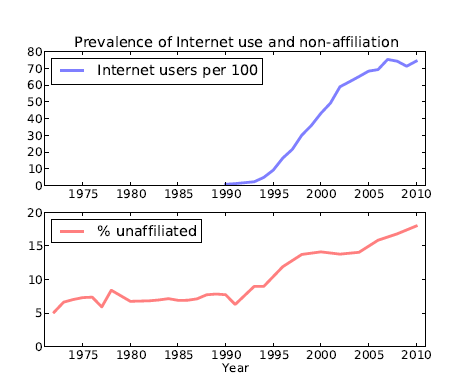
Back in 1990, about 8 percent of the U.S. population had no religious preference. By 2010, this percentage had more than doubled to 18 percent. That’s a difference of about 25 million people, all of whom have somehow lost their religion.

LosingReligion

(By the way, I’m not a fan of graphs that mislead by having different scales: the percent change in the adoption of the internet is far, far greater than the percent change in the adoption of atheism — this chart illustrates a similarity in timing, only.)

A computer scientist, Allen Downey, has dissected these trends to identify the major components affecting religiosity, and has narrowed it down to three big ones: upbringing, education, and access to the internet.

He finds that the biggest influence on religious affiliation is religious upbringing—people who are brought up in a religion are more likely to be affiliated to that religion later.

However, the number of people with a religious upbringing has dropped since 1990. It’s easy to imagine how this inevitably leads to a fall in the number who are religious later in life. In fact, Downey’s analysis shows that this is an important factor. However, it cannot account for all of the fall or anywhere near it. In fact, that data indicates that it only explains about 25 percent of the drop.

He goes on to show that college-level education also correlates with the drop. Once it again, it’s easy to imagine how contact with a wider group of people at college might contribute to a loss of religion.

Since the 1980s, the fraction of people receiving college level education has increased from 17.4 percent to 27.2 percent in the 2000s. So it’s not surprising that this is reflected in the drop in numbers claiming religious affiliation today. But although the correlation is statistically significant, it can only account for about 5 percent of the drop, so some other factor must also be involved.

That’s where the Internet comes in.  In the 1980s, Internet use was essentially zero, but in 2010, 53 percent of the population spent two hours per week online and 25 percent surfed for more than 7 hours.

This increase closely matches the decrease in religious affiliation. In fact, Downey calculates that it can account for about 25 percent of the drop.

That’s a fascinating result. It implies that since 1990, the increase in Internet use has had as powerful an influence on religious affiliation as the drop in religious upbringing.

I think there’s more to the story than this, though. The internet is too big and messy to be simplistically causal: there are also a great many sites dedicated to reinforcing the lies of religion, obviously, and there are Chrisians and Moslems who use the internet as a tool for evangelism and tribe-building. A more interesting question would be about how people use the internet. I don’t think a person’s faith would be challenged by the internet alone, but only if they use the internet to explore and compare conflicting views.

Australians denying science!

I have been informed that the courts in Australia are making anti-biological rulings. This is horrible news.

Now they are even making rulings on biology, and in a new case, informing us that they can also trump reality.

Oh, my.

We have just been informed by our enlightened justices that biology no longer exists, but is simply a social construct.

I am outraged!

Biology is now simply a matter of judicial decree.

This abuse of good science must end!

After all, biology does not exist anyway. We just make these things up to suit our fancies.

No!

So the courts can now determine whether reality exists or not. Those are certainly some sweeping powers. Of course these activist judges have been playing God for quite some time now.

This abuse of biology and science is terrible. So, Bill Muehlenberg, defender of science, what exactly have these wicked activist judges done in defiance of all evidence?

A Sydneysider has won a High Court case to be recognised as gender-neutral. Norrie, who was born male but underwent gender reassignment to become a woman, identifies neither as male or female and has taken legal action against NSW’s Registry of Births, Deaths and Marriages to be granted a non-specific certificate.

Norrie stopped taking hormones after surgery, preferring to live as neither male nor female. Counsel for Norrie said it is the register’s purpose to record the truth. “Norrie’s sex remained ambiguous so that it would be to record misinformation in the register to classify her as male or female,” a judgment summary reads. Sitting in Canberra on Wednesday, the bench unanimously found in favour of Norrie.

What? Well, that was a bit of a damp squib.

Sorry, Bill, biologically, that is a perfectly reasonable decision. Sex is complex, and gender layers another unfathomably difficult welter of complexity on top of that, so, speaking as a biologist, I have to say there is nothing in the science to defend your black and white, absolutist, rigidly binary view of human behavior. Men aren’t all one way, and women aren’t all another way, with the empty set between them. The court wasn’t being ‘activist’ or defying the science, but actually making a rather sensible decision in accord with reality. Norrie would know better than you or a judge that they don’t fit neatly into your limited and limiting pigeonholes.

But hey, Bill, you have another problem. It’s very kind of you to rush to defend ‘science’ (or rather, your unfortunately ill-informed version of it), but if you’re so enamored of it that you wield it as a shield and bulwark to defend your personal bigotry against homosexuals and transgendered people, how come you’re also attacking evolutionary biology?

The entire framework of Darwin’s theory leads inevitably to the gas chambers and the concentration camps. The biologically inferior had to be exterminated in order for humanity to survive and flourish. “If one society crushes another, that is not wrong. That is not even a shame. That is natural selection at work.”

And outright advocating creationism (and bad theology, too)?

The Judeo-Christian worldview is unique among the religions and philosophies of the world in affirming that human beings are made in the image of God. It is the uniqueness of humans that sets these two religions apart from all others.

And then to also be a climate change denialist…tsk, tsk.

But this makes sense, since the warmists and their media stooges really have embraced a new religion here. The religion of climate change requires as much faith – if not more – than most other religions. It is an article of faith to believe the warming hysteria, and anyone who dares to question it is branded a heretic and an apostate.

Evolution and anthropogenic climate change are actual facts, Bill; why do you think your twisted views trump reality, and that you can pretend biology and the science of our environment no longer exist? When it suits you, that is.

It’s sweet that science has become the assumed default standard of truth, but it’s not so cool that wingnuts seek to appropriate it to defend clearly anti-scientific positions.