Bread and circuses…well, circuses anyway, not so much bread

Michael Shermer indulges in some shabby Libertarian statistical games to wave away American economic inequality. Sure, there are inequities, he argues, but they’re not so bad — the poor are also getting slightly richer.

The rich are getting richer, as Brookings Institution economist Gary Burtless found by analyzing tax data from the Congressional Budget Office for after-tax income trends from 1979 through 2010 (including government assistance). The top-fifth income earners in the U.S. increased their share of the national income from 43 percent in 1979 to 48 percent in 2010, and the top 1 percent increased their share of the pie from 8 percent in 1979 to 13 percent in 2010. But note what has not happened: the rest have not gotten poorer. They’ve gotten richer: the income of the other quintiles increased by 49, 37, 36 and 45 percent, respectively.

I have a few problems with this. First, in an article titled “The Myth of Income Inequality”, he’s doing a bit of bait-and-switch: it doesn’t matter if the baseline is rising, the question is about the disparity. Income disparity is greater now than it was before. His own numbers show that.

This argument is basically a version of the “Well, the poor all have cell phones!” dismissal. They’ve also got refrigerators and TVs, therefore, you should just ignore the fact that the wealthiest are sucking up all our prosperity to fund luxuries and frivolities. We should just pretend that we’re all getting the benefit of a rising tide, and never mind that yacht towering above your dinghy.

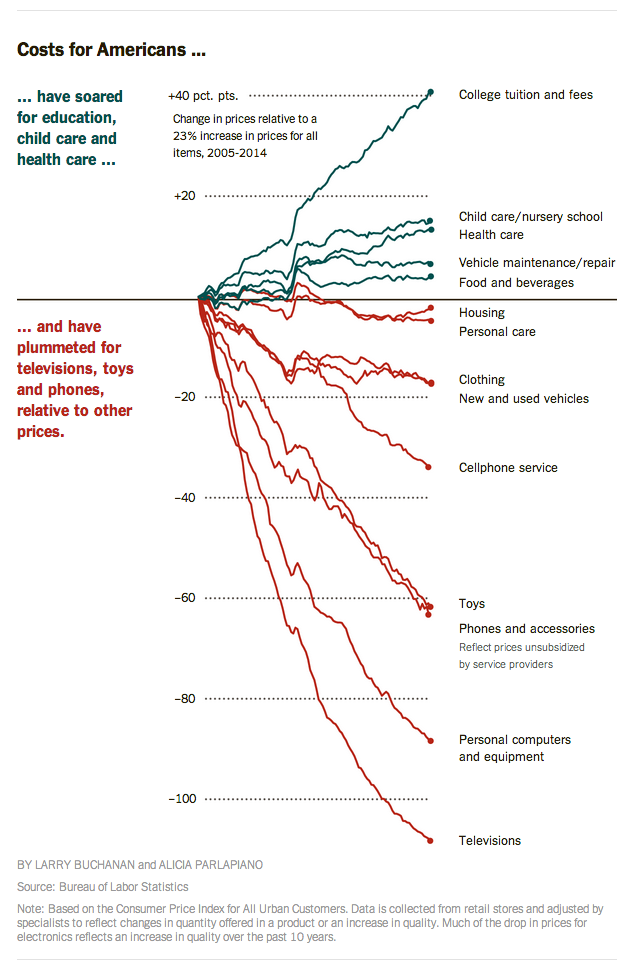
But there are other funny things going on in this economy. Look at this chart: the costs of TVs and toys and cell phones (the latter at least is essential now; but it’s a new cost for the poor, even if it is dropping) are plummeting, but the stuff that really matters for upward income mobility, like child care, health care, and education are going up. Especially education. We are saddling new graduates with overwhelming amounts of debt.

poorcosts

Another interesting game Shermer plays is to ignore the difference between income and wealth. It’s good that the poor are getting some increase in income, but if you’re using it to make ends meet or dig out from under a pile of debt, you’re not going to be accumulating any wealth — you can still get poorer. Meanwhile, the rich don’t have to worry about covering essential living expenses, and can invest and get richer. It’s useful to be able to see the distinction, so here’s a handy table of wealth and income in the US.

Income, net worth, and financial worth in the U.S. by percentile, in 2010 dollars
Wealth or income class Mean household income Mean household net worth Mean household financial (non-home) wealth
Top 1 percent $1,318,200 $16,439,400 $15,171,600
Top 20 percent $226,200 $2,061,600 $1,719,800
60th-80th percentile $72,000 $216,900 $100,700
40th-60th percentile $41,700 $61,000 $12,200
Bottom 40 percent $17,300 -$10,600 -$14,800
From Wolff (2012); only mean figures are available, not medians.  Note that income and wealth are separate measures; so, for example, the top 1% of income-earners is not exactly the same group of people as the top 1% of wealth-holders, although there is considerable overlap.

Here’s another sneaky trick. When the concern is inequality, let’s ignore the most extreme and instead focus on perceptions.

One reason for the controversy is that people overestimate differences between the rich and poor. In a 2013 study published in Psychological Science entitled “Better Off Than We Know,” St. Louis University psychologist John R. Chambers and his colleagues found that most people estimate that the richest 20 percent make 31 times more than the poorest 20 percent (it is 15.5 times), and they believe that the average annual income of the richest 20 percent of Americans is $2 million, whereas in fact it is $169,000, a perceptual difference of nearly 12 times. “Almost all of our study participants,” the authors concluded, “grossly underestimated Americans’ average household incomes and overestimated the level of income inequality.”

That’s beautiful sleight of hand. First, as previously mentioned, talk only about income, not wealth (and most of us already have poor intuition about the difference; notice also that if you look at the table above, the guesses pretty much hit the mark on wealth, rather than income). Then talk only about the top 20%, rather than the top 1%. And then make much of the fact that people’s guesses about rich people’s incomes are wrong. Har har, the proles guessed that managers make 31 times as much money as they do, when it’s really only 12 times.

Really? Try this exercise: imagine that you got paid just 10 times as much as you do now. “Just” 10 times. How much of a difference would that make in your life? I’m in a comfortable position; optimistically, I’m probably somewhere in the bottom of the 20%, so I don’t have to worry much about making ends meet, and give me an order of magnitude more money and I’d just be socking it away in a bank. But if you’re poor, if you’re struggling to cover child care and rent and keep the family fed, that’s an immense difference.

And of course the other factor is that the 20% aren’t actually working any harder than the 80% — their labor may require more training (which we’re trying hard to lock poor people out of with skyrocketing education costs), but they’re not actually working any harder than you are. My father was often working two jobs in order to keep spinning his wheels in poverty, so I’ve seen this inequality at work, and am well aware that I’m on the lucky side of the rich-poor divide.

But set aside all the squinty-eyed statistical games, and simply ask the fundamental question: Who owns the country? Where is the product of 315 million people’s labor going?

In the United States, wealth is highly concentrated in a relatively few hands. As of 2010, the top 1% of households (the upper class) owned 35.4% of all privately held wealth, and the next 19% (the managerial, professional, and small business stratum) had 53.5%, which means that just 20% of the people owned a remarkable 89%, leaving only 11% of the wealth for the bottom 80% (wage and salary workers). In terms of financial wealth (total net worth minus the value of one’s home), the top 1% of households had an even greater share: 42.1%.

That’s the inequality that we’re concerned about, that a mere 1% own well over a third of the wealth of the country, and it’s increasing — they use that wealth to manipulate media and politics to steal even greater quantities of our work. We are becoming a kleptocracy.

But never mind that. Look! Over there! There’s a poor person with an Xbox!


But wait! Even that claim that the poor have gotten richer may be dodgy: this analysis of reported incomes shows that we’ve been experiencing a decline.

Setting the bar low. Burying it, actually.

Penn Jillete defends Anthony Cumia. We’re all missing the important detail that exonerates him — sure, he went off for hours in a racist tirade, but don’t you all realize that Cumia is licensed to carry a concealed handgun?

Penn Jillette says that people are burying the lede in the alleged incident that led to SiriusXM’s decision to fire “Opie and Anthony” host Anthony Cumia. He also argued that he’s never seen any evidence that suggests Cumia is racist as many of his critics have alleged.

We are burying the lede of this story, which is that Anthony, who has a reputation for being a bit of a hot head, is carrying, comes up gets hit in the face and does not hurt the person back, Jillette said during his “Penn’s Sunday School” podcast this weekend.

That is incredible. If I am in the position where I cross somebody who is carrying a gun and who can defend themselves and hurt me, and their choice is to write angry stuff on Twitter instead of fighting me back — wonderful. Gandhi! That’s Gandhi! … That is Martin Luther King, he continued.

Seriously? He just compared a racist ranter to Gandhi and Martin Luther King because he didn’t shoot a black woman in the face?

Sure. This sounds exactly like something King or Gandhi would say.

Savage violent animal fucks prey on white people. Easy targets. This CUNT has no clue how lucky she was. She belted me 10 times. I had a gun

No,an ANIMAL BITCH used it’s instinctual violence on me. I restrained myself from putting it to sleep

It’s a jungle out in our cities after midnight. Violent savages own the streets. They all came 2 defend this pig. I had to yell like at dogs

Gosh. I’ve never shot anyone, and I’ve never even raged at minorities as animals. I guess that means I must be like Jesus!

By the way, the article strangely features a photo of Cumia’s concealed carry license…with a 2012 expiration date. I guess True Skeptics™ don’t give a damn about little details like that.

cumialicense

Godless baseball

It’s that time again — for the third year in a row, Minnesota Atheists have adopted the Mr Paul Aints for their regular conference. Come out on Friday, 11 July to watch the game, eat hot dogs, drink beer, and shake your fist at the gods, and then join us on Saturday for the conference. They’ve got Susan Jacoby! Debbie Goddard! Dan Barker! Rebecca Watson! The comedian Elizabeth Ess! Some other guy who was cheap and local! You must participate!

Closure on the Obokata/STAP affair

I’ve been following the story of stimulus-triggered acquisition of pluripotency (STAP) cells with considerable interest, and there’s a good reason for that: from the very beginning, it contradicted how I’d always thought about cell states, and if it were true, I’d have to rethink a lot of things, which was vexing. But on the other hand, empirical results always trump mental models, so if the results held up, there was no question but that I’d have to go through that uncomfortable process of reorganizing my preconceptions. It would be OK, though, because there’d be a great prize at the end.

Well, it turns out that I don’t have to reboot my brain after all, because now that all the flailing about is over, STAP is a product of sloppiness and fakery, and is dead.

So here’s the controversy, and why I found it vexatious. We want to be able to specify cell states; in particular, we’d love to be able to take any cell from the human body, tickle it with a few specific signals, and see it throw away all of its historical constraints and become a different cell type altogether. In particular, the Holy Grail is to find the right combination of switches to cause any cell to become a pluripotent stem cell — the kind of cell we can then induce to become any other cell type we might need.

We know this can’t be impossible, and is probably even fairly simple, because we know that cells can do this already (well, to some degree; your body accomplishes this task by setting aside reserve populations of stem cells. It’s also likely that some cell types are so tightly locked in by the process of differentiation that their state is not reversible). The idea is that we just need to find the right combination of signals/genes — the right kind of key — and we can unlock the cell, and make it open to additional inductions that will allow us to manipulate it.

We have some idea of the shape of the key. Yamanaka identified four genes, Oct4, Sox2, cMyc, and Klf4, that when activated, switched cells into a pluripotent state, making induced pluripotent stem cells, or iPS cells. It works. The handicap right now is that we only have a kind of brute force method of switching those genes on, and two of them are oncogenic, so it’s as if we’ve got a rather clumsy key that opens the lock, but also damages it in unfortunate ways. The resolution to that problem, though, was learning how to finesse the genes — we need to figure out how to more delicately switch on the necessary genes by a way other than bluntly transfecting cells with copies of the genes that are always on.

Then along came Haruko Obokata, an investigator in Japan who announced that she could induce stem cells with simple, generic stress, such as by exposing them to acid or physically pushing on the cells. It was like saying she didn’t need a specific key, all you needed to do was shake the lock really hard, and it would spontaneously pop open. What, really? That just seems too simple. It would be phenomenally awesome if true, but it seemed unlikely. But then, I remember this one lab I worked in where all the publicly popular drugs, like ketamine, were kept locked in a drawer to which only the PI had a key…but the countertop wasn’t secured to the bench, so if you knew about it, you could just lift the top and get easy access. It was a backdoor to the goodies that was so stupid you couldn’t believe it existed, but it did.

Could it be that cells similarly had a stupid weakness that could be so easily exploited? The short answer is no; read the whole article by David Cyranoski.

But the paper1 that set out the fundamental technique was soon shot full of holes. There was plagiarized text in the article. Figures showed signs of manipulation, and some images were identical or nearly identical to those used later in the same paper and elsewhere to represent different experiments. More damning were genetic analyses that strongly suggested the cells were not what they were purported to be. And although deriving STAP cells was advertised as simple and straightforward, no one has yet been able to repeat the experiment.

Within the space of six months, Obokata was found guilty of misconduct by her institution; well-respected scientists, including RIKEN head Ryoji Noyori, bowed their heads in apology; and both papers were retracted. In the end, the evidence for STAP cells seemed so flimsy that observers began to ask where were the extra precautions and the ‘extraordinary proof’ that had been promised post-Hwang.

It sure would have been nice to have a simple technique for generating stem cells, but I have to confess to being a bit relieved. There’s the vindication of prior thinking and the value of incrementally improving our stem cell protocols, of course, but also, I’d personally rather that it weren’t trivial to switch my cells to a de-differentiated pluripotent state — that’s a recipe for easy cancer generation, too. It is somehow reassuring to think that evolution has shaped multi-cellular organisms to be somewhat resistant to spontaneously going all stem-celly under stress.

If your only justifications for sexism are stupid, you should maybe stop making them

Once again, we get stupid answers to a good question. A a guest post on the Curious Wavefunction decides that Larry Summers was right, there are innate differences between men and women. (Curiously, this is the same blog that posted a positive review of Nicholas Wade’s book — strange how sympathy for racism and sexism go hand in hand). It starts off well by pointing out a real phenomenon, the different sex ratios found in different scientific disciplines.

Here are statistics on the sex ratio among graduate students. The order here is by level of analysis (with computer science thrown in somewhat arbitrarily next to physics). The first number is men; the second number is women.

Physics:   1694: 448
Computer Science:  1465: 380
Chemistry:  1520: 897
Biology:  3936:4494
Psychology   1047:2566
Anthropology:  186: 360:
Sociology: 230: 400
Political Science: 422: 303

Why is that, you might wonder…and of course, the answer we’re going to get is that there’s something about the Y chromosome or the hormonal environment that predisposes one to like computers vs. cells, or experiments with lab rats vs. electronic gadgets. Which, simply on the face of it, is complete bullshit.

I’ve noticed that these arguments often prefer to show a current snapshot of the statistics to make their point: looking at historical trends tends to screw up their assertion of a biological difference. A century ago, virtually none of these disciplines had a preponderance of women enrolled in them, and women professors were extremely rare. I guess there has been a remarkable degree of selection extinguishing all those stupid women from the population in the last 100 years. It’s simply not possible that cultural factors might strongly influence the pattern.

Similarly, we could ask questions about aptitude. Women just don’t like those disciplines with low female enrollment, because ladybrains. But how do we account for historical shifts in ability? Look what’s going on in the British school system.

The relative improvement in girls’ performance in examinations at 16 has been achieved over the last ten years. In the l960s, boys outperformed girls by about 5%; for the next fifteen years, boys and girls were performing at almost equivalent levels. However, from 1987 only about 80 boys to every hundred girls achieved 5 high grade passes at 16+. Boys lost their advantage in terms of school leaving credentials and are now struggling to keep up to girls’ success rate. In the mid l980s, girls turned the tide of credentialism, even at least temporarily, in their favour.

Oddly, no one seems willing to advance the bold hypothesis that maybe boys’ genes and hormones make them less scientific. It’s always the other way around, that women are less capable, because ladyparts…even in defiance of the evidence that women are performing better than men.

OK, well I promised we’d have some good questions. I lied. This guy asks stupid questions.

This brings us to two related questions: Why is the percentage of women somewhat proportional to the “socialness” of the science?

WHAT THE HELL…? Look at the list up above. Can you tell me which of those disciplines is more “social” than the others? Science in every discipline is an extremely social enterprise — if you’re going to succeed in it, you have to be able to engage with your colleagues, present your work publicly, collaborate, teach, and work in committees. If you think you can crawl into a basement and do computer science without bathing for 5 years, well, you can…but you won’t get a job afterwards, and you won’t be able to be a significant team member. Really, I know computer scientists. They do bathe regularly, and they can be friendly and engaging.

This assumption is a classic example of circular reasoning. Women are more social; some disciplines have more women than men; therefore, biology must be more social than physics; and the evidence for that is that biology has a higher proportion of women graduate students than physics. Ta-daa. QED. Guys win.

And why don’t women choose academic careers after they finish graduate school? To answer these questions, it’s worth looking at Steven Pinker’s contribution to the post-Larry Summers debate at Harvard.

Wait. That’s a different question, and it’s informative that the distinction isn’t addressed. Women are succeeding in greater numbers in graduate school than they are in post-doctoral careers. That’s revealing! By getting through graduate school, which is a pain-in-the-ass and a major sacrifice of time and money, these women have already shown a strong interest and ability in science. They are full-on dedicated scientists.

What’s the difference in the transition from life as a graduate student to the professoriate? More expectations for teaching, networking, committee work, grant writing, and collaboration. More of those “social” skills we’ve just been told women are naturally better at. As usual, none of this argument makes any sense, and consists entirely of sloppy attempts to rationalize prior biases.

We are promised evidence that women are simply less suited to working in science. Let’s see the list.

The full debate is also worth reading in full—and I apologize for giving Elizabeth Spelke, Pinker’s opponent, short shrift here–but this is Pinker’s summary of the psychological differences between men and women:
1. Men, on average, prioritize status, while women weigh status and family equally.
2. Women, on average, are more interested in people; men are more interested in things and abstract rule systems. 
3. Men are by far the more reckless sex.
4. Men, on average, have a superior ability to do three-dimensional mental transformations.
5. Men, on average, are superior at mathematical reasoning.
6. Men have more variability than women across traits, which means that men are over-represented in the upper and lower tails of ability distributions.

Jebus. Those are just assertions. Who says women don’t “prioritize” status? How was that measured? Do women just sit around content to be egalitarian? Has anyone considered the possibility that status-seeking is going to be entirely culture dependent, and that there are different ways for different people to achieve high status? (I know they have, but those complexities are always jettisoned by the advocates for male superiority — the parameters of male dominance are naturally and obviously the only ones that matter, and they are objectively independent of societal constraints.)

I’m not going to was time going through these bald assertions one by one, but let me just say, they don’t apply. We’re already looking at a fairly rarefied subset of human endeavor occupied by people of largely above average socio-economic status, from families with an already above average emphasis on education. You can’t derive the properties of an already select subset from generalizations about the population as a whole, or you’d have to conclude that most scientists are blue-collar and service workers. We already know that there are strong cultural and familial influences that bias some women to pursue careers in science — factors that are not present for most women. Or most men. So even if their generalizations about the abilities of women were valid on the whole (and I don’t agree that they are; #2, 4, and 5 are clearly influenced by social conditioning, and #3 is statistically true but again probably influenced by social expectations), you simply can’t use them to talk about a small population that is both self-selected and strongly constrained by socioeconomic opportunities.

But #6…oh, #6, how I despise you, and how I constantly hear it trotted out as a justification. Look at the structure of that argument. We can clearly show that more men than women have mental disabilities and illness, therefore, we should expect that more men should show a greater range of high intelligence.

WHY? That makes no sense. It’s some kind of weird appeal to statistical fairness — that for some reason, Nature must balance every curse with a blessing, that every curve must be a perfectly symmetrical bell shape. But that is not true. There is no reason to expect it to be true.

It’s also selectively applied. I noted up top that the same people who argue for differences in intellectual aptitude between the sexes also like to argue for differences in intellectual aptitude between races. Yet for some reason, you’ll never see them suggest that since black people have a higher frequency of criminals and ignorant, uneducated men (I’d suggest that poverty and discrimination play a strong role in that, but you know these guys — they say it’s objective evidence of genetic inferiority), they must therefore also have a greater proportion of saints and geniuses in their populations.

It would be only fair, you know. Everything has to balance.

Or we never see this interesting proposal: malnutrition also increases the variability in a population. Therefore, if we want more supergeniuses, we should starve children — sure, we’d get a lot of death and illness, but the ones who thrive are going to be tough and brilliant.

I find myself endlessly exasperated by these transparently stupid justifications. They aren’t even internally consistent.

Muslim creationists are as obtuse as the Christian kind

Over the last few days, I’ve had a ‘conversation’ with a Muslim creationist on Twitter. He’s claiming that the embryology in the Quran is accurate and specific, and amusingly, he’s citing this article on the web to support his claim, saying that it is on his side. He starts off with some criticisms — he doesn’t like the tone, it’s not sciencey enough — but he says that it confirms that the “Quran is more specific and very different in the level of detail then Greek”.

There’s an amusing bit where it suddenly sinks into his thick skull that I’m the author of the article.

That’s not going to stop him, though. Watch. He still insists that I wrote the opposite of what I actually wrote.

Clinic Stories

Robin Marty proposes to do in-depth investigative reporting on the stresses on family planning clinics.

Clinic Stories is a 12 part series that will look at 12 different clinics or cities in the country, telling the history of legal abortion through location and the people inside and outside it.

Each Clinic Story will be an intensely researched, longform article anywhere between 5000 and 10,000 words, detailing the history of the clinic and its role in the movement, tracking laws that it has challenged, protesters it has faced, anti-abortion and pro-abortion rights groups that have worked for it or against it, and where it fits into the greater history of the last four decades of the abortion rights movement. It will include interviews with current and former workers, escorts and even those who have worked to shut those clinics down.

Robin is writer with a fine track record who has been fighting for abortion rights for years, and this should be a very good addition to our knowledge. She’s looking for support — this is going to take time and effort to do well — so she’s asking for donations. Help her out, it will be worth the investment.

Not even creationists want to be associated with creationism

You wouldn’t guess it from the name, but the Akron Fossil and Science Museum isn’t really a museum, has nothing to do with science, and they think their fossils are less than 6,000 years old. It’s also not in Akron; it’s in Copley, Ohio. It would be hard to come up with a more misleading title.

One possible reason is that it’s a way to lure in participation from public schools. At least one teacher, by error or devious intent, has taken students from the Cuyahoga Falls public school district to this creation exhibit, so maybe it’s an underhanded game.

I suspect a more common reason. Creationists love to ape the trappings of real science, and are a bit ashamed of the low reputation their stupid beliefs have, so they play these games. It makes no sense to me. I wouldn’t rename my courses “Jesus’s Holy and Sacred Revelation of Biology”, just to sucker in the rubes. But then I’m not peddling bullshit.

Because Indians are magic!

So you wish you were an Indian, because they’re so spiritual and noble and one with nature — they’re so magical that having a name like Manny Two Feathers or Vicki Ghost Horse means the crap you sell on e-bay has extra cred and is worth more money.

Now you can be! It’s easy. There are plastic tribes popping up all over the place, and all it takes to become one is money.

The "United Cherokee Nation," which did not respond to Phoenix inquiries, charges a $35 application fee, while the "Western Cherokee Nation of Arkansas and Missouri" has a $60 application fee and a $10 annual roll fee. The "Cherokee of Lawrence County" don’t charge for membership but instead asks its members to "make it a priority to send $10 a month to help with the tribe" and $12 to subscribe to its newsletter.

Membership fees and dues are just two signs a "Cherokee" group isn’t legitimate, task force members said. Other signs include members using Indian-sounding names such as "Two Feathers" and "Wind Caller," acting and dressing like Hollywood-stereotyped Indians or Plains Indians, asking for money to perform DNA tests or genealogical research, requirements to wear regalia to meetings and requirements to go through an Indian-naming ceremony.

Once admitted into the groups, members usually get membership cards, bogus "Certified Degree of Indian Blood" cards and genealogy certificates "proving" they are eligible for membership.

You might notice the Cherokee mystique: most of the fake tribes seem to be some branch of the Cherokee nation. Apparently nobody wants to be a long lost member of the Humptulips tribe, or a Stillaguamish — although you’d think Lakota, with their history as the stereotypical Plains Indian, would be more popular.

They usually dress it up more, of course. The Red Nation of the Cherokee (totally fake) thinks that if you really feel like an Indian in your heart, then you ought to join the tribe.

We do not need to follow the standards of the antiquated BIA regulations/policies of the late 1700’s or after any longer! Which, dices people up into fractions and percentages, we are true human beings and a whole person.

Our beliefs are, if an individual is of multi-Nations, then they should be allowed to honor each of them in their own way, not being forced to choose one over the other.

We of the Red Clay People of all Nations believe, we should not have to prove our heritage’s on the talking leaves paper, but be allowed to prove in the older way, what is truth in our hearts.

The Creator has heard the prayers of the people, and gave vision to start RedNation of the Cherokee. To make a place, for all the people to have a home and family, to come to and to be finally called brother or sister and to be recognized as blood.

The “talking leaves paper”? Jebus. I know a lot of local Indians (UMM offers free tuition to people of real Indian descent, verified by membership on a real tribal roll), and not a one talks like that. They also don’t wear fringed buckskin clothes with feathers in their hair. You will occasionally see them in traditional costume — which is usually jeans and a plaid work shirt, with maybe a decorative bit of bead jewelry, or a feather in their cowboy hat — when artists and cultural representatives show up on campus for our yearly powwow of native music and dancing. But get real, these are human beings who are part of a changing culture — they are not the TV Indians who never left the 18th century.

I did find this fake tribe’s rationale amusing.

Another group asking for federal recognition is the Cherokee of Lawrence County, Tenn. The tribe’s principal chief, Joe "Sitting Owl" White, said he eventually expects his tribe to be federally recognized because he and his 800 fellow members are Cherokee, and he cites photography as proof.

We’ve been called every name in the book, but we are Cherokee, he said. We can take photos of our members and hold them up and see the Cherokee in us.

He also said his tribe has scientifically proven with DNA evidence that the Cherokee people are Jewish.

You know, I actually wouldn’t be at all surprised if some members of the Cherokee of Lawrence County were certifiably and demonstrably of Jewish descent, so he might not be wrong about that. I should apply and join — they could test me and prove that Indians were also Celts who drifted over on a coracle, and Vikings who colonized the entire continent.

Los Angeles Women’s Atheist and Agnostic Group Inaugural Meeting | Center for Inquiry

This just isn’t fair. The east coast has Women in Secularism in the spring, and now the west coast has LAWAAG every month.

Join us for the inaugural meeting of The Los Angeles Women’s Atheist and Agnostic Group!

LAWAAG was formed by multi-media artist Amy Davis Roth with the goal of fostering a safe and supportive space for those who primarily identify as women, who are leaving faith, or who already live a secular or atheist-based lifestyle.

LAWAAG will meet the first Tuesday of every month at 7pm at CFI-L.A.. Along with regular monthly meetups, the group also organizes art, activism and outreach projects, and works towards building community and support for women without faith.

In order to foster a safe space that acknowledges and can focus on the specific issues women encounter and deal with in a secular community, we currently only accept members who primarily identify as women. However, we often participate in and sponsor co-ed events. We welcome new members at our monthly meetup and welcome all to attend our publicized co-ed events. Please go to our events page for a list of upcoming and current events.

Please contact Amy Roth with any questions or media inquiries.

There’s a gaping void in the middle of the country. Quick, someone set up something similar in Minneapolis! Or the South! Or in every state!


Oh, and by the way, Secular Woman is two years old now.