I’m a 7. Definitely. Definitely a 7.

I’m seeing this rendition of the Dawkins Scale going around on social media.
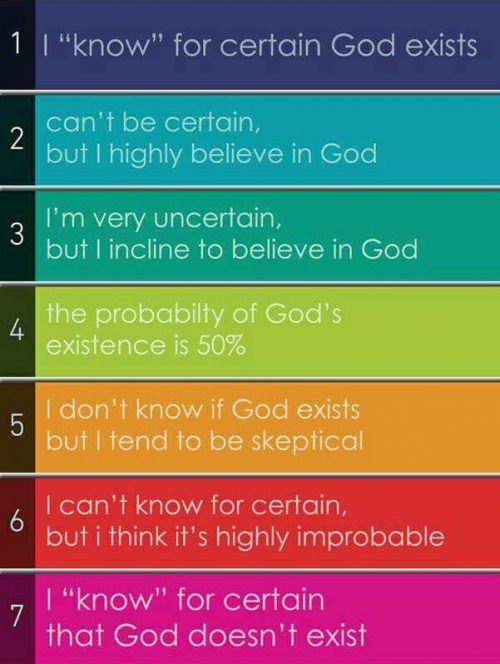
What I find most amusing is all the people saying that they’re a 6, and that anyone who is a 1 or a 7 is an idiot. It’s amusing because I’m a 7.

Here’s the deal: the “god” we’re debating here is this amorphous, poorly defined thing that is floating around in people’s heads, often with a collection of inconsistent, incoherent associations tied to it. Before you ask me whether I believe in it, you had better tell me specifically what you mean and not rely on a set of variable cultural assumptions.

It’s like you’re asking me whether I believe in new Shimmer, and when I ask what it is, you tell me it’s a dessert topping. It’s a floor wax! No, it’s both a dessert topping and a floor wax, and it’s also three things that are one, and it’s the omnipotent ruler of the universe, and it’s afraid of iron chariots, and it thinks you deserve to burn in hell, but it loves you very much!

I’m just going to tell you to sober up, get your act together, and give me a clear and coherent definition of what you’re talking about, and then maybe I’ll be able to decide whether I believe in it or not. Until then, I’m a 7, and you’re just blithering bullshit with a wacky notion with loads of contradictions that you’re trying to conceal by reducing it to a 3-letter word.


Creationist castle

The Creation “Museum” is losing money, so Answers in Genesis is going to try and shore up profits with a renovation. It’s not looking good.

They’re going to upgrade the theater with 3-D projection. This is the theater where they currently show Men in White, a short movie that is so bad that when I visited the “museum” I only lasted 30 seconds before concluding that I wouldn’t be able to sit through it, or the gimmicky shaky seats and water sprays. Now they’re going to have plesiosaurs looming out at you as an excuse to drip water.

But the big deal they’re bragging about is that they’re going to redesign the entrance to include…new displays! Static displays with no evidence! More apologetics! I’m not feeling the urge to visit it a second time.

Wait, what’s that in the center of the exhibits? Those red balls? That looks familiar.

It is familiar! I’ve seen that so many times. It’s the centerpiece of many of Ham’s droning talks.

They have taken this cartoon, and plan to turn it into a 3D diorama.

You know, this doesn’t suddenly make it more true or believable. It does discredit the “museum” even more that they think it a noteworthy addition to create a sculpture of an old cartoon by a creationist hack. Why? Was Ben Garrison unavailable?

Jordan Peterson is peddling IQ myths and fallacies

Jordan Peterson is notorious for his desire to annihilate a liberal arts education, wanting to throw out the humanities and social sciences (except psychology, apparently) as tainted by post-modernism. We’re supposed to fire all those bad professors who teach bad ideas, false facts, and unacceptable interpretations of the evidence.

I guess that means we can fire Peterson, then.

This article correctly identifies him as The Professor of Piffle. In addition to his intolerance and failure to understand modern literary criticism, it turns out that he, a professor of psychology, doesn’t understand how the brain works.

To fully grasp the depth of Peterson’s belief in power hierarchies, take his commitment to IQ testing: “If you don’t buy IQ research,” he has told his students, “then you might as well throw away all of psychology.” Peterson rejects the theory of multiple intelligences (emotional intelligence, musical intelligence, and so on) and insists that all of human intelligence is biologically determined, essentially unalterable, and expressed in a single number that can be ranked. Your IQ, he says, will govern where you end up in life: with an IQ of 130, you can be an attorney or an editor; at 115, you can be a nurse or a sales manager; at 100, you can be a receptionist or a police officer; at 90, you can be a janitor.

Peterson’s defence of IQ rests on shaky foundations. While he tells students that IQ was empirically established through Charles Spearman’s factor analysis, he does not share the well-known critique of that method: factor analysis supports both of the contradictory causal explanations of intelligence (intelligence as innate versus intelligence as the product of environmental advantage). Peterson then stacks the deck in favour of biology, citing brain size and neural conduction velocity (essentially, the speed at which an electrical pulse moves through tissue) as the determinants of IQ. Again, he does not tell students that both explanations were discredited by later research.

In the tradition of nineteenth-and early twentieth-century pseudo-scientists, phrenologists, quacks, and scientific racists, Peterson’s commitment to IQ is simply the reflection of his commitment to an unalterable hierarchy of human beings. And this is why his dismissal of “unnatural” and “made up” gender pronouns, alongside his casual sexism—his belief that women would be better served by having babies than careers and that male feminists are “creepy”—turns out to be central to his intellectual project, which seeks to resurrect the conventional patriarchal pecking order. For Peterson, transgender people and powerful women upset the “male dominance hierarchy” that forms the centerpiece of his thought. His world view is predicated on the promise of restoring authority to those who feel disempowered by the globalism, feminism, and social-justice movements he derides.

I have to object to the phrase “stacks the deck in favour of biology”, because no sensible biologist would accept that load of crap as in any way valid. It is not good that “the most famous professor in Canada”, as the article calls him, is promoting bad science.

How to throw your life away and piss on your own reputation

The atheist community is buzzing about this story: a popular host of the Recovering From Religion podcast, Scott Smith, has died. I have briefly met Smith but didn’t know him at all well; the founders of Recovering From Religion, Darrel Ray, Nathan Phelps, and Jerry DeWitt are very well known. Most of what I’m seeing about his death is shock and dismay and testimonials about what a good guy he was. I didn’t know him well enough to say whether he was a good guy or not, but the facts of the story tell me that he was NOT a good guy at all. This is a terrible story of an awful person who apparently had a lot of people fooled.

Authorities have identified the man and woman who were found dead in a North Side San Antonio home after a suspected murder-suicide shooting.

William Scott Smith, 54, is believed to have fatally shot his wife, 46-year-old Jennifer Smith, before turning the gun on himself. Their three young children were at school during the killing.

Though William Smith’s motive is still unclear, court records indicate that Jennifer had filed for divorce earlier this month.

Let’s get this straight. This man was facing a divorce, and his wife wanted to be free of him.

So he murdered his wife.

He murdered a woman, full stop. Because she wanted to be free of him.

He murdered someone for the crime of wanting her independence.

There is nothing that Smith could have done in his life that could possibly atone for the criminality and inhumanity and selfishness of the circumstances of his death. His behavior was reprehensible and unforgivable. That he killed himself afterwards was not an act of atonement, but of cowardice.

Further, he orphaned three children, who get a life’s dose of trauma and grief right now. This, too, is unforgivable and irresponsible.

Don’t grieve for Scott Smith. Grieve for his victims.

His facebook page now has a brief memorial note at the top:

We hope people who love Scott will find comfort in visiting his profile to remember and celebrate his life.

Nope. Don’t celebrate the life of anyone who ended it with the murder of his wife, the mother of his children. Jennifer Smith is the one who should be remembered.

Only a fool would think they found the tomb of Jesus

Perhaps the only good result of the dissolution of Scienceblogs is that I’m no longer even distantly associated with National Geographic. I say this because, as usual, the magazine is indulging in religious pandering to the old people who still subscribe to it.

They are reporting on the age of “Jesus’ tomb”. That is, they found some mortar in the Church of the Holy Sepulchre that dates back to Roman times…which is not news. Jerusalem was a Roman city in Roman times, it contains many ancient buildings, and finding Roman structures is not evidence that this particular hole in the ground is the specific tomb of a specific executed criminal in 33AD, nor that a slab of rock is specifically where Jesus was laid out after death. The mortar was dated to 345AD, which compounds the confusion — how is the erection of a temple 300 years after the purported execution evidence that this is Jesus’ hole in the ground?

Also, the identity of this particular spot was generated by a Christian zealot, Helena, mother of the Emperor Constantine, who went swanning about Jerusalem around 325AD, pointing at rocks and sticks and random plots of ground and declaring them to be sacred Christian treasures. She claimed to have found the True Cross™, the True Ropes™ that bound Jesus to the cross, the True Nails™ that staked him to the cross, the True Tunic™ that Jesus wore, and the True Tomb™ where he was buried, purportedly briefly. It’s all nonsense and not credible, but NatGeo makes it a big feature in their magazine, and it’s also going to be the subject of a documentary on the National Geographic Channel on Sunday.

It’s part of the tradition. Helena and Constantine contrived a set of fake holy sites to fleece the ancient and medieval rubes, and NatGeo regularly contrives phony stories about Jesus to fleece the more modern, but still equally gullible, rubes.

Our president is a certifiable madman

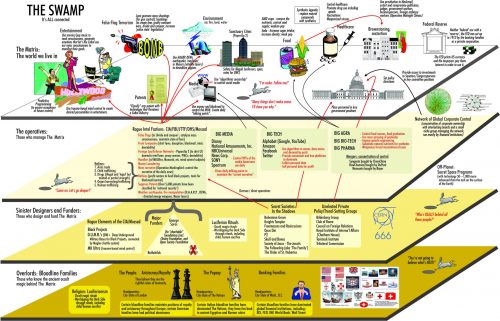
The other day, he tweeted something from a site called MAGAPILL, because they’d posted something praising him for his ‘accomplishments’. Here’s what else MAGAPILL endorses.

It’s an astonishing expression of paranoid insanity. You can get lost in all the bizarre details.

We’re using HAARP, DEWs, and satellite lasers to control the weather. GMO crops are agents of control. Lone gunmen are false flags to encourage gun control.

We have off-planet secret space programs. CERN is somehow tied to 666? Bilderbergers, Knights Templar, and Luciferian Rituals. George Soros. What is it with George Soros? I don’t know anything about Soros. To me, he’s an old guy with an undeservedly large fortune, just like all the other rich fucks, nothing more. That he sometimes endorses progressive causes doesn’t seem to warrant the foaming-at-the-mouth hatred he gets.

I’m also bewildered by the fondness of MRAs and Nazis for an old Keanu Reeves movie. Why all the Matrix allusions? It’s really strange that the fascists of today saw a movie by Lilly and Lana Wachowski and decided that yes, that was the uniform for their movements.

Everything about these guys, Donald Trump included, simply screams warped and dangerously demented perception of reality. And they’re running the country? Goddamn.


If you really want to zoom in on that mess, here’s a link.

I expressed myself about Genesis: Paradise Lost


In case you don’t want to listen to a whole half hour of this, here’s my concluding statement:

Look. I’m an atheist. This stuff plays directly into my hands — if your religion demands that every statement in your holy book must be absolutely, inarguably true, and that your entire faith hinges on a complete lack of metaphor, poetry, allusion, and analogy in that book — that it is as dry and literal and factual as a table of measures in an engineering text — then I’ve got you. I am going to win over your children to my side, and you know it.

As an atheist, I’m often told that I don’t understand your religion. But I do. I understand it better than the fanatical literalists, anyway. Religion has a long history of struggling to reconcile reality and belief, to find humanity’s place in a largely unknown and complex and frequently hostile universe. If there is any saving grace in faith at all, it is that it is an attempt to find a rock of certainty in the unpredictable chaos of life — it is aspirational, a search for truth. As such, religion changes over time. It evolves.

Where it fails is when people like Ham and the Hovinds give up on the search and the struggle and decide that they have an absolute lock on an irrevocable and ultimate truth, one that will no longer bend to the evidence, that will no longer care about the nature of reality, but only the nature of one antique interpretation of the words of a book. They will not change any more. They will cling stubbornly to this one unmoving stone of dogma, and they will insist that everything else is wrong. They will close their eyes and grasp tighter and tighter to that one illusion of certainty as it crumbles around them. By refusing to bend, they commit themselves to someday breaking.

The movie goes on like this for another hour and a half: more tiresome and tired old creationist arguments interspersed with brief episodes of bad CGI accompanied by a slow, lugubrious voice of god. It ends with another 10 or 15 minutes of fast cuts between their cast members, all testifying and preachifying about the glory of god and how lovely Jesus makes them feel.

It just makes me terribly sad. These are lost minds committed to battling against the real world.

A delicate exercise

It must be tricky to critique flat Earth stories, which are risibly goofy and in defiance of the evidence, when you personally believe in young Earth stories, which are just as idiotic, but Danny Faulkner of Answers in Genesis tries. He attended a flat earth conference, and what’s remarkable about his essay is how gingerly he treads. Make no mistake, Faulkner does not believe in this flat earth crap, he gives a few specific criticisms of some of their rationalizations, and it is not currently the policy of Answers in Genesis to support flat earth claims (they say the Bible does not claim the Earth is flat), but give them time — if flat-earthers become numerous enough to be fleeced, expect even more niceness from AiG.

It’s just the irony of it all. Faulkner was getting a little taste of how loony these fringe Bible kooks look to the rest of us, with their weird claims that flout all the evidence, but are fervently held solely because they connect them to their religious beliefs. No, the Bible doesn’t flat out state that the Earth is flat, but it is a reasonably inferred part of the mythology, and there are all kinds of hints that the ancient authors modeled the world that way; it also doesn’t come right out and say that the Earth is only 6000 years old, but it is also clear that the ancient authors had no concept of deep time, and so AiG has inferred and imposed a set of interpretations on the Bible that bolster their preferred preconceptions. There is no difference between flat-earthers and young-earthers in their methodology or their biases or their abuse of science.

There’s also the lack of perspective. I’ve attended creationist events, and this is exactly what they sound like: disappointingly vague, reliant entirely on religious testimonies and that damnable Christian persecution complex.

I was a bit disappointed by the content of the conference. I had expected that I would hear and see information about flat-earth that I hadn’t encountered already, but that wasn’t the case. Many of the presentations largely were personal testimonies of how people had come to believe in flat earth. Hence, I didn’t learn much about the flat-earth model that I didn’t already know. However, I did learn much about the flat-earth movement itself. In conversations and in the presentations, I learned how people came to lose jobs, friends, and even family members once they, in their own words, “came out of the closet about flat earth.” Therefore, many of the people in attendance clearly viewed the meeting as a safe refuge where they could meet ostracized people like themselves. This clearly brought joy to many attendees, and I suppose the last thing these people would do would be to castigate someone in their midst who isn’t a flat-earther, provided that person behaved as a guest.

I’ve never seen a creationist talk that wasn’t thickly larded with personal testimonies about their religious beliefs, that didn’t end with pious ranting about Jesus, and that wasn’t full of offended indignation that those wicked seculars wouldn’t let them preach the Gospel in public schools.

If you want some real fun, Faulkner mentions this nice flat-earther he met, named Noel Hadley. He’s a hoot. He thinks Francis Crick learned about the structure of DNA from LSD-fueled sex parties, Peruvian shamans, ancient Egyptians, and snake myths.

But let’s not forget, the Egyptians also had a part in Crick’s discovery. Did Pharaoh not wear a cobra on his crown as a symbol of the divine word and third eye—the pineal gland—by which true hidden knowledge might be discovered to the devoted initiate? In his book, The Secret in the Bible, author Tony Bushby suggests the capstone of the Great Pyramid was once a clear crystal or glass that produced a visible beacon of light from its apex. He writes: “Whenever a light is shone down into a glass pyramid in exact scale or proportion as the Great Pyramid, a ‘Rainbow Serpent’ is created. The light provides a type of force or energy that, in turn, creates the vertical spiral of light, a serpent upraised, invisible in rock, but visible in a clear substance. That is what the Ancient Egyptian Priesthood meant when they said, ‘A serpent lies coiled in the Great Pyramid.’” Bushby’s conclusion is as you might now suspect. The Rainbow Serpent, directly referenced by the priesthood, was a double helix like representing Francis Crick’s strand of DNA.

Every continent seems to have a role in ancient serpent worship. Claude Lévi-Strauss writes of the Aztecs: “In Aztec, the word coatl means both ‘serpent’ and ‘twin.’ The name Quetzalcoatl can thus be interpreted either as ‘Plumed serpent’ or ‘Magnificent twin.’” Throughout shamanic religions, from Australia to Tibet and eastern Asia, back into Egypt again, throughout Africa, and finally North and South America, visions of “spiral ladders” or “braided ropes” cannot be overlooked either. Authors Mircea Eliade, Willard R. Trask, and Wendy Doniger write in Shamanism: Archaic Techniques of Ecstasy, “the symbolism of the rope, like that of the ladder, necessarily implies communication between sky and earth. It is by means of a rope or a ladder (as, too, by a vine, a bridge, a chain of arnyaw, etc.) that the gods descend to earth and men go up to the sky.”

Right. The guy who illustrated his article with this abomination knows a lot about DNA.

Danny Faulkner, meet Noel Hadley. You two are indistinguishably crazy twins, and you don’t even know it.