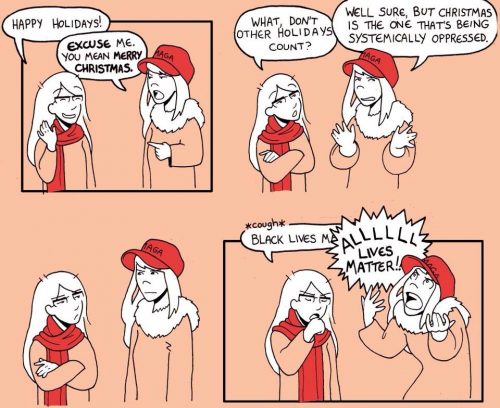
I despise internet hyperbole, no matter who does it. It’s one of the things I like least about the left-leaning news site Raw Story — they periodically erupt with click-baity inane headlines on the order of “Internet Decides Donald Trump is a Moron”. No, the internet decides nothing, and all you’ve got is a collection of tweets from people who don’t like Republicans. Of course, the right wing does it too, perhaps even more, and here’s an example: Trump Makes “Merry Christmas” Great Again; Leftist Heads Explode. How are your heads feeling today, fellow lefties?
We may not all have stopped saying it, but we did feel the weight of it outside of conservative regions like the South. We understood that “Happy Holidays” was preferred and that we risked offending and insulting others—or losing our jobs, i.e. mine in academia—by uttering the words “Merry Christmas.”
I felt it when I lived in Massachusetts, as I’ve attested in a post about my experience with this socio-cultural and economic pressure. No one said, “if you say ‘Merry Christmas,’ you’re out of here.” They didn’t have to. The left uses the fact that conservatives and others on the right don’t want to offend or upset others. They know we don’t like to make a fuss and that we are likely to turn the other cheek or remain silent when we are attacked or in the face of controversy . . . particularly when our jobs are on the line.
Unbelievable. The whole point of that post is the claim that Donald Trump successfully annoyed the Left and was pushing leftist buttons
— that he was trolling and doing this specifically to rile up others.
He tweeted this just to keep the liberals up all night screaming at him on Twitter, and from the tweet timeline it appears to be working. https://t.co/itjVPboyg4
— Legal Insurrection (@LegInsurrection) December 25, 2017
You know, that’s kind of the opposite of not wanting to offend or upset others
. This twit is openly chortling about offending and upsetting leftists! That was the whole point of Trump’s tweet!
In case you’re wondering about the referenced post about their experience, it’s more of the same — imagined offenses against kind, gentle, well-meaning conservatives.
In Massachusetts, I worked in Boston but lived in a smallish, mostly blue collar town. In Boston, it was “Happy Holidays” . . . if one dared recognize that there even was a December holiday (or reason to be happy). Out in my town, it was the general sense that “Merry Christmas” was preferred, but I had to say it first, and the person to whom I said it would look around nervously, blush, and then finally, with a sense of strong defiance or of quiet camaraderie, say “Merry Christmas” back.
Look, this is just plain stupid, and the reverse of the facts. If you are working in academia or living in a large city, you know that some of the people you meet are going to be Jewish, or Muslim, or atheist, and wishing them a merry Christmas is rude and insensitive (although I’ve also noticed that those people are usually willing to take the greeting in the spirit it is given, and not sweat the implications). We’re actually aware of the context and the environment, and being able to wish someone well in a non-sectarian way is a good thing. The only people nervous about saying “Merry Christmas” are conservatives who are vaguely aware that they’re being exclusive.
The reason people were laughing at Trump is not that they were angry, but that 1) it’s another Trumpian lie, and 2) it was clearly aimed at the kind of narrow, hypocritical, conservative white Christian dumbass who wrote that post. If you want to know how we really feel, ask the Rude Pundit.
One of the fun parts of being a total atheist is that you don’t give a damn what religion someone believes. Seriously, someone can tell me they think that God is a toilet and shitting is the way to give thanks to Him for His blessings of indoor plumbing. It doesn’t fucking matter. In fact, unless you are making laws according to your religion and imposing them on me or you’re harming others based on your faith, why should I care? You’re just a harmless person who believes that fairy tales are real and, c’mon, who gives a fuck? You think Cinderella really went to a ball so you wear glass slippers around your neck? Groovy, man. Enjoy.
So when President Donald Trump made a big fuckin’ deal about being “allowed” to say, “Merry Christmas” again, I wondered who the fuck was stopping him. I mean, you wanna say, “Merry Christmas” or “Hail Satan” or “I fuck unicorns,” I’m not gonna care (ok, I’ll be a little judgmental about the unicorn fucking – or at least curious as to what that fucking is like). Who said you couldn’t say, “Merry Christmas”? Everyone I’ve known ever has always said, “Merry Christmas.” I say, “Merry Christmas” and I think that Jesus is a fictional character in an overlong, poorly-plotted book.