
My father always impressed me with his deep knowledge of cars. He could tell you the make, model, and year of any car with a glance, and further, he could tell you how to disassemble its carburetor or repair its brakes or tell you all about its ignition timing, and other such things that soared right over my head. I was unfortunately car-blind, an automotive ignoramus who could not distinguish a Ford from a Chevy, let alone make any finer distinctions. Clearly, there has been a generational decline in awareness of the automotive world. Our forefathers had a deeper appreciation of cars and their place in the world around us.
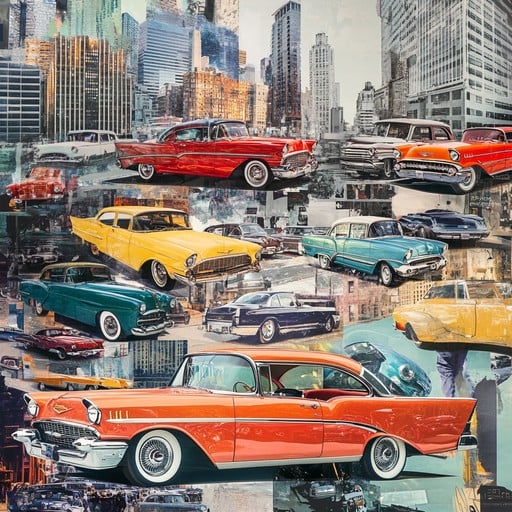
You can see it in the art of our culture.
I thought about this when I read this article, Humanity’s ancient bond with biodiversity is visible in rock art.

Across continents and cultures, one of the most striking features of ancient rock art is how often it places the natural world at its center. Whether etched into sandstone cliffs in the Sahara, painted in hidden shelters in Southern Africa, or drawn on stone faces deep in the Amazon, the recurring subject is not architecture, warfare or abstract political power.
It is animals, forests, rivers, spirits of the land and the intimate relationship between people and the living world around them. I have seen rock art in remote regions of the Amazon, left by ancient San communities in Angola, across the Ennedi Plateau in Chad, and in the Nuba Mountains of Sudan, I have come to believe that these works reveal something profound: long before the language of “biodiversity” existed, many human societies understood that their survival, identity and spirituality were inseparable from the ecosystems that sustained them.
Modern conservation discourse often treats biodiversity as a scientific concept — a measurable index of species richness, ecological resilience and genetic variation. This framing is useful, but it can obscure an older and deeper truth. For much of human history, biodiversity was not an abstraction. It was immediate, sacred and embedded in daily life. The extraordinary prevalence of animal and ecological imagery in rock art across the world suggests that early human societies recognized, at minimum intuitively, the centrality of the natural world to both material survival and cultural meaning.
I do not think my father regarded cars as “sacred”, although he’d agree that the diversity was not an abstraction. It was real! He was an auto mechanic. That was his business. I would not be surprised to learn that he believed that automotive diversity was central to both material survival and cultural meaning. He also admired the beauty of certain cars and expressed aesthetic preferences in addition to appreciating the practical mechanical differences.I am certain that we can find people who have attached a kind of spiritual reverence for certain models of cars. But so what? Humans categorize and classify and add value arguments to everything we see; it is not at all surprising or informative to retroactively paint spiritual interpretations on top of the work of survival, and it is especially specious to then deplore how the current generation has lost their proper understanding of how the world works.
Of course, it would be simplistic and romantic to suggest that ancient peoples were conservationists in the modern sense. They hunted, altered landscapes, and undoubtedly contributed to local ecological pressures at times. But what the rock art strongly implies is that many societies understood themselves as existing within ecological systems, not above them. Nature was not viewed merely instrumentally. It was spiritually, socially and existentially central.
This matters because modern industrial societies have, in many respects, lost that orientation.
Yes. Let’s recognize the pragmatic pressures that drive a culture’s artistic focus. Show me societies that did not understand that they exist within ecological systems, while being dependent on those same ecological systems. Of course ancient artists were fascinated with the living world around them, and drew it and probably dreamed about it. I would agree that modern industrial societies have shifted their focus from natural ecosystems to technological ecosystems, and it would be a good idea for us to be more conscious of the broader biological implications of our way of life, it is not surprising that human beings dwell on the subjects that most interest them and have difficulty expanding their sphere of analysis.
I am sure that many of those ancient cultures also had interpretations of the world that were rooted in magic and gods and invalid spiritual ideas, and that we’ve abandoned. Most of that is invisible and unexpressed in the catalog of rock art that we have, because it’s easier to draw a gazelle than a cosmic spiritual connection. We have to make up the spiritual element now and impose it on the art, which makes trying to draw conclusions and interpret our interpretations a masturbatory act.
I can sympathize with many of the conclusion this author reaches while being skeptical of how they reached them.
Ancient rock art is therefore more than archaeological evidence or aesthetic achievement. It is testimony. It bears witness to the fact that human societies across vast stretches of time and geography saw themselves in a relationship with a biologically rich world and considered that relationship important enough to record in an enduring form.
In this sense, rock art offers a quiet but powerful rebuke to modern ecological indifference. It reminds us that our ancestors often lived with a deeper awareness of ecological dependence than many contemporary societies do. They may not have had the vocabulary of biodiversity science, but they understood that the fate of humans and the fate of the living world were intertwined.
We would be wise to recover some of that understanding.
OK, yes, we should have a deeper appreciation of biodiversity and work to preserve it. But is the way to do that by invoking the inferred spirituality of our ancestors, and suggesting that they had the right answer, while we do not? I know we don’t have the right answer, but we also have this new layer of technology that complicates our understanding of the world that must be incorporated into our answer, and pretending that solutions that worked in Chad ten thousand years ago will work again is dodging the problem. I suppose we could just simplify the world, jettison all the technology, and go back to living in small villages, and then we’d appreciate nature much more.
My dad, who has been dead for 34 years, could also work himself up into a good rant about those goddamn fuel injection systems and unrepairable computer chips in modern cars. We’ve lost our understanding of the elegance of a simple V8 engine. Bring back the beauty of the Fords of the 1950s.
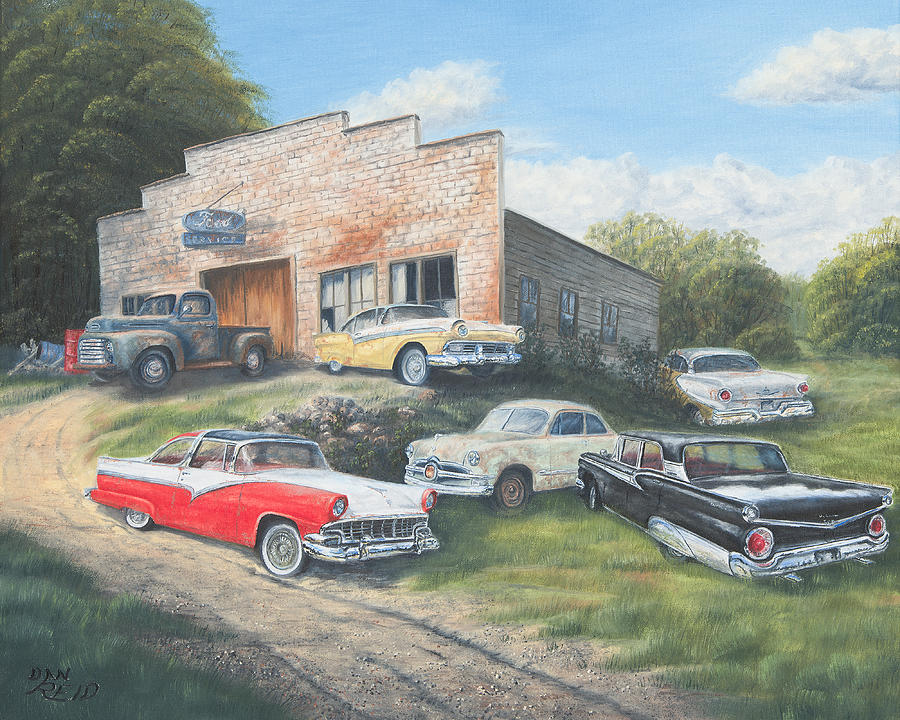

I remember driving in a 1950s era car that my dad was extremely proud of in the early 60s: bench seats, stick shift, slightest hint of tailfins, no seatbelts. I couldn’t for the life of me tell you the make and model.
It’s obvious why people in pre-industrial societies would draw pictures of nature — that’s what surrounded them. That’s what they interacted with on a daily basis. And if the animals weren’t there, if the rains didn’t come, if the crops didn’t grow, if the sun didn’t shine enough (but not too much), they were dead. Their spiritual obsessions were with making sure the rains came, the animals they hunted would be there, the sun would shine, floods would occur in their accustomed time and place, etc.
“Modern” people — that is, urban and suburban people — have limited exposure to nature, to the point that most aren’t all that conscious of where their food comes from, where the materials that are used to make their cars and their suburban homes come from. Trees and grass are furniture, put there by human will. They aren’t even aware of the weather, other than as an occasional inconvenience. It’s the modern Western idea that we can conquer everything and make it the way we want to. When things stop because of a major snowstorm or a hurricane, they are outraged because how dare natural things interfere with their lives?
Our everyday environment is made up of cars (as your pictures show), of food that comes prepackaged (cf. Andy Warhol’s soup can art) from supermarkets. It’s not nature that impacts our daily lives, but other people. I remember when I moved to NYC, on a street that was one-way uphill, when there was a snowstorm and cars couln’t get started at the light, the other people would just honk, as if the sound pressure would mover the stuck car forward. The idea that there’s a reality outside of what people make is just foreign to them.
Rock art commonly has animals and hunters. Same with cave paintings. But no vegetables, fruits, or plants. Hmmmmmmmm.
Justin time… http://www.smbc-comics.com/comic/cave-3
Humans in any given era are just living their lives based on the knowledge of the times – cavemen didn’t have any special insights into ecology, tribes in the middle east jotting down stories didn’t have knowledge of the shape of the earth or animal kinds, and people in the 50s didn’t have a lock on utopian society that we should be reverting to. Selective memory and a misplaced mysticism about past societies/people are the best ways to tell whatever narrative you’d like!
In the last graphic, the painting, the red and white car looks like a 1957 Chevy.
The yellow and white car by the building might also be a 1957 Chevy.
Nobody makes cars like 1970s British Leylands nowadays.
I couldn’t tell you the make of most cars without looking for the branding (even then I often don’t know which badge is connected to which brand), but I am sad that, at least in the UK, so many are grey. So many shades of grey, so boring, so depressing, so often nearly the colour of the road they are driven on which seems like it would be dangerous.
@6 https://www.youtube.com/watch?v=VEQriHQpJFQ
I think it’s not a “spiritual” problem so much as an emotional one. So many humans are so full on humanity’s power that they assume we could cause a hurricane without a widespread brown-out. Ironically, a lot of those people are also very religious, simultaneously questioning humanity’s ability to “rise above” our non-human brethren.
I remember a lecture my Dad gave me circa 1968 as we were driving in town and I couldn’t identify the car in front of us. For some reason that set him off and he lectured me on how when he was my age he could identify every car on the road. I quipped that there were only FIVE models on the road then. That didn’t help although, to be fair, my lack of automobile knowledge was more than made up for with sarcasm.
The first car he learned to drive was a Ford Model A. His father, among many ventures, sold Packards in Montana.
I wasn’t a total loss, car wise. I built cars from model kits and even won some awards at the local Dime Store for best paint job and detailing. Fun fact: I still have those models in a box in the attic.
Obviously the Fast/Furious franchise has passed PZ by…mostly me also as I’ve only watched a few. Some of the kids these days appreciate, but maybe can’t afford, the legendary cars of the past. Good old American cars like 57 Chevies, 60s GTOs, the Hemi Cuda…
Nah the kids these days have embraced diversity by buying more affordable Japanese cars that are quite tweakable and bad ass. Or some European cars beyond Bimmers. My own interests have been towards Infiniti G cars, but Honda/Acura and Toyota/Lexus have some decent cars too, of much later vintage than the American classics. A V8 is no longer necessary.
Still not understanding the cambered stance cars.
Times have changed per car appreciation. The technology has improved too. Cars have seatbelts and airbags for instance. And better fuel mileage.
I often watch this youngster’s channel for his views on JDM cars:
And Euro/Brit:
A friend has a turbo Mini Cooper he loves.
My dad inherited a white, Ford Galaxie 500 back in the 60s. I remember standing on the bench seat next to him as he drove around town. And I remember a TV commercial bragging about the size of the engine compartment: “You could fit a bowling alley in there!”
Other than the ’78 Corvette I wasted money on later in life, that’s pretty much the extent of my knowledge of old cars.
Cheerfulcharlie @ 3
Vegetables are static, clearly the artists attributed animals with greater importance for their environment.
Vegetables will not run away from you when you approach. It is possible rock art depicting animals had some ritualistic importance. Unfortunately this must remain speculation.
…if you ever feel like taking a walk.
Never owned a Ford. Only drove a couple of rentals, one grossly under powered, the other over powered. Late 60’s early 70’s I worked for a Ford division (aerospace, not automotive). Every year they brought new models to show off. One particular year my friend and I were looking at them. Under the hood was a lot of plastic that was previously metal. We pointed at it and laughed. I don’t know if that was the beginning of crumple zone design, or just being cheap.
Can someone with experience tell me how much they live up (down??) to their sobriquets: Fix Or Repair Daily, and Found On Road Dead? Another friends six year old Mustang has had several major problems for pretty low mileage.
Wasn’t Henry Ford an antisemite?
As you said, human society is concerned with things that affect them in the day-to-day.
Which makes it a bit odd to think that some of the first things we teach our children are the names and sounds of common barnyard animals. That makes sense for a mostly agrarian society, but these days many people have to travel an hour to see a cow. For most people that makes them about as common as a zebra. Does it matter so much if a three year old can tell you that “the cow goes moo,” at least outside of IQ tests?
#wheelsOnTheBusRules
I believe the black vehicle in the last pic is a Ford Ranchero, and the white/grey one in the background is a Ford Fairlane, circa 1960. Those round tail lights are characteristic of the species. Late 50’s cars were ubiquitous in my teenage life, because kids could afford to acquire and fix them. They got about 6 miles to the gallon, but gas was anywhere from 16 to 25 cents a gallon. We used to empty our pockets and look under the car seats for change to go to the beach, and could generally come up with 35 cents or so. And ya, AstroLad, a Ford would keep going forever, but only if you could work on it yourself, because they required constant repairs, tweaks and deep understanding. Ancient VW bugs were more my thing.
Submoron @17
Yes – The International Jew, a collection of column’s in the Dearborn Independent that were based based on Henry Ford’s rants about the “the Jews” was a major influence on the Nazis.
People in the future, if there are any, will look a back on this age and wonder about the rock art that we leave.
“Hmm…looks like a depiction of a war between the tribes that worship the ‘large apple’ and those that worship the ‘window frame’. With some penguins pecking at the survivors?”
Our understanding of the world focuses on what we consider more important things, not which car has the bigger infotainment screen, as expressed in:
Our Expression of Gratitude for meal times or any other time you wish
We give thanks to this world for its life-giving resources
We will utilize them wisely and peacefully without harm
And, we respect those people whose work sustains our lives.
(However, we would like to have a 1960 Messerschmidt KR200)
Dunno about spiritual superiority, but I think our hunter-gatherer ancestors were cognitively superior to us. When your survival depends on an intimate knowledge of your ever-changing environment, you have to be pretty bloody sharp. Most people today could almost sleep-walk through their days.
On the way home from a supermarket drive today I witnessed an older school Skyline buzz past me in the passing lane. I know this because it said “SKYLINE” in quite large lettering on the rear deck. Hard to miss. Was lowered a bit, not cambered, and growled through a single straight pipe. Couldn’t tell if it was left or right hand drive. Last Skyline I recall was much older, restored instead of modded, and right hand drive.
Such rare spectacles might be spiritual moments for some. I’m just glad I knew the significance (or meaning from a previous thread). I mean it was cooler than seeing some run of the mill Maxima, Q50/60, or Z car.
How would you even draw “abstract political power”? The only person I think might be able to is Chuck Tingle, for the cover of “Pounded in the butt by abstract political power”.
Raven @5
The cars on the third image, the painting, all seem to be Fords. The red and white one looks like a Victoria, the yellow and white in the back is a Fairlane. The black one is probably a second-generation Thunderbird.
You’ll find three instances of the ’57 Chevrolet in the first picture, the sloppy, probably IA-generated, collage. The burnt orange car in the top and bottom, and also right top, is sort of a BelAir coupé, but without that version’s prominent “wing” molding on the rear fender. Curiously, the top images of the same car show different treatments of the side molding.
We used to call those type of monsters a ‘yank tank’. Road boats.
My dad was also deeply into car. He was born in 1924 and dropped out of school when a teen to work in the garage in the small town where he grew up. He eventually ended up in Jacksonville, Florida where he drove city buses and started working on stock cars with some friends. They mostly raced at a little one mile dirt track in Jacksonville but they did have a car in the Daytona race when part of the track ran on the beach then cut through the sand dunes to run down A1A. One afternoon dad and I were watching an old movie from the era which had a scene of the Daytona race and he spotted their car. He went to tech school to get certified as an automatic transmission mechanic, but he could do anything with a car. He was also good at identifying the brands, models and years though that was probably mostly gone by the 60s when so many foreign cars entered the market.
I could never do any of that. The only way I know the brand of a car is from the logo on the car and if it was our family car then it was a Ford product. Year and model…forget it. Now my brother, who was born when I was 18+, has some of that car knowledge. When he was a teen, he and a friend rebuilt an old hot rod in my parent’s front yard.
@26 pancho35
I agree; the cars in the painting all do seem to be Fords. I think the black one in the foreground is a Galaxie. And yes, that first piece of “art” is definitely AI-generated. You can tell by the jumbled mess of pieces of buildings in the background, and random, arbitrary chunks of images scattered throughout.
There’s a fairly accurate 57 Chevy in the foreground. Most of the others are parts of 56 and 57 Chevies with distorted perspectives and grilles from other cars. I hate “Artificial Intelligence.” If that’s our “cave art”, I wonder what our descendants will infer about our culture.
@16 If such sarcastic crap like what FORD stands for ever had any basis aside from blind tribalism or marketing rubbish, and I’ve got my doubts, it doesn’t apply nowadays. It can’t. Because nowadays, there are just a few worldwide conglomerates with many more badges than there are actual companies. There’s even a lot of crossover between the conglomerates. Any particular vehicle world wide might have a chassis built here, holding an engine built there, a gearbox from somewhere else and all assembled somewhere else again. With a badge on it that is determined by whatever people in whichever country will repsond best to. MG used to be a tiny British sports car. Now, here in Australia, it’s a Chinese hybrid SUV.
As for the op, sorry PZ, but your old man, no matter how clever, was wrong about ‘god damn fuel injection systems’ etc. Cars have changed over the decades, generally for the better (safety, efficiency, etc etc) and not even to be more complex necessarily. Carburetors are a nightmare of tiny little intricately balanced parts and valves and so on. Fuel injection is simpler and more reliable and more powerful/efficient. Colonel Potter in MASH complains about ‘modern’ (1950’s) cars today because they have gear boxes that change themselves and don’t need to be crank started. Your ‘simple V8 engine’ was a cranky disaster that wouldn’t last half the time of a modern one given the same amount of maintenance.
Most of the assumptions in that report are wrong.
I’ve seen ancient Aboriginal rock art of supernatural spirits. There’s an ancient painting of yams on the cliff walls of Nitmiluk Gorge, showing where yams grow. There’s a well-known rock painting of a sailing ship at Nanguluwur from when a local saw a Dutch clipper sailing by the north coast and put it on a rock wall. Painting lots of animals is a sign that they were important to human culture at the time, as they are now (plenty of people still paint animals).
And on the flip side, indigenous people don’t always act as “guardians of nature”, even in precolonial times. The Maori drove the moa and Haast’s eagle to extinction long before Europeans came. The Malagasay hippopotamus is another example.
indianajones @30
I had a friend who when we were in high school had gotten a hold of an early 70s Camaro with a 427, nitrous, and transmission “shift kit”. Basically an overpowered suicide car no kid (or adult) should own. He thankfully made the mistake of trying to switch out the four barrel carb with 3 two barrels. Could not get the set up right and sold the car, replacing it with a nice grey felt pool table that wasn’t a threat to life or limb. He lived beyond his teens.
Nowadays cars do have injectors instead, which was a step up. I’m ignorant of the details but one popular enhancement mod trick on newer cars involves flashing the ROM on the car’s computer (or something), which probably voids the warranty. I suppose the computerization of newer cars can be hacked in a good way, squeezing out more performance. Over my head.
Oh and I think some of the cars these days are ready made with on-board preset “modes” for performance (sport), economy etc.
My lowly HRV has econ mode as did my previous Civic. It also has a sport mode on the transmission which allows for pseudo-manual paddle shifting. I would NEVER try this because it also has a continuous variable transmission (CVT). Honda CVTs don’t have the bad reputation Nissan CVTs do, but they still seem like an over-engineered bad idea. PZ’s dad might have been legit horrified by one of these things. No paddle shifting for me. Maybe if I had a real automatic transmission with discrete gears.
I’d agree that spirituality (especially if it has to do with the “supernatural”, which of course, if it existed, would be very much natural) is quite nonsensical, but that a larger appreciation (perhaps even an instinctive appreciation) of nature could be something very positive, especially if it leads to people leaving less refuse and greenhouse gases in nature.
Unfortunately, I had to agree with the pope on that one, who recently toured illegal toxic waste dumping grounds, proving that Christianity has during the last two millenia failed to create a moral world.
I have seen these native american pictographs in northern Minnesota, in the BWCA:
https://elyoutfittingcompany.com/lac-la-croix-pictographs/
@29 Flange
You’re right, the black car is an early (Fairlane) Galaxie. The image the painter copied appears in the Wikipedia article on the Galaxie. I have no idea of how to post it here…
OK, right, I mistook the cloud reflection for an open back. On closer look, though, it’s a 4-door, so not a T-bird, but I think too fancy to be a Fairlane. Thus ends my knowledge of Fords.
I’ve often wondered who much rock art was teenager graffiti.
I thought I was the only one who was car blind . Only cars I can reliably tell are a 65 Mustang , a 59 Buick and a 63- 67 Chevy Impala . And these are only because my family drove some ( except for the Mustang )
RE Cave Art; Do you recall the incident in 1992 when Eclaireurs de France (scouts) were cleaning the Cave of Mayrières supérieure and destroyed some 15000year old paintings?