Important breakthrough in our understanding of bat whiskers

Every now and then, I’ll hear about someone who not only writes daily, but finds it easy to do so 99% of the time. I won’t say that I think such people are fantastical, but it’s an alien concept to me. I’m till quite proud of the daily posting I’ve achieved over the last year, and of advances I’ve made in my rate of fiction writing, but some days, well. Some days it don’t come at all, and these are the days that never end. So here I am, compelled by unholy pacts to post before I can sleep, and just… nothing appeals.

There’s plenty of stuff that I find interesting, but to write about? Less so. I thought about Democracy Now’s report on the Ohio train disaster (which you should check out), but I’ve posted about that two days in a row now, and this sentence makes a third. There are always little bits of research about how long coral can survive warming temperatures, or an advance in electrolysis efficiency, but on posts like that it keeps coming back to the same basic thing, we need to build the collective political power to enact real change. Some days, I just… can’t.

I’ll get back to that soon, I suppose, but right now it just feels a bit draining. Instead, let’s learn about bat whiskers!

The researchers worked at the Smithsonian Tropical Research Institute recording Pallas’s long-tongued bats—a South and Central American bat that has the fastest metabolism of any mammal—as they drank from hand-blown glass flowers designed for the study to replicate the plants the animals feed from. High-speed infrared cameras captured photos and video of the bats as they descended upon the glass flowers and navigated their muzzles and tongues into the “bloom” to eat the nectar. Feedings typically lasted between a half- to one second.

The researchers found that bats with clipped whiskers were less agile and accurate during feeding and flight than animals with untouched whiskers. The animals with clipped whiskers were held for a few days until the hairs regrew, then released back into the jungle. “Clipping the whiskers doesn’t reduce the bats’ ability to feed, they just do it a little less gracefully,” Amichai said. “If it were gymnastics, they’d get an 8.5 instead of a 9.8.”

See, this is the kind of animal research that has always appealed to me. Clipping whiskers is, I’m sure, deeply offensive to the bats, but it’s certainly not going to cause lasting harm, especially with the researchers ensuring their subjects have plenty of food available. It reminds me of when I helped make blindfolds for flying geckos so a fellow student could study their steering ability.

I have to admit, I never really gave much thought to bat whiskers, but for a creature that zips around shoving its head in floral tubes, it makes sense to have a facial perimeter alert system.

The role of long whiskers in nectar-feeding bats’ flight control provides new insight into the co-evolution of the bats with the flowers they feed on, Amichai said.

The majority of bats possess short whiskers not arranged in any particular pattern or direction. But the researchers found that whisker length in nectar-eating bats evolved at least twice, along with the evolution of their long tongues and faces, to help them better navigate the deep chambers of the flowers they prefer. In turn, the long reach these flowers require results in more pollen sticking to their pollinators and thus the broader proliferation of their kind.

The researchers plan to continue their work using higher-resolution images, flowers that move, interactions with predators and other expansions on the experimental model, Amichai said.

In the meantime, the latest study offers a fascinating glimpse into how nectar-feeding bats combine various forms of sensory information to navigate the world around them, Amichai said. Their world is a combination of scent, echolocation, spatial memory, knowledge of the seasons, and the physical sensation and equilibrium provided by their whiskers.

“I find thinking in these terms of switching back and forth between completely different ways to perceive the world—and seamlessly integrating their input—to be a mind-blowing concept,” Amichai said. Understanding how animals perceive and interact with their surroundings helps scientists develop better conservation strategies, he said.

“We are strange animals—we rely almost solely on vision and, to a lesser extent, hearing to perceive the world. As a result, we interpret other animals’ behavior in similar terms and that often leads us to completely misinterpret what they’re doing and why,” Amichai said. “Understanding the sensory world of other animals helps us see the world through their eyes and understand their behavior, needs, and challenges better.”

In the recently made Battlestar Galactica reboot, one of the human-form cyclons laments the fact that even though he’s technically a robot, designed and built (or grown? I’m not clear on that), because he was made “in the image of” humanity, his eyes can only perceive as much as a human might. Instead of being able to see the full grandeur of the universe, he’s limited by the imperfect meat of his body.

I sympathize with that. I don’t feel a particular need to examine the world around me with my beard, but I’d like to be able to get more information out of smells, or to be able to hear with more clarity or accuracy. Since I doubt I’ll be getting my dreamed-of cyborg replacement parts in this lifetime, so instead I’ll just have to muse on what might have been, down another evolutionary timeline.

Oh, to be a bat, flitting from flower to flower.

Researchers see good results from lower mowing intensity, and fewer pesticides

My posts about agriculture tend to lean one of two ways. The first is to advocate for a dramatic, rapid increase in indoor food production. That includes the various forms of indoor farming, as well as efforts to cultivate edible bacteria and microalgae. The second is that for the land that’s currently being used for farm, we shift to a form of ecosystem management much closer to what Native Americans did prior to the European invasion. Land Back should be part of that, of course, but the basic idea is to cultivate an ecosystem that’s full of useful and edible organisms, and to treat it as a community resource, owned in common by everyone, for everyone’s benefit. As always, the exact specifics of this approach will vary depending on regional and local conditions.

I get that just swapping over would feel like a big change to most people. We’re very used to what “farming” looks like, and it can be hard to trust that something like bacterial flour or rows of plants under LEDs would be able to feed humanity in our billions. Fortunately, while I’m more interested rapid, radical change, my philosophy for making the world better is one where every step along the way should come with its own improvements. My favorite example is probably the use of plant life to mitigate air pollution. There’s ample evidence that being around greenery improves both our mental and our physical health (not that those are really separate things). We’d get pretty immediate benefits from adding plants to the urban landscape. Those improvements to our health and wellbeing give us more power, through better health and saved money, to fight for the next step up.

That’s why, while the vision in my head may be some sort of solarpunk permaculture utopia, there are actually much smaller steps that we could take, which would have measurable benefits, both in terms of dealing with climate change directly, and in terms of improving ecosystem health. For example, this study lays out what seems to be a sort of intermediary step, designed to capture carbon, improve ecosystem health, and reduce dependence on pesticides and herbicides, with relatively little effort:

The researchers conducted two independent experiments at the University’s research facilities at the Ruissalo Botanical Gardens in Turku. In the greenhouse and common garden studies, the research team showed that the intensity of mowing has a great impact on pastures. By reducing the intensity of the mowing and cutting the plant higher, the overall yield of the pasture increased and the plants developed bigger roots. This indicates a higher atmospheric carbon sequestration into belowground storage.

What was surprising, Fuchs emphasises, is that the researchers found a detrimental effect of herbicide residues in soil on root growth regardless of the intensity of the yield harvest.

“This demonstrates a tremendous limitation to the potential carbon binding and storage belowground when soils are polluted by pesticide. Considering the vast amount of pesticides applied to agricultural fields yearly, we can conclude that the impact on soil quality is a major driver of limited root growth, carbon sequestration, and consequently plant resilience and productivity,” Dr Fuchs says.

The authors propose additional field studies to extrapolate their findings onto a field scale. Both studies conclude that climate change mitigation via optimising carbon sequestration and storage in soil can be achieved by reducing pesticides, which will facilitate root growth and improve plant resilience.

All over the world, cultivated grasslands are used as grazing pasture as well as for growing fodder that is turned into hay and silage. They cover large parts of the world’s agricultural land and have a tremendous potential for climate change mitigation through carbon storage. The plants use carbon dioxide as they grow, and some of this atmospheric carbon becomes bound in the soils.

“Consequently, understanding how pesticide pollution in soil and intensive management limit plant productivity is the key to optimising intensive grassland-based agriculture in a sustainable and climate-friendly way,” Fuchs concludes.

Oh yeah, it means better crops, too. Did I bury the lede? Maybe a little. They don’t really talk about ecosystem health, but I think it’s pretty easy to see how less intensive mowing, and less pesticide use would both have a “side effect” of improving the general health of the area.

I think we should be ending most of our animal agriculture, which would eliminate much of the need for grasslands as fodder, but we’re not going to get there overnight, and anything we can do to improve things now will make our lives just a little bit easier down the line. Of course, that only matters if this research actually leads to a change in practice. It always comes back to that, doesn’t it? There’s something we could try to make the world better, but nobody in the aristocracy seems to feel like investing in it. That’s why I keep coming back to collective power and political change.

As I said at the beginning, the steps we take now can be both immediately beneficial to us, and beneficial to our ability to get bigger changes down the road. We’re not capitalists here at Oceanoxia, so don’t think in terms of “political capital”. The kind of power we on the left want to build isn’t something that’s lost when used. Each victory brings more people and power to the cause, and sets us up for an even bigger victory.

I think many of us are accustomed to witnessing a political and economic “ratchet” effect, in which Republicans use their power to damage things like the social safety net, and Democrats stabilize things, but don’t actually reverse the damage, or guard against further damage. I mean, the Dems do plenty of damage themselves, but we’re talking generalities. While we’ve made great advances in terms of civil rights (hence the current reactionary backlash), 9/11 ushered in a new era of authoritarian government power in the United States, coupled with a dramatic increase in the concentration of wealth and power in the hands of the ruling class. It’s discouraging, and often horrifying to watch.

The one bit of hope I’m offering today is that we can, by working together, create our own ratchet effect, whereby we can increase our own power and happiness, and lay the foundations of a much better future than what currently looms on the horizon.


Thank you for reading! If you found this post useful, please share it around. If you read this blog regularly, please consider joining my small but wonderful group of patrons. Because of my immigration status, I’m not allowed to get a normal job, so my writing is all I have for the foreseeable future, and I’d love for it to be a viable career long-term. As part of that goal, I’m currently working on a young adult fantasy series, so if supporting this blog isn’t enough inducement by itself, for just $5/month you can work with me to name character in that series!

Norfolk Southern set off a weapon of mass destruction in Ohio last week.

The past is present. This is a theme that comes up pretty often on this blog, and it’s one that I believe applies to a lot of the problems we face as a species. The most common topic to which I apply it is probably white supremacy, but it also applies to the development of capitalism from feudalism, to patriarchy, to the lasting impact of the first Cold War both around the world and within the U.S., and even to the century-old labor law that allowed Joe Biden and Congress to intervene on behalf of rail corporations to force workers to take a deal they didn’t want. If you recall, that 2022 labor dispute was about whether rail workers have a right to sick leave. Not paid sick leave, but any sick leave that they wouldn’t be actively punished for taking. The government could have weighed in to force the rail companies to treat their workers like actual people, but they opted for the opposite.

The lack of sick leave was compounded as a problem because rail companies in the United States have spent the last few years firing as many people as they possibly could, while simultaneously adding more and more cars to the trains. The result of that was longer trains carrying more material, with fewer people to actually drive the train, and to make sure that these massive machines were being operated safely. Requiring them to allow their workers to take time off when sick, even unpaid time off, would require them to hire more workers, which goes against their current business plan.

See, if you hire more workers, you have to pay more workers, and that means you have less money with which to inflate your stock prices (and so the personal wealth of executives and other shareholders) through stock buybacks.

Norfolk Southern Corporation (NSC) Tuesday announced that its Board of Directors has authorized a new program for the repurchase of up to $10 billion of its common stock beginning April 1, 2022.

The company’s current program will be terminated on March 31, 2022.

The company said purchases will be made through open market transactions, privately negotiated transactions, accelerated share repurchase programs, or by combinations of such methods.

The new program, which has no expiration date, may be modified or terminated at any time. The timing and volume of any repurchases will be guided by management’s assessment of market conditions and other factors.

That’s important to bear in mind going forward. As you read about the damage done, the corners cut, the deliberately unsafe conditions, remember that all of that was in service to further enriching a small number of people who are already obscenely rich. Lives lost due to this disaster are lives taken, in exchange for money, whether from the accident itself, or from cancer years down the line.

Unfortunately, on the theme of “past is present”, the law from 1936 isn’t the worst part. See, most trains in the U.S. still use a braking system from the 1860s. It’s an ingenious design, to be sure. It uses air pressure to create a chain reaction that runs down the train. The brakes at the front trigger the brakes in the next car back, which trigger the next car, and so on, till you reach the back of the train. In the case of the train that derailed in East Palestine, OH on Thursday, February 3rd, that process was 150 cars and 1.8 miles long. What that means is that the front of the train began to stop long, long before the back of the train. It means it takes a long time to actually stop, but it also means that if any car even thinks about derailing, there’s a huge amount of compression happening to make the train fold up like an accordion.

There is an electronic braking technology that causes every car to brake simultaneously – something that would have seriously mitigated this disaster – but the rail companies lobbied hard to keep their 150 year old brake systems, because replacing them all would have cost them…

Two weeks of revenue.

Then came 2017: After rail industry donors delivered more than $6 million to GOP campaigns, the Trump administration — backed by rail lobbyists and Senate Republicans — rescinded part of that rule aimed at making better braking systems widespread on the nation’s rails.

Specifically, regulators killed provisions requiring rail cars carrying hazardous flammable materials to be equipped with electronic braking systems to stop trains more quickly than conventional air brakes. Norfolk Southern had previously touted the new technology — known as Electronically Controlled Pneumatic (ECP) brakes — for its “potential to reduce train stopping distances by as much as 60 percent over conventional air brake systems.”

But the company’s lobby group nonetheless pressed for the rule’s repeal, telling regulators that it would “impose tremendous costs without providing offsetting safety benefits.”

That argument won out with Trump officials — and the Biden administration has not moved to reinstate the brake rule or expand the kinds of trains subjected to tougher safety regulations.

“Would ECP brakes have reduced the severity of this accident? Yes,” Steven Ditmeyer, a former senior official at the Federal Railroad Administration (FRA), told The Lever. “The railroads will test new features. But once they are told they have to do it… they don’t want to spend the money.”

[…]

While the Obama administration had estimated that the rule could save more than $1 billion by averting accidents, the Trump administration rolled out new figures that cut the estimated benefits by a third.

The AAR lobbying group concurred that “the costs of the ECP rule substantially outweigh its benefits,” and claimed the mandate would cost them about $3 billion — or roughly 2 weeks of their operating revenue in a typical year. The FRA estimated the brake requirement would cost about half a billion.

Trump’s Transportation Department ultimately rescinded the brake rule in late 2017.

Remember the stock buyback? $10 billion just to inflate the value of their stocks? This is where some of that money came from. That’s $3 billion for all the companies represented by the lobbying group mentioned above, by the way. Norfolk Southern’s share of that would have been less. They chose this path, knowing that it would lead to incidents like this, as it had done already. They had the money, they just wanted it for themselves, and the government said, “yeah, that’s fair”. It seems money was the primary consideration for the corporations and for the Obama administration, at least when it came to their negotiation.

When people talk about capitalism and socialism, the default is to frame things in terms of “the means of production” – who owns the stuff you need to make stuff? Under capitalism, it’s owned by capitalists, and so the vital machinery of society can only be used by society if it further enriches those who own that machinery. Under socialism, in theory, it’s owned by the workers – the people who actually use the machinery. Another way to think about it is that under capitalism, the government serves capital by default – that small class of people at the top – and under socialism, the government serves the working class by default. It’s an over-simplification, and obviously different people have different notions of what it actually means for a government to “serve the working class” or whether that’s even possible, but I think you get the gist.

We live under capitalism, and our governments serve those at the top, by default. That means that when there’s a dispute between capital and labor, the government sides with capital, unless there’s a large, well-coordinated effort to push back. They send in cops to break up protests. They manipulate the economy to make people more desperate. They use the law to deny workers the right to say no. They accept the transparently dishonest arguments against safety legislation.

And then, when something like this happens, as it always does, it’s the common people who bear most of the cost by default. There are lawsuits, of course, and I’m certain more will follow, but really think about what that means. The default process, if a corporation sets off a weapon of mass destruction in your town, is that you have to sue them before you get any recompense, or really any meaningful help. They have a well-funded legal department. What do you have?

Remember, the government was telling people they could return to their homes days before we even knew everything that was in the derailed cars. They did that knowing that one of the products of their “controlled” release and burn was phosgene – a gas made famous for its use as a chemical weapon in World War 1. It was specifically used to clear out trenches, because it’s heavier than air, and so flows along the ground and pools in low places.

Like basements, for example. Which were not tested prior to telling people they could go home, as far as I can find out.

In addition to getting their way on brake safety, the rail companies also got their way on the classification of hazardous materials. From earlier in the same Lever article I quoted above:

Though the company’s 150-car train in Ohio reportedly burst into 100-foot flames upon derailing — and was transporting materials that triggered a fireball when they were released and incinerated — it was not being regulated as a “high-hazard flammable train,” federal officials told The Lever.

Documents show that when current transportation safety rules were first created, a federal agency sided with industry lobbyists and limited regulations governing the transport of hazardous compounds. The decision effectively exempted many trains hauling dangerous materials — including the one in Ohio — from the “high-hazard” classification and its more stringent safety requirements.

Amid the lobbying blitz against stronger transportation safety regulations, Norfolk Southern paid executives millions and spent billions on stock buybacks — all while the company shed thousands of employees despite warnings that understaffing is intensifying safety risks. Norfolk Southern officials also fought off a shareholder initiative that could have required company executives to “assess, review, and mitigate risks of hazardous material transportation.”

The sequence of events began a decade ago in the wake of a major uptick in derailments of trains carrying crude oil and hazardous chemicals, including a New Jersey train crash that leaked the same toxic chemical as in Ohio.

In response, the Obama administration in 2014 proposed improving safety regulations for trains carrying petroleum and other hazardous materials. However, after industry pressure, the final measure ended up narrowly focused on the transport of crude oil and exempting trains carrying many other combustible materials, including the chemical involved in this weekend’s disaster.

When I first started working on this article, the only chemical we were sure was involved was vinyl chloride. They were concerned that the tanker cars would explode with a lethal shrapnel radius of about a mile, so they decided to do a controlled release and burn, by setting small charges on the tankers, to blow small holes and let the vinyl chloride gas out to burn off.

The primary products of that fire would have been phosgene, as I mentioned, and hydrogen chloride, which almost certainly bonded with water in the atmosphere to fall back down as hydrochloric acid – acid rain. This did what it always does – it reacted with aluminum in any clay soil it encountered, inflamed the gills of any fish in the water it flowed into, and has killed an estimated 3,500 fish as of yesterday. Basically, acid rain is like a gas weapon but for fish, so when they gassed the town, they were nice enough to bring something for the watershed as well.

Of course, while that’s the most likely chain of events, the reality is that vinyl chloride was only on 5 out of 50 derailed cars. What’s on the other ones? Well, was strangely difficult to find out. It was about 24 hours before the vinyl chloride’s presence was confirmed, but it was days before we got a list of what was in the other cars.

Among the substances were ethylene glycol monobutyl ether, ethylhexyl acrylate and isobutylene were also in the rail cars that were derailed, the list shows.

Contact with ethylhexyl acrylate, a carcinogen, can cause burning and irritation of the skin and eyes, and inhalation can irritate the nose and throat, causing shortness of breath and coughing, according to the Centers for Disease Control and Prevention.

Inhalation of isobutylene can cause dizziness and drowsiness as well, while exposure to ethylene glycol monobutyl ether can caused irritation in the eyes, skin, nose and throat, as well as hematuria, or blood in the urine, nervous system depression, headache and vomiting, according to the CDC.

Personally, I feel as though a company able to spend billions on stock buybacks ought to be able to have that information more or less instantly, but what do I know? I was foolish enough to assume that train brakes had been updated since the Civil War.

 The current official line is that there’s little chance of anyone coming into contact with the worst stuff at this point, but I’m far from alone in doubting that. The infuriating reality of the way our society works, is that people will have to prove – some probably with their lives – that there was lasting contamination. These people will have to suffer through years or even decades of disease and medical bills to get recompense. They may get a big payout – I certainly hope they do – but that won’t give them back the time they lost in the process.

I’m sorry if it’s annoying for me to keep harping on this, but I want to say again that the actions proposed to prevent disasters like this – an end to understaffing and new brakes – wouldn’t even have made the company unprofitable. It would have just made them slightly less profitable, and because of that, they were willing to sacrifice thousands of people.

Of course they were. That sacrifice is the engine that drives global capitalism. It’s carried out every day, all over the world. Whether it’s the people being poisoned by electronic waste, or the people poisoned by fossil fuel extraction, or the people poisoned by contaminated water supplies, or the people poisoned by the local mine, or the local factory, the sacrifice is carried out everywhere and every day. Hell, we’ve even got a nice, formal term for those places where the poor and powerless are fed to the corporate machine – sacrifice zones.

A sacrifice zone or sacrifice area (also a national sacrifice zone or national sacrifice area) is a geographic area that has been permanently impaired by environmental damage or economic disinvestment.[6] They are places damaged through locally unwanted land use (LULU) causing “chemical pollution where residents live immediately adjacent to heavily polluted industries or military bases.”[2]

One definition, by an English teacher at the International High School at Prospect Heights in Brooklyn, New York, was: “A sacrifice zone is when there is no choice in the sacrifice. Someone else is sacrificing people and their community or land without their permission.”[7] In collaboration with the students, a more sophisticated definition was produced: “In the name of progress (economic development, education, religion, factories, technology) certain groups of people (called inferior) may need to be harmed or sacrificed in order for the other groups (the superior ones) to benefit.”[7]

  Traditionally, sacrifice zones are fixed locations. The communities around mines, oil fields, factories, and dumps are where most of this happens. The U.S. rail industry has created what amounts to a sacrifice zone “lottery”. The odds of your town getting hit by a bomb train are low, but eventually someone will have the “winning” ticket. It was never a question of whether this would happen, but of when.

That’s why I think it’s appropriate to think of this as an attack carried out for money.

There was no question that this was going to happen. It had already been happening, and yet the United States Government was so pathetically weak before the corporations, that it couldn’t even require and update to braking systems from the 1800s. This is reminiscent of how all of humanity was poisoned by industrial and commercial use of lead, and new poisonings keep happening to this day, even though we’ve known about the danger for literal centuries. As I said yesterday, the more I hear about this, the worse it gets, and I’m not convinced we have all the information that we need, even now. We don’t yet know what the long-term effects of this will be, but it’s fair to assume that they will manifest, and that Norfolk Southern will use their vast, ill-gotten wealth to avoid accountability.

Personally, I think that Norfolk Southern should be nationalized, without compensation to shareholders. They’ve demonstrated that they cannot be trusted to handle the responsibilities of managing a rail company. They made a clear and conscious choice to sacrifice other people for personal gain. If someone like Osama bin Laden had arranged for this to happen deliberately, most of my fellow USians would be calling for the death penalty for everyone involved. Some would be calling for torture. While I don’t believe either should be on the table for anything, I can think of no reason why this crime of malicious, greedy negligence should be treated as any less evil, just because the motivating philosophy was capitalism.

If you live anywhere near East Palestine, get a full checkup if you can afford it. Having those data can help make the case, later on, that an illness was caused by this disaster. Likewise, don’t sign or agree to anything from Norfolk Southern without talking to a lawyer, and ideally other people in the same position as you – they will probably try to get people to sign away their right to sue. I very much hope I’m wrong, but I fear that this accident will be shaping people’s lives for decades to come, and I fear it won’t be the last.

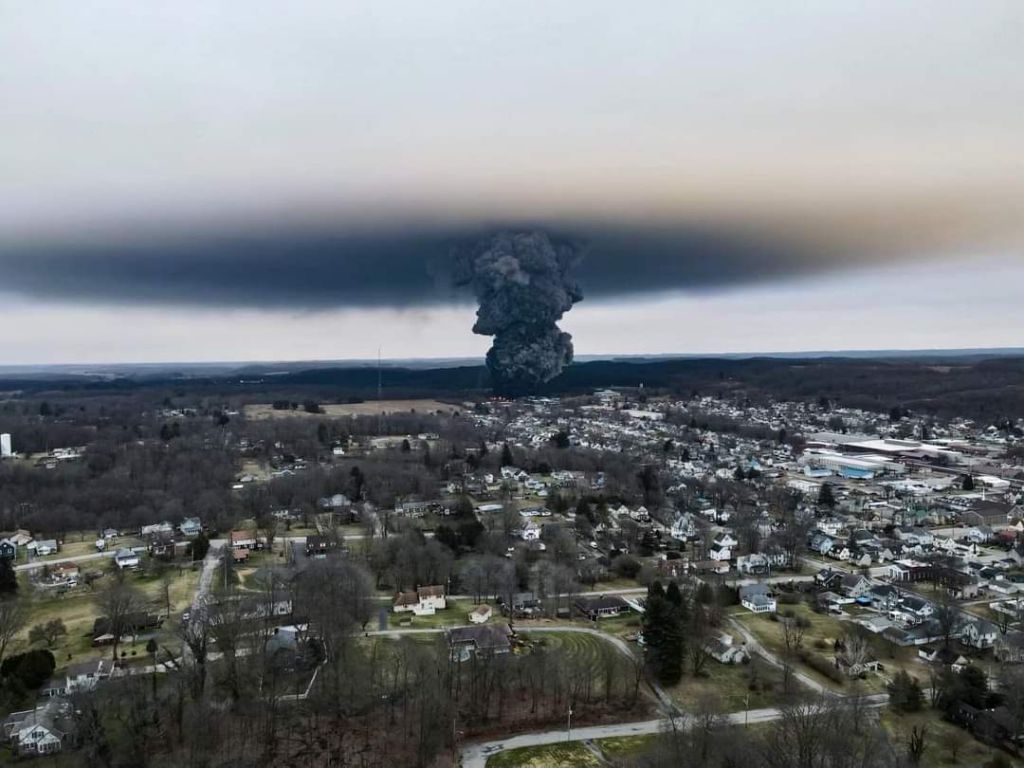
The image shows a massive column of black smoke rising above the town of East Palestine, Ohio. The column reaches low cloud-height and spreads out, forming a toxic mushroom cloud.

A brief update on the movement to Stop Cop City

I’m working on a longer post about what’s been going on in Atlanta, what information we have on the police killing of Tortuguita, what’s going to be happening in the next month, but I wanted to spend today digging into the Ohio train derailment, because the more I learn, the worse it looks (Edit: Bomb train post will be up some time tomorrow). That said, I wanted to post something quick about it to give people who might want to do something as much advance notice as possible.

So, the bare bones – Climate Justice Alliance has announced that there’s a call for local protests from February 19th -26th in solidarity with the effort to defend the forest. Further, organizers are planning a mass convergence on Atlanta from March 4th-11th, for all who are able to go.

This action guide covers pretty much anything one might feel able to do in support of the cause, so check it out if that interests you. If nothing else, it’s worth looking at in thinking about how you might go about fighting for other causes as well.

Household Chores and Sam Vimes’ Boots

As I’ve mentioned in the past, I’m reasonably certain that I have inattentive type ADHD. One of the ways in which it has affected my life, is that I have a hard time with housekeeping. I don’t feel like going into much detail on that, but one of the effects is that my kitchen knives have not been treated well, and need a great deal of care. Fortunately, I currently have the time to work on that, which is a luxury I do not take for granted. In fact, it relates to the expensiveness of poverty that we discussed the other day. Having a sharp knife is nice, and not everyone has the time to maintain them. Those with money can outsource that chore, but a lot of other folks just have to deal with dull knives, especially if they forget that there’s one sitting in water sometimes.

I also have another edged instrument that really needs some work, though I’ve kept it in much better condition. you see, while you were wasting your time with Gillette and other such disposable grooming instruments, I was studying the blade. Specifically I decided to buy a straight razor, over a decade ago, and learn how to use it.

The image is of a Dovo straight razor on a whetstone. It has a silver-steel blade (high carbon, no actual silver) and a little bit of gold plating ornamentation. The scales (the two pieces of wood forming the handle) are ebony. A little tarnish is visible in the hollow of the blade.

I’m not sure how much money I’ve saved, but given the price of Gillette blades when I stopped using them, I think it’s been at least a couple hundred dollars. This razor, if I take care of it, will keep working for the rest of my life, or close to it, but I had to have a couple hundred dollars to invest in a good razor and a good strop, and I also went for a nice brush. It’s the Sam Vimes Boots Theory of Socioeconomic Unfairness in action. I had the money and the time to buy this, and to learn how to use it.

I decided to work on it now, because after all this time, I also decided to buy another one, for a couple reasons. The first is just that alternating will make the edge last longer on both of them, and make both razors last longer. Hopefully I’ll get to will them to someone some day. The other reason is that it’s a bit hard to tell exactly how sharp my razor is. It works well enough, but I can feel that it’s dull, for a razor. The question is, how sharp is sharp enough?

There are tests, of course. The popular one is pulling out a beard hair, holding it by the base, and seeing if you can cut it just by applying pressure. If the razor’s too dull, it’ll just bend the hair over. But it’s also been a decade since I’ve shaved with a really sharp razor, and I’d really like something to compare to.

There’s also a luxury in having the time to rely on a razor like this. I’ve absolutely cut myself, especially when shaving around the ears, and rushing is generally not a good idea. It’s part of why I didn’t exactly fight to keep shaving my face when Tegan said she preferred a full beard – I had committed to something that was cheaper and more environmentally friendly in the long run, but a great deal more work.

I’m looking forward to the new razor – I don’t indulge in new stuff very often – and I very much want a world where everyone has the resources to save money like this if they want to.


I saved for a bit to buy the new razor, so I feel like I can afford it, but if you want me to feel even better about it, you can join my small but wonderful group of patrons. I don’t have a lot of benefits right at this moment, but I’m working on changing that.

Ben Shapiro doesn’t care about anti-Semitism.

Ben Shapiro doesn’t care about anti-Semitism

I know. Shocking. Who would have thought it?

Ben Shapiro has a history of performative outrage over “anti-Semitic” ideas like disagreeing with the far-right, genocidal policies of the Israeli government, or acknowledging that Israel has a big lobbying presence in the United States. He also has a history of ignoring or excusing actual anti-Semitism, like Trump’s conflation of all Jewish people and the nation of Israel or, more recently Joe Rogan’s claim that, and I quote, “”The idea that Jewish people aren’t into money is ridiculous. It’s like saying Italians aren’t into pizza!”

I hope nobody reading these needs this explanation, but the idea that Jews are greedy is a very old stereotype that has been used for literal centuries to encourage hatred and distrust of Jewish people. Claiming that money is a part of Jewish culture the way Pizza is a part of Italian culture? Fucking hell, that’s like Ye West saying he thinks learning about Hannukah comes with “financial engineering”. In case it wasn’t clear, money is a part of most cultures I’ve heard of, and comments about Jews being “into money” are a bit rich, coming from a guy who got paid $200 million for his bigoted, reactionary podcast. Still, at least Shapiro condemned Ye’s antisemitism, and scolded Candace Owens for defending him. I know Rogan didn’t say that he loves Hitler, but surely Ben Shapiro would be upset by this, right?

Well, sort of.

See, Shapiro was bothered by it. If he wasn’t, why would have have had a private conversation with Rogan about it? But while Ilhan Omar, who did not say the same thing Rogan did, was worthy of condemnation even after she clarified her meaning and publicly apologized, Rogan was just misunderstood, and he gets a pass.

So, I think jokes are different than than, you know, actual honest observations. I did talk with Joe a little bit about this yesterday, and he was saying what I sort of suggested he was saying yesterday, which is everybody likes money and Jews are good with it. And, you know, again, that is a very different thing than, I think, how it came out on the air when Joe was talking about it.

I will say that there is a difference between making stereotypical comments and having a stereotypical worldview. When you talk about full damaging racism or antisemitism, it is actions that are tied to a full scale worldview that are truly damaging. Now, there can be prominent people who say things that then tie into that worldview or give credence to that worldview unintentionally by saying things. And that’s a problem. But the bigger problem is the worldview itself.

So, to take an example, if you make a stereotypical comment about Black people in a joke to a friend, is that good? No, it’s not good. It’s ugly and it’s bad and shouldn’t do it. Does that make you a racist for the rest of your life? No. It means you did a bad thing. It means you said a bad, racist thing. Does it mean that you even buy into a full scale racist world? No. And I think we’ve lost all nuance in this discussion. It’s true with antisemitism too. If somebody makes a Jewish joke, is that the same thing as somebody buying into a broad scale program with regard to Jewish conspiracy theory?

The reason why people’s radar went up when Joe said that is because when you say Jews love money, this does tie into a broader actual worldview about Jews, which is Jews are greedy and Jews are terrible, and they use their greed and horror in order to control world finance. And because they use their greed and horror to control world finance, they’re victimizing surrounding groups. This is, sort of, left-wing view of what Jews are – Jews are evil capitalist, predatory threats who are disproportionately successful because Jews are bad. Right, so, when you say things like Jews love money, it ties into that in one area. It can also tie into old-style religious antisemitism – the whole idea that Jews would sell out Jesus for 30 pieces of silver or stuff like that. You can see how it would tie into broader antisemitic worldviews. But it doesn’t necessarily mean that your comment was meant that way or that it does tie into that.

And I don’t think that the best way to fight racism or antisemitism is to fight these specific comments all the time. Or – you can mention them, you can point out that they’re bad and wrong. But to waste all of your ammo on that, as opposed to the broader worldview I think is a serious problem. It’s the broader worldview that needs to tumble down because that broader worldview sometimes allies itself with fellow travelers who believe things like capitalism is indeed bad, disproportionately successful people are bad and greedy, and that crosses streams of the antisemitic conspiracy theory that I suggested before. And now you have a real antisemitic movement. That’s really dangerous.

He didn’t mean it like that, guys. He just meant to say that Jews are good with money. Nothing wrong with that, right?

So yeah. Ben Shapiro doesn’t actually care about anti-Semitism. Huge, I know. Talking about conservative hypocrisy feels like beating a dead horse, but unfortunately this particular horse won’t stay dead. Hell, Shapiro even coined the term “JINO” – Jew In Name Only – to apparently distinguish between “good” Jews and “bad” Jews. It seems that how strongly he objects to anti-Semitic remarks depends on how friendly the person in question is to his cause (Rogan is pretty conservative on a lot of stuff), and how powerful the person is (Rogan is the biggest podcast host in the world, whereas Candace Owens works for Shapiro). The only principle to which he holds true, is his love of the hierarchy maintained by capitalism.

Videos: Beau of the Fifth Column on the ongoing saga of the Nord Stream pipelines.

Seymour Hersh is a Pulitzer-winning journalist whose career has legitimately served the public interest many times over the last few decades. As the second video below mentions, if you’ve heard of the Mỹ Lai massacre, at least in the U.S., it’s because of his reporting. In more recent years, he’s developed a reputation for what’s been described as an over-reliance on anonymous sources, often to support controversial claims, that smacks of gullibility. Despite that, his history demands at least some respect, and when it comes to who blew up the Nord Stream gas pipelines, I’m sympathetic to the idea that the U.S. is the most likely culprit. The thing is, contrary to what some seem to believe, the U.S. is not the only entity in the world with agency. Other countries act on their own, for their own reasons all the time. I feel the need to say this because there are people across the political spectrum in the U.S. who seem to believe that it literally controls the entire world. Life is more complicated than that, which I think is a good thing.

I am not, however, anything like an expert on this sort of thing, so I found these videos helpful. The first one digs into who has the motive and capability to do something like this. It makes the case that basically everyone except Germany has motive, and pretty much everyone probably has the capability.

 Hersh has written an article on his Substack that claims the United States blew up the pipeline. He outlines a plausible order of events, and bases it all on information from a single anonymous source, claimed to be involved in planning the operation. Again, I have no trouble believing that the U.S. would do this, but as Beau says in the video above, that applies to a lot of entities, not even limited to national governments. Hersh’s claim certainly has plausibility, but it’s only credibility lies in Hersh’s reputation – in how willing the reader is to take him at his word. This is by no means unique to Hersh, but it does mean that we haven’t actually been shown evidence. If I were to put out a blog post tomorrow saying that France did it, or Exxon did it, and cited an anonymous source, I think it would be perfectly reasonable for nobody to believe me. Hell, if I was contacted by someone claiming to be involved in the operation, I would immediately assume they were someone messing with me. If nothing else, choosing to leak that information to a random blogger with a couple hundred daily views (please share my work, but like – the good posts) would be profoundly irresponsible.

But my point – and it’s one I got from Beau in the video below – is that in terms of evidence, the article and its author are all we currently have. That doesn’t mean Hersh is wrong, but it does mean that some skepticism is probably warranted.


Some More News: Why Being Poor Is So Expensive

Just over a year ago, Tegan wrote a post for me about the Vimes Boots Theory of Socioeconomic Unfairness, and about the Vimes Boots Index that it inspired. For those who are unfamiliar with the theory, you should read more Terry Pratchett. Since doing so will take some time, however, I’ll share the relevant excerpt:

“The reason that the rich were so rich, Vimes reasoned, was because they managed to spend less money. Take boots, for example. He earned thirty-eight dollars a month plus allowances. A really good pair of leather boots cost fifty dollars. But an affordable pair of boots, which were sort of okay for a season or two and then leaked like hell when the cardboard gave out, cost about ten dollars. Those were the kind of boots Vimes always bought, and wore until the soles were so thin that he could tell where he was in Ankh-Morpork on a foggy night by the feel of the cobbles. But the thing was that good boots lasted for years and years. A man who could afford fifty dollars had a pair of boots that’d still be keeping his feet dry in ten years’ time, while a poor man who could only afford cheap boots would have spent a hundred dollars on boots in the same time and would still have wet feet.” – Terry Pratchett, Men at Arms

The unfortunate reality is that this phenomenon extends far, far beyond boots, and is by no means limited to the pages of fiction. In our capitalist society, almost everything that’s used by rich and poor alike seems to be designed to be cheaper and easier for the rich, from durable goods, to banking services, to healthcare, and beyond. In fact, it’s such a big problem (in my eyes – rich people don’t think it goes far enough) that one could fill up and hour-long video (including ads) just digging into why it’s so damned expensive to be poor. If only there were people who did that sort of thing…

REI Workers Win Fight for Union Election

Corporations are utterly dependent on workers. They need workers to make their products, to ship their products, and to sell their products. Corporations also hate that dependence. Their least favorite part of capitalism is that workers, if they’re well-enough organized, can bring a company to its knees. The people running most corporations seem to feel that it is unjust for the peasantry to have that kind of power, so they’ve spent vast amounts of money to get the government to take their side. The work of last century’s labor movement has meant that they can’t just murder workers who refuse to work anymore, so they rely on the government to ensure that the general population is so poor and desperate that they’d literally run out of food and shelter if they tried to use a protracted strike to get better conditions. Unfortunately, this dynamic is a feature of the economic system we inhabit, and so it also applies to “good” companies that aren’t technically owned and run for greed alone.

REI is a good example of this. I worked there for a few months just prior to leaving the United States, in a lot of ways, they seem like a better form of corporation. They’ve got a nice story – a group of outdoorsy types decided that the equipment was too expensive, and decided to form a cooperative business for themselves and like-minded folk, to make their hobby more affordable. The company is a cooperative, but rather than being owned by workers, it’s owned by customers. To be clear – all REI workers are co-op members, but they’re a minority, and have probably a bit more power to affect company policy than the average U.S. voter has to influence government policy. Probably not zero, but close enough that, well, the workers still need to organize to get fair pay and treatment.

After REI employees in a suburb of Cleveland, Ohio walked off the job Friday morning, the recreational equipment retailer agreed to schedule a union election vote next month and stopped pushing to exclude certain workers.

Following successful union drives at two other REI stores, employees in Beachwood last month filed for a union election with National Labor Relations Board (NLRB) seeking representation with the Retail, Wholesale, and Department Store Union (RWDSU).

John Ginter, a sales associate at the Beachwood REI, told Cleveland-based Ideastream Public Media that he and his co-workers are seeking better working conditions.

“We are basically making demands that we have a livable wage, that we are able to live our lives outdoors, like REI’s mission statement includes,” he said. “So having a better work-life balance, being able to care for ourselves and to increase benefits for employees across the spectrum, whether or not they are part-time, full-time, whatever that situation would be.”

According to the report: “Ginter alleged REI has some ‘pretty rigid stipulations’ with regard to which employees are eligible for benefits and accrual of sick time. He also said he believes his REI location is ‘not living up to our diversity, equity, and inclusion statement.'”

Beachwood workers launched their brief unfair labor practice (ULP) strike Friday as an NLRB hearing got underway at the federal agency’s Cleveland office.

In a ULP charge that RWDSU filed Thursday with the NLRB, the union claimed REI “engaged in the unlawful surveillance of workers and/or created an impression of surveillance of the workers at the Beachwood store.”

RWDSU has also accused REI of putting forth “meritless assertions to delay the election” by claiming that sales leads, bike shop workers, and “casual” employees—or those who work part-time with irregular schedules—should not vote.

“RWDSU vehemently disagrees with REI’s objections,” the union said in a statement. “It is especially galling because, as the company unnecessarily fights RWDSU in Ohio, it is currently bargaining contracts with workers holding these same classifications at the SoHo, New York and Berkeley, California stores. REI’s hypocrisy is union-busting plain and simple and is a meek attempt to exclude more than half of the proposed bargaining unit to be eligible to vote.”

REI was far from the worst job I’ve had. I was hired as a cashier, and I honestly enjoyed the work. I got to help people plan for trips that I’d been on, share my experience with people who wanted advice, and I got a good discount on everything I bought. More than that, customers who buy from REI get money back based on how much they’d spent, and that dividend could come in the form of actual money, not just store credit. For people who buy a lot of outdoor gear, it’s actually a great deal, and I would recommend it. I’d honestly have been happy just working there, had the job not been in the United States.

During that stretch of time, Tegan and I were paying $300 per month for intensely mediocre insurance that, because we were trying to get at least a little government assistance (Obamacare and all that), came with a huge amount of paperwork, contradictory statements and instructions, and several insurance cards sent to us over the course of a year. When I went for my last doctor visit before leaving the country, none of the cards worked, and I was forced to pay $200 out of pocket for a 10 minute “checkup”. I think there was an option for insurance through REI, but it wasn’t viable for me as a part-time worker.

Still, REI puts a lot of effort into the whole, “we’re one big happy corporate family” message, and it’s honestly more compelling from them than most companies. Everyone got a voucher for one day off, planned in advance, specifically for the purpose of doing something outside, for example, and there were regular weekend activities like hikes or bike rides that people could join if they wanted.

But I’d like to draw your attention to something. The article I quoted is titled “‘Strikes Work’: REI Agrees to March 3 Union Election After Ohio Walkout”. I fully agree that strikes work, and that we should support them by default, but there’s something wrong with this situation. This wasn’t a strike for better pay, or a strike for safer conditions, or better health insurance, it was a strike to get an election in which they can vote on whether or not to form a union.

Again – simply forming a union required coordinated labor action, and permission from the company. Biden recently tweeted that workers have a right to form a union, but do they? REI workers had to strike just to get the right to vote on whether to form a union. It seems to me that, as with voting in elections, people shouldn’t have to fight every time they want to exercise their rights. Instead, people in the U.S. have to fight to exercise a whole host of rights and freedoms that they’re supposed to have, while companies steal from them, put them in danger, and spend the money that the workers make for them on union-busting, and on lobbying the government to further stack the deck in their favor.

The sad reality is that even with a supposedly progressive company like REI, the way capitalism is set up, management is always pitted against labor. Even in cooperatives that are owned and managed by workers in a democratic fashion, the workers themselves often have to take on the adversarial role of management, for the company to have a shot at surviving in an economy that’s very much built around the whims of the aristocracy.

This is why I don’t think “social democracy” is good enough. It’s better than what the United States has, to be sure, but it leaves capitalists in the driver’s seat, and requires constant struggle by the working class to exercise and maintain the rights they’ve won. That doesn’t mean I’d oppose it, of course. I’d happily take the version of the U.S. that a moderate like Bernie Sanders might create, but it’s not just about whether or not people have a decent life. It’s also about whether other people have the power to take that life away. The reality is that the American Dream was always a lie, and the ruling class, both in and out of government, have worked hard to make sure that it stayed a lie, as they’re doing to this very day. Organizing for better treatment is, without question, an important thing to do all by itself, but as has been noted many times in the past, it’s a first step, not the end goal. As long as the fundamental organization of the economy is designed to create so much inequality in power and wealth, the folks at the top will always be working to gain more control over the peasantry, and that will always be far easier for them than what workers have to do to keep what freedom they have.

I’m glad that REI outlets are unionizing, and I hope the trend continues, but I think this is a good reminder that even as we celebrate the progress we make, we have to be thinking about the next fight.