Millions threatened by toxic dust from drying Great Salt Lake

Fresh water is a resource that’s likely to become increasingly scarce in the coming years, even without corporations buying up water supplies. The Great Salt Lake of Utah was already on track to dry up before global warming really got going, simply because of how much water is taken from the rivers that feed into the lake. Add in warmer temperatures, and you have a body of water that’s evaporating much faster than it’s being replenished.

The big danger here is not that people will run out of water, though. It’s worse than that. See, the reason the Great Salt Lake is so salty is that, unlike the Great Lakes further east, it doesn’t drain into the sea. That means that all the minerals carried into it by its tributary rivers just stay there, concentrating as water evaporates, and new minerals arrive. The problem is that sodium chloride isn’t the only mineral that’s been concentrating there over the last 16,000 years or so. There’s also arsenic in the mix, and other toxic chemicals.

In the areas where the lake has already dried, the lakebed is protected from the wind by a crusty layer of salt, but that layer is pretty thin, and once it’s gone, northern Utah starts getting toxic dust storms.

The terror comes from toxins laced in the vast exposed lake bed, such as arsenic, mercury and lead, being picked up by the wind to form poisonous clouds of dust that would swamp the lungs of people in nearby Salt Lake City, where air pollution is often already worse than that of Los Angeles, potentially provoking a myriad of respiratory and cancer-related problems.

This looming scenario, according to Ben Abbott, an ecologist at Brigham Young University, risks “one of the worst environmental disasters in modern US history”, surpassing the partial meltdown of the Three Mile Island nuclear reactor in Pennsylvania in 1979 and acting like a sort of “perpetual Deepwater Horizon blowout”.

Salt Lakers are set to be assailed by a “thick fog of this stuff that’s blowing through, it would be gritty. It would dim the light, it would literally go from day to night and it could absolutely be regular all summer,” said Abbott, who headed a sobering recent study with several dozen other scientists on the “unprecedented danger” posed by lake’s disintegration.

“We could expect to see thousands of excess deaths annually from the increase in air pollution and the collapse of the largest wetland oasis in the intermountain west,” he added.

There is evidence that plumes of toxic dust are already stirring as the exposed salt crust on the lake, which has lost three-quarters of its water and has shriveled by nearly two-thirds in size since the Mormon wagon train first arrived here in the mid-19th century, breaks apart from erosion. Abbott now regularly fields fretful phone calls from people asking if Salt Lake City is safe to live in still, or if their offspring should steer clear of the University of Utah.

“People have seen and realized it’s not hypothetical and that there is a real threat to our entire way of life,” Abbott said. “We are seeing this freight train coming as the lake shrinks. We’re just seeing the front end of it now.” About 2.4 million people, or about 80% of Utah’s population, lives “within a stone’s throw of the lake”, Abbott said. “I mean, they are directly down wind from this. As some people have said, it’s an environmental nuclear bomb.”

I feel like we need metaphors other than nuclear disaster for this sort of thing. I get that radioactive fallout is the go-to way to describe this kind of long-lasting damage to the environment, but I think it’s a bad comparison. The long-term health effects might be similar, but this isn’t an event with lasting effects – it’s just… lasting effects. This is also a problem that is both foreseeable (obviously), and preventable, at least in the short term. Water conservation and finding a water source other than the rivers feeding the lake would allow it to start growing again, and water seems to be an effective “seal” on the nasty stuff. This is a make-or-break moment when it comes to ecosystem services – the water draining into that lake is literally protecting people from taking in poison with every breath.

The Great Salt Lake’s predicament is often compared to that of the dried-up Owens Lake in California, one of the worst sources of dust pollution in the US since the water feeding it was rerouted to Los Angeles more than a century ago. But the sheer heft of the Great Salt Lake, sometimes called ‘America’s Dead Sea’ but in fact four times larger than its counterpart that straddles Israel and Jordan, presages a loss on the scale of the Aral Sea, once the world’s fourth largest lake but strangled to death by Soviet irrigation projects.

The demise of the Aral Sea was dumfounding to many Soviets, who thought it virtually impossible to doom a lake so large just by watering some nearby cotton. “But these systems are actually very, very delicate,” said Abbott, and they can quickly spiral away. The Great Salt Lake, its equilibrium upended by the voracious diversion of water to nourish crops, flush toilets and water lawns and zapped by global heating, could vanish in just five years, a timeline Abbott admits seems “absurd”.

“History won’t have to judge us, not even our kids will have to judge us – we will judge ourselves in short order,” said Erin Mendenhall, the mayor of Salt Lake City, who is now regularly bombarded with questions about the toxic dust cloud from mayors of other cities. “The prognosis isn’t good unless there’s massive action. But we have to start within one year, we have have to take the action now.”

With the climate warming, I have to say I’m worried that letting the rivers flow might not be enough, but there’s no question that it should be done. That, in turn, should be part of a national conversation about water policy. It may be that areas with an over-abundance of water can help to supply those with less (though not for a profit), or it may be that places like Salt Lake City need to be abandoned altogether. Climate change is just one part of it, but we’re rapidly approaching a point where places we’re used to inhabiting will no longer support human life, and I don’t think we’re doing enough to prepare for that.

Video: Rebecca Watson on mask science (they work!)

Both Tegan and I decided to start masking early on in the pandemic, well before anyone was requiring it. Sometimes, it was something close to useless like a bandanna, but since Tegan had a customer service job in Glasgow, she made herself a couple multi-layer masks, and I eventually bought a neck gaiter with disposable filter inserts. I’ve always viewed the mask question from something of a gamer’s perspective on odds. Back when I was an avid World of Warcraft player, I had to pay close attention to cumulative percentages. Any one piece of gear, while helpful, wasn’t as useful as all of it together, whether it came to your chance of landing a critical strike, or your chance of blocking or dodging an enemy’s attack.

I don’t expect the vaccine to protect me entirely, just to improve my odds. Masks are the same – they might only stop a small percent of particles I’d otherwise inhale, but that still improves my odds of staying healthy. I wouldn’t expect my masks to do anything to stop the fine particulate air pollution I’ve mentioned in the past, but yeah – they provide one very imperfect physical barrier between myself in the world. How could it not be better than nothing? After the last couple years, it just feels like common courtesy to mask.

Still, some people adamantly oppose masking, and will insist that the science shows no clear benefit. Obviously I disagree, but I think it’s fair to be doubtful, especially with so many contradictory messages out there. Rebecca Watson takes on that uncertainty, and a recent report on the efficacy of masks. The TL:DR is that masks do help with COVID, at least a little, but also that the people who put the report together did so in such a way as to give the impression that they don’t.

As always, you can find the video’s transcript and sources on Skepchick, but I just wanted to highlight one thing:

“But wait,” you may be saying, “my MAGA uncle says that Cochrane Review says masks don’t work. What’s going on?”

[..]

The review is titled “Physical interventions to interrupt or reduce the spread of respiratory viruses,” and it is available in full online and as always I link to all my sources in the transcript which you can find linked below or at patreon.com/rebecca. This review did conclude that “Wearing masks in the community probably makes little or no difference to the outcome of influenza-like illness/COVID-19 like illness compared to not wearing masks.”

Immediately, you might note that this is about “respiratory viruses,” and not specifically COVID-19. That’s important, because they lumped in a few studies on the effectiveness of masks versus COVID along with a whole bunch of studies on non-epidemic influenza, which is way less contagious and rarer to contract, meaning that of course you’re going to need way more data to show any result, compared to looking at masks in the middle of the COVID-19 pandemic.

In fact, epidemiologist Gideon Meyerowitz-Katz decided to remove the data for influenza to see what would happen, and sure enough, the random controlled trials for masking DURING A PANDEMIC showed a clear, modest benefit. He points out that the review is perfectly fine otherwise, but personally I think it’s a pretty big deal that Cochrane released this during a pandemic, knowing that people would assume that the conclusion would be applied during a pandemic. It’s like releasing a review concluding there’s no benefit to wearing a seat belt, without mentioning that most of the data I examined was from a survey of people sitting in parked cars in the grocery store parking lot. It turns out that context is very important!

This frustrates me. Scientists ought to know how important context is, and I find it hard to believe that they don’t know how much confusion there is on this particular topic. I suppose I’ll never know for sure whether the way they structured their report was deliberate, but I feel like the responsible thing to do would have been to write a paper that wouldn’t create this kind of confusion. Still, it’s nice to have a bit more support for my position. As I said before, I think masking in indoor public spaces is just a matter of courtesy.

Now, I’m not always the most courteous guy – sometimes I forget a mask when I go out, or I don’t have one that’s clean. I also eat at restaurants on rare occasions, and if you’re in some form of eatery, wearing a mask seems a bit like spitting in the wind. I’m also aware that my opinion on “common” courtesy isn’t particularly common – the vast majority of folks in Dublin don’t wear masks anymore, and based on the consistently low COVID numbers, that doesn’t seem to be doing a whole lot of harm. It helps that we’ve got a pretty high vaccination rate. The Kraken may have originated here, but it didn’t turn out to be much of a monster.

Masks work, in that they improve your odds. That’s a limited and uncertain benefit, but the reality is that we are beset by uncertainties at every moment in our lives. Accepting that is – or ought to be – a natural process of growing up and maturing, but obviously it’s not a comfortable process, and most people are trained, to some degree, to reject uncertainty. The distressing truth is that this world is messy and complicated, and sometimes when you’re dealing with a mess, it’s better to just wear a mask.

Research suggests we’re under-estimating global warming feedbacks

For at least as long as I’ve been actively paying attention to the climate issue, activists and scientists have both expressed frustration at the way the IPCC has failed to adequately account for amplifying feedback loops. For those who need a refresher, these “loops” are various effects of warming, that go on to cause more warming all by themselves. The examples that first come to mind for me are the release of CO2 and methane from melting and rotting permafrost, the lowered albedo (decreased reflectivity) of the planet due to melting ice, and a decrease in CO2 uptake, and increase in CO2 emissions from wildfires and other climate-driven ecosystem destruction. One of the feedback loops that had worried me the most in the past was the proposed danger of warming oceans causing a destabilization of sea-floor methane deposits called clathrates, which could in turn release vast amounts of methane into the atmosphere. Fortunately, data from oil and natural gas spills indicate that while that destabilization may still happen, the gas will be almost entirely absorbed by the ocean before it can reach the surface. I felt like it was good to put in that bit of good news (though I’d like to see follow-up research), because the main focus of today’s post is research led by Oregon State University that says even scientists may be under-estimating feedback loops:

Ripple, Wolf and co-authors from the University of Exeter, the Potsdam Institute for Climate Impact Research, the Woodwell Climate Research Center and Terrestrial Ecosystems Research Associates considered both biological and physical feedbacks. Biological feedbacks include forest dieback, soil carbon loss and wildfire; physical feedbacks involve changes such as reduced snow cover, increased Antarctic rainfall and shrinking arctic sea ice.

Even comparatively modest warming is expected to heighten the likelihood that the Earth will cross various tipping points, the researchers say, causing big changes in the planet’s climate system and potentially strengthening the amplifying feedbacks.

“Climate models may be underestimating the acceleration in global temperature change because they aren’t fully considering this large and related set of amplifying feedback loops,” Wolf said. “The accuracy of climate models is crucial as they help guide mitigation efforts by telling policymakers about the expected effects of human-caused greenhouse gas emissions. While recent climate models do a much better job of incorporating diverse feedback loops, more progress is needed.”

Emissions have risen substantially over the last century, the researchers note, despite several decades of warnings that they should be significantly curbed. The scientists say interactions among feedback loops could cause a permanent shift away from the Earth’s current climate state to one that threatens the survival of many humans and other life forms.

“In the worst case, if amplifying feedbacks are strong enough, the result is likely tragic climate change that’s moved beyond anything humans can control,” Ripple said. “We need a rapid transition toward integrated Earth system science because the climate can only be fully understood by considering the functioning and state of all Earth systems together. This will require large-scale collaboration, and the result would provide better information for policymakers.”

In addition to the 27 amplifying climate feedbacks the scientists studied were seven that are characterized as dampening – they act to stabilize the climate system. An example is carbon dioxide fertilization, where rising concentrations of atmospheric CO2 lead to increasing carbon uptake by vegetation.

The effects of the remaining seven feedbacks, including increased atmospheric dust and reduced ocean stability, are not yet known.

I know the phrase “further study is needed” is pretty standard in the conclusion of a research article, but in this case, further study is needed. I mean, I suppose if we continue down the path favored by capitalists, then I suppose “need” is the wrong word – we can do that in ignorance just fine. For those of us hoping to slow the change and prepare for that which we can no longer prevent, however,  understanding how fast things are moving is crucial. In the event that we ever take climate change seriously, as a species, it’ll be good to know this stuff. The researchers do more than digging into the science though. They also have a message for policy makers. Can you guess what it is?

OSU College of Forestry postdoctoral scholar Christopher Wolf and distinguished professor William Ripple led the study, which in all looked at 41 climate change feedbacks.

“Many of the feedback loops we examined significantly increase warming because of their connection to greenhouse gas emissions,” Wolf said. “To the best of our knowledge, this is the most extensive list available of climate feedback loops, and not all of them are fully considered in climate models. What’s urgently needed is more research and modeling and an accelerated cutback of emissions.”

The paper makes two calls to action for “immediate and massive” emissions reductions:

  • Minimize short-term warming given that “climate disasters” in the form of wildfires, coastal flooding, permafrost thaw, intense storms and other extreme weather are already occurring.
  • Mitigate the possible major threats looming from climate tipping points that are drawing ever-closer due to the prevalence of the many amplifying feedback loops. A tipping point is a threshold after which a change in a component of the climate system becomes self-perpetuating.

“Transformative, socially just changes in global energy and transportation, short-lived air pollution, food production, nature preservation and the international economy, together with population policies based on education and equality, are needed to meet these challenges in both the short and long term,” Ripple said. “It’s too late to fully prevent the pain of climate change, but if we take meaningful steps soon while prioritizing human basic needs and social justice, it could still be possible to limit the harm.”

Do more, and do it quickly, while we still can.

I know, it’s a message that this little community has never heard before. In all seriousness, though, it comes back to this – we have the resources, through nuclear power, “renewable” power, mass transit, and ending overproduction, to make a huge dent in human contribution to the problem, in a way that would measurably improve normal people’s standard of living. Likewise, we can and should invest heavily in changing how we grow food, and in ending most animal agriculture. We could even do this, in theory, while leaving our current ruling class with so much wealth that they’d never need to work in their lives. Unfortunately, they seem to be psychologically incapable of contemplating anything that might diminish their status relative to the peasantry, and they’re too addicted to wielding power to ever give it up. If they ever decide to be useful, I’ll welcome their resources (especially since they never had a moral right to them in the first place), but while we wait for that particular pig to fly, I suggest we explore ways to to make those changes without their help.


Thank you for reading! If you found this post useful, please share it around. If you read this blog regularly, please consider joining my small but wonderful group of patrons. Because of my immigration status, I’m not allowed to get a normal job, so my writing is all I have for the foreseeable future, and I’d love for it to be a viable career long-term. As part of that goal, I’m currently working on a young adult fantasy series, so if supporting this blog isn’t enough inducement by itself, for just $5/month you can work with me to name character in that series!
Good news from Spain!

I cover a lot of fairly grim topics on this blog, not least of which is a rise in fascism that seems to be happening all over the globe sometimes. I believe it’s important to talk about problems, as one part of trying to fix them, but that can get a bit grim from time to time. The good news is that the aforementioned fascism is, in many ways, part of a reactionary backlash against real progress that has been made in the area of civil rights. Even as some people are trying to roll back advances, others are pushing ahead, fighting for more advances, and winning.

In particular, Spain has just passed a couple laws that I think are worth celebrating. First, they’ve made it radically easier for people to change their gender on their national identity card:

The law, which passed by 191 votes in favour, 60 against with 91 abstentions, makes Spain one of the few nations to allow people to change their gender on their national identity card with a simple declaration.

In Europe, Denmark was the first country to grant such a right in 2014.

Thursday’s vote was the last hurdle for legislation that has caused a major rift within Spain’s fractious left-wing coalition, as the country gears up for a general election later this year.

The legislation is a flagship project of the equality ministry, which is held by Podemos, the radical left-wing junior partner in the Socialist-led coalition.

“This is one of the most important laws of this legislature… we have taken a giant step forward,” Equality Minister Irene Montero told lawmakers ahead of the vote.

“This law recognises the right of trans people to self-determine their gender identity, it depathologises trans people. Trans people are not sick people, they are just people.”

Until now, adults in Spain could only request the change with a medical report attesting to gender dysphoria and proof of hormone treatment for two years. Minors needed judicial authorisation.

The new law drops all such requirements, with those aged 14 and 15 allowed to apply if their parents or legal guardians agree.

Those aged 12 and 13 will also require a judge’s permission to make the move.

‘We are not ill’

The vote was hailed by campaigners who said Spain was setting an example that would encourage others to follow suit.

“We’re celebrating the fact this law has passed after eight years of tireless work to obtain rights for the trans community,” Uge Sangil, head of FELGBTI+, Spain’s largest LGBTQ organisation, told AFP outside parliament.

“We’re winning human rights with the free determination of gender… From today, our lives will change because we are not ill.”

This is a clear win. The article notes, as I’ve done in the past, the ways in which trans rights are under assault, as well as the way England’s right-wing government overrode Scotland’s decision to enact a similar law. I’ve honestly not paid much attention Spain, but this is not the first time I’ve felt I should change that.

The other change that I think is worth celebrating is the decision to provide paid menstrual leave, with a doctor’s note, covered by the public healthcare system. Periods can be debilitating. For some people they’re not much of a problem, but at the other end of the spectrum you get cramps, migraines, vomiting, stiffness, and probably other problems I’m forgetting. It is not reasonable to demand that people just work through that, especially since, as I keep saying, there’s no actual scarcity to justify depriving people. As a USian, the requirement of a doctor’s note gave me pause, but in a good public healthcare system, that’s far less of a burden than it would be in the States.

The bill approved by Parliament on Thursday is part of a broader package on sexual and reproductive rights that includes allowing anyone 16 and over to get an abortion or freely change the gender on their ID card.

The law gives the right to a three-day “menstrual” leave of absence – with the possibility of extending it to five days – for those with disabling periods, which can cause severe cramps, nausea, dizziness and even vomiting.

The leave requires a doctor’s note, and the public social security system will foot the bill.

The law states that the new policy will help combat the stereotypes and myths that still surround periods and hinder women’s lives.

Equality Minister Irene Montero, an outspoken feminist in the leftwing government, hailed “a historic day of progress for feminist rights”.

“There will be resistance to its application, just as there has been and there will be resistance to the application of all feminist laws,” she told parliament.

“So we have to work (…) to guarantee that when this law enters into force, it will be enforced”.

“The days of (women) going to work in pain are over,” Montero said last year when she unveiled her government’s proposal.

But the road to Spain’s menstrual leave has been rocky. Politicians – including those within the ruling coalition – and trade unions have been divided over the policy, which some fear could backfire and stigmatise women in the workplace.

Worldwide, menstrual leave is currently offered only in a small number of countries including Japan, Taiwan, Indonesia, South Korea and Zambia.

I get why there’s a fear of stigma there, but I think that’s a problem with a capitalist society that demands work (for the interests of capital) to justify dignity or survival. I prefer a societal norm that accepts humans as we are, and doesn’t make unreasonable demands of people, especially for them to have basic rights. This kind of law is only really a problem when you’re forcing people to compete with each other for a “good” life.

I’m hopeful that this will be a step not only towards a more just world, but also towards destigmatizing disability in general, whatever the cause. We’ve got a long way to go, still, but we have made progress, as a species, and that’s worth celebrating. The activists who made these laws a reality have my full respect and appreciation, and I look forward to other countries following this example.

Video: John Oliver on Psychedelics

Boy, that headline sounds a lot more entertaining than what this actually is. I do love the ambiguity of the English language sometimes.

When we talk about systems of power and domination like white supremacy or patriarchy, some people object by pointing to the ways in which those systems often hurt the people they supposedly privilege. This isn’t a bug, but rather a feature. White supremacy was developed not as a way to elevate the newly-invented “white race”, but as a way to control the majority of that race, to get their help in atrocious colonial projects, and to get them to defend a hierarchy that often hurts them more than it helps. To quote Lyndon Johnson:

If you can convince the lowest white man he’s better than the best colored man, he won’t notice you’re picking his pocket. Hell, give him somebody to look down on, and he’ll empty his pockets for you.

This approach had many benefits for the white aristocracy – it got the consent of white people to murder and enslave countless Indigenous people in Africa and the Americas, and it often got those same white people to fight hard to defend the hierarchy because while they weren’t at the top, they could see every day that they weren’t at the bottom either. It created a pretty one-sided, cross-class solidarity based on sadism and bigotry, that continues to be central to maintaining capitalism to this day. While open hatred has gained popularity with the recent fascist backlash, there was a brief period in which the power of liberatory social movements made bigoted people look for ways to hide their bigotry, while still upholding systemic white supremacy. A good quote on this comes from Lee Atwater, another miserable bigot:

You start out in 1954 by saying, “N*****, n*****, n*****.” By 1968 you can’t say “n*****”—that hurts you, backfires. So you say stuff like, uh, forced busing, states’ rights, and all that stuff, and you’re getting so abstract. Now, you’re talking about cutting taxes, and all these things you’re talking about are totally economic things and a byproduct of them is, blacks get hurt worse than whites.… “We want to cut this,” is much more abstract than even the busing thing, uh, and a hell of a lot more abstract than “N*****, n*****.”

Again, we have the same theme – from people in or close to the ruling class who support white supremacy – that while black people are hurt more by systemic racism, a lot of white people get hurt by it as well. There are pretty easy examples – police violence, while mainly aimed at black and brown people, it also hurts white people all the time. That fits pretty well, since both white supremacy and police are all about keeping normal folks in line, but the pattern echoes throughout society. When the law no longer allowed black people to be explicitly excluded from government assistance and other public services, white society decided that if it couldn’t be for whites alone, it couldn’t exist at all. They were so obsessed with keeping black people down that they were willing to hurt poor white folks along with them.

And a similar thing happened with the drug war. To quote another horrible person who worked to uphold capitalism and white supremacy:

The Nixon campaign in 1968, and the Nixon White House after that, had two enemies: the antiwar left and black people. You understand what I’m saying? We knew we couldn’t make it illegal to be either against the war or black, but by getting the public to associate the hippies with marijuana and blacks with heroin. And then criminalizing both heavily, we could disrupt those communities. We could arrest their leaders. raid their homes, break up their meetings, and vilify them night after night on the evening news. Did we know we were lying about the drugs? Of course we did.

Once again, I think it’s important to note that while these people were absolutely vicious bigots, they also used and perpetuated bigotry as a tool to attain, hold, or increase their power. And the harm? Well, the so-called War on Drugs has been almost universally regarded as a total failure, except with regard to its utility in justifying a massive expansion in the government’s power to destroy lives.

It goes beyond that, though. Most of the attention is quite rightly focused on the abuse, exploitation, and enslavement of black people in the U.S., but one of the ways in which it hurts everyone has been through a lack of access to, and understanding of a variety of drugs. It’s not just about fun, though I think we should have a right to that. Many of these are drugs that can measurably improve people’s wellbeing, and help us work through things ranging from trauma to the inevitable approach of death. I think I’ve mentioned in the past that during my last couple years in the U.S., I had a license to use medical cannabis to help manage stress and anxiety. I never touched the stuff until I was in my 30s, but for the couple years in which I had legal access, it made a huge difference in my life. I haven’t tried anything “stronger” though, partly because I haven’t felt a need, and partly because of criminalization.

I’d prefer not to get on the wrong side of the law, and when it comes to things that come in pill form, there seems to be an increasing problem with contamination (consider getting fentanyl test strips and narcan – they save lives). There may be inherent risks in the use of any given drug – just as there are with things like caffeine or alcohol – but the real danger comes from criminalization. The danger of violence comes from the police, and from the danger presented by the police. The danger of contamination comes, in most part, from the necessity of “underground” production. The danger of the drugs themselves comes from ignorance of the effects, and the danger (also from cops) inherent in seeking treatment or advice.

Decriminalizing makes it easier for researchers to study drugs and their effects, makes the trade safer, since there would be no need to hide from or defend against law enforcement, makes it easier to know what’s in a given drug, and makes it easier to get help if something goes wrong. In general, the standard should be informed consent – make sure people know the facts, and respect their right to make their own decisions.

Still, while we seem to be a ways off from me getting my way, there has been research into things like psychedelics over the years, and slow progress is being made on legalization for medicinal purposes, which is great. The more I hear, the more I want to have some of these things as an option when I reach my final days. Cannabis wasn’t a “gateway” that made me start using other drugs, but it did give me a little perspective on the lies told about them.

You know what does make me interested in other drugs? Videos like this, which break down the lies, and lay out what we know about how certain drugs have helped people:

You’re not alone: Labor Action Tracker shows strikes across the United States

In recent years, there has been a rise in labor organizing and labor action in the United States. As I’ve said before, watching that happen has been extremely encouraging. While the aristocracy and the government (which mostly serves the aristocracy) have been working hard to crush labor power, the reality is that organizing and strikes work. Mass layoffs, and policy designed to make people poor and desperate absolutely cause real harm, and destroy lives, but they take such drastic steps because they are terrified that their workers will realize – and use – the power that comes from collective action.

The thing is, though, collective action only works if you’re not alone. With corporate media often being outright hostile to labor organizing, and two capitalist parties that regularly side with the bosses, it’s probably not hard for people to feel like the fight is simply too big to take on. It creates a sort of Prisoner’s Dilemma, in which workers have trouble knowing if it’s safer to stand together and fight, or keep their heads down and just try to survive as best they can. That’s why it’s important to normalize talking about this stuff, and why it brings me great pleasure to introduce you to the Cornell-ILR Labor Action Tracker.

Welcome to the Cornell-ILR Labor Action Tracker. The goal of our project is to provide a comprehensive database of strike and labor protest activity across the United States in order to better inform and support labor movement activists, policymakers, and scholars. We would like to especially thank and acknowledge the ILR School for generous funding to support our project. We also thank the staff at China Labour Bulletin for inspiring and encouraging us to develop the labor action tracker.

We began documenting strikes in late-2020 and labor protests in early-2021. Our database of strikes is most accurate as of 2021. We have a relatively high degree of confidence in our ability to comprehensively capture strike activity. Due to the high number of labor protests across the United States, we aim to provide a general understanding of labor protest activity rather than achieve a complete count. Please note that our map generates the total number of strike and/or labor protest locations, which is more than the total number of individual strikes and/or protests (e.g. a single strike at five locations will appear five times on our map). Information we gather is from public sources and manually inputted into our tracker. Please see our methodology document for a more detailed description of our definitions, protocols, and variables. Follow us on twitter @ILRLaborAction to keep up to date with our project!

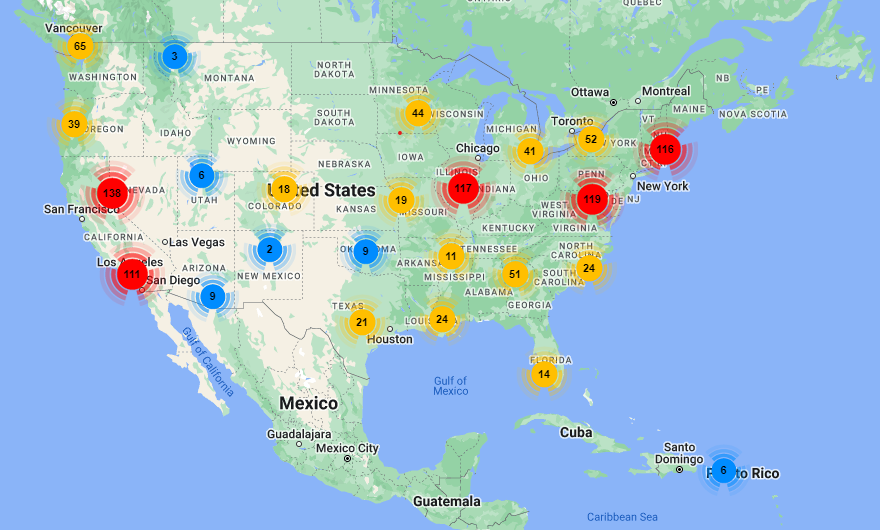
The tracker covers strikes and lockouts throughout the United States and its territories, with an interactive map that lets you find each action, as well as details about what’s happening and why:

This image is a map of labor actions in the contiguous United States, and in Puerto Rico. There are color-coded dots showing the number of actions in each region. Blue for less than 10, yellow for 10-99, and red for more than 100. On the tracker’s website you can zoom in to see more details, or use their search and sorting function if you need to stick with a text-based format.

Zooming in brings you details about where the action is, when it is, what company it’s aimed at, how many workers are involved, and what they’re asking for. This tracker has been up for a couple years, so it’s taken me a while to hear about it, or at least to notice it enough to investigate. That said, better late than never, and if I’m just hearing about this now, there are probably others in the same boat.

I like to talk about how humans are at our strongest when we work together, and a key part of that is being able to communicate and coordinate with each other. If you’re looking to start organizing your workplace, then finding local actions and turning out to support them could be a great way to make connections and get advice or help. If you just want to be supportive in general, this could be a way to find groups near you that might need help paying bills or getting food while they face off with their bosses.

Usually when it comes to politics in the United States, red is a color to avoid, but in this case, I want to see big, red markers all over the map.

Skeptical Sunday: A video on the sorry state of the Discovery and History channels

If memory serves, I watched a lot of the Discovery Channel as a kid. While some of the content I watched back then had its problems, they don’t come close to the nightmare that the channel has become. I’d like to believe that nobody takes it seriously anymore, but I’m afraid that, along with the History Channel, far too many people still think they’re watching a credible source.

After watching this Ancient Aliens debunk, and hearing about Discovery Channel’s mermaid debacle, I basically stopped paying attention. Unfortunately, both channels have continued their pursuit of sensationalism over education. The Illuminaughtii digs into their bullshit, the harm it does, and also touches on the white supremacy that’s woven into the various “theories” about why black and brown people shouldn’t get credit for their cultural heritage.

Definitely check out the documentary I linked above (if you have time), but this video is a good overview of the decline of so-called “educational” television in the U.S.


Video: Daily life in a Swedish moose park

I’ve always had a fondness for moose. I saw them on rare occasions growing up, and it was always a cool experience. They’re very much a relic of the age of megafauna, and I like having creatures like that around. I also find them to be more than a little terrifying, on account of being huge, so I have to say that I wasn’t expecting to see a video of cuddly moose!

Rail Workers United: Nationalize the rail industry!

Devotees of capitalism often cite “competition” as the force that both keeps anyone from gaining too much power, and that drives innovation. I have my disagreements with that perspective, but even if I were to accept it as fact, it wouldn’t apply to railroads. I’m not the first to point this out, but competition doesn’t work for railroads. It’s a natural monopoly. This means that the corporations who have taken ownership of the rail industry have a huge amount of power (especially with the government taking away their workers’ right to strike), which they’ve mostly used to maximize profits and avoid regulations and responsibility.

The solution is to nationalize the rail industry. Ideally that would be part of a larger investment in rail infrastructure for both passengers and freight, but even without that, the rails should be operated as a public utility, subject to democratic control, not by corporations who’re happy to kill people for money. I’m not alone in thinking this, and it’s not an opinion that’s limited to literary softies like me – Rail Workers United has called for nationalization in the wake of the recent Norfolk Southern train derailment:

Dear Friends and Fellow Workers:

In face of the degeneration of the rail system in the last decade, and after more than
a decade of discussion and debate on the question, Railroad Workers United (RWU)
has taken a position in support of public ownership of the rail system in the United
States. (see Resolution attached). We ask you to consider doing the same, and
announce your organization’s support for rail public ownership.

While the rail industry has been incapable of expansion in the last generation and has
become more and more fixated on the Operating Ratio to the detriment of all other
metrics of success, Precision Scheduled Railroading (PSR) has escalated this
irresponsible trajectory to the detriment of shippers, passengers, commuters,
trackside communities, and workers. On-time performance is suffering, and shipper
complaints are at all-time highs. Passenger trains are chronically late, commuter
services are threatened, and the rail industry is hostile to practically any passenger
train expansion. The workforce has been decimated, as jobs have been eliminated,
consolidated, and contracted out, ushering in a new previously unheard-of era where
workers can neither be recruited nor retained. Locomotive, rail car, and infrastructure
maintenance has been cut back. Health and safety has been put at risk. Morale is at
an all-time low. The debacle in national contract bargaining last Fall saw the carriers –
after decades of record profits and record low Operating Ratios – refusing to make
even the slightest concessions to the workers who have made them their riches.

Since the North American private rail industry has shown itself incapable of doing the
job, it is time for this invaluable transportation infrastructure – like the other transport
modes – to be brought under public ownership. During WWI, the railroads in the U.S.
were in fact temporarily placed under public ownership and control. All rail workers of
all crafts and unions supported (unsuccessfully) keeping them in public hands once
the war ended, and voted overwhelmingly to keep them in public hands. Perhaps it is
time once again to put an end to the profiteering, pillaging, and irresponsibility of the
Class One carriers. Railroad workers are in a historic position to take the lead and
push for a new fresh beginning for a vibrant and expanding, innovative and creative
national rail industry to properly handle the nation’s freight and passengers.

Please join us in this historic endeavor. See the adjoining RWU Resolution in Support
of Public Ownership of the Railroads, along with a sample Statement from the United
Electrical (UE). If your organization would like to take a stand for public ownership of
the nation’s rail system, please fill out the attached form and email it in to RWU. We
will add your organization to the list. Finally, please forward this letter to others who
may be interested in doing the same. Thank you!

In solidarity,

The RWU Committee on Public Ownership
[email protected]
202-798-3327

Damned straight. This is far from the first time that the corporate leaders of an industry have proven themselves incapable of handling the responsibilities given them, and while I don’t favor nationalization for everything, public ownership is the clear option for the rails. The resolution itself is the most whereas-laden document I’ve read in a while, but it also paints a somewhat tragic history of past efforts to claw this public good from the clutches of capitalists:

Whereas rail infrastructure the world over is held publicly, as are the roads,
bridges, canals, harbors, airports, and other transportation infrastructure; and

Whereas numerous examples of rail infrastructure held publicly have operated
successfully across North America for decades, usually in the form of local/
regional commuter operations and state-owned freight trackage; and

Whereas, due to their inability to effectively move the nation’s freight and
passengers during WWI, the U.S. government effectively nationalized the
private rail infrastructure in the U.S. for 26 months; and

Whereas, at that time it was agreed by shippers, passengers, and rail workers
that the railroads were operated far more effectively and efficiently during that
time span; and

Whereas every rail union at that time supported continued public ownership
(the “Plumb Plan”) once the war had ended; and

Whereas, specifically, when the rank & file rail workers were polled by their
unions in December 1918, the combined totals were 306,720 in favor of
continued nationalization with just 1,466 in favor of a return to private
ownership; and

Whereas the entire labor movement at that time was in favor of basic industry
being removed from private hands, with the delegates to the 1920 AFL
Convention voting 29,159 to 8,349 in favor, overruling the officialdom of the
AFL and its conservative position; and

And then they go into the current situation, including the way rail companies fight against improvements of all sorts. It feels like brake systems designed in the 1860s are less the exception than they are the rule. Looking at the world today, I think it’s arguable that we never really left the age of the robber barons – they just got better at obscuring who they are and what they do.

I support nationalizing the rails, and more than that, I think we should immediately invest a huge amount of money in upgrading and expanding rail infrastructure in the United States. I know that the current urban/suburban sprawl of some regions make some people think that rail can’t work in that country, but I think that creating a real, reliable rail network would encourage communities and businesses to congregate around stations and hubs. Hell, we could even invest in helping people move, and reclaim a lot of that sprawl for rewilding

I don’t know how likely this effort is to succeed, but I think that its best chance of success is for there to be a public movement in support of nationalization that extends far beyond rail workers. Solidarity means building all of our collective power, and pushing forward on all fronts where we find ourselves able to do so. The people, united, are a slime mold.


Thank you for reading! If you found this post useful, please share it around. If you read this blog regularly, please consider joining my small but wonderful group of patrons. Because of my immigration status, I’m not allowed to get a normal job, so my writing is all I have for the foreseeable future, and I’d love for it to be a viable career long-term. As part of that goal, I’m currently working on a young adult fantasy series, so if supporting this blog isn’t enough inducement by itself, for just $5/month you can work with me to name character in that series!

Keeping what we’ve won: The ozone layer still needs defending.

When confronted with the claim that climate change is simply too big for us to do anything about, a lot of people like to bring up the ozone layer. For those who are unfamiliar, in the late 1970s humanity realized that our release of certain chemicals, mainly chlorofluorocarbons used in refrigeration, was eating away at our planet’s ozone layer like acid. Most alarming was a “hole” – a giant patch of especially thin ozone, over Antarctica. This scared a lot of people, because that ozone works to shield us from the frankly horrifying amount of radiation coming from the sun. Less protection would mean more skin cancer, among other problems, and so the world got together and mostly phased out the use and production of CFCs and other ozone-depleting chemicals.

And it actually worked. There are still a lot of chemicals we produce that mess with ozone, but the international effort to change course worked.

Scientists said the recovery is gradual and will take many years. If current policies remain in place, the ozone layer is expected to recover to 1980 levels — before the appearance of the ozone hole — by 2040, the report said, and will return to normal in the Arctic by 2045. Additionally, Antarctica could experience normal levels by 2066.

Scientists and environmental groups have long lauded the global ban of ozone-depleting chemicals as one of the most critical environmental achievements to date, and it could set a precedent for broader regulation of climate-warming emissions.

“Ozone action sets a precedent for climate action,” World Meteorological Organization Secretary-General Petteri Taalas said in a statement. “Our success in phasing out ozone-eating chemicals shows us what can and must be done — as a matter of urgency — to transition away from fossil fuels, reduce greenhouse gases and so limit temperature increase.”

And as with climate action, this is only really a “success” if we stay the course and keep not using those chemicals. As the article I quoted notes, just a few years ago, there was an upsurge in CFC emissions from eastern China a few years ago that had a number of people understandably worried. Emissions are back down now, but it’s a good reminder that we are still actively interacting with our atmosphere, and doing well for a few years doesn’t mean that we get to be irresponsible again.

Speaking of which…

While Elon Musk still has his fanboys, I think a lot of people reconsidered their belief in his genius when he kept insisting that Mars, a frozen, radioactive desert, was a totally viable place for humanity to live. Musk is, however, clearly playing five-dimensional chess. On the one hand, he’s going out of his way to obstruct mass transit projects that would reduce the need for personal cars, and on the other, he’s working hard to ensure that while it might not be frozen, Earth is also a radioactive desert:

Rocket launches emit both gases and particulates that damage the ozone layer. Reactive chlorine, black carbon, and nitrogen oxides (among other species) are all emitted by contemporary rockets. New fuels like methane are yet to be measured.

“The current impact of rocket launches on the ozone layer is estimated to be small but has the potential to grow as companies and nations scale up their space programmes,” Associate Professor in Environmental Physics Dr Laura Revell says.

“Ozone recovery has been a global success story. We want to ensure that future rocket launches continue that sustainable recovery.”

Global annual launches grew from 90 to 190 in the past 5 years, largely in the Northern Hemisphere. The space industry is projected to grow more rapidly: financial estimates indicate the global space industry could grow to US$3.7 trillion by 2040.

“Rockets are a perfect example of a ‘charismatic technology’ – where the promise of what the technology can enable drives deep emotional investment – extending far beyond what the technology also affects,” Rutherford Discovery Fellow and planetary scientist UC senior lecturer Dr Michele Bannister says.

Rocket fuel emissions are currently unregulated, both in Aotearoa New Zealand and internationally.

UC Master’s student Tyler Brown, who was involved in the research, says Aotearoa New Zealand is uniquely positioned to both lead and participate in this field. “New Zealand’s role as a major player in the global launch industry means we can help steer the conversation. We stand to benefit enormously from additional growth in our domestic space industry, and with that comes the opportunity to ensure that global activities are sustainable for the planet as a whole.”

The review lays out detailed plans of action for companies and for the ozone research community, with a call for coordinated global action to protect the upper atmosphere environment. Actions that companies can take include measuring the emissions of launch vehicles on the test stand and in-situ during flight, making that data available to researchers, and putting effects on ozone into industry best-practise rocket design and development.

“The international ozone research community has a strong history of measuring atmospheric ozone and developing models to understand how human activities could impact this critical layer of our atmosphere. By working with launch providers, we are well-placed to figure out what impacts we might see”, says Dr Revell.

“Rockets have exciting potential to enable industrial-level access to near-Earth space, and exploration throughout the Solar System. Creating sustainable global rocket launches is going to take coordination across aerospace companies, scientists, and governments: it is achievable, but we need to start now,” says Dr Bannister. “This is our chance to get ahead of the game.”

If you’re a regular reader of this blog, you know that I’m a big fan of being proactive, when it comes to the environment. “Getting ahead of the game” is the big dream, but for the most part, it has just been that – a dream. Whether it’s handling of dangerous chemicals, public testing of automated driving systems, or lying about addictiveness and pushing opioids on people, the default is for the rich to get their way. They get to do whatever they want until the peasants get together a big enough mob to stop them. Over, and over, and over again.

I’m in favor of space exploration, and in developing our ability to get off this planet. I love the idea of humanity as an interstellar species, and one of my biggest gripes with mortality is that I won’t be able to see that happen. On the plus side, there’s no guarantee that it’ll happen how I want it to, and I also won’t be alive to see the horror show that is space exploration and exploitation driven by the greed of capitalists.

My big dream for my lifetime is to see humanity move towards a society that values life and the common good over the greed of the worst among us. Decade by decade, we have developed our ability to see problems coming well before they arrive. In the past, I’ve likened science to a flickering light over a rough sea. It gives us a series of imperfect snapshots of an ever-shifting future, and as we’ve gotten better at it, the flashes of light have gotten closer together, and lasted longer. A side effect of our success with the ozone layer was that it proved not just that we could see a problem coming – we’ve been able to do that for centuries – but that we could change course in response, and avoid that problem almost entirely.

The climate movement is plagued by fatalism, and it’s easy to understand why. It took decades of fighting to address the problem of lead pollution, and decades to get the truth about tobacco and cancer, and decades to get any protections of air and water. The fight for climate action is older than I am, and it seems like emissions only keep increasing, and the main thing governments are doing to prepare for the rising temperature, is increasing police and military spending. Worse, we live with the knowledge that at any moment, some multi-billionaire could use their obscene power to do something with global implications, like risking our ability to see into space, or mucking about with geo-engineering.

Or ignoring the warnings and undoing everything we’ve achieved in protecting the ozone layer.

But that achievement itself is worth remembering. The other source of doom-flavored fatalism that same group of powerful people who want to continue preventing real change. They spend so much money trying to stop us, because they know that we can change things, and that we can build a world in which nobody has the power to just fuck up the whole planet because of their greed and insecurity.

We can do this. We’ve done it before.


Thank you for reading! If you found this post useful, please share it around. If you read this blog regularly, please consider joining my small but wonderful group of patrons. Because of my immigration status, I’m not allowed to get a normal job, so my writing is all I have for the foreseeable future, and I’d love for it to be a viable career long-term. As part of that goal, I’m currently working on a young adult fantasy series, so if supporting this blog isn’t enough inducement by itself, for just $5/month you can work with me to name character in that series!