Seafloor mining threatens to open dark new phase of habitat destruction

While global warming is, without question, the greatest threat facing humanity, it’s far from the only threat, and ending CO2 emissions will only help so much if we continue perpetrating wanton habitat destruction in our pursuit of resources. I think it’s more likely than not that we could find more of a balance, in which the destruction caused in resource extraction is more limited, but it would require a very different kind of economy. The process of maintaining the health of the ecosystem around a mine would need to be at least as important as the materials being extracted, like healing the wounds created by surgery. The same is true of waste produced from manufacturing, even as we reduce the volume by eliminating profit-driven overproduction. We have to deal with climate change, but we also have to deal with habitat destruction and chemical pollution, for our own sake.

This is also not a conversation we can afford to put off until climate change is “dealt with”. I think it’s reasonable to assume, by now, that by the time we’re off fossil fuels, the climate’s natural momentum will drive continued warming for centuries, or even millennia to come. In practical terms, we may never be done “dealing with” climate change. No, we need to be dealing with all of these problems, all at once. I support extraction of rare earth minerals and other stuff needed for electronics, but not at any price. Slavery needs to end, all over the globe, and reparations must be made to those who have been enslaved, in addition to what is already owed for the crimes of history. The waste of these precious resources through planned obsolescence, the lethally neglectful handling of electronic wasteall of it needs to end. It really, really sucks that this is where we’re at, but the reality is that we really do have to do everything all at once. There’s no more time to just put this stuff off, and unfortunately the current momentum of society has us hurtling towards destruction.

Our oceanic ecosystems were in trouble long before the climate’s warming was detectable. Overfishing, the destruction of the sea floor through trawling, and a million different kinds of pollution have oceanic ecosystems on the ropes just like many ecosystems on land; and just like terrestrial ecosystems, oceanic ecosystems are at risk from resource extraction even if we stop all oil and gas drilling:

An investigation by conservationists has found evidence that deep-seabed mining of rare minerals could cause “extensive and irreversible” damage to the planet.

The report, to be published on Monday by the international wildlife charity Fauna & Flora, adds to the growing controversy that surrounds proposals to sweep the ocean floor of rare minerals that include cobalt, manganese and nickel. Mining companies want to exploit these deposits – which are crucial to the alternative energy sector – because land supplies are running low, they say.

However, oceanographers, biologists and other researchers have warned that these plans would cause widespread pollution, destroy global fish stocks and obliterate marine ecosystems.

“The ocean plays a critical role in the basic functioning of our planet, and protecting its delicate ecosystem is not just critical for marine biodiversity but for all life on Earth,” said Sophie Benbow, the organisation’s marine director.

There are two images. Image A shows a healthy seafloor community on a

There are two images. Image A shows a healthy seafloor community on a “seamount”, with a variety of corals and other organisms. Image B shows the results of trawling on a seamount – a barren, flat landscape with no visible life but what looks like a passing sea cucumber sort of thing, which has a pink body, and whitish, nearly transparent appendages. The photo was uploaded to Wikimedia Commons with permission from CSIRO Marine Research.

Trawling for fish already causes extensive damage. When nets drag along the sea floor, they obliterate whole ecosystems, leaving barren desert behind. With total darkness, low temperatures, and high pressure, these ecosystems develop slowly. Recovery, if it ever happens, is far off. Trawling for minerals would be much worse, because they’d be deliberately digging deeper into the sea floor, and bringing up not only pollutants related to the metals being extracted, but also any toxic waste that has collected in the sediment over the years. It may be that there is some way to make seafloor resource extraction viable, but this is not it.

Seafloor ecosystems are about as “out of sight” as it is possible to get, but I think that preserving them is just as important as preserving places like the Atlanta Forest. We have to stop doing this. The people in power are apparently impervious to reason, but we have to stop doing this.

That’s why I think we need organizing. That’s why I want people to have the capacity for a real general strike in the United States, because our leaders either do not care about the damage they are doing, or ideology and wealth have made then incapable of understanding it.

I do get to do a bit of a bad news/good news/bad news “Oreo” with this article, though. One of the concerns they mention is that disturbing the sea floor also risks disturbing methane deposits, triggering the dreaded “clathrate gun”, releasing vast amounts of methane into the atmosphere, and causing global warming to leap forward. While I think that this is a concern worth having, and something that merits more caution and more research, there’s also reason to believe that, given the depth of most such deposits, the methane would dissolve into the water before it reached the surface. That would not be without consequences, but it would spare us a sudden, devastating increase in temperature.

The bad news is that we will probably never really know the sheer scale of biodiversity loss that has already happened through trawling, and that capitalists, unsurprisingly, see no problem with plowing ahead:

Recent research has also emphasised that our knowledge and understanding of biodiversity is woefully incomplete. “Each time an expedition is launched to collect species, we find that between 70% and 90% of them are new to science,” said Benbow. “It is not just new species, but whole genera of plants and creatures about which we had previously known nothing.”

This view is supported by David Attenborough, who has called for a moratorium on all deep-sea mining plans. “Mining means destruction, and in this case it means the destruction of an ecosystem about which we know pathetically little,” he said.

Delicate, long-living denizens of the deep – polychaete worms, sea cucumbers, corals and squid – would be obliterated by dredging, researchers have warned. Nor would there be any chance of a quick recovery. At depths of several kilometres, food and energy are limited, and life proceeds at an extraordinarily slow rate. “Once lost, biodiversity will be impossible to restore,” says the report.

The battle over our planet’s deep-sea resources focuses primarily on the trillions of nodules of manganese, nickel and cobalt that litter the ocean floor. These metals are critical to the manufacture of electric cars, wind turbines and other devices that will be needed to replace carbon-emitting lorries, power plants and factories.

As a result, mining companies are now jostling to dredge them up in vast quantities using robot rovers – attached by pipelines to surface ships – that would trundle over the ocean floor, sucking up nodules and pumping them to their mother craft.

But operations like these would devastate our already stressed oceans, destroy their delicate ecosystems and send plumes of sediments, laced with toxic metals, spiralling upwards to poison marine food-chains, say marine biologists.

For their part, mining companies have defended their plans by pointing out that drilling for mineral reserves on land is even more damaging to the planet’s stressed ecosystems. If we focus all our efforts to dig up cobalt, nickel and manganese there, we will degrade the environment ever further. Better turn to the ocean depths instead, it is argued.

The claim is dismissed by Weller. “These companies are presenting deep-sea mining as a new frontier but they really mean it to be an additional frontier – for none of these companies is suggesting that if we started mining the deep seabed then they would stop mining on land. We would just be adding to our woes.”

Precisely this. They are presenting a false choice, and ignoring the fact that, as I said above, we have to stop doing this. Mining on land has to change – we can’t just leave the waste in tailing ponds until the dams give out and they pour poisonous sludge onto communities downhill. It will require sacrifices, of course, beginning with billionaires. I’m not suggesting we cut out their hearts in some dark ceremony – ẏ̶̖̬̤̯̱̕e̷̳̟̔̉t̷̪̻͌̿̂͗͆ͅ – but that we ruthlessly sever their fortunes, condemning them to the horror of living like normal people.

This kind of resource extraction is, as Attenborough said, inherently dangerous and destructive. That doesn’t mean we can never do it, but it does mean that when we do, it ought to be driven by need, not greed, and not the kind of economic need driven by one’s place in a an exploitative global capitalist system:

Ocean experts are concerned about the prospects of deep-sea mining operations beginning in the near future, following the decision of the Pacific Island state of Nauru to accelerate exploitation of the sea bed. In June 2021, it notified the International Seabed Authority (ISA) – responsible for regulating mining in areas beyond national jurisdiction – of its intention to sponsor an exploitation application for nodule mining in the Pacific.

In doing so, Nauru triggered a ‘two-year rule’ – a legal provision which creates a countdown for the ISA to adopt its first set of exploitation regulations for deep-seabed mining and could result in the green light for deep-seabed mining this year. Discussions among the 167 member states of the ISA are now under way.

“This is a critical year,” said Weller. “The newly agreed UN High Sea treaty signifies a clear global recognition of the importance of ocean conservation but collaborative efforts are still needed to keep the brakes on deep-sea mining.”

I’m not saying greed is playing no role in this, but it makes sense that, especially with the looming threat of sea level rise, island nations would be looking for whatever edge they can get. Their economic situation was forced on them by the same imperial powers that have forced climate change on all of us, and it only makes sense to try to save themselves with whatever means they have at their disposal. After all, it’s not like the habitat destruction will stop if Naru decides not to mine its sea floor. No, island nations are facing the same artificially maintained Tragedy of the Commons, in which the primacy of private ownership creates an incentive to take as much as you can, because if it’s not you, it’ll be someone else.

And that, my friends, is why the workers of the world must unite, and bring about global solidarity, for the survival of humanity.


Thank you for reading! If you liked this post, please share it around. If you read this blog regularly, please consider joining my small but wonderful group of patrons. Because of my immigration status, I’m not allowed to get a normal job, so my writing is all I have for the foreseeable future, and I’d love for it to be a viable career long-term. As part of that goal, I’m currently working on a young adult fantasy series, so if supporting this blog isn’t enough inducement by itself, for just $5/month you can work with me to name a place or character in that series!

A glimmer of hope for a critically endangered wildcat

Scottish wildcats are a nearly-extinct species of cat that looks similar to, and can interbreed with, house cats. Specifically, they look like thick-furred tabbies. They also seem to inspire some rather dramatic language, being called “highland tigers”, or, in the case of this video, the last king of Scotland:

To be fair, I did name my cat His Holiness Saint Ray the Cat, so I guess I’m not one to talk. By now I’m sure you’re aware that if you have a pet cat, you should probably keep it indoors. It does mean you’ll probably have to put more effort into entertaining it, but it really would be for the best, for the ecosystem around you. With climate change, pollution, and feral cats, I think it’s probably for the best if we do what we can to take a little pressure off.

One thing that’s important to keep in mind about housecats is that they do not operate like a normal member of an ecosystem. Humans actively maintain their presence, while protecting them from diseases, and giving them safe shelter from predators and from the elements. Feral cats are more vulnerable, of course, but they don’t exist in isolation from fully domestic cats. There’s interbreeding, if pet owners don’t spay or neuter their pets, there are pets that get lost or abandoned, and become feral. Human activity, absent a real effort to the contrary, tends to support and maintain feral cat populations, in addition to maintaining a population of unnaturally healthy pet cats that also kill local wildlife.

Sunlight seems to make this Scottish Wildcat's tabby fur glow golden. Its hazel eyes pop thanks to black-rimmed lids that look like it has eyeliner. its lips and chin are white, and there's white fur on its throat. The rest of its body, out of focus in the background, looks like gray and black stripes. Further back, you can see vegetation, very out of focus. The photo was uploaded to Wikimedia Commons by Airwolfhound

Sunlight seems to make this Scottish Wildcat’s tabby fur glow golden. Its hazel eyes pop thanks to black-rimmed lids that look like it has eyeliner. its lips and chin are white, and there’s white fur on its throat. The rest of its body, out of focus in the background, looks like gray and black stripes. Further back, you can see vegetation, very out of focus. The photo was uploaded to Wikimedia Commons by Airwolfhound.

These concerns are generally raised because of the harm done by feral and pet cats to bird and rodent populations, but when you add in a creature like the Scottish wildcat, interbreeding becomes a huge problem. There are simply more house cats than wildcats, and because they can interbreed, the house cat population will absorb the handful of remaining feral cats in much the same way that Homo sapiens absorbed the dwindling Neanderthal population, if left unchecked. Biologists will be able to point to DNA markers of distant wildcat ancestry in the feral cat population, but wildcats, as a species, will no longer exist.

When it comes to the question of whether there are any “pure” wildcats left, I think that the answer lies not just in genetic analysis, but also in behavior, and the role they play in the ecosystem. As the video below mentions, feral housecats behave very differently from wildcats. Where wildcats are solitary outside of breeding season, and maintain a low level of density, feral housecats form colonies, generally supported by a mix of wild prey and well-meaning but misguided humans who feed them. That social behavior harbors diseases, which can then be passed on to the wildcat population.

The feral cats are a problem for the wildcats, but if feral cats were to fully replace the wildcats, it would be worse for the ecosystem. In addition to maintaining low population density, wildcats do often go for larger prey than housecats, sometimes even taking fauns, which is probably which they’ve historically made farmers nervous. Referring again to the video below, having a mid-sized predator around changes the behavior of prey species, which in turn changes the impact that they have on the rest of the ecosystem. It seems odd to call a little creature like this an “apex predator”, but in the highlands as they exist, the title seems to fit.

There are three angles on conservation focused on predators like wolves or wildcats. One is the social aspect – they’re charismatic. These cats are extremely cute, and so it’s easy to get people to care about them. The second is that if you have a healthy, stable population of medium or large carnivores, that means that the entire ecosystem that’s feeding them is also healthy. It means that the various prey species are also getting enough to eat, and aren’t themselves being eaten to extinction. The third is the one I mentioned in the paragraph above, and I think it’s one that people are less likely to think of, so I’m glad it was brought up.

I find it encouraging that in this documentary that was put on Youtube 6 years ago, the expert estimated that the Scottish Wildcat had maybe 5-6 years left. That means that their efforts to preserve the species have actually been successful, so far, and while they’re not in the clear yet, they seem to have a real shot. That’s good news, both for the cats, and for our ability to deliberately reduce the harm that we’re doing to local ecosystems. The expert most cited in that video, Paul Donahue, has a point, in worrying that with only three or four dozen wildcats actually in the wild, capturing them for a breeding program would hurt more than it helps. I honestly don’t know whether that’s the case, but it seems as though the projected release of 20 cats per year would quickly make up for that loss. It’s also not clear to me whether they captured any new cats for the program, whether all the cats used were already being held in zoos. It seems to be the latter.

I was initially going to talk about the practice of “headstarting” turtles – raising them in captivity till they’re past the point at which hatchlings experience the highest mortality, to give them a better shot at surviving to adulthood than they would otherwise have. This program is similar to that, but a better comparison might be what happened with the black footed ferret in the midwestern United States. The short version is that they went from numbering in the tens of thousands to having just 18 individuals left in the entire world. There was a captive breeding program, an associated habitat conservation effort, and now there are several hundred of them in the wild.

The ferrets faced a different set of threats from the Scottish wildcat, and weasels are obviously not cats, but I think that the comparison is worth making. When it comes to conservation, I’m generally an “all of the above” sort of guy. I think we should do as much as we can both to help ecosystems recover from the harm we’ve been doing to them, while also reshaping our society to be more steady-state, and more a part of those ecosystems. As I said, I understand Donahue’s concern about taking cats from the wild for captive breeding, but that effort does seem to be progressing. The association Saving Wildcats has gotten approval to begin releasing captive-bred wildcats into Cairngorms National Park in northeast Scotland, starting in June. This is sort of a trial period, during which they’ll be releasing small numbers, tracking them with GPS collars, and seeing how they do:

The first in a series of trial releases at undisclosed locations in the National Park is planned for June. The Saving Wildcats project said it would be the first conservation translocation of wildcats in Britain. Eventually, as many as 20 wildcats could be released annually.

Scotland’s nature agency, NatureScot, approved the licence for this summer’s release. It assessed Saving Wildcats’ application in line with the Scottish Code for Conservation Translocations. The process considers a range of issues including animal welfare, site suitability and potential impacts on neighbouring and community interests.

Saving Wildcats, which involves a number of organisations, has been breeding the animals at Royal Zoological Society of Scotland’s Highland Wildlife Park at Kincraig, near Aviemore. The wildcats are to be released in a 600 sq km area involved in a landscape conservation project called Cairngorms Connect.

It is a partnership of neighbouring land managers – Wildland Limited, Forestry and Land Scotland, RSPB Scotland and NatureScot – working towards a 200-year vision to enhance habitat, species and ecological processes.

NatureScot’s head of biodiversity, Dr Katherine Leys, said Saving Wildcats offered a lifeline for the species. “This journey is not without difficulty, and we know that there are more hurdles to overcome before we reach the point where we are ready to release the Wildcats into carefully selected areas of the Cairngorms National Park.

“Once there, the Wildcats will face further challenges, so it’s crucial the project continues to work with local communities, farmers, land-owners and cat owners to ensure wildcats are given the best chance to survive and thrive.”

Saving Wildcats project lead and Royal Zoological Society of Scotland’s head of conservation, Dr Helen Senn, added: “When the time comes, we will be able to move Wildcats under licence from pre-release enclosures at Highland Wildlife Park to carefully selected areas in the Cairngorms Connect landscape which provide a suitable mix of habitats and potential prey for the species.

“After release, the Wildcats will be monitored using GPS collars as they face the many challenges of life in the wild. The fight to restore Scotland’s Wildcat populations is just beginning and we are grateful to everyone providing expertise and support along the way.”

Apparently the National Farmers Union of Scotland is also on board, which is good, because farmers concerned about livestock were part of why wildcats have come so close to extinction.

As they say, there’s a ways to go yet before they’re at the hoped-for 20 cats rewilded per year. Even so, this is a big step in the right direction. I mentioned the division among activists on this issue, between focusing on providing the right conditions for the wildcat population to recover on its own, and doing the captive breeding that led me to write this post. Part of the reason I like “all of the above” approaches, where they are possible, is that the work that has been done to control feral cat populations, and to get landowners on board with preserving habitat, and helping keep track of the wild population – all of that work will absolutely increase the likelihood that the captive breeding program will succeed.

I don’t know the extent to which those efforts have been active around Cairngorms, but I believe work like that has been ongoing across Great Britain. The future is still very uncertain for the “highland tiger”, but from where I’m sitting, there’s more than a glimmer of hope.

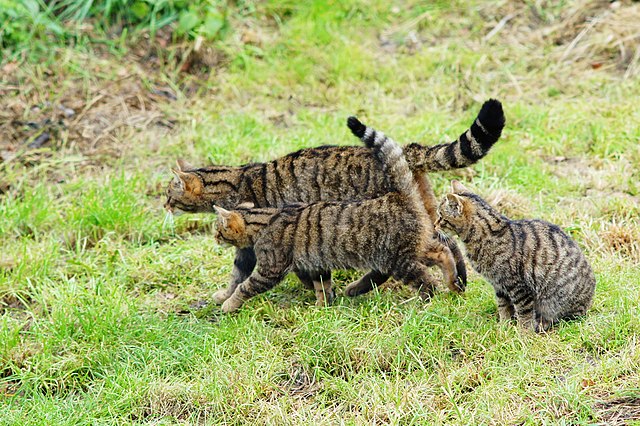
The image shows three wildcats on a patch of grass. It looks to be a mother and two teenage kittens. Their fur is a light brown-gray with vertical black stripes, forming black bands on the tail, and a black tailtip. The mother cat is walking toward the left of the image, looking at something off-camera, and one of the teenagers is walking pressed against her side, with its tail straight up in the air. The other kitten is sitting, back in a neat curve, looking at whatever the other two are approaching. The sitting kitten looks like he's about to get up and follow the others. The photo was uploaded to Wikimedia Commons by Peter Trimming.

The image shows three wildcats on a patch of grass. It looks to be a mother and two teenage kittens. Their fur is a light brown-gray with vertical black stripes, forming black bands on the tail, and a black tailtip. The mother cat is walking toward the left of the image, looking at something off-camera, and one of the teenagers is walking pressed against her side, with its tail straight up in the air. The other kitten is sitting, back in a neat curve, looking at whatever the other two are approaching. The sitting kitten looks like he’s about to get up and follow the others. The photo was uploaded to Wikimedia Commons by Peter Trimming.


Thank you for reading! If you liked this post, please share it around. If you read this blog regularly, please consider joining my small but wonderful group of patrons. Because of my immigration status, I’m not allowed to get a normal job, so my writing is all I have for the foreseeable future, and I’d love for it to be a viable career long-term. As part of that goal, I’m currently working on a young adult fantasy series, so if supporting this blog isn’t enough inducement by itself, for just $5/month you can work with me to name a place or character in that series!
Video: Don’t Join the Military

Having some health issues today, so I’m taking it easy. Tomorrow you get a post about Scottish wildcats, and there will be pictures and videos, all cute. In the meantime, here’s a video about why you should not join the military. The TL:DW is that the military is a tool of oppression for a ruling class that is driving us all to extinction.

New study reinforces concern over the collapse of oceanic currents

There are a lot of big worries when it comes to global warming, but one of the big ones is that it will change the big ocean currents. These currents are important for the role they play in “stirring” the oceans, and delivering oxygen to waters too deep and dark for photosynthesis. The other big role they play is in redistributing heat around the planet. Ireland, for example, is further north than anywhere I’ve lived in the U.S., but its climate is much more stable. It never gets as cold in the winter, and it never gets as hot in the summer, and that’s all thank to the “ocean conveyor belt” current known as the Atlantic Meridional Overturning Circulation, which brings heat north and east from the Gulf of Mexico, and gives western Europe a relatively warm and stable climate. If the current shuts down, Europe suddenly gets a whole lot colder, and some other part of the world gets a whole lot warmer, and the general result is global chaos:

Such an event would have catastrophic consequences around the world, severely disrupting the rains that billions of people depend on for food in India, South America and West Africa; increasing storms and lowering temperatures in Europe; and pushing up the sea level off eastern North America. It would also further endanger the Amazon rainforest and Antarctic ice sheets.

The complexity of the AMOC system and uncertainty over levels of future global heating make it impossible to forecast the date of any collapse for now. It could be within a decade or two, or several centuries away. But the colossal impact it would have means it must never be allowed to happen, the scientists said.

“The signs of destabilisation being visible already is something that I wouldn’t have expected and that I find scary,” said Niklas Boers, from the Potsdam Institute for Climate Impact Research in Germany, who did the research. “It’s something you just can’t [allow to] happen.”

Unfortunately, what we can or cannot “allow” has little bearing on what we do, or rather what is done by the ruling class. As Boers says later in that article, the odds of this catastrophe increase with every bit of CO2 we add to the atmosphere (and that’s not to mention all the other greenhouse gases we produce). The current has been slowing down, and while there’s not conclusive proof that that’s due to climate change, that certainly seems to be the most likely culprit. These currents are primarily driven by big changes in temperature and salinity at the poles, and shockingly, if you add a whole bunch of fresh water from melted ice into the mix, that’s gonna change conditions.

New research published in Nature reports on an effort to model what’s going on down there, and how increasing meltwater will affect things, and you’ll be shocked to hear that the results aren’t great for us:

Antarctic circulation could slow by more than 40 per cent over the next three decades, with significant implications for oceans and the climate.

Direct measurements taken from the deep ocean have established that warming is already underway.

The deep ocean circulation that forms around Antarctica could be headed for collapse, say scientists.

Such a decline would stagnate the bottom of the oceans and affect climate and marine ecosystems for centuries to come.

The results are detailed in a new study coordinated by Scientia Professor Matthew England, Deputy Director of the ARC Centre for Excellence in Antarctic Science (ACEAS) at UNSW Sydney. The work, published today in Nature, includes lead author Dr Qian Li – formerly from UNSW and now at the Massachusetts Institute of Technology (MIT) – as well as co-authors from the Australian National University (ANU) and CSIRO.

Cold water that sinks near Antarctica drives the deepest flow of the overturning circulation – a network of currents that spans the world’s oceans. The overturning carries heat, carbon, oxygen and nutrients around the globe. This influences climate, sea level and the productivity of marine ecosystems.

“Our modelling shows that if global carbon emissions continue at the current rate, then the Antarctic overturning will slow by more than 40 per cent in the next 30 years – and on a trajectory that looks headed towards collapse,” says Prof England.

Modelling the deep ocean

About 250 trillion tonnes of cold, salty, oxygen-rich water sinks near Antarctica each year. This water then spreads northwards and carries oxygen into the deep Indian, Pacific and Atlantic Oceans.

“If the oceans had lungs, this would be one of them,” Prof England says.

The international team of scientists modelled the amount of Antarctic deep water produced under the IPCC ‘high emissions scenario’, until 2050.

The model captures detail of ocean processes that previous models haven’t been able to, including how predictions for meltwater from ice might influence the circulation.

This deep ocean current has remained in a relatively stable state for thousands of years, but with increasing greenhouse gas emissions, Antarctic overturning is predicted to slow down significantly over the next few decades.

Impacts of reduced Antarctic overturning

With a collapse of this deep ocean current, the oceans below 4000 metres would stagnate.

“This would trap nutrients in the deep ocean, reducing the nutrients available to support marine life near the ocean surface,” says Prof England.

Co-author Dr Steve Rintoul of CSIRO and the Australian Antarctic Program Partnership says the model simulations show a slowing of the overturning, which then leads to rapid warming of the deep ocean.

“Direct measurements confirm that warming of the deep ocean is indeed already underway,” says Dr Rintoul.

I wrote about some of those direct measurements back in 2020, and I think this is a good reminder that all of these models are built using real-world data, and repeatedly tested against new data as it becomes available. This is also a good point at which to remind everyone that we will start feeling the effects of a continued slowdown long before, and long after the current can be described as “stopped”. As with so many other aspects of climate change, this isn’t likely to be enough to and civilization by itself, but it will certainly make life harder. Changes to temperature and precipitation will continue to interfere with conventional food production, and it’s hard to say when we’ll be able to see how this is affecting fisheries. The truly catastrophic stuff, like the lower layers of the ocean turning anoxic, are unlikely to happen in our lifetimes, simply due to the sheer size of the oceans – it takes time for things to affect such a large mass.

That said, we have been “affecting” said mass for well over a century, and the scale of that effect has been growing that whole time. It may be that the “less catastrophic” stuff will be more than enough to end our species, so while I feel like we’re on the wrong path, I’ll agree again with Dr Boers above – we cannot allow this to continue.


Thank you for reading! If you liked this post, please share it around. If you read this blog regularly, please consider joining my small but wonderful group of patrons. Because of my immigration status, I’m not allowed to get a normal job, so my writing is all I have for the foreseeable future, and I’d love for it to be a viable career long-term. As part of that goal, I’m currently working on a young adult fantasy series, so if supporting this blog isn’t enough inducement by itself, for just $5/month you can work with me to name a place or character in that series!

Happy Trans Day of Visibility

Human development is a fascinating topic, about which I know little. If you want the science, PZ could tell you infinitely more than I, but from what I do know, the whole process is fantastically complex. At every point in the development of pre-birth development, there are a myriad of things happening simultaneously, most of which could, in theory, go in a number of ways. Eye color is an obvious one, but there’s also hair color, facial features, vocal chords, the development and function of organs, and so on. Then, after someone’s born, there are all sorts of thing that influence how they develop as they grow up. All those experiences they have, the lessons they learn, the people around them – it all shapes the development of their brain, and while the brain may be considered “developed” in the mid 20s, most people keep learning and changing throughout their lives. Given that incredible plasticity and variation, it seems very, very unlikely to me that the one area of human development that is always consistent would be the division of humanity into precisely two sexes, let alone precisely two genders.

Take eyesight, for example. In addition to the array of eye colors, there’s also a wide spread of functionality. It’s not like the options are “can see” and “can’t see”, there are people who lose sight over their lives, and others who could never see to begin with. There are people who can see fine, but only at the very center of their vision, or people who can only see around the periphery. There are people who can’t see the difference between certain colors, but have excellent vision other than that. I admit that this is an argument from incredulity, in some ways, but the reality is that people who fall outside this miraculous gender binary that we’re supposed to have, have always existed, and have always made their presence known. There is ample evidence that trans people are who they say they are, and that they represent no threat, as a group, to anyone.

The problem is that, despite those facts, there is still a hate movement that is attempting to erase trans people from public life, and to that movement, facts do not matter. I’m absolutely certain that many of the people who are pushing this genocide forward are genuinely operating out of hatred and disgust. At the same time, they very demonstrably lie all the time, and it apparently makes no difference. I think it’s fair to say that they are, as fascists have done in the past, using hatred of a politically powerless minority as a way to rally support, justify extremism, and seize power. It’s been pointed out many times by now, but it bears saying again – this is, pretty much word for word, what the Nazis did, and it’s not a coincidence that this movement seems to share a lot of other rhetoric and “enemies” with Hitler’s party.

So, simply stating the facts is not enough. I suppose my “irrepressible complexity” argument is an effort to get some people to open their minds, if only a little, to a different perspective. Unfortunately, that’s also not enough. They’re coming for trans people right now, in some parts of the United States, which means those of us who want to be considered allies need to step up, however we can. Thankfully, some people have been doing just that, which lets me give some examples of how someone could help.

People have been speaking out at school board meetings and other public events. Legislators and activists have worked to speak against legislation targeting trans people, and to amend that legislation to reduce the harm that it can do. Teachers are working to provide a more thorough understanding of the complexity of sex and gender throughout nature, and people are showing up all over the world to oppose the leaders of this hate movement. Local communities are rallying to defend the targets of fascist hate, and to stand in opposition to fascist rallies, and (which is relevant to today) publicly showing support for the trans community.

We all have limits on what we’re able to do. Not everyone is able to be a frontline warrior, and not everyone has the power or ability to affect legislative change. As far as I can tell, while there’s always a strong need for those willing to put their bodies on the line, liberatory movements tend to understand that it takes a village to raise a movement. There’s a need for all sorts of people, with all sorts of skills, doing all sorts of things. I’m a cis guy, so I wouldn’t presume to speak on what people should do, or what counts as “enough”, but the message I’ve seen for this trans day of visibility, including from FTB alum Dr. Jey McCreight, is that the very least we can do is publicly support trans rights, and publicly show our love for the trans people in our lives.

I’m bad at making myself do actual activism these days (it’s something I’m working on), so this is me, doing the bare minimum. As far as I know, there’s zero chance that this will cost me anything, socially. My immediate family and social circle seem to all be pretty cool people, with trans friends and loved ones of their own. They, like me, have seen the joy of trans people being able to just live, without constantly having to perform a lie, and that makes it easy to understand why that’s a right worth fighting for.

An official “Day of X” generally serves to draw attention to an issue that really ought to be on people’s minds all the time. When it comes to this issue, I’m willing to bet my readers think about it at least as much as I do, so while you probably don’t need my two cents, here’s my advice to myself: Look for ways to help, especially where you are. Even if there’s not an active effort to oppress trans people where you live, there are probably still groups working to build and organize support for trans rights. If you find yourself with money to spare, look for activist groups that are fundraising, or even just trans people who need help making ends meet. Keep an eye out for events like the one in Dublin that I missed today. It’s good to show up for events like that, and they’re a way to network with other activists if you’re looking to do so. If you want to be considered an ally, show yourself to be one through your actions.

Video: Pat Robertson’s surprising trans take from 2013

I’ll have a longer post up later for Trans Day of Visibility today, but I wanted to share this video clip. Apparently, back in 2013, notorious Christian fundamentalist and bigot Pat Robertson was asked about trans people, and his response, while far from ideal, underscores just how recent and manufactured the current trans panic actually is. Pat Robertson said that sometimes women are born in men’s bodies, or men in women’s bodies, and that it’s not a Christian’s place to judge. I don’t know that he’d say the same today, and it doesn’t wash away the harm he’s done, but it’s an interesting glimpse into what a pretty extreme person had to say about the issue a decade ago.

Video: No More Presidents

Well, Trump has been indicted, so that’s exciting. I’m still not holding my breath for him being held accountable for the actual harm he did, vs. a campaign finance violation. I’m not sure whether to expect violence, or a bunch of impotent rage that doesn’t really go anywhere. At this point I’m honestly more concerned about violence coming from the ongoing genocide attempt against trans people than I am about violence over the indictment, but it’s hard to predict. I think the best possible outcome would be no violence on either part, and indicting presidents becomes more normal going forward. I doubt I’ll get everything I want on that, but a man can dream, right?

I look forward to the day when we have no more presidents.

Video: Why is RIKERS Still Open? The War on Bail Reform

The cash bail system in the United States is based on the mistaken notion that, without holding someone’s money hostage, they wouldn’t show up for their court date. There’s not much evidence to support this, and ample evidence that, in effect, cash bail serves to allow poor people to be locked up without trial, simply because they are poor. When those people are being held in a place like Rikers – sometimes for years – the nightmarish conditions can drive them to suicide, or to giving a false confession just to be able to return to their lives in some way. Olayemi Olurin is among other things, an attorney and abolitionist who’s made a name for herself recently with her cutting political commentary. She’s been very vocal about the ongoing human rights violation that is the jail on Rikers Island, and this clip from her new show does a good job making the case to shut down Rikers, and end cash bail:

Historic Welsh Village Becomes Investment Opportunity, Residents Become Collateral Damage

Housing prices have been skyrocketing all over the so-called “developed world”, and while various other excuses have been made, the primary problem seems to be rentier capitalism – buying something that other people need, for the sole purpose of denying access to anyone who doesn’t pay. I don’t think there’s much question that we could stand to build more housing, especially in some areas, but owning other people’s homes as a profit-generating investment is, by default, going to increase the cost of housing. Not only do landlords have an incentive to keep raising rents, they also have an incentive to keep buying up more homes, driving up the prices, and moving home ownership ever farther out of the reach of people who work for a living.

And on the subject of work, collecting rent is what’s known as “passive income” – you are paid for doing no work at all, simply because you control access to a necessity, because the government will enforce your claim. Some landlords will also do things like maintenance work, but most hire others to do that, using the money given to them by their tenants. Landlords do not work for the money tenants give them. This is an inherently exploitative business model, and yet another aspect of capitalism that can only exist because the government participates on behalf of the landlord. Absent that power, the landlord would need to take care of their own enforcement, and at that point we’re basically back to feudalism.

When we talk about corporate home ownership, and rising rents, I tend to think about cities, where a single entity can own whole blocks of flats, or one rich asshole can own dozens of multi-family houses, but the reality is that this is happening everywhere, and it seems unlikely that it will stop until nobody owns their own home anymore. Case in point, a Welsh village built in the 1500s, to house workers in a slate quarry.

Sixteen homes in a historic Welsh hamlet built for workers at a 16th century slate mine are up for grabs for £1million after the asking price was slashed by £250,000.

Estate agents have been looking to sell the historic slate mining village of Aberllefenni since 2016, but uncertainty over Brexit meant a deal has never materialised.

Having originally put it up for sale for £1.5million, the asking price dropped to £1.25million in November 2019, only to lower it once more in the hope of securing deal.

Estate agent Dafydd Hardy previously said it would be ‘an excellent investment opportunity.’

Work in the nearby slate quarries apparently stopped in 2003, and it seems like the people who live there have never actually owned their homes. There’s no question that the people whose homes this places in danger have done nothing to deserve having their lives turned upside down for someone’s “excellent investment opportunity”, but under capitalism, poverty itself is deemed worthy of punishment. If you get steamrolled by some corporation or an individual rich asshole, that’s your fault for not being rich enough to defend yourself. And yes, in case you were wondering, we have heard from one of the people affected, whose rent has been raised since the village was bought:

Sara Lewis, 55, who has a lung disease, has to use her oxygen bottle on the bench at Aberllefenni, Gwynedd.

Her rent has increased from £435 to £550 after her new landlord bought the property and 15 others in the village.

Walsh Investment Properties said the original rental amount – under a previous landlord – was “not sustainable”.

“My home is my haven,” said Ms Lewis, who has lived in the property, Glanyrafon, for 22 years.

“The furthest I’m going is the bench. If I belong anywhere, it’s Glanyrafon.

Ms Lewis receives £300 as part of her Universal Credit payment towards her monthly rent, and has recently heard that Gwynedd council will provide £100 of discretionary funding, which leaves her to find an extra £150 each month.

“I’m protesting about the [UK] government to begin with for this standard £300 a month rent, which is ridiculous, and against Gwynedd council.

“It’s so stressful. It’s just a horrible situation to be in.”

Ms Lewis, who cannot work because of her emphysema, has spent six hours each day sitting on the bench between last Monday and Friday.

She said that being out in the wind and the rain is affecting her health but she is prepared to continue next week.Walsh Investment Properties director Chris Walsh has previously said that most of the properties had been paying “a low rent for a number of years”, adding that was “not sustainable in the current economy [and] we feel it is fair and reasonable to charge a market rent”.

Fair and reasonable, because profit for the rich is more important than life for the poor.

Oh, did I say earlier that she’d done nothing wrong? I’m so sorry I lied to you about that – she committed the absolutely heinous act of being unable to work due to illness. This, of course, means that she must be turned out of her home, because only people who WORK deserve to live with dignity. You know, like the millionaire couple who bought her home and raised the rent:

Now, a report by the Daily Mail has depicted the lifestyle of the Chris and Lisa Walsh.

It claims that they enjoy a lavish life of travelling across the world, including Mrs Walsh posing for photos outside the five-star Bellagio in Las Vegas in 2019 and her Facebook cover photo backdrop being a stunning view of the Greek island of Santorini, reports NorthWalesLive.

Now, one should not trust the Daily Mail, in general, and maybe this is my bias speaking, but I’m inclined to believe them. Like I said at the top, being a landlord does not involve actual work, It’s just a way to profit off of the fact that an awful lot of us can’t afford to own our own homes, but if we don’t get shelter, we’ll probably die from exposure. To me, this story highlights the lie that anyone can get ahead under capitalism. The village was built, apparently as a sort of company town, in the 1500s, and its most recent owner was a slate company that was established in 1861. It seems unlikely that the people living in that village ever had a real opportunity to build wealth from their own labor, or own their homes. The jobs “created” by the wealthy only ever really benefit the wealthy, or those jobs wouldn’t exist. This is what it looks like when everything is built around money and those who hold the most of it- nobody has a right to live in dignity and security, unless they’re rich enough to profit off the labor and suffering of others.


If you want to help me pay rent, you can do so by signing up at patreon.com/oceanoxia.  There aren’t currently a lot of benefits, beyond the feeling of joy that comes from giving me your money, but I’m working to change that, and if you can spare a dollar or two per month, you can even influence that process! How exciting!

Environmental Racism Made Worse by Global Warming: West Coast Edition

One key to understanding the world as it exists today, is understanding that most of it has been shaped by white supremacy for most of the last few hundred years. That’s not the only factor, but it’s one of the biggest ones, and it is still an active ideology, in one form or another, in most of the ruling class of the so-called “West”. This doesn’t just affect non-white people in those countries, though, because the colonial empires – primarily the U.S. these days – still exert a great deal of control over the so-called “Global South”.

Environmental racism is one effect of white supremacy, both on the global scale, and on the local scale, as the least powerful are routinely forced to live with exposure to mine runoff, industrial chemicals, coal dust, traffic pollution, and more. When it comes to traffic pollution, keep in mind that a combination of segregation, redlining, and malice in designing the interstate highways system, black communities were very deliberately forced, by the government, to live with higher air pollution, on average, than white communities. As with climate change, none of us are safe from air pollution, but it is not a coincidence that in a country built on white supremacy, as the United States was, non-white people have it the worst.

I say “as with climate change”, but the reality is that climate change isn’t really separable from air pollution. Global warming, in a myriad of ways, both causes air pollution, and makes “existing” pollution more dangerous. I suspect one would find similar results around the globe, but for a local example of how this works, and how it relates to race, we can look at this study of how the rising temperature will make existing inequality worse:

“We have known that air pollution disproportionally impacts communities of color, the poor and communities that are already more likely to be impacted by other sources of environmental pollution,” said the study’s lead author Jordan Kern, assistant professor of forestry and environmental resources at NC State. “What we know now is that drought and heat waves makes things worse.”

For the study, researchers estimated emissions of sulfur dioxide, nitrogen oxides and fine particulate matter from power plants in California across 500 different scenarios for what the weather could look like in future years, which they called “synthetic weather years.” These years simulated conditions that could occur based on historical wind, air, temperature and solar radiation values on the West Coast between 1953 and 2008. Then by using information about the location of power plants in California and how much electricity they would be generating under different weather conditions, they estimated air pollution within individual counties.

They saw the worst air pollution in the hottest, driest years, which Kern said is due to the demand for more air conditioning during hot years. In addition, drought can impact the availability of hydropower. The excess electricity has to come from somewhere else, which is where fossil fuel plants come in.

“One of the things we were interested in was teasing apart the relative roles of drought, which can be chronic, lasting for months or years, versus heat waves, which can happen like a flash in a pan,” Kern said. “We found drought is a driver of chronic pollution exposure, but heat waves are responsible for these incredible spikes in emissions in a short period of time.”

They also saw that counties with a higher existing pollution burden were disproportionately impacted by pollution during drought and heat waves. Counties that were more diverse by race and ethnicity were also far more likely to be impacted by increased emissions from power plants during droughts and heat waves.

“The more diverse your county is by race and ethnicity, the more likely you are to be impacted by air pollution on an annual basis,” Kern said. “During a drought, the relationship is more pronounced.”

Ideally, those power plants will be replaced with nuclear and renewable power sources, but it doesn’t seem like our leaders are in any hurry to get that done, which means we’re still forced to deal with fossil fuel plants. This is also not a problem that can be viably solved by asking people to not use air conditioning, or by rationing power during heat waves, because those heat waves are getting longer, and hotter, and killing more people as the climate warms. We’ve always needed to adapt our surroundings to deal with temperature, but we’re entering the first phase of human history where increasing numbers of people will need access to artificial cooling to survive.

The study authors also explored policy scenarios, and found that taxing companies for pollution produced would help the problem except during heat waves, but you probably won’t be surprised to learn that I find that solution to be inadequate. As with the rail companies, power generation and distribution should be nationalized, as a first step in ending the use of fossil fuels. There may be a place for using taxation to gently guide corporate behavior, but this is not it. Even if I did not believe that electricity should be treated as a public good, these corporations have been continuously demonstrating, for longer than I’ve been alive, that they cannot be trusted to operate responsibly, or with any concern for the public good. Justice demands it, both as a response to the climate crisis, and as one very small step toward dealing with environmental racism.