Video: Phone Security and Surveillance

Most of the time, when I talk about the problems facing us, I also talk about the kinds of things that I think people can do. Most of that relates to the need for systemic change, and a global shift in power and economic policy. In other words, we need to work against the capitalists driving us to extinction, as well as the governments that serve them. That also means that, even if your activism is all legal and peaceful, the likelihood is high that your government will work against you, especially if you have success. That is why, in this age of mass surveillance, seasoned activists place a lot of emphasis on taking steps to secure the privacy to which we should have a right. There’s a lot to be aware of, when it comes to our phones, and I honestly find it difficult to keep track of everything. Fortunately, Renegade Cut has put out this video, which works as a good primer on the subject:
Record Ocean Heat Frightens Scientists, Threatens Grim New Era

For the last few decades, Earth’s oceans have been absorbing the vast majority of global warming – over 90%. This has resulted in declining oxygen levels, marine heatwaves, and a myriad of problems for marine life. Last March, I covered research from Monterey Bay Aquarium that confirmed that “extreme” heat is now the norm for a majority of the ocean’s surface. That would be alarming enough, even though the news is a year old, but now we’ve got more bad news to add to it:

Temperatures in the world’s oceans have broken fresh records, testing new highs for more than a month in an “unprecedented” run that has led to scientists stating the Earth has reached “uncharted territory” in the climate crisis.

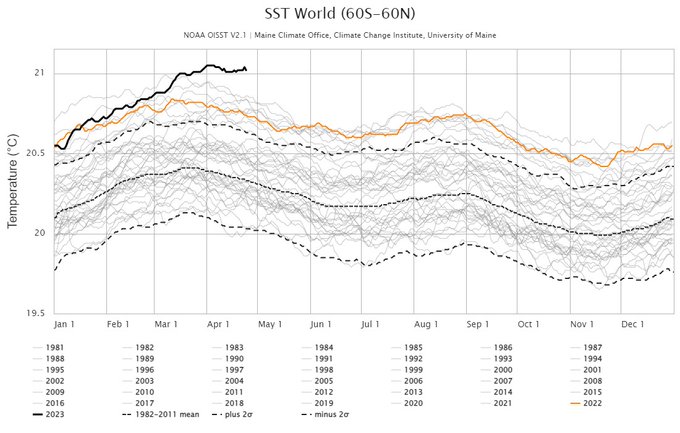
The rapid acceleration of ocean temperatures in the last month is an anomaly that scientists have yet to explain. Data collated by the US National Oceanic and Atmospheric Administration (NOAA), known as the Optimum Interpolation Sea Surface Temperature (OISST) series, gathered by satellites and buoys, has shown temperatures higher than in any previous year, in a series stretching back to 1981, continuously over the past 42 days.

The world is thought to be on the brink of an El Niño weather event this year – a cyclical weather system in the Pacific, that has a warming impact globally. But the El Niño system is yet to develop, so this oscillation cannot explain the recent rapid heating, at a time of year when ocean temperatures are normally declining from their annual March and April peaks.

Prof Mike Meredith of the British Antarctic Survey said: “This has got scientists scratching their heads. The fact that it is warming as much as it has been is a real surprise, and very concerning. It could be a short-lived extreme high, or it could be the start of something much more serious.”

The image shows the annual variation of ocean surface temperatures for every year from the present, dating back to 1981. April 2023 is far and away the hottest global sea surface temperature from that time period.

The image shows the annual variation of ocean surface temperatures for every year from the present, dating back to 1981. April 2023 is far and away the hottest global sea surface temperature from that time period.

That “something much more serious” is will happen, sooner or later. As the oceans warm, their capacity to keep absorbing the excess heat diminishes, which means that from our perspective, things are going to suddenly start warming a lot faster. Hotter oceans also have less capacity to absorb gases from the atmosphere, which increases the rate at which greenhouse gas concentrations increase. On top of all of that, there’s the fact that a hotter ocean creates stronger storms, which will set us even further back in this age of endless recovery. If the oceans are reaching some sort of thermal tipping point, that could also disrupt the big ocean currents that are so important to moving heat around the planet, and to bringing oxygen to the depths. A big change to those currents could have pretty immediate and dramatic effects on a global scale. It’s not just this year, either. Over the last 15 years, the oceans have apparently warmed as much as the previous 45 years; a finding that has been described as so disturbing that scientists don’t like to talk about it:

Scientists from institutions including Mercator Ocean International in France, Scripps Institution of Oceanography in the United States, and Royal Netherlands Institute for Sea Research collaborated to discover that as the planet has accumulated as much heat in the past 15 years as it did in the previous 45 years, the majority of the excess heat has been absorbed by the oceans.

In March, researchers examining the ocean off the east coast of North America found that the water’s surface was 13.8°C, or 14.8°F, hotter than the average temperature between 1981 and 2011.

The study notes that a rapid drop in shipping-related pollution could be behind some of the most recent warming, since fuel regulations introduced in 2020 by the International Maritime Organization reduced the heat-reflecting aerosol particles in the atmosphere and caused the ocean to absorb more energy.

But that doesn’t account for the average global ocean surface temperature rising by 0.9°C from preindustrial levels, with 0.6°C taking place in the last four decades.

The study represents “one of those ‘sit up and read very carefully’ moments,” said former BBC science editor David Shukman.

Lead study author Karina Von Schuckmann of Mercator Ocean International told the BBC that “it’s not yet well established, why such a rapid change, and such a huge change is happening.”

“We have doubled the heat in the climate system the last 15 years, I don’t want to say this is climate change, or natural variability or a mixture of both, we don’t know yet,” she said. “But we do see this change.”

It’s true, we don’t know for sure what’s going on. Maybe Godzilla is to blame!

In all seriousness, I don’t blame Shuckmann for being careful in the claims she makes. If I’m annoyed, it’s because of the people who love to jump on qualifiers like that to say, “See? They don’t even know what’s happening!” The reality is that even if this turns out to be a blip, and we’re lucky enough to get cooler sea surface temperatures over the next few years, that won’t change the trajectory we’re on. The heat in the oceans won’t just go away, even if it’s not at the surface. What’s more, when you have an unusually hot year, that adds to the momentum of the whole crisis. Ice melts a bit faster, permafrost thaws and rots a bit more, we get a few more fires, and now there’s just that much more CO2 in the atmosphere, and that much less ice to reflect sunlight back into space, and ecosystems are just that much less resilient.

As long as greenhouse gas levels keep rising, this can only go one way.

A study published earlier this year also found that rising ocean temperatures combined with high levels of salinity lead to the “stratification” of the oceans, and in turn, a loss of oxygen in the water.

“Deoxygenation itself is a nightmare for not only marine life and ecosystems but also for humans and our terrestrial ecosystems,” researchers from the Chinese Academy of Sciences, the National Center for Atmospheric Research, and the National Oceanic and Atmospheric Administration said in January. “Reducing oceanic diversity and displacing important species can wreak havoc on fishing-dependent communities and their economies, and this can have a ripple effect on the way most people are able to interact with their environment.”

The unusual warming trend over recent years has been detected as a strong El Niño Southern Oscillation (ENSO) is expected to form in the coming months—a naturally occurring phenomenon that warms oceans and will reverse the cooling impact of La Niña, which has been in effect for the past three years.

“If a new El Niño comes on top of it, we will probably have additional global warming of 0.2-0.25°C,” Dr. Josef Ludescher of the Potsdam Institute for Climate Research told the BBC.

It looks like we should expect more extreme weather in the coming year or so, but if we have reached a point where the oceans are going to be less effective at absorbing heat and greenhouse gases, then things up on dry land are probably going to start progressing much more quickly. I often talk about how the action that has been taken so far to end fossil fuel use is criminally inadequate, but at this point that’s only half the picture. It’s been a decade or two since we passed the point at which dangerous warming could still be prevented. The inaction of our leadership, which seems to be a gerontocracy still stuck in the mid-20th century, has meant that it will keep warming for the rest of my life, and the rest of your life, dear reader, and the lives of your children, and of their children. Absent a series of technological and political miracles that seems very unlikely, this is our future now.

That means that simply ending fossil fuel use, while absolutely essential, is not enough. We must do better to prepare for a hotter planet. We must change how we produce food, to protect it from the conditions that we have created. We must reshape our infrastructure to deal with higher temperatures, stronger storms, and rising seas. We must take measures to to help those countries that have been deliberately kept poor for the benefit of rich nations withstand the hellish forces that have been unleashed upon this world.

Well, we must do all of that if we value human life. If we want to weather this storm, and keep making the world better.

It is past time that we considered that “we” don’t really want any of that, when it comes to the aristocracy of global capitalism. Despite Biden’s words, his actions show that he feels no urgency to deal with climate change. I’ll probably write more about this soon, but the people who run our world seem to be deliberately driving us to destruction, while setting themselves up to rule what remains. Maybe they think that reducing the population will reset the timer on how long they can cling to a system based on endless growth. Whether it’s delusion, malice, or both, they seem poised to use global warming to kill off most of humanity, while they live in luxury and insist that it’s all for the greater good.

I think the oceans could literally be boiling, and they’d still insist that they know best.

We are running out of time and options, both as a species, and as the working class that makes up most of that species. I don’t know how much longer we can afford to wait for those at the top to go against everything they believe, and act for the benefit of humanity. I think we’ve already wasted more time than we had on that false hope, and we’ve yet to fully grasp the price that we’re going to pay for that. We need revolutionary change, and we need it as soon as possible. It is my hope that a combination of worsening conditions, and a general strike, might get the powerful to change their tune. I don’t know how to get there from where we are. I’ll look into it, but I feel like we need more than my current attempt at an organizing guide. Mass unionization is probably the most direct route to the kind of organization we need. It’s a concept that’s familiar to people, and unions are more popular now than at any time I can remember. While I still like the notion of organizing centered around communities, the reality is that work is a bigger part of people’s lives than community right now, so it makes sense on multiple levels to start there.

In the meantime, one thing that individuals can do, outside of organizing and agitating, is prepare for hard times. If you can afford to, make a habit of keeping a store of non-perishable food, not just because climate change may disrupt supply chains and lead to shortages, but also because in the event of a general strike, you and those around you are likely to need the supplies. I’m pretty sure I’ve said this before, but a strike is a siege, and so success will depend on how well supplied we are.

At the same time, if you can, feed people who are hungry. Help people who need help. Economic desperation is the main weapon wielded by the rich in the class war, and undermining that empowers people, and builds solidarity. Those of us who want humanity to have a future have to come together and fight for that future. What I laid out above is the only path I can see that might lead to revolutionary change without war. As mentioned above, this big jump in ocean temperatures may just be a blip. We might have a rough year, then go back to a “normal” that’s still unacceptable. But we might not. Things have gone so far that it’s a real possibility that we’ve passed a major tipping point sooner than expected. If we don’t organize, prepare, and change course very soon, things will get ugly.


Thank you for reading! If you liked this post, please share it around. If you read this blog regularly, please consider joining my small but wonderful group of patrons. Because of my immigration status, I’m not allowed to get a normal job, so my writing is all I have for the foreseeable future, and I’d love for it to be a viable career long-term. As part of that goal, I’m currently working on a young adult fantasy series, so if supporting this blog isn’t enough inducement by itself, for just $5/month you can work with me to name a place or character in that series!

River study shows how global warming is killing Indigenous Alaskans

When I hear about the thawing of the permafrost, my mind generally goes straight to the greenhouse gases being emitted, and how that’s making the climate crisis that much worse. Maybe I’m in the minority here, but I tend to forget that it also has more immediate effects, down here on the ground. When we talk about changes to mountain snowpack, and melting glaciers, I think a lot of people get that that ties to water shortages either now, or in the not-so-distant future. Permafrost, in addition to holding a vast amount of dead plant matter, also holds a lot of water, and when that melts, it can join in with the snowpack and glacier water to change how the rivers downstream behave.

Streamflow is increasing in Alaskan rivers during both spring and fall seasons, primarily due to increasing air temperatures over the past 60 years, according to new CU Boulder-led research.

This increased volume of free-flowing water during the shoulder seasons is compounded by earlier snowmelt and thawing permafrost, also driven by increasing temperatures; all of which are affecting the formation and safety of Alaska river ice in winter, and the timing of when rivers “break up” in response to seasonal warming each spring.

The findings are the result of a collaboration between researchers at CU Boulder, the United States Geological Survey (USGS) and the National Park Service, who analyzed data from 1960 to 2019 for nine major river basins in Alaska. Their results, published in February in Environmental Research Letters, show how rivers can serve as a measurable quantity for understanding the cumulative impacts of climate change in Arctic regions.

“Measuring rivers is useful because it integrates all these other changes in temperature, precipitation, permafrost and snow cover. All the dynamics that feed the hydrologic cycle eventually get filtered into the amount of water in a river,” said Dylan Blaskey, lead author on the study and doctoral student in civil engineering.

[…]

The researchers analyzed six decades’ worth of monthly data from river gages in nine Alaskan rivers, comparing streamflow to air temperature, soil temperature, soil moisture and precipitation across the basins. They also accounted for large scale climate anomalies, such as El Niño and La Niña.

Streamflow in Alaskan rivers typically peaks in summer, and remains quite low in winter, with stark transitions between the two seasons. The study found that while the amount of water flowing through these rivers on a yearly basis is not changing, when it flows through them is shifting, with more water freely flowing from October through April—creating more gradual seasonal transitions.

Changes in air temperature have had the biggest impact on streamflow in these Alaskan rivers. The average days above freezing in April and October have increased by about a day every decade, according to Blaskey. These months are also when average monthly streamflow has increased the most: by 15% per decade in April and 7% per decade in October.

They also found that the correlation of increased streamflow with temperature is only getting stronger over time when data from the first 30 years (1960–1989) are compared to the most recent 30-year period (1990–2019).

Since the 1960s, winter air temperatures have increased by 7.2 degrees Fahrenheit (4 degrees Celsius) on average across the global Arctic. The findings from Alaskan river gages help quantify the disproportionate impacts that climate change is having on the planet’s northernmost ecosystems.

“One of the opportunities and challenges of researching in Alaska is that signals of climate change have already begun to appear,” said Blaskey.

I’ve been primarily a city-dweller for over a decade now, and I’ve lived in places that don’t tend to have serious water problems yet. That means that while my work has generally kept me aware of what’s happening in the world around me, seemingly small fluctuations in river flow don’t really affect my life in any direct way. For the Indigenous people who have been living off the land in Alaska for millennia, there’s no choice but to deal with these changes:

Indigenous communities use rivers for vital transportation and sustenance, whether frozen in ice or as free-flowing water. Many rivers are part of traditional hunting and fishing routes, which can be traveled over when they are frozen. Rivers also serve as essential thoroughfares to connect communities and to bring in seasonal supplies, such as fuel and food, because road networks are limited in Alaska.

As the seasons shift, ice freezes later and breaks up earlier, undermining the stability and safety of river ice.

“The shrinking of the fall and spring seasons affects how long river ice persists and is safe to travel over. Indigenous communities have suffered an increasing number of fatalities over the last few decades,” said Musselman. “It seemed that everyone at the workshop had stories of someone who had fallen in the ice and lost their life.”

We’re well past the point where the metaphor of the canary in the coal mine is relevant – we’ve been losing actual miners for a while now. Fortunately, if we look to the history of mine safety, we know how to improve things- it’s by organizing and working together. Whether it’s activists or people just trying to go about their lives, we are losing people in this fight. The changes have barely begun, compared to what lies ahead, but the world has already been made measurably less safe in a myriad of small ways that can be difficult to quantify.

Take all of the evidence together, though, and it’s pretty clear that we’re in trouble. Those people who’ve been forced to the bottom, and to the margins of society are getting hit first, as we’ve always known they would, but there’s nowhere that’s not affected now, and it’s only going to keep getting hotter.

Video: Child Labor is Back In The USA

As Katydid commented when I posted John Oliver’s video on farm workers, child labor isn’t exactly new in the United States. That said, there seems to be a coordinated effort to roll back child labor protections across multiple states, at the same time as we’re seeing corporate child labor violations across multiple states. We were very, very far from perfect before, but now the US seems to be moving rapidly in the wrong direction on this, as the crew at Left Reckoning discuss:

President Boric proposes plan for Chilean lithium to benefit the Chilean people

Chile has been on an interesting and positive arc in recent years. Left-wing politician Gabriel Boric won the presidency there, representing the first big shift to the left since the fascist Pinochet took over in a US-backed coup in 1973. They’re currently working on a number of reforms, and are trying to negotiate a new constitution, to replace the one from the Pinochet era. One big change that was just announced was a plan to gradually nationalize Chile’s lithium industry. They intend to honor existing contracts, but to have more direct government involvement in new ones, with the intent of bringing more of the profits to the Chilean people, and eventually producing lithium-based products in Chile, rather than only selling raw lithium. From the Associated Press:

Boric, who spoke Thursday on a national media network, said the state will participate in the entire lithium production cycle in a “public-private collaboration” that the government will control.

“Any private company, whether foreign or local, that wants to exploit lithium in Chile must partner with the state,” he said.

Chile has the world’s third largest lithium reserves, at 9.6 million tons, behind Bolivia with 21 million and Argentina with 19.3 million, according to the U.S. Geological Survey. But Chile was the world’s second largest producer last year with an estimated 39,000 metric tons, after Australia, with 61,000 tons.

Boric wants to create a National Lithium Company to partner with private companies, but he conceded that likely will not happen quickly because it would require support from an absolute majority in both houses of Congress, which is fragmented among a variety of parties.

In the meantime, he said, the state National Copper Corporation will sign agreements with private parties for lithium extraction.

Currently, there are two companies that mine lithium in Chile: the U.S. company Albemarle and Chile’s Chemical and Mining Society (Soquimich), which has been controlled for three decades by Julio Ponce, whose father-in-law was the late dictator Augusto Pinochet. Boric said Ponce’s contracts will be respected.

Boric said that in addition to being involved in mining, the government will promote the development of lithium products with added value, with the goal of becoming the world’s leading lithium producer.

The minister of mining, Marcela Hernando, recently told Congress that the government cannot advance alone in the exploitation of lithium because “technology and knowledge are in private industry.”

A public-private partnership is needed, Hernando said, though he added that “the state is the owner of lithium,” which is an “uncompromisable” position of the government.

This seems like a pretty generous arrangement, to me. As the AP mentioned, the existing situation gives the profits from Chile’s lithium to a US company, and the son-in-law of a murderous, fascist dictator installed by the US. I’m underscoring that, because there’s a long history of colonial powers – especially the US – violently installing governments that will give them favorable deals on natural resources. If a nation manages to re-assert sovereignty and self-governance, they’re then faced with the existence of these exploitative deals that might as well be designed to keep that nation in poverty. If they say, rightly, that the existing contracts lack validity because of how they came to be, well, that’s an excuse for the US to come in with assassins, death squads, and coups.

To me, it appears that Boric is trying to thread that needle by carrying the burden of enriching a dictator’s relative and a corporation from North Carolina for many years to come. This plan lays out a slow path to a better arrangement that may avoid US interference, by indulging Ponce and Albemarle far more than they deserve. Even so, I think it’s pretty much certain that both will view this as a plan to steal from them, and will do everything they can to block this policy from going through, and to replace Boric with some flavor of neoliberal.

Chile’s congress still needs to approve this, and to me that says it’s far too soon to celebrate. Some of you may recall that I posted about the effort to draft a new constitution, last year. The first draft was shot down, and so they’re trying again this year, with a more conservative rewrite. Boric campaigned on ending the era of neoliberalism that was imposed by Pinochet and the United States, but unfortunately winning the presidency doesn’t mean he has the power to do that. It is good that one person can’t just force through whatever they want, but placing limits on an individual’s political power can only do so much if there are no limits on an individual’s economic power. I think the situation in Chile is nowhere near as dire as the United States, but it’s clear that the capitalist class still has power to wield, to undermine efforts to move Chile to the left, even discounting the threat of less legal interference.

I’m worried, obviously, but I absolutely think this is a good thing for Boric to be attempting, and I hope he keeps trying even if this attempt is blocked. Learning the history of this sort of thing can, quite naturally, lead one to be pessimistic about how a situation like this will play out. It’s good to be on the alert about this sort of thing, and reasonable to worry, but never forget that our whole project, on the left, is all about breaking from historical patterns. Victory is by no means guaranteed. The losses of the past and the horrors of the present make it very clear that we are fighting against the odds. In our current divided state, the aristocracy has far, far more power than the working class, and a lot of that time, that does mean that we will lose. We should keep fighting anyway, because the alternative is to accept misery and servitude for most of us, followed shortly by likely destruction for all of us.

“I do not fight fascists because I will win. I fight fascists because they are fascists.”
Chris Hedges

Video: True Facts about the hippopotamus

Hippos are terrifying. I feel like everyone expects elephants and rhinos to be big and intimidating, but hippos sometimes feel too big, to the point where, if you’re standing on a narrow bridge over a river, and a hippo surfaces under you, it can be genuinely disorienting, and you have to take your brain aside to explain why a whole-ass nuclear submarine just surfaced out of that brown puddle. They also make noises that are… big. They sound like a giant laughing.

I’ll admit, though, that while I’ve seen them in the wild, and even got a plaster cast of a footprint (It’s still at my parents’ place back in the US), I don’t actually know a whole lot about them. Fortunately, Ze Frank is here to educate us, and tell us more than we ever wanted to know about hippos and their poop. One of the facts I didn’t know before, was that they’re actually more closely related to dolphins and whales than to rhinos and elephants. Their common ancestor apparently decided that running around on river bottoms and grazing on land was a better deal than going full aquatic. As always, these videos are not for children or adults who don’t think like children.

The global economy has lost more money to invasive species than to earthquakes

Invasive species are, as I’ve said before, a point at which traditional environmentalism intersects with climate activism. They can, by overwhelming local species, effectively terraform an entire land mass, as European earthworms have almost completed doing to North America. I think most of the time, even for species that don’t spend their lives underground, people don’t tend to notice invasive species or the effects they have. It’s very like how climate change has been “invisible” to most people, for most of the last 30 years, and it’s only recently that a lot of people have noticed something’s off.

Well, just as we’ve been using money to measure the cost of natural disasters, we can apparently now measure the cost of species invasion, and it turns out that the two are pretty comparable:

In a new study, an international research team led by scientists from the Écologie, systématique et évolution (CNRS/Université Paris-Saclay/AgroParisTech) reveals an explicit order of magnitude: the global economic impact of these biological invasions is equivalent to that of natural catastrophes. From 1980 to 2019, financial losses due to invasive alien species amounted to $1208 billion (US), compared to nearly $1914 billion in losses caused by storms, $1139 billion attributed to earthquakes and $1120 billion due to floods.

Scientists have also found that the costs of biological invasions increased more rapidly than those of natural disasters over a given period. Invasive alien species have a long-lasting and cumulative effect: for example, the zebra mussel is capable of attaching itself to a wide variety of substrates, wreaking havoc on everything from ship hulls to nuclear power plant pipes. Its spread is particularly problematic in North America.

Honestly, that makes sense. I’ve seen the way invasive species can choke out all life except for themselves, and there’s no way something like that doesn’t ripple out through the ecosystem. What economic damage is done, for example, by honeysuckle wiping out a forest’s understory? I don’t know, but it can’t be zero.

I’ve long held that we, as a species, now affect this planet on the scale of a “force of nature”, but it’s a power that we currently cannot control. Time will tell, I suppose, whether we manage to change that before we destroy ourselves, but the one reason I’m a bit optimistic about that, is that our ability to figure out how we are changing the world is growing.

More than that, ecologists have been working on how to control invasive species for a long time, and it’s something where, if nations were to actually take the issue seriously, we could probably make pretty radical progress pretty quickly. As with everything else, invasive species control isn’t going to save the world by itself, but it’s a piece of the puzzle, and it’s something that normal people can actually get involved with. Clearing out a local invasive could easily be part of community cleanup efforts, for example, with the support of local universities and/or nature centers, and I’m willing to bet that there are people in such institutions who would love to get more community involvement in that stuff. Imagine how much we could get done if the government got involved to help with material costs, or even provide financial incentives? We’ve used bounties in the past to destroy and destabilize ecosystems – why not do the same for rehabilitating them?

Murdered for defending a forest: Official autopsy undermines cop justification

This past January, I wrote briefly about the police killing of a forest defender named Manuel “Tortuguita” Terán . When I posted that, we didn’t know much, including who the victim was, but I pointed out that the story given by the cops – that Tortuguita had fired on them first – was probably a lie. The primary reason for that assumption was the simple fact that cops lie all the time, about pretty much everything. The secondary reason is that while there probably are activists out there who would feel justified in attacking police, I cannot believe that they’d go about it by facing an advancing wall of armed cops head-on, without any cover. My assumption seems to be well-founded, and I think I should provide a content warning for descriptions of gunshot wounds going forward.

The people who knew Tortuguita said that they were a pacifist, and as far as anyone knew, they were unarmed. Then came the body cam footage from cops who were nearby, saying that the gunfire they heard sounded suppressed (some of the cops’ weapons had silencers) and responding to someone on the radio implying that the cop who did get shot was the victim of “friendly fire”. Then came the autopsy commissioned by Tortuguita’s family, which indicated that they’d been hit by dozens of bullets – so many that their paths through their body frequently intersected.

And now, we have the official autopsy, revealing, in addition to the horrifying damage to their body, zero gunpowder residue on Tortuguita’s hands, meaning zero evidence that they had fired a gun.

DeKalb county’s autopsy, released to the media through open records requests on Wednesday, offers no support for the notion that Paez Terán fired a weapon, stating that “gunpowder residue is not seen on the hands” or clothes of Paez Terán. Residue on the hands might indicate that a person fired a gun, but neither this analysis nor a test known as the GSR kit is foolproof, according to experts.

Patrick Bailey, director of the DeKalb county medical examiner’s office, told the Guardian that the county forwarded evidence to the GBI for them to perform the GSR kit, or gunshot residue test.

Nonetheless, the autopsy report does little to clarify what actually happened that day, except for noting in 19 pages of clinical detail the 57 gunshot wounds that Paez Terán received, employing every letter of the alphabet more than once to label the injuries.

“I tried to read the whole thing – in the end it was a little too much,” said Daniel Paez, Manuel’s older brother, reached at his home in Texas. “The very fact that they’re talking about Manny, and how they died – I didn’t even want to share it with our mother, since the pain of losing Manny continues to haunt us; it doesn’t seem to get better.”

“It’s just brutal,” said Wingo Smith, one of the team of attorneys representing the Paez Terán family. “It’s just gruesome, the effect of the shots on their body, the actual devastation.” Smith and his colleagues received the autopsy results and met with staff at the DeKalb medical examiner’s office last week, and shared the report with the Paez Terán family.

I want to note, here, that we don’t seem to have any body cam footage from the officers that killed Tortuguita. It’s almost like there’s either something to hide so they won’t release it, or the cops went in with an intent to kill, and so turned of the cameras. I have no evidence for this, of course, other than the fact that they apparently lied about what happened, and the fact that, once again, body cam footage of the event is either being held back, or doesn’t exist. According to the Intercept article I linked earlier, the cops initially lied by saying there wasn’t any footage at all, then walked that back partially, saying there was footage of the aftermath (which they’re not releasing).

I’ve felt this way for a while, but I think there’s ample reason to view this killing as an extrajudicial execution for the crime of opposing them. They went in ready to kill, and that’s exactly what they did. That would explain the inconsistencies in the story, it would fit what everyone around Tortuguita had to say about who they were, and it would explain why there’s no footage of the shooting – because the cops didn’t want there to be.

This is exactly the shit that the movement to defend the Atlanta forest is trying to stop. A huge facility for cops to train in urban warfare is just another level of militarization, on top of the harm done to the community by destroying the forest. Tortuguita was killed for trying to stop that. Crimethinc goes into more detail in their post Atlanta Police and Georgia State Patrol are Guilty of Murder: The Evidence and the Motive:

Gunshot residue tests are held to be reliable indicators of whether a person has fired a gun, scientifically and legally speaking. Gunshot residue can wear off over a period of four to six hours, but as mentioned in the autopsy, Tortuguita’s hands were bagged shortly after the murder, in order that if there was any gunshot residue on their hands, it would be preserved. According to the “Investigator Narrative” included in the autopsy, the official who prepared that narrative reported to the scene of the murder within two and a half hours and “covered the hands with white handbags to preserve any trace evidence.”

We can be sure that Atlanta authorities missed no opportunity to secure and publicize any evidence that could corroborate their narrative that Tortuguita shot first. Instead, because the autopsy showed that Tortuguita did not fire a gun at all, the results of the Dekalb County autopsy were suppressed for months.

Is it possible that Tortuguita somehow fired a gun while wearing gloves, or fired a gun and then cleaned their hands? According to the Dekalb County autopsy, Tortuguita experienced at least 57 gunshot wounds; this video shows that all of the gunfire occurred in less than eleven seconds.1 That means that Tortuguita died within a few seconds of the first shot, whoever fired it. In the instants between the first couple shots and their death, there was no time for Tortuguita to remove and conceal gloves, nor to clean gunshot residue off their hands.

To all that evidence, we must add the findings of the second autopsy, the one that Tortuguita’s family commissioned, which found that Tortuguita was “likely sitting cross-legged with their hands up” when they were killed.

This is consistent with the gunshot wounds described in the autopsy conducted by the Dekalb County Medical Examiner:

• Right Forearm and Hand—fractures of the index finger and thumb metacarpal. […]

• Left Forearm and Hand—fracture of the middle finger proximal phalange.

The image is a diagram of the locations of gunshot wounds on Tortuguita’s body. A majority of them seem to be on their legs, with several on their hands and arms, two in their gut, two in the collarbone region, and one through the eye.

As can be seen in the diagram included in the Dekalb County autopsy, bullets struck Tortuguita in both their left hand and their right hand. If they had been holding a gun in either of those hands, the gun would have been struck by a bullet, leaving evidence that Tortuguita had been holding the gun when police opened fire. Atlanta authorities would have eagerly released that evidence in order to corroborate their narrative.

They have done no such thing. They did release a photograph of the gun that they allege was in Tortuguita’s possession—but in the photograph, the gun does not show any sign of having been struck by a bullet.

It follows that Tortuguita did not fire a gun on the morning of January 18, 2023.2

In that case, how did it occur that an officer was shot that day, and with a bullet allegedly matching a handgun registered to Tortuguita that was found on the scene?

According to an early Georgia Bureau of Investigation press release,

The handgun is described as a Smith & Wesson M&P Shield 9mm. Forensic ballistic analysis has confirmed that the projectile recovered from the trooper’s wound matches Teran’s handgun.

In fact, Georgia State Patrol—the officers who murdered Tortuguita—are all standard-issued firearms that use 9mm ammunition. According to the “Investigator Narrative” included in the Dekalb County autopsy, during the killing of Tortuguita,

“The uniformed officers reportedly discharged their service weapons, to include a .223 caliber rifle and 9mm handguns.”

So the fact that the gun apparently registered to Tortuguita used 9mm ammunition proves nothing, considering that Georgia State Patrol officers were shooting 9mm ammunition that day.

If exculpatory “forensic ballistic analysis” existed confirming that the bullet that struck the officer was fired from the specific handgun registered to Tortuguita, the authorities would surely have released that by now. The fact that they have not done so suggests that the GBI statement that “the projectile recovered from the trooper’s wound matches Teran’s handgun” means simply that it was 9mm ammunition, like all the bullets that the Georgia State Patrol officers were firing.

Tortuguita experienced at least 57 gunshot woulds within a period of eleven seconds. That offers a hint of how many bullets were in the air during the murder. We don’t know how many rounds Georgia State Patrol officers fired off, but it may have been considerably more than that.

I would say it’s almost guaranteed that there were more bullets than that. It’s been shown that cops tend to miss more often than they hit their targets, so there were probably at least 100 9mm bullets in the air during those 11 seconds. The article goes on to discuss the body cam footage I mentioned earlier, with an officer apparently believing the police shot one of their own. More than that, the police “evidence” doesn’t fit with the video footage we do have:

One more detail remains to be accounted for. According to the “Investigator Narrative” included in the Dekalb County autopsy, “Two empty 9mm shell casings were located under the decedent’s body” by the investigator who arrived on the scene after the shooting. Did Tortuguita fire those shells?

Video footage distinctly shows that the first three shots were fired in a steady, practiced rhythm, followed an instant later by a fourth shot, after which all the other shots began. It seems most likely that an edgy officer—not Tortuguita—fired those four shots, after which all the other officers began firing. If Tortuguita had fired those first shots, there would presumably have been three or four shell casings around Tortuguita’s body—and more to the point, there would have been gunshot residue on Tortuguita’s hands.

  Have I mentioned that cops lie, yet? I feel like I might have forgotten to mention that. Cops lie a lot, which makes it hard to believe anything they say, especially since they also have a habit of planting evidence. The Crimethinc article goes on to discuss motive, and some other factors – it’s worth a read.

Environmental activists are murdered with shocking regularity around the world, where activists – often Indigenous people – are pushing back against environmental destruction that is almost universally driven by greed. According to The Guardian, Tortuguita was the first such killing in the US. The biggest driving factor in Atlanta, while greed is certainly involved in the Cop City project, seems to be the degree to which USian cops hate being told “no”. They want their new playground, they want unchallenged authority, and they are clearly willing to kill to get their way.

I believe I’ve said before that I have a great deal of respect for the people on the front lines of this fight, and I hope it’s clear to all of you that using that “military” terminology is important. These activists are not trying to wage war, but a a war is being waged against them, and their lives are very much in danger.

If you want to help, Defend the Atlanta Forest has a few suggestions, most of which don’t involve putting your body on the line:

There are many ways to get involved. You can support online, help organize your community, show up for actions, or any other number of activities depending on your availability and comfort level. The movement appreciates the need for diverse tactics, meaning many forms of struggle that move towards a common goal. Here’s some more ideas:

  • You can sign up for sporadic text alerts here: 470.606.1212
  • You can Visit the forest at 3251 W Side Place, Atlanta GA 30316.
  • You can organize protests, send phone calls or emails, or help with direct actions of different kinds to encourage contractors of the various projects to stop the destruction. You can find some of the contractors here: stopreevesyoung.com
  • Call Brasfield & Gorrie (678.581.6400), the Atlanta Police Foundation (770.354.3392), and the City of Atlanta (404.330.6100) and ask them to cancel the project and to remain peaceful with tree-sitters and other on-the-ground protesters.
  •  You can form an Action Group in your community, neighborhood, town, city, college, or scene. Together, you can host information nights, movie screenings, potluck dinners, and protests at the offices of contractors, at the homes of the board members, on campus, or elsewhere. You can post and pass out fliers at public places and shows, knock on doors to talk to neighbors and sign them up for text alerts, fundraisers, or actions, or you can innovate new activities altogether.
  • You can conduct independent research about the destruction of the forest, construction projects, their funders, their contractors, or lesser-known details about the project using public records searches or other open source investigation techniques and send your findings to us at defendtheatlantaforest[at]protonmail[dot]com.
  • You can organize to join or create a camp in the South River/Weelaunee Forest. Respect people’s space and try to be friendly.
  • Finally, you and friends or your group could organize to caravan down to the forest from near or far during weeks of action.

Obviously, this fight is ongoing. The twitter account associated with this list has announced a week of action from June 24th to July 1st of this year (2023, for people reading this in the future). As they said, how you go about helping is up to you. Any help is better than none, and it takes a village to raze and empire. Tortuguita’s cause was just, and it’s one that we should carry on, be it in their name, or just because it is necessary. Climate change, bigotry, capitalism, authoritarianism – they’re all different fronts on the same war, and sitting out the fight simply isn’t an option.


Thank you for reading! If you liked this post, please share it around. If you read this blog regularly, please consider joining my small but wonderful group of patrons. Because of my immigration status, I’m not allowed to get a normal job, so my writing is all I have for the foreseeable future, and I’d love for it to be a viable career long-term. As part of that goal, I’m currently working on a young adult fantasy series, so if supporting this blog isn’t enough inducement by itself, for just $5/month you can work with me to name a place or character in that series!

Georgia National Guard plans to track teenagers’ locations to flood them with recruitment ads

A few months back, I wrote about how (poor, mostly black) children were being coerced into joining JROTC. Armies in general have a long history of preying on the young and the poor, and the United States is no exception. The government-enforced poverty, the obscene costs of education and healthcare – so much about how the country is set up can make enlistment seem like the best shot at a decent life, even without the predatory tactics of recruiters. Unfortunately, recruiters are predatory, and are naturally updating their tools and tactics to be as effective as possible at feeding young people to the US war machine:

The federal contract materials outline plans by the Georgia Army National Guard to geofence 67 different public high schools throughout the state, targeting phones found within a one-mile boundary of their campuses with recruiting advertisements “with the intent of generating qualified leads of potential applicants for enlistment while also raising awareness of the Georgia Army National Guard.” Geofencing refers generally to the practice of drawing a virtual border around a real-world area and is often used in the context of surveillance-based advertising as well as more traditional law enforcement and intelligence surveillance. The Department of Defense expects interested vendors to deliver a minimum of 3.5 million ad views and 250,000 clicks, according to the contract paperwork.

While the deadline for vendors attempting to win the contract was the end of this past February, no public winner has been announced.

The ad campaign will make use of a variety of surveillance advertising techniques, including capturing the unique device IDs of student phones, tracking pixels, and IP address tracking. It will also plaster recruiting solicitations across Instagram, Snapchat, streaming television, and music apps. The documents note that “TikTok is banned for official DOD use (to include advertising),” owing to allegations that the app is a manipulative, dangerous conduit for hypothetical Chinese government propaganda.

The Georgia Army National Guard did not respond to a request for comment.

I bet they didn’t. Why would they bother? It’s not like there’s much chance of a Lever article stopping this.

I also love the irony of hand-wringing over “hypothetical Chinese government propaganda”, in a document outlining the use of a host of apps as conduits for US government propaganda. This is a good time to remind you, once again, that the US government does not care about human rights, privacy, or tyranny. It only pretends otherwise when it needs a cover for starting another war.

And while I do think military recruitment is absolutely a form of propaganda, they’re not just aiming this at the kids they’re trying to enlist, but also planning to send ads to parents, teachers, and other “centers of influence”, all aimed at pushing kids to sign up. It’s chilling to see it all laid out like this:

While the planned campaign appears primarily aimed at persuading high school students to sign up, the Guard is also asking potential vendors to also target “parents or centers of influence (i.e. coaches, school counselors, etc.)” with recruiting ads. The campaign plans not only call for broadcasting recruitment ads to kids at school, but also for pro-Guard ads to follow these students around as they continue using the internet and other apps, a practice known as retargeting. And while the digital campaign may begin within the confines of the classroom, it won’t remain there: One procurement document states the Guard is interested in “retargeting to high school students after school hours when they are at home,” as well as “after school hours. … This will allow us to capture potential leads while at after-school events.”

Although it’s possible that children caught in the geofence might have encountered a recruiter anyway — the 2001 No Child Left Behind Act mandated providing military recruiters with students’ contact information — critics of the plan say the use of geolocational data is an inherently invasive act. “Location based tracking is not legitimate,” said Jay Stanley, a senior policy analyst with the American Civil Liberties Union. “It’s largely based on the collecting of people’s location data that they’re not aware of and haven’t given meaningful permission for.” The complex technology underpinning a practice like geofencing can obscure what it’s really accomplishing, argues Benjamin Lynde, an attorney with the ACLU of Georgia. “I think we have to start putting electronic surveillance in the context of what we would accept if it weren’t electronic,” Lynde told The Intercept. “If there were military recruiters taking pictures of students and trying to identify them that way, parents wouldn’t think that conduct is acceptable.” Lynde added that the ACLU of Georgia did not believe there were any state laws constraining geofence surveillance.

As the article goes on to say, a lot of this is allowed because of the way the US government ensures that basically anything rich people want to do is allowed by default. Corporations make money off of our data, and so their right to do so is protected. Children, on the other hand, should absolutely not expect protection:

It’s doubtful that potential vendors for the Georgia Guard have data accurate enough to avoid targeting kids under 17, according to Zach Edwards, a cybersecurity researcher who closely tracks the surveillance advertising sector. “It would also sweep up plenty of families with young kids who gave them phones before they turned 16 and who were using networks that had location-targetable ads,” he explained in a message to The Intercept. “Very, very few advertising networks track the age of kids under 18. It’s one giant bucket.”

In-school recruiting been hotly debated for decades, both defended as a necessary means of maintaining an all-volunteer military and condemned as a coercive practice that exploits the immaturity of young students. While the state’s plan specifies targeting only high school juniors and seniors ages 17 and above, demographic ad targeting is known to be error prone, and experts told The Intercept it’s possible the recruiting messages could reach the phones of younger children. “Generally, commercial databases aren’t known for their high levels of accuracy,” explained the ACLU’s Stanley. “If you have some incorrect ages in there, it’s really not a big deal [to the broker].” The accuracy of demographic targeting aside, there’s also a problem of geographic reality: “There are middle schools within a mile of those high schools,” according to Lynde of the ACLU of Georgia. “There’s no way there can be a specific delineation of who they’re targeting in that geofence.”

Indeed, dozens of the schools pegged for geotargeting have middle schools, elementary schools, parks, churches, and other sites where children may congregate within a mile radius, according to Google Maps. A geofence containing Hillgrove High School in Powder Springs, Georgia, would also snare phone-toting students at Still Elementary School and Lovinggood Middle School, the latter a mere thousand feet away. A mile-radius around Collins Hill High School in Suwanee, Georgia, would also include the Walnut Grove Elementary School, along with the nearby Oak Meadow Montessori School, a community swim club, a public park, and an aquatic center. Lynde, who himself enlisted with the Georgia National Guard in 2005, added that he’s concerned beaming recruiting ads directly to kids’ phones “could be a means to bypass parental involvement in the recruiting process,” allowing the state to circumvent the scrutiny adults might bring to traditional military recruiting methods like brochures and phone calls to a child’s house. “Parents should be involved from the onset

They only want parental involvement if it’ll increase recruitment, I guess. The US makes extensive use of its armed forces to impose its will around the world, and members of the National Guard are a part of that, with the added bonus that they can be deployed within the US to “keep order”, and for political stunts. Given my overall views, it probably won’t surprise you that I don’t think this new program is in any way acceptable. More than that, I think that the people pushing it should be barred from holding power or influence, because they are pushing it.

It feels as though it becomes clearer every day that the US government does not serve the USian people. Just as we and our data are the products of big tech companies, our government cares for us only to the extend that we are needed to work for the rich and powerful. Not only are they cyber-stalking teenagers to recruit them into an institution that serves private interests, they’re going to do it by paying a for-profit corporation, because what really matters is that more money goes to those who’re already rolling in it.

The image shows Captain Barbossa from Pirates of the Caribbean, with a glowing hat brim and collar, and some kind of augmented reality visor over his eyes, with a modern city in the background. The text reads,

The image shows Captain Barbossa from Pirates of the Caribbean, with a glowing hat brim and collar, and some kind of augmented reality visor over his eyes, with a modern city in the background. The text reads, “You best start believing in cyberpunk dystopias – you’re in one

Bird feeders aren’t problem-free, but they make a difference when winter comes

Our immune systems are fascinating and complex, I assume, but as with everything else in our bodies, their effectiveness depends on having adequate resources. If we don’t get enough to eat, we’re less able to fight off infection. Obviously, the same holds true for all other animals, including everyone’s favorite feathered bipeds. That means that if we want to help the local bird population thrive, we should put out bird feeders, right?

Well, not to spoil the ending, but yes, probably. There are, however, some legitimate concerns about widespread use of bird feeders. The first one is that by creating a regular, common feeding place for multiple species, you increase the spread of disease. There’s legitimate concern, especially with the current avian flu pandemic (in birds – it’s not a serious problem for humans yet), and it’s recommended that you periodically clean your bird feeders, for the sake of the birds. Nobody likes eating off dirty dishes, especially when everybody in town has been eating off those same dishes.

There’s also another problem, that I hadn’t really considered – by creating a common feeding spot, you’re also forcing inter-species social dynamics into existence, which could in turn alter the ecosystem:

According to Alex Lees, who, with his colleague Jack Shutt, published the paper in the journal Biological Conservation, the issue is that there are a few species that are now habitual feeder users – familiar garden visitors including great tits and blue tits. And they appear to be receiving a boost from feeding.

“We know from historical research that these species are increasing in number,” says Dr Lees. This could, he says, be at the expense of other “subordinate” birds.

“A blue tit is a dominant species – it tends to win in interactions and fighting for food or quarrelling for nest sites,” explains Dr Lees. “Whereas species like willow and marsh tits are subordinate. They tend to lose those in interactions.

“For willow tits, we know that one of the reasons for the decline is that 40% of their nesting attempts fail because blue tits essentially steal their nesting cavities.”

A constant supply of peanuts and seeds that boosts the number of blue tits and great tits could be helping to drive the continuing decline in the willow tit population. It could also throw off a natural, seasonal ebb and flow in species numbers, Dr Lees says.

“Migrant pied flycatchers are in direct competition with great tits for nesting sites,” he explains. “So, again, by boosting the population of great tits in the UK, we may be tipping the balance in favour of these resident species over those summer migrants.”

As Dr. Lees goes on to say, this won’t necessarily be the case in every ecosystem, because not all birds are going to clash like that. It seems like it’s primarily going to be a problem when bird feeder dynamics work to amplify an existing set of behaviors, so you’re not always going to end up with a tit-à-tit conflict like that. Still, between that and the disease risk, are bird feeders doing more harm than good?

Well, I can’t make broad statements, but based on some research from Sweden, if you live somewhere with harsh winters, then the regular food provided by feeders reduces the severity of birds’ immune response.

A small change in body temperature can be fatal for humans. Small birds, meanwhile, lower their body temperature at night by several degrees during the winter. Just like us, the birds attempt to save energy when it is cold. If they are exposed to infection, the body’s first reaction is to raise its temperature, which clashes with the bird’s simultaneous need to save energy by lowering body temperature.

“We investigated how access to food during winter affected the balancing act between maintaining a low body temperature in order to save energy, and the possibility of raising body temperature in order to fight infection,” says Hannah Watson, biologist Lund University.

The study shows that birds who were fed during the winter did not need to lower their body temperature as much at night as birds who did not have access to feeding tables. They had gathered enough energy to survive a winter night in spite of a having higher body temperature.

When the birds were exposed to a simulated infection, all the birds had essentially the same temperature during a fever. Instead of conserving energy to survive the winter, the birds without access to extra food were forced to use more energy in order to raise their body temperature high enough to battle infection.

“We had expected to find that the birds that had access to birdfeeders would have more energy to fight an infection, and that as a result they would exhibit a stronger fever response. Our results, however, show the opposite – birds that did not have access to a reliable source of food had the strongest reaction to infection. This enabled them to reach the same fever temperature as the birds with extra food,” says Hannah Watson.

Basically, a well-fed body has options, when it comes to fighting infection, that a malnourished body does not.

But if you’re like me, you may be wondering what it means to expose a bird to a “simulated infection”. While it did make me wonder about how one would convince a bird it had been exposed to a disease, and must therefor be sick, I figured I’d just go to the actual paper, since it’s freely available, and see what they actually did. Basically, they injected a substance from the cell wall of an E. coli bacteria, which caused the birds’ immune systems to react to the presence of a “disease”, without any actual risk of an infection. I doubt the birds appreciated any of their involvement in this study, but I think it’s a neat trick, and a cool way to study how immune systems work without any actual infection.

I think most people who feed birds do it because they like seeing the birds at the feeder. Growing up, my grandparents had several bird feeders right outside their dining room window, and I have fond memories of watching the birds while I ate breakfast during holiday visits. My parents also have bird feeders, and in the years they’ve been up, the diversity of birds coming by seems to have increased.

I’m not going to make recommendations about how you interact with your local bird community, but for me, at least, the knock-on effects of it are not something I’ve thought about much. All in all, I think the problems caused by bird feeders pale in comparison to what we’re doing to the planet as a whole, and how that is affecting the birds. The lesson I’m gonna close with is that if you ever see birds at your feeder during the harsh weather, and feel good knowing they’ve got something to eat, you can rest assured that your feelings are supported by science, and you really are helping them.