The Art of Book Design: True Detective Mysteries

McFadden Publishing. True Detective Mysteries, June 1928.

There were many imitators over the years, but True Detectives Mysteries (later known simply as ‘True Detective’) is the original true crime magazine, and ran from 1924 until 1971, under McFadden Publishers and from 1971 – 1995 under several other publishers.

Bricks and Mortar and Water – Part 2

This is Part 2 (Part 1 here), which may or may not extend into Part 3 (spoiler: it will! (spoiler: most likely but no promises)).

Anyway, I arrived at the aqueduct, and was duly impressed:

Here’s an attempt to get the full length in one photo.
© rq, All rights reserved.

Getting closer to the brick texture here.
© rq, All rights reserved.

View from the other end – it was definitely a shifting light kind of day.
© rq, All rights reserved.

Of course, where possible, I have to climb onto things, so here’s a view back towards the mountains. I walked quite a distance across the top, but not all the way – some few metres along, the arches seemed slightly too damaged to risk (that mossy-grassy patch in the photo, actually), and my formerly brick-laying Lithuanian colleague agreed.
© rq, All rights reserved.

There were also figs.
© rq, All rights reserved.

Now I don’t actually remember what I was going for in this photo…
©rq, All rights reserved.

… but my Lithuanian colleague was kind enough to take a photo of what I looked like taking it.
© rq’s Lithuanian colleague, All rights reserved.

A window into the world.
© rq, All rights reserved.

That’s all for Part 2, then – Part 3 will take a closer look at the decrepit brickwork and the arches, because there’s a few interesting things, if you like that sort of thing. :)

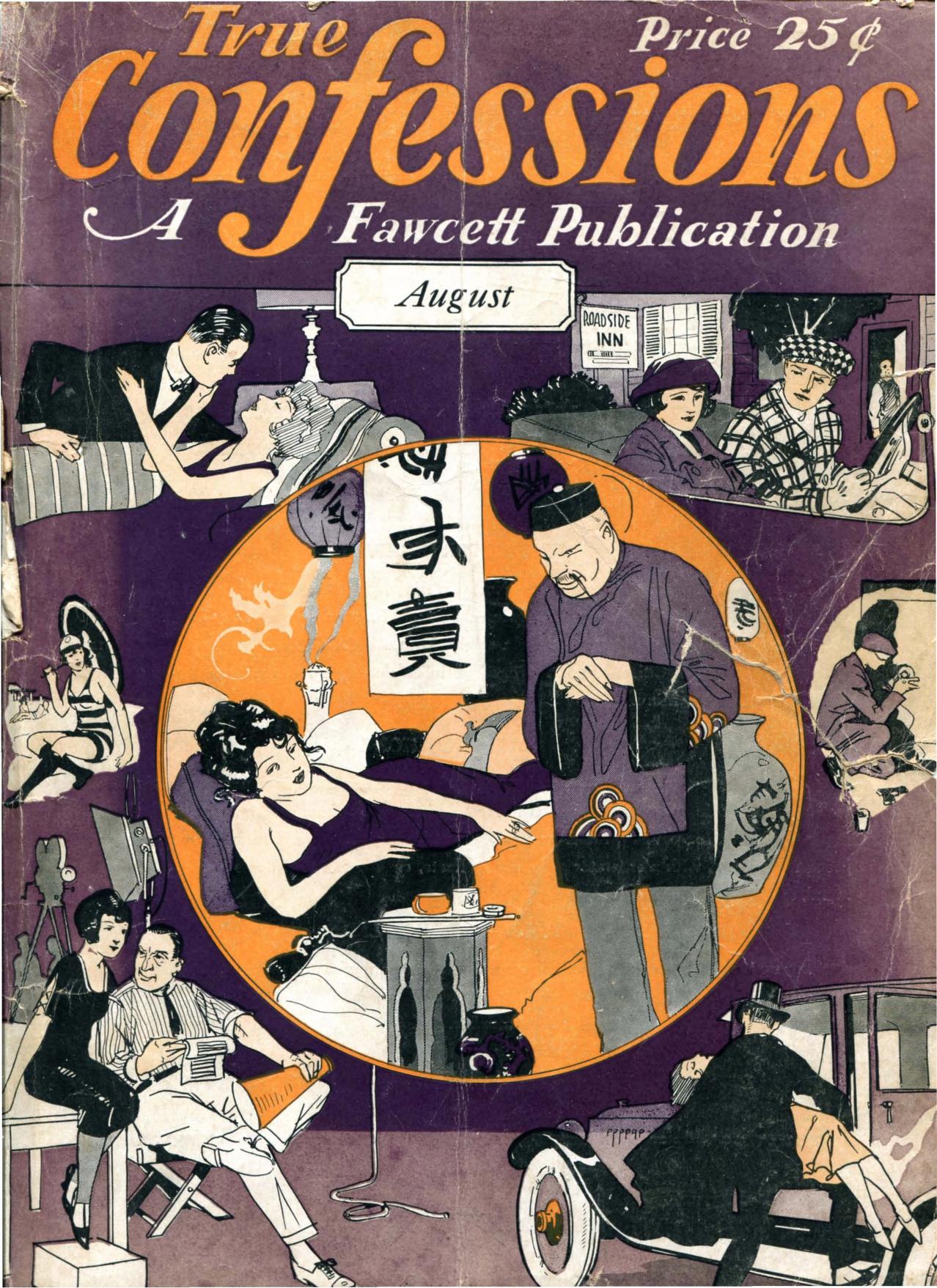
The Art of Book Design: True Confessions

Fawcett Publications. True Confessions, August 1922.

The originator of yesterday’s pulp magazine, Wilber Hamilton Fawcett, went on to establish this well-known pulp magazine in 1922. It became wildly popular and survived well into modern times. It folded sometime in 2018, but specific information is difficult to find.

via: The Internet Archive

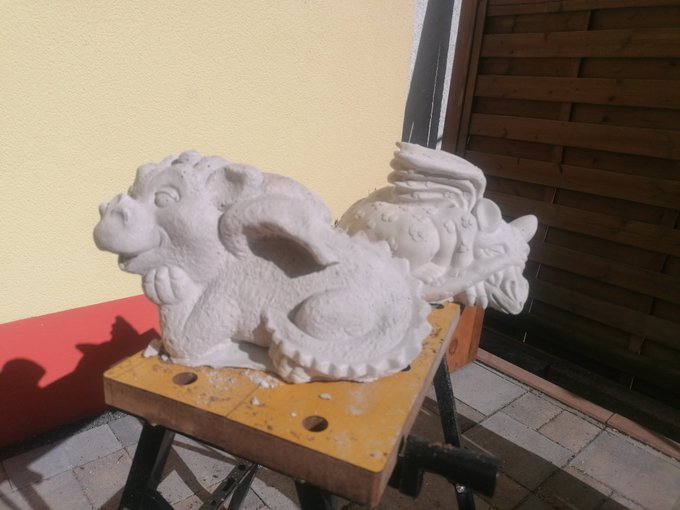
Excuse me, I’m a Little Horse

Kestrel’s little horse is looking better, bit by bit.

Progress! I thought it might be interesting to see how the layers of fine pastel dust build up. People who have never done this before don’t realize that it just takes time and patience; you don’t have to glob the pastel on there, thin tiny layers are the way to go. The nice thing about pastels is they are very slow and you have a lot of control, but it takes many layers to get a nice deep rich color. I’d also like to point out that I changed the markings from the living horse a little bit. It’s one of the nice things about painting; if you don’t like where a particular thing is, you can just move it over a little, or add on an extra blob here and there! 

©kestrel, all rights reserved

©kestrel, all rights reserved

©kestrel, all rights reserved

©kestrel, all rights reserved

Aaaand… now it’s time for some details with acrylics! Acrylics kinda scare me because they are very fast. They dry out so quickly in my area I sometimes can’t even get the paint on to the model, because it dries on the brush as I’m trying to apply it. There are products that slow down the drying time on acrylics and I am using them here.

Although the acrylics are perfect for details, you just can’t get that same degree of blending and shading as you do with pastels. Some people use an airbrush for the blending, but I don’t have one, so it’s pastels for me.

©kestrel, all rights reserved

He’s starting to look like a horse now. In case anyone wonders, eyes are about the last thing you do. It would be very sad indeed if you did the eyes, got them perfect (NOT easy, especially at this scale!) and then the model fell over into a puddle of paint and ruined them. So, you save them for the very last. They really help to bring the piece to life.

It’s starting to look like I’ll be able to get him done by the deadline!

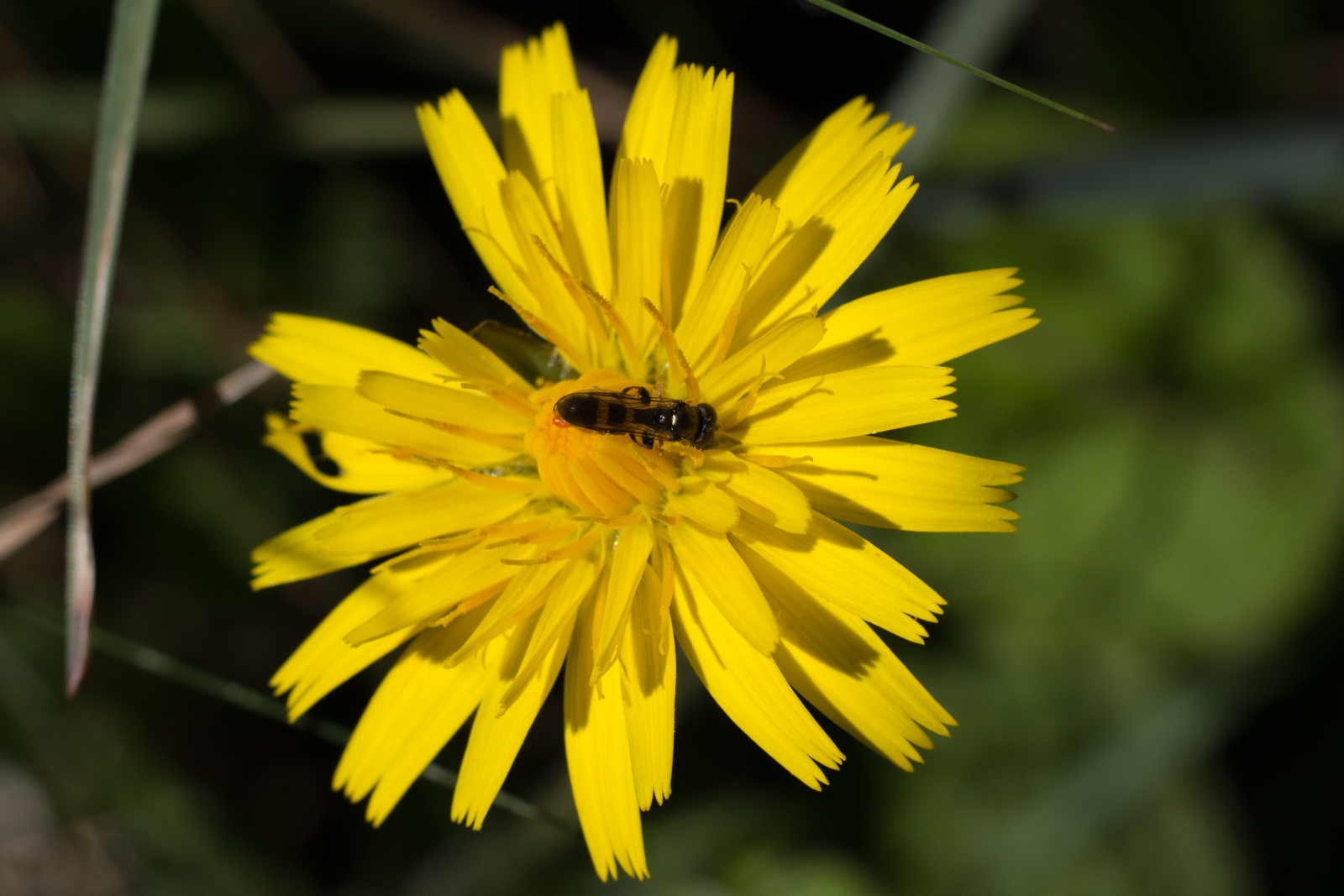
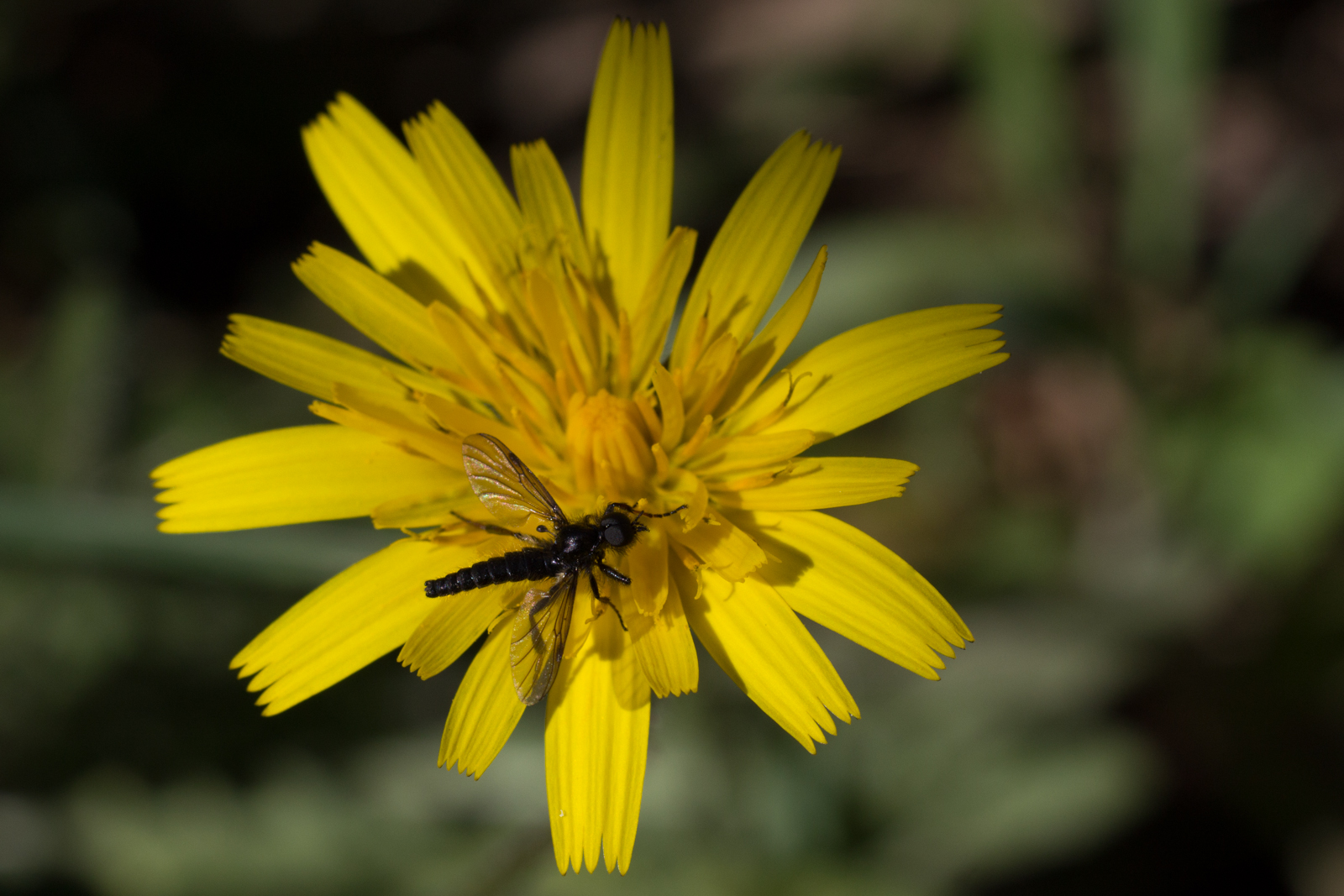
It’s a Damned Yellow Composite

Nightjar has sent us some bright yellow flowers to brighten our week.

Today’s flower is a… well, let’s call it a DYC, Damned Yellow Composite. I can never tell them apart and it’s not really important. And I also can’t identify the flies (I think?) that are visiting the flowers, so it’s all around an ID fail from me. I still hope they cheer you up!

©Nightjar, all rights reserved

©Nightjar, all rights reserved

Making Kitchen Knives – Part 15 – Tumble Time!

I was on and off working on this project in February. I have filled my tumbler with very fine sand (one that is used to fill in the spaces between concrete pavement bricks) and walnut shells and I polished the blades with increasing grit belts, then I stuck them into the tumbler for a day or two until I thought I can get the scratches all out after 12 hours evaluation.

It was still more time consuming than I would like to, mostly because many blades were ever so slightly bent, a problem that I really hope to solve with plate quenching in the future. On a bent blade, the concave part gets polished quickly, but the convex is a pain in the ass.

So I progressed slowly and at 150 grit I stopped, thinking that the fine sand can take the scratches out in time. It did, however, it took over a week in the tumbler, so next time I will go probably somewhere around 240 or perhaps even 320 grit before going to the tumbler. The blades did have a nice sand-blasted like look to them, so they were de-facto good to go functionally, but I thought they might be still improved by putting them in the tumbler some more. So I did, into a mixture of jeweler’s rouge (Fe2O3 powder) and crushed walnut shells. And I was right, they have now a very nice satin finish that I think is perfect for kitchen knives.

A mirror polish can be a bit sticky, so for kitchen knives, it is not the best option. I will see how sticky this polish is in a bit, but it looks good. Unfortunately, pictures do not give it justice, I won’t even try.

Time-wise, I have spent about 110 minutes per blade with this polishing process to achieve this result. So an improvement of 58%, but with a different look in the end.

Here is the blade line-up from worst to best:

© Charly, all rights reserved. Click for full size.

The first left blade has a slight crack on the edge. Not from the tumbler – that would be possible, but it did not happen – but from the one time where I forgot that the blades are drying on a rug and I took it to wipe my hands. All twelve fell to the floor and this one cracked near the edge and will have to be re-ground to a different shape – I do not know which yet. It was also one of the curly ones and that might have played a role too.

The second blade from the left would be perfectly OK if I did not mess it up. There is a place about 1/3 from the tip where I run accidentally not over the edge of the platen but over the corner. I nearly ground through the blade there, making an unseemly spot where it is paper-thin. I will probably prototype this to a much smaller blade, like a peeling knife. A lesson for the future.

The third and fourth are the remaining two of the curly-wavy blades. One will be re-shaped into a fish gutting/filleting knife for my uncle, one will remain an all-purpose kitchen knife, only with a slightly narrower blade than intended. It will be more similar to the knife I gave my mom and my brother.

The next five blades have a slight bend to the right side that I was unable to straighten out. They will be functional, but cutting straight will be a bit difficult, so not ideal for bigger things like cabbage, but still OK for carrots, leeks and onions, and sausages.

The last three are what I intended to achieve. 25% success rate – a disaster. But I am still learning, so hopefully next batch comes out better.


Maps

This post has been planned since late last summer, before I fell off the map (har har) for a while. It’s slightly out of date, as it were, but here goes – before posting the new content, I’ll clear up all the (two!) posts I had planned previously.

Anyway.

Not a new story, but (via the CBC):

Canadian Geographic has created a giant floor map, and an accompanying Indigenous Peoples Atlas of Canada, to change the way kids — and adults — look at this country.

“We hear so much about truth and reconciliation and what does it mean in reconciling our understanding and knowledge,” said Charlene Bearhead, an education advisor for the map and the Indigenous Peoples Atlas of Canada.

Unreserved host Rosanna Deerchild sits on the Indigenous Peoples Atlas of Canada floor map, which is the size of a gymnasium. (Stephanie Cram/CBC)

The map does not contain provincial boundaries, names of provinces, or many of the current names of cities and towns. Instead, it outlines the different Indigenous communities found across the country, the languages spoken, and the treaties signed with the Crown.

[…]

“For the most part Indigenous people walk on the map and it makes sense and they are like, ‘I know where this is, I know the story of this place for my people,'” said Bearhead.

“Non-Indigenous people walk onto the map and have this blank look on their faces,” a reaction Bearhead recognizes once they realize there are no provincial boundaries drawn on the map.

After a bit of confusion, Bearhead said what often follows are lengthy discussions of Indigenous histories and experiences.
Story in full at the link.
And in addition to that, here’s another one:

“People always say that mapping is a colonial tool, or a tool of colonialism, and it certainly has been used in that way, but I think the power of mapping is that there is so much power in it. It doesn’t necessarily have to be oppressive,” said Annita Lucchesi, a doctoral student in the cultural, social, and political thought program at the University of Lethbridge.

“It can be liberating. It can be healing. It can be empowering, especially when it’s being used by people who have been historically oppressed.”

The Southern Cheyenne cartographer is creating an atlas of missing and murdered Indigenous women and girls across Canada and the U.S. So far, Lucchesi has helped document over 3,000 cases, some reaching as far back as 1900.

[…]

“The beauty of maps is we can share as much or as little as we like and it still makes sense. We get to decide where those boundaries are. We get to decide what colours to use, what symbols to use, we can put cultural ideas on them. They’re so flexible and there’s so much freedom in that that it’s really a liberating form of storytelling.”

Lucchesi said she hopes that through her work with Indigenous mapping, new relationships between Canada and Indigenous peoples can be created.

“Through mapping we’re able to tell stories to each other that help us to build better relationships, help us to understand one another a little bit better so that we can respect the sovereignty of Indigenous peoples.”

Story at the link.

For more maps of Turtle Island, see here, with other links, too:

Native Land is a Google Map of the territories and languages of the indigenous peoples of the United States and Canada. The map consists of two main layers, one showing the ‘territory’ of First Nation and Native American tribes and the other showing the geographical spread of indigenous languages.

[…]

Natives of North America is another interactive map of the Native American Nations. Obviously one of the biggest problems in mapping Native American territories is that official boundaries between the Nations did not exist and these territories were constantly shifting.

[…]

The Invasion of America is a fascinating map of Native American land cession between 1776 and 1887. During this period the United States seized over 1.5 billion acres from the Native Americans.

“It is just a flu” Should Never be Comforting Phrase in the First Place

I do not know whether this applies to the anglophone world, but in Germany, and to the same extent in CZ, “flu” and “cold” are treated as more or less synonymous. And because the common cold is, well, common, most people when they say they came down with flu, what they really want to say is they had/have a bad case of the common cold.

One of my former colleagues thus thought that flu is something trivial and she always disparaged me when I said that flu is a serious illness and not something to be flippant about. I do not know how she managed to live for over thirty years and get herself a kid without encountering real flu, but she was among the lucky ones in this regard I guess. A healthy, strong woman in her thirties.

But in 2008 her luck ran out. In the morning she came to work as normal, but just mere two hours later she began to have fever and chills and got a splitting headache. She excused herself from work at noon and went home and did not return for two weeks.

When she came back, a rare thing happened – she acknowledged that she was wrong and I was right in our previous discussions about this. She just had a case of real flu and for a few days during that time, she actually feared for her life, because there were times when the fever made her see double and she was barely able to go the loo.

It is a sad reality that some people – I dare say many people – actually, really need to experience some hardship first hand to be able to believe it is real. Be it flu, or poverty, or discrimination.

When some people were saying that Covid-19 is just another flu in a derogatory and dismissive way, I rolled my eyes so hard I nearly strained them. Even if Covid-19 were just a new strain of flu, a new strain of flu would be terrifying. Even old and established strains of flu can be terrifying when they encounter an unvaccinated person who never got flu before.

“It’s just another flu” should have been a call to arms, not a placating head pat, even if it were true.

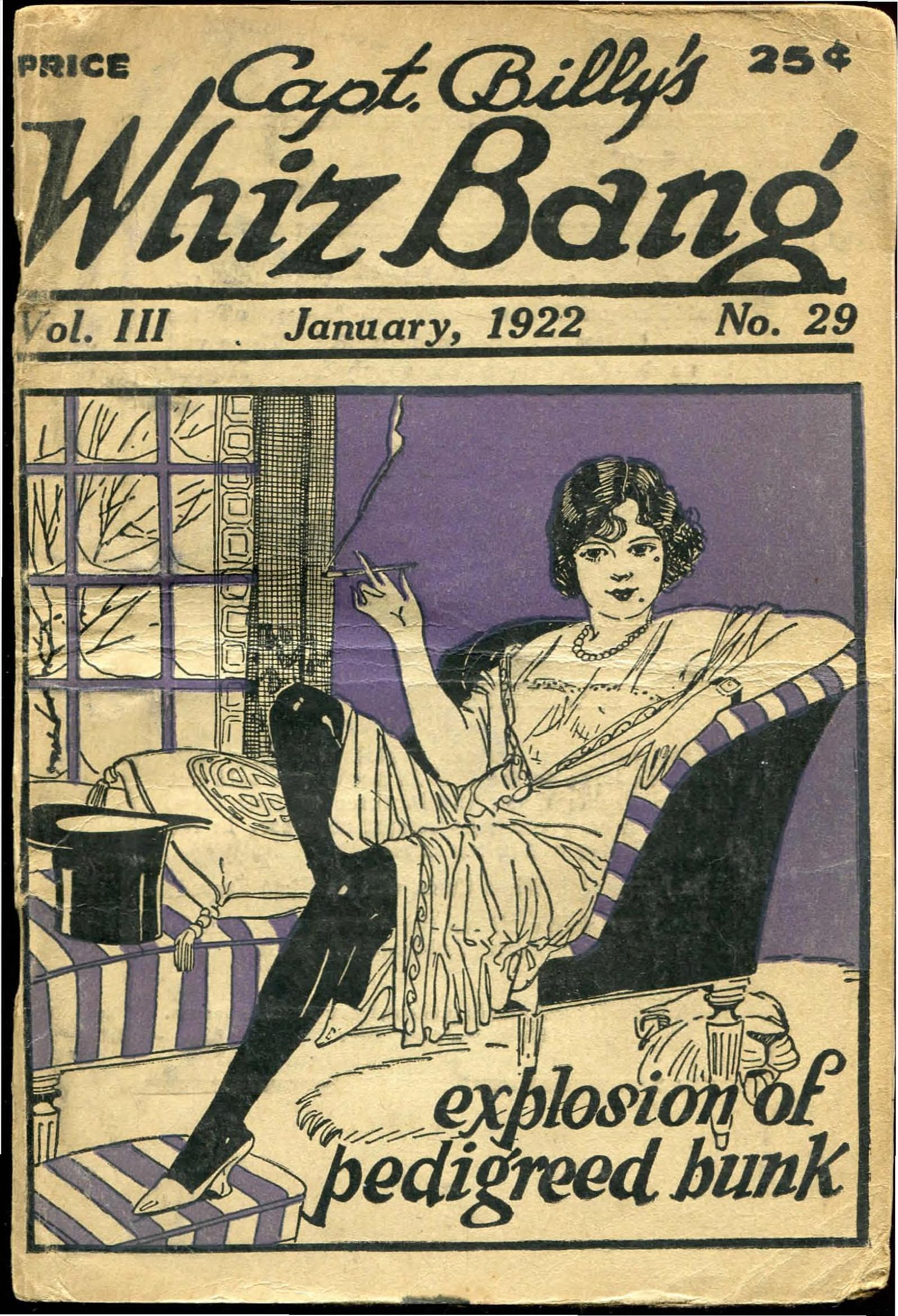
The Art of Book Design: Capt. Billy’s Whiz Bang

Wilber Hamilton Fawcett. Capt. Billy’s Whiz Bang, January 1922.

Welcome to pulp week at The Art of Book Design. Capt. Billy’s Whiz Bang was first published in October of 1919, and became incredibly popular during the 1920s, despite outcries that the magazine was immoral and corrupt. At one point, the magazine was selling up to 425,000 copies per month, but with the onset of the depression, people had less discretionary money, the light-hearted humour of the magazine went out of fashion, and the magazine folded in 1934.

via: The Pulp Magazine Archive, at the Internet Archive


Hi Again

Well hello there strangers and not-so-strangers. It’s a new world out there, or so I’ve been told – who really knows what’s actually going on out there?

It’s been a while, and I apologize for that (but in a ‘sorry to inconvenience everyone because I’m a polite Canadian’ way, not because there’s anything I should be apologizing for). The past several months have been a whirlwind of personal issues and deaths in the family and a few other things I could think of if I bothered, but long story short, I’m healthy, the kids are healthy, I’m still in a relationship, and work is hell. I’ve actually talked about quitting out loud a few times by now, which is a pretty big thing because of how much I (usually) love what I’m doing, but after being thrown under the bus a couple of times, the shiny parts ain’t so shiny no more. I feel a bit like:

(original here)

Plus now the state of emergency means I could become a frontline worker at any time (depending on how things go down). Life, eh?

Anyhoo, enough about that.

In the meantime, I’ve collected like a bajillion (no exaggeration) links about art and other things that I’d like to clear out of my gmail drafts, so in this time of quiet contemplation and creative inspiration that working from home provides us with (please, I’m looking on the bright side), I will try to get some of that content out to you. Plus maybe some photos of my own from time to time.

I am a bit more active on twitter these days (@andtheunicorn, if anyone’s interested), where I try to post a different photo every day or three, plus I like to pretend I’m interacting with the world.

So, today is a ‘hello again’, next two posts are two I’ve had lined up since last August, and we’ll see what happens after that.

Stay healthy, everyone, wash your hands, and best wishes to you all! Special shout-out to all you teachers, shop workers, delivery people, mail persons, and others previously not appreciated but now deemed essential services – most especially to all those in the medical field. ♥ like crazy for you all.

The Art of Book Design: Pussy-cat Town


Marion Ames Taggert. Pussy-cat Town. Illustrated by Rebecca Chase. Boston, L.C. Page & Company, 1906.

I was a cat person long before I became a dog person, and I still have a soft spot in my heart for felines, so when I saw this book I knew I had to feature it. The book is full of sweet drawings and there are many more than I’m sharing here. I’ve included all of the full-page illustrations, but there are multiple smaller black and white drawings on many of the pages. I hope you enjoy the book as much as I did. [Read more…]

Corona Crisis Crafting IV: Face Masks

Around the world hospitals are asking for volunteers to sew masks and I started already for my sister and her colleagues, as well as the relatives who care for her elderly patients.

I’m using this pattern and it’s super easy. Time needed is probably 15-20 Minutes per mask, so grab your fabric stashes and start sewing (finally you have the justification for keeping all those letter sized fabric pieces).

BTW, I guess that some protection nobody could measure in their experiments is that wearing them really keeps you from touching your face.

©Giliell, all rights reserved

I’ll also hand out instructions with them that read as follows:

Hello,

I’m a washable cloth mask. I am not a medical product and should not be mistaken for one. I am especially no substitute for other measures like washing hands and staying at home. Please wash me before you first use me and after each use. I’m 100% cotton and can be washed at 60°. Caressing me with a hot iron is a good idea as well. I’m free. If you want to say thanks please stick to the guidelines put forward by the authorities. But if maybe you have some elastic lying around, that would be nice, so many more masks can be distributed.

Best wishes and take care