The Anvār-i Suhaylī (Lights of Canopus).

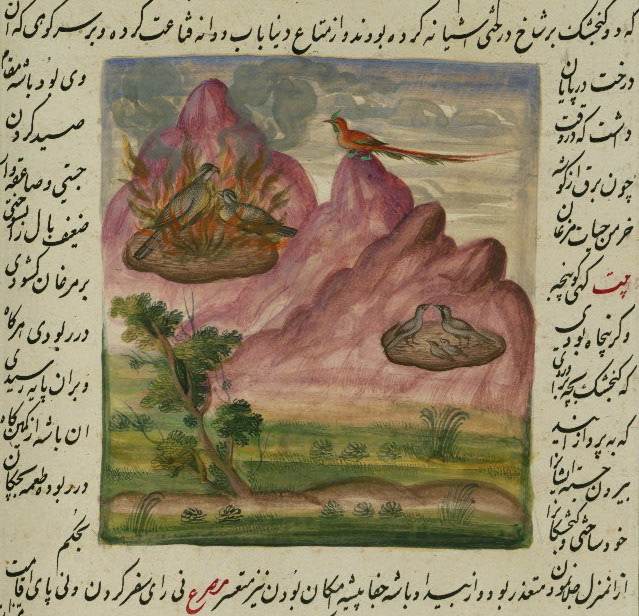
A beautiful Simurgh looks on as Phoenixes burn in their nest. This, and the images to follow, are from the beautiful Anvār-i Suhaylī or Lights of Canopus. From The Public Domain:

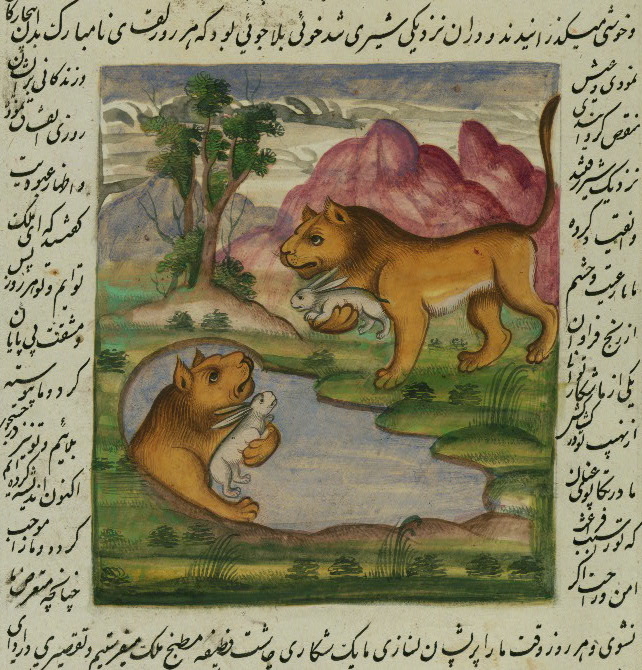
The Anvār-i Suhaylī or Lights of Canopus — commonly known as the Fables of Bidpai in the West — is a Persian version of an ancient Indian collection of animal fables called the Panchatantra. The tales follow the Persian physician Burzuyah on a mission to India, where he finds a book of stories collected from the animals who live there. Much like in the Arabian Nights (which actually uses several of the Panchatantra stories), the fables are inter-woven as the characters of one story recount the next, with up to three or four degrees of narrative embedding. Many of the fables offer insightful glimpses into human behaviour, and emphasise the power of teamwork and loyalty: one passage describes how a hunter catches a group of pigeons in a net, only for them to be saved by a mouse who gnaws through the rope. The version celebrated in this post hails from nineteenth-century Iran and is particularly notable for its exquisite illustrations — scenes of tortoise-riding monkeys, bird battles, conversing mice, delicate purple mountains — 123 in total. The artist behind the images is not mentioned, but the creator of the equally elegant nasta’liq style writing which they serve, is named by The Walters Art Museum (who hold the manuscript) as one Mīrzā Raḥīm.

And from The Walters Art Museum, where you can see the whole manuscript in .pdf:

Walters manuscript W.599 is an illuminated and illustrated copy of Anvar-i Suhayli (The lights of Canopus), dating to the 13th century AH/AD 19th. It is a Persian version of Kalilah wa-Dimnah (The fables of Bidpay). It was completed on 26 Jumadá I 1264 AH/AD 1847 by Mirza Rahim. The text is written in Nasta’liq script in black and red ink, revealing the influence of Shikastah script. There are 123 paintings illustrating the text. The Qajar binding is original to the manuscript.

Husayn Va’iz Kashifi (died 1504-1505) (Author)
Mirza Rahim navadah-i Mirza Amin Afshar (Scribe)

1264 AH/AD 1847 (Qajar)

Best friends?

Oh, one of my favourite stories, and one that is much older than I thought.

Another beautiful Simurgh!

Those mice, always rescuing everyone.

Yet another rescue by a mouse. They must have been adored by everyone. :D

You can see many more images at The Public Domain, or download the .pdf of the whole manuscript via The Walters Art Museum.

The quest for medievalism in ‘The Witcher 3’.

I realize that not everyone finds Medievalism to be as fascinating as I do, but this is really, um, fascinating!

Introduction: In the fictive landscape of the Northern Kingdoms, the character Geralt of Rivia rides on his chestnut mare clad in chainmail armour whilst sporting two-handed swords comparable to a zweihander or longsword of the late 15th century. As I encounter my second village through the third-person view of my protagonist, a short observation leaves me with the impression of a plausible society taken from the Middle Ages. Such a historically detailed environment within a fantasy game of the 21st century should be no surprise to the avid gamer, however, it raised the question of the representation of history within computer games.

[…]

This study seeks to investigate the medieval thematic in computer gaming and pursue what historical elements that persist through this relatively new medium. More distinctly, the many missions and quests experienced in the ‘The Witcher 3’ is the main object of study as they work in concert, providing both enhanced purpose for the player as well as constricting the freedom given in the open world of the Northern Kingdoms. Quests – a task or mission given by non-playable characters (NPCs) or during certain interaction with objects in the game – present a variety of impressions through participatory segments that the player encounters in the game. It is the potent meaning of said quests that this study seek to delve into in order to find, not only the historical features, but also the fascination that seems to propagate itself in games.

You can read Christer Lidén’s full thesis here. (.pdf)

Via Medievalists.net.

Oh my, I’m A Dominican!

I’m also a Knight Templar! I took this twice, because I had a conflict when it came to movies and the awful phrases. Also, giving me a choice between sword, flower, and book is not fair. So, Dominican:

You would belong to them because you are an intellectual person that not only loves learning and studying, but, above all, transmitting the Truth to others.

And Knight Templar:

You belong to them because of your strength and great desire of conquest. You are willing to risk your own life for others and for your Faith.

Silly fun, go see where you’d be slotted in Medieval Times.

A New White Excuse: “I Was At Standing Rock!”

Courtesy Wind Over Fire Healing Arts Center/Facebook
A New Age “ghost dance” held in southwestern Minnesota has many indigenous people wondering just when the cultural appropriation will end.

White “aggrieved entitlement” people. They never seem to run out of excuses for their bloated sense of entitlement, of helping themselves to the least little thing; of exploiting marginalized peoples. It’s damn near a way of life for many white people. When it comes to “new age” rites, seems to me there’s a wealth of pagan history to mine, gosh, you might even find some you’re related to in some way.

Towards the later days at the No DAPL camp, I wasn’t quiet about all the entitlement-minded white people there, who had no use for the rules laid down by the people running things. Because of course, rules, they are never for white people are they? I wasn’t quiet about all the white protest/event tourists, either. People who were there to honestly provide support and help, no problem. As usual though, they weren’t the ones making a fuss or making it all about them, because they knew it wasn’t about them. They knew that in the end, they would go home, and not have to deal with it all.

In Minnesota, there’s a group who recently held their 2nd annual “Ghost Dance”. When called on this, they denied it was a ghost dance. They said it was a “Ten Moons” dance. Then they decided to go with “Ghost Dance isn’t exclusive to Indigenous people! Lots of cultures had ancestor dances! China! Africa! So it isn’t indigenous in nature.” Oddly enough, their not indigenous at all dance is decidedly indigenous in appearance, and specifically so. The history of the Ghost Dance is a dark one, once the colonials got terrified and started up more wholesale slaughter, and brutally oppressed indigenous peoples all the more out of fear. It’s not a toy for white people to play pagan. It’s not yours. It’s not your culture, it’s not your history. If non-indigenous people ever wonder why various rites and dances have been closed to outsiders, look no further.

“It would be great if everyone just joined together,” said Laven, discontented by the scrutiny of their ceremony and the charges of cultural appropriation. “We have enough crap. I was at Standing Rock, and I hear the Native Americans, and I had heard them.”

Oh my. What a fine example of white entitlement. There’s really nothing else like it. Golly, white people have had enough crap! It’s just like everything indigenous people have gone through! And now, Standing Rock is the latest excuse. Fuck you, Ms. Laven. A universe of fuck yous. You have not heard one godsdamn thing. You don’t give one little shit about indigenous people or their struggles. All you care about is exploiting them to make money. I hope you are bad-mouthed from here to the end of the galaxy, because that’s the very least of what you deserve.

Full story at ICTMN.

William T. Horton.

Chris Ford: Affinity &emdash; Horton1

Click for full size.

William T. Horton is an artist little know these days. His work is stark, yet full of expressiveness and intensity. The Public Domain has an excellent article up, with many images. Just a few more here. Click all for full size.

The publisher Leonard Smithers (1861–1907) launched, bankrolled or otherwise helped the careers of an impressive variety of names: Richard Burton, Aubrey Beardsley, Aleister Crowley, Ernest Dowson, Oscar Wilde, W. B. Yeats, and Max Beerbohm were all referred to as “Smithers People” at one time or another. He drew to his circle the most eccentric and interesting characters of the era and in 1896 launched the arts and literary magazine the Savoy to showcase many of them. Aubrey Beardsley was made art editor while Arthur Symons was placed at the editorial helm. While not entirely a “Decadent” outfit (it also published George Bernard Shaw and Joseph Conrad), the magazine became a lightning rod for the curious and in it, as Bernard Muddiman wrote, “the abnormal, the bizarre, found their true home”1. It also launched the career of an illustrator and mystic named William T. Horton. Arguably one of the most fascinating and most unusual of all the “Smithers People”, he published very little work and remains almost completely unknown today.

Chris Ford: Affinity &emdash; Horton2

The Path to the Moon from Horton’s A Book of Images (1898). Click for full size.

Chris Ford: Affinity &emdash; Horton3

Horton’s cover for Knut Hamsun’s Hunger (1899) — Source: private scan from book. Click for full size.

Chris Ford: Affinity &emdash; Horton4

One of two Horton images featured in H. Rider Haggard’s The Mahatma and the Hare, a Dream Story (1911) — Source. Click for full size.

You can read and see much more at The Public Domain. Horton’s A Book of Images can be seen in its entirety here. W.B. Yeats’s introduction to A Book of Images is well worth reading, too.