The project is going into its final stage, so I should probably update you on the process some more. So today I am going to write about how the two honing steels were made. Lotsa of pictures follow.
This year we have snowy winter. The snow came late, but it came in droves. And with plenty of snow also came bramblings, a flock of about 30 individuals. They returned multiple times, and I have managed to get some pictures, although the light was less than ideal.
In my opinion, every household should have at least one person who knows how to sharpen a knife and occasionally does so. Not that good knives need to be sharpened very often, but even the best knife will get a bit dull at some point and it will need to be sharpened.
But most of my friends do not know how to sharpen knives, some are even afraid of it. There is in my opinion absolutely no need to be afraid of sharpening knives, and you do not need any fancy or expensive equipment either. And when searching for knife sharpening info online, one can encounter some pretty wild stuff, sometimes stuff that is not true.
Two-three years ago during one of my yearly get-together with friends from university, I was (as usual) dismayed by the state of knives in the communal kitchen at our lodging, so I have decided to sharpen at least one knife to a state when it will cut and not squish. However, on this particular trip, I have forgotten to take a whetstone, so I had to do without it.
I went on a walk in the forest and I have checked the geology on the wayside, where the bare rock was exposed. It was granite, which is of no use. However, where is granite, there often are metamorphic shales nearby, so I went further – and it was indeed just a few km further (about a half-hour walk). This particular metamorphic shale was phyllite, which is suitable for making a whetstone. So I took two stones to a nearby stream and I ground them against each other until I got perfectly flat surfaces.
And thus obtained whetstone worked perfectly well. The knife did not have the best edge it could get, but it was good enough for cutting safely and comfortably. I have even managed to teach one of my friends how to sharpen with it, and I did recommend to him to buy a professionally made one afterward.
And what did I recommend to him to buy? A cheap two-layer whetstone for 10,-€, 100 and 300 grit. The same one with which my father was sharpening knives his whole life and which I sometimes take with me on my travels.
If you are interested in learning how to sharpen a knife, I do recommend the above mentioned Burrfection YouTube channel. He does explain the principles well, without exaggerating. And he supports his claims with empirical evidence. For example, I have said to my friend that sharpening angle more or less does not matter if it is between 10-20° and constant throughout the blade. That claim was based on nothing more than my subjective experience, which could be mistaken. But Burrfection did say the same and he has the equipment to test the said claim. So he did.
Do not be afraid of knife sharpening. The basics are easy and more than enough for a typical store-bought mass-produced western knife.
These were very welcome visitors – about 8 to 10 of them. Last year I have seen no goldfinches at all, the whole year. A small flock last week made me really happy.
I think it does.
My mom’s knives needed to be sharpened. Normally I would sharpen the knives with the current manufactured batch, but since the honing steels, whilst not finished yet, got to a stage when they can be at least tested, I have decided to test them. So instead of sharpening the knives on my belt grinder and stropping them with the MDF wheel, I have sharpened them the old fashioned way on a whetstone and then honed the edge on steel.
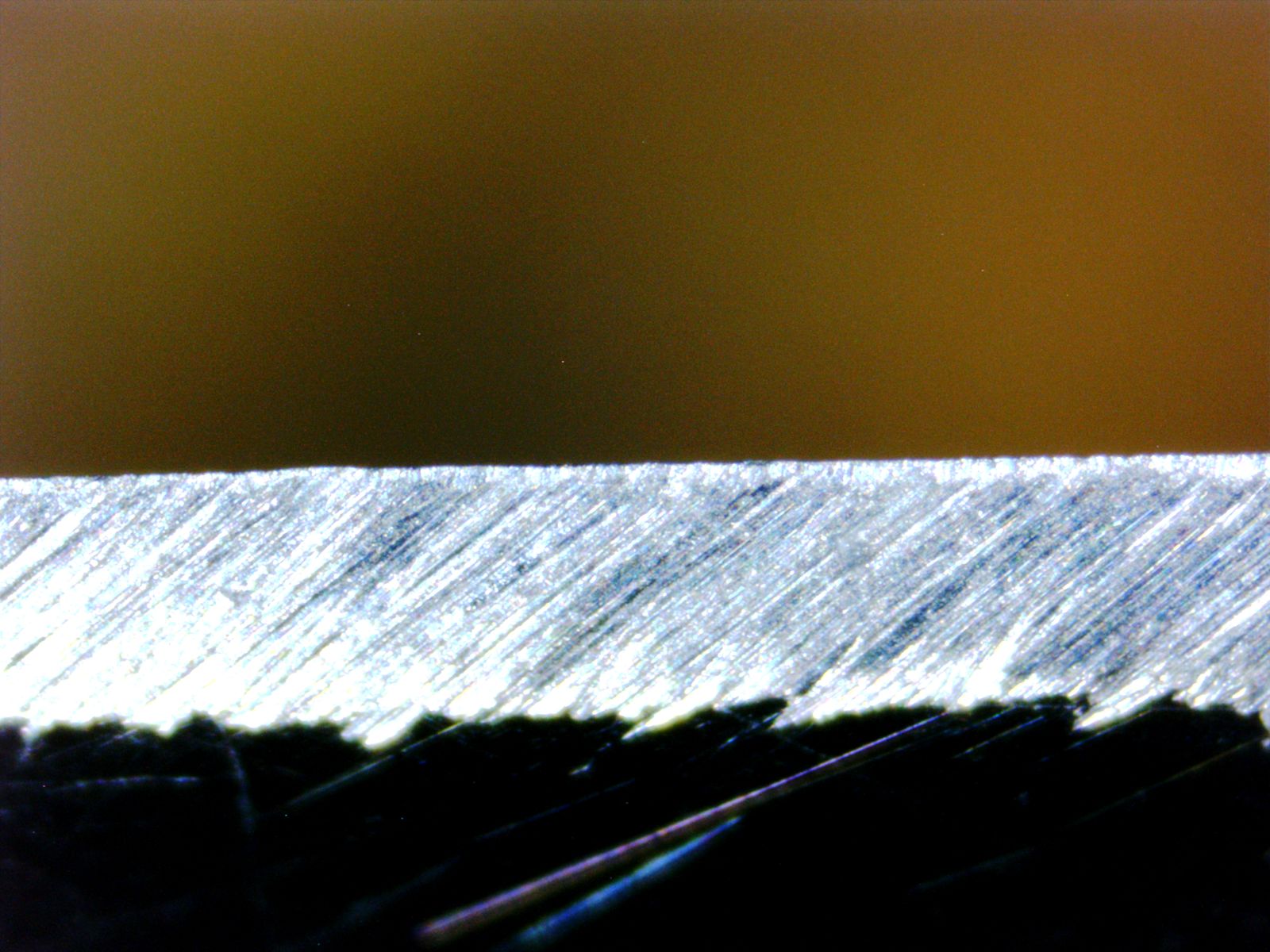
First a picture of a “blunted edge” bevel.
You can see the perpendicular scratches right near the edge. Those were made by the belt sander. The angled scratches are from half-arsed maintenance with a whetstone that I have done last week when I did not have time to do the job properly. This is not, strictly speaking, a blunt knife. It would still take yer finger off in a jiffy and was perfectly fine for hard veggies like carrots and taters. But it did struggle with tomatoes a bit. Notice how the light reflects differently from the mirror-polished primary bevel, which thus appears nearly black.
As far as size goes. this bevel is very small – about 0,3 mm wide.
First I have re-established nice regular bevels at 15° with the rough side of the whetstone, which has circa 100 grit. 15-20 passes were needed, even though the bevels are very small – the steel is very hard. It does not look very different from the first picture, except for the scratches being all angled all the way to the edge now. On carbon steel, this would establish a so-called “needle” which is a thin foil of steel on the edge that bends and cannot be ground away, but I have not seen this happen with N690. The needle here breaks usually off very easily, leaving behind a bit of jagged edge.
Fine 320 grit side of the whetstone is used to slightly smooth the edges and eventually break off the needle on harder and brittle steels (like most stainless steels). However here it does not look that much different from the second picture, which I did not expect. The knife at this stage is perfectly capable of cutting tomatoes, but it does not shave hair yet. And this is where the test of the honing steels comes into play.
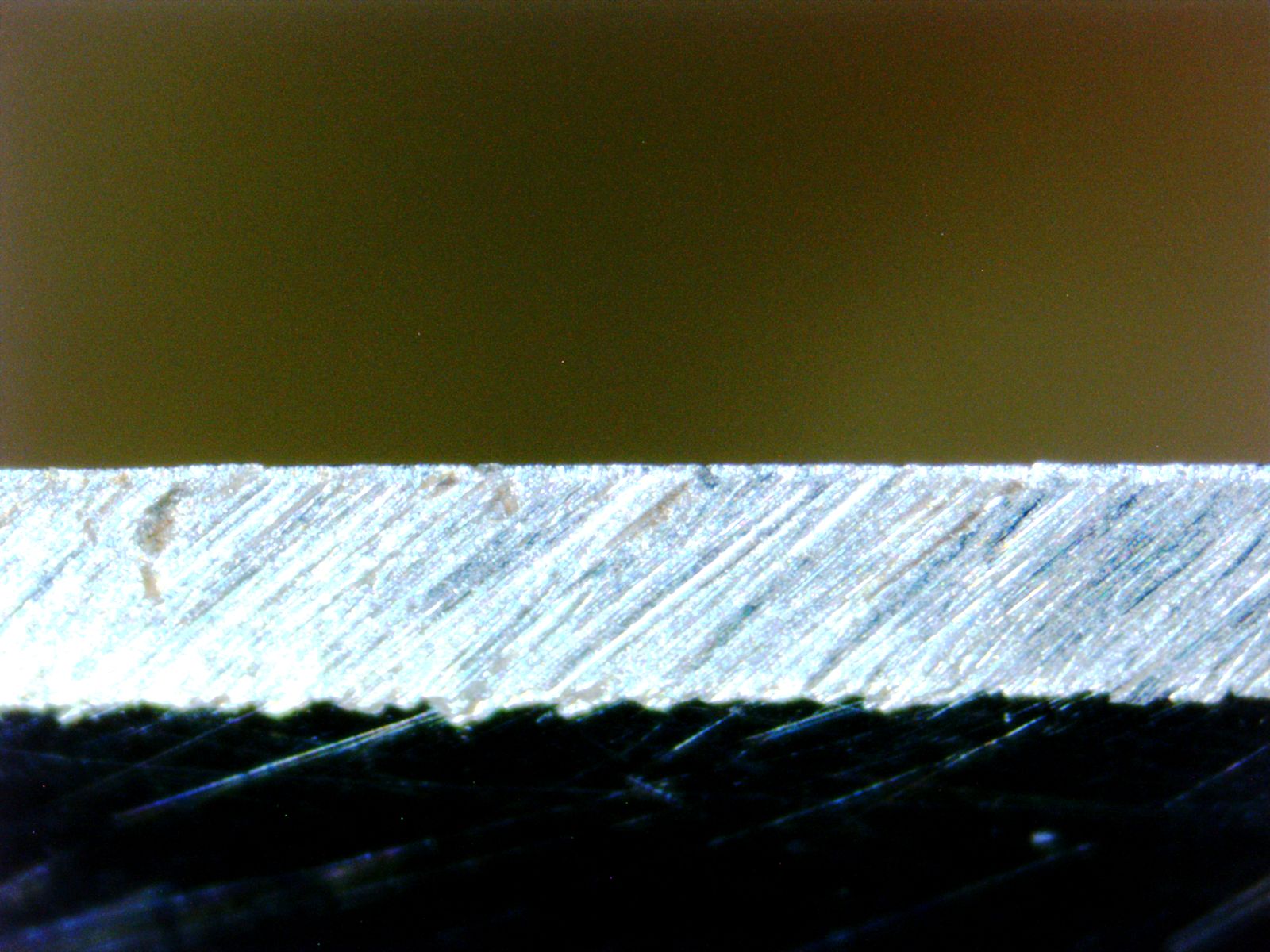
Now the bevel looks significantly different from before. Note that the edge is now mirror-polished between some of the deeper scratches – the light reflects very differently from the bevel than it did before. The knife is now also shaving-sharp not only tomato-cutting-with-its-own-weight sharp.
So TLDR is – Although this is not a scientific proof, I am convinced and I think the honing steel works as intended.
Somebody somewhere in the comment section (I think on Marcus’s blog) expressed dislike for resin stabilized wood along the lines that it is the same as making the handles out of plastic. I disagree. Stabilized wood is a pain to work because it behaves like plastic in that regard, but it does not look like plastic and neither does it feel like plastic in the hand – it feels like wood. And as I was working on this project, I found out that it even sounds like wood – stabilized pieces give out very nice clonk-clonk when hit against each other. I think it might be possible to make musical instruments out of it, but I won’t try.
However, before said wood reaches its desired stabilized state, I have to work with epoxy resin. Lots of it.
I hate it.
It is gluey, it sticks to absolutely everything and it is transparent, so when it drops somewhere it is difficult to see in time. Tools and surfaces need to be cleaned with paper towels soaked in denatured alcohol, which is not cheap and the fumes do not smell exactly delicious. And the work needs to be done fast, because if the epoxy gels, it won’t soak into the wood no more.
With my macgyered vacuum pump I have reached a vacuum of 0,2-0,3 bar, which was sufficient for extremely porous wood, but might not be sufficient for this. Applewood has very small pores and is very hard, even the very decomposed pieces were still harder than for example poplar or basswood. So I have decided to bite the bullet and buy a small, cheap vacuum pump in the hope that it will work better. And it does – and it does not.
Even with my poorly sealed pickle jar, I have easily reached vacuum 0,6 bar within a minute. The wood released so many bubbles that the resin developed foam head like beer.
However, the pump also got very hot after a few minutes of running, which made me a bit worried. My macgyvered pump was a bit cumbersome and awkward, but overheating was completely a non-issue. I am not so sure about this one. I hope it does not burn out before I at least get to sell some knives.
Overheating aside, the wood soaked up the resin very nicely and although I have only used clear resin, it developed very nice and pleasant colors. The resin would cure over time at room temperature, but it is possible to speed up the curing by heating it to 60-80°C. So I did that the next day and I baked the pieces for two hours, after which I could appreciate the nice clonk-clonk that I was talking about at the beginning.
I have also approached the issue a bit more scientifically this time and I have weighed all the pieces before and after. Here you can see the results.
This made me very happy with the results. The relatively healthy wood has gained approx 30% in weight, the not-very-much rotten root wood doubled its weight and the more decomposed wood has almost tripled its weight. All pieces of similar size weighed approximately the same after the stabilizing process, irrespective of what wood they were made of. And finally, all pieces when put in water either sunk completely or just barely floated with 99% submerged. So even the relatively healthy wood should be soaked up with resin to sufficient depth.
Now that the wood is stabilized, the only thing that is left is to psych myself up to go into the freezing workshop and finish the knives. Which includes first a bit of grinding and drilling, and then a lot of gluing. Even more fun with epoxy awaits, hooray!
My vacuum pump was delayed one more week but it should be due to arrive today afternoon. In the meantime, the weather was cold and I could not be arsed to heat the workshop and start another project. So I have decided to spend some time exercising my bobbin lace making skills again.
Last year I have taken my grandmother’s old blueprints and I scanned them. And now I took the scans to photoshop and I refined them into a form that can be printed out.
As you can see, these are true antique blueprints, made with the technology that actually gave us the word.
For the printable templates, I have refined the curves a bit but I have done my best to preserve the original placement of pins and knots as well as the type of weave. My intention was to reproduce the old work, not to reinterpret it.
Doilies are insidious. You make the inner circle first and that is quick and easy. Then the next inner circle takes a bit longer but it is fairly quick still. The next one then takes even longer. And the outermost one then drags on and on for what feels like forever.
Bobbin lace making shows itself to be a reasonable upper-back and shoulder exercise. The bobbins weigh next to nothing but holding your hands at breast height for hours is not easy. It is not exactly hard work, but it is not as easy as some might think.
Regarding my technique, I am not at my mother’s or my grandmother’s level yet. I am not able to hide the beginnings/ends as well as they do, neither can I make some types of lace (the diamond shapes on the last one are fugly) as neat and regular as they do. However they both were making bobbin lace since childhood and for decades, whereas I only learned it last year, so I am not losing any sleep over not being as good as they.
Yesterday we had a rare occurrence – a sunny day in winter. With pristine snow.
It did not lure me outside, I loathe winter with a passion and winter sports even more. But I did point my camera out of my window and did some clickety-click. It looks pretty. From the inside of a warm living room.
Since I have spent more time making the blades than I originally intended, I have decided to go the full hog and NOT make the handles out of some plain wood. Instead, I have decided to kill two birds with one stone – to get some fancy wood for this project and to reduce the clutter in my raw material storage. I have decided to use the apple stumps that my neighbor gave me.
First I had to cut the stumps into smaller logs of course.
That was not fun. Like, at all. I hate working with a chainsaw because the work quickly exhausts my meager strengths. Luckily the battery in this small saw gets drained after about half an hour of serious work, so with two batteries, I can get in about one hour of work before having to take a long break. Which is about the duration that I can do this without trouble.
Even so, before I was done it did actually happen once that the batteries held longer than I did and I got unpleasant mild hypoglycemia. That did not happen to me for a long time, but it was a reminder that absolutely must not skip or delay meal breaks.
I also blunted and had to sharpen the chain at least three times because there were small stones embedded in the wood.
Next came cutting the logs to a smaller size on a circular saw. Another not-favorite work of mine, since my circular saw is small and not exactly up to the task. I am also afraid of it most of all my tools. But I managed it mostly, although I too blunted the blade again by hitting an invisible stone inside the wood. That was not a happy week at work. I can tell you that. This I cannot sharpen myself, I have to pay for it and it ain’t cheap.
Aaand more cutting! This time on my Crappola bandsaw. I “only” broke three saw blades before cutting most of the wood down to workable size and shape. And whilst these are cheap on an individual basis, three at once cheap ain’t no more.
And these are the pieces that I have decided to use for the actual project – there is plenty more for future projects, including some smaller pieces of burl. So I did get some value for the destroyed sawblades, only not as much as I would like to.
On the left is some partially rotten but still reasonably hard and strong root wood. It still gives a nice resonating “clonk” when struck. I do love the stripey coloring, given to it by the decay.
In the middle is some mostly healthy wood, still completely hard and strong, but with a few cracks and occasional woodborer-holes. I hereby declare that those add to the character. They are inevitable parts of wood harvested from a tree that stood dead for several years.
And on the right is some really fancy looking spalted wood. This is so decomposed (by a fungus), that it is significantly softer and less-dense than healthy wood. It sounds a bit dull when struck too. But it is still not so soft and spongey that it would be unworkable on its own. That is important, otherwise I could not do my next step.
I have cut the slabs and I cut and ground rough outlines of the handles, with a few mm to spare. This will save me some resin later on and it will also mean I won’t have to grind away as much resin-soaked wood as I would otherwise. Which is good, because working resin stabilized wood sucks. Majorly.
And now the wood is drying up on the heating radiator in my living room. Not only does it need to be completely dry before I proceed, but it also has to wait until my ordered vacuum pump arrives. I do hope it does arrive next week. It is already delayed a bit. I also hope it works OK and that I have not thrown 100€ out of the window.
I do love that I have got three sets of different woods, all from the same species but each with its own unique character. I do not think I will dye the resin for these and I will just infuse them with a clear resin, leaving all cracks and holes distinct and visible. I think there is real potential for beauty here.
The Dakota Access Pipeline issue is still not fully resolved, but that does not mean that one cannot work on another issue. And in fact, people of Standing Rock are building a wind farm. For more information go here. If you can afford to donate, you can do so here. Current donations go towards building an access road to the future wind farm.