Amnesty International issues damning report on Israel’s apartheid practices

Amnesty International is the latest mainstream organization that has finally come to the conclusion that what Israel practices with regard to the Palestinians is apartheid, joining other human rights groups like Human Rights Watch and B’Tselem that said similar things a year ago. The 280-page report outlines in great detail the reasons for saying so, pointing to what it calls decades of oppression. It says that Israel achieves this through four main methods.

Fragmentation into domains of control

At the heart of the system is keeping Palestinian separated from each other into distinct territorial, legal and administrative domains

Dispossession of land and property

Decades of discriminatory land and property seizures, home demolitions and forced evictions

Segregation and control

A system of laws and policies that keep Palestinians restricted to enclaves, subject to several measures that control their lives, and segregated from Jewish Israelis

Deprivation of economic & social rights

The deliberate impoverishment of Palestinians keeping them at great disadvantage in comparison to Jewish Israelis
[Read more…]

More Than Millennials by Mano Singham

I published this article More Than ‘Millennials’: Colleges Must Look Beyond Generational Stereotypes in the Chronicle of Higher Education, Vol. LVI, no. 7, October 16, 2009.

I wrote it in response to what I saw as a lot of disparaging remarks made about the cohort of young people that have been labeled as ‘millennials’. This was not just in the media but also among educators. I spent much of my teaching career teaching members of this cohort and felt that they were being maligned, because my own experience with them was nothing like what was described.

More Than Millennials

Axes of good and evil

All people are flawed but we are not flawed equally. There are many axes that can be drawn along moral and ethical dimensions and each one of us will fall at different points along them, having different strengths and weaknesses. It is next to impossible to extract an overall single score that would define our ethical and moral worth for comparison purposes, unless one decides to pick one axis as determinative over all the others. Doing so is what enables some people to feel morally superior to others. But even then, while it is hard to do that for positive values, there can be a particular moral and ethical dimension where someone is so bad that it overrides everything else and we can conclude that they are simply bad people, even if they have some redeeming qualities in some area. Sociopaths fall into that category.
[Read more…]

Columbus and the Flat Earth Myth by Mano Singham

One of the things that surprised me after coming to the US is how many students (and even adults) believed that it was Christopher Columbus who established the fact that the Earth was round and that prior to his 1492 voyage across the Atlantic, people believed the Earth was flat. (Some people still believe the Earth is flat but that is another story.)

I wrote an article about this myth that appeared in Phi Delta KAPPAN, vol. 88, no. 8, p. 590-592, April 2007 that you can read by following the link below.

Columbus and the Flat Earth Myth

I will be posting my published articles on this blog site

I find that some of my published articles can no longer be freely accessed on the web and so I have begun to do what I had been planning to do for a long time, and that is to post my non-technical articles on this site and not depend on the publications to maintain the links and provide access to them.

I posted the first one yesterday in response to a request from someone who could not access the article on the original journal site. That article garnered a huge response in the educational community. I will be adding posts with links periodically. The title of the posts will have the article title and my name so that they can be found easily by search engines.

Social norms

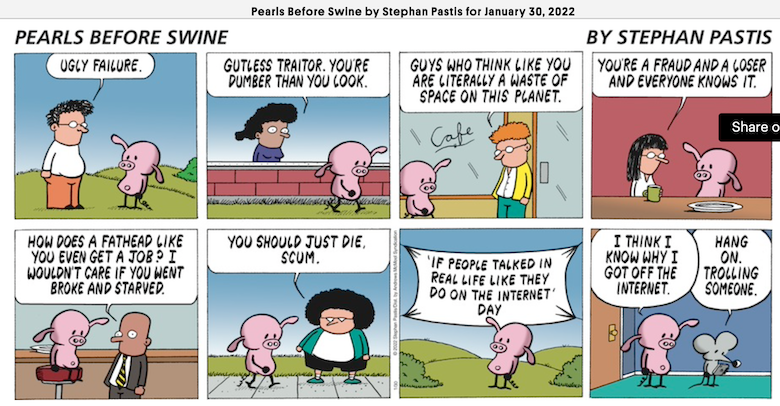
(Pearls Before Swine)

I like to think that I interact online the same way that I do face-to-face. It seems natural to me to be consistent. In fact, I once asked a good friend of mine who reads my blog whether I came across online as the same person that she knew personally and she said that I did. Of course, since we had the conversation face-to-face, she may have been being polite but I don’t think so because we are good enough friends that she could be honest. In addition, she is tactful enough to tell me the truth sensitively.

So it is a mystery to me that some people seem to adopt such different personas in the two spaces. Or are people who are so gratuitously rude on the internet that way in real life too and I am just fortunate in not knowing them personally?

The great butter quarter mystery

When I moved to Monterey here from Cleveland nearly three years ago, one of the first things I noticed was the difference in butter sizes. A one pound pack of butter comes in four quarters but the length of each quarter was less and the girth greater for the Monterey butter than for the Cleveland butter. The butter dish I bought seemed designed for the Cleveland dimensions in that the sides of the sticks in Monterey just barely fit under the cover while there was plenty of space at the two long ends. The only exception I have found is when some manufacturers break the butter up into eight segments. When you put two of the smaller segments end to end, you get the size of the quarters I had been used to.

At first I was puzzled by this and wondered whether I had just bought a brand of butter that was idiosyncratic in the butter cutting machine it used. But no. All the brands seemed to be the same stubbier size. I put that down to one of the great mysteries of life but then came across this article that explains how this difference came about.
[Read more…]