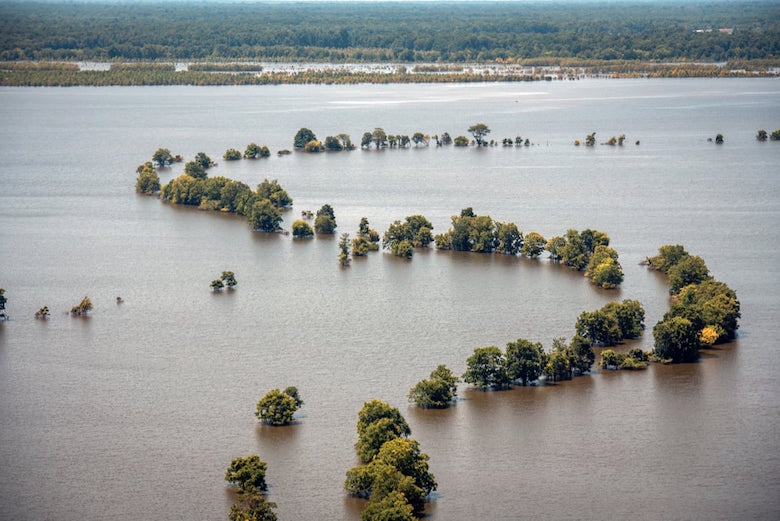
Long term flooding

When one thinks of floods, one thinks of a disaster that lasts for a short time. Heavy rains or hurricanes or snowmelt causes a rise in the levels of rivers that overwhelm their banks and levees or the sewer and other drainage systems. But although the damage caused can be great and long lasting, the water usually subsides fairly quickly.

But this year, there have been parts of the US where people have not seen the ground for six months because the floods have stuck around.

Compounding the problem was a high Mississippi River, which remained near or above flood stage for the longest span since 1927. The perfect storm of historic rainfall and a high river resulted in a backwater flood that has lingered beyond anything the region has ever seen.

Only within with the past couple weeks has the water receded, and for the first time in nearly half a year, farmers are finally beginning to see their land re-emerge.

Imagine seeing something like this for six months.

Farmland in the lower Mississippi delta remains submerged in floodwater. Photograph by Rory Doyle/The Guardian

It is surprising that this phenomenon is not getting wider coverage. I had heard about widespread flooding but assumed that it was in different regions at different times. I had not been aware that some places seem to be under permanent floods.

How English became the language of science

These days, pretty much everyone who works in science research is proficient in English. This is, of course, unfair to those scientists who grew up in places where it is not their native language because they are forced to learn a second language in order to read the literature and spread their own ideas. Fortunately, it is a little easier to read and write technical material because one does not have to deal with the pitfalls of metaphors and idioms and colloquialisms, as one might have in other areas. In science, one usually eschews flowery language in favor of directness and the crucial technical terms are usually unambiguous in meaning. In my own career, I have met many scientists from all over the world with whom it was difficult to have general conversations but with whom one could communicate on science quite easily.
[Read more…]

How much sleep do we need?

I like to sleep and can usually fall asleep pretty easily, unless there is something major that is bothering me. When I was still working, I had to get up early in the morning but now that I am retired, I luxuriate in waking up around that same time, but then rolling over for a couple more hours. The duration and quality of one’s sleep seems to be related to other health issues and so researchers have been looking at what we can learn about the role of sleep.
[Read more…]

Should this result about poker be a surprise?

I am a terrible poker player, losing every time even when the other players are also novices. (Bridge is my favorite card game.) I long felt that the reason I lose at poker is because I lack a ‘poker face’ (one that reveals nothing to the other players) and am also bad at reading other players’ faces, mannerisms, and body language that reveal something about the strength of their hands. In the language of the game, I think I have many ‘tells’ that other players pick up on while I fail miserably in detecting any tells that they may have. I was under the impression that these factors play an even more important role than knowledge of the odds, such as the likelihood of drawing an inside straight or filling a full house.
[Read more…]

Learning from Nigeria on battling the anti-vaxxers

Nigeria, Pakistan, and Afghanistan were three countries where anti-vaccination campaigns led by Muslin clerics and fanatics seriously set back the very real chance to globally eradicate polio. But Shobana Shankar writes that a vigorous campaign waged by Nigeria to combat the anti-vaxxwers provides useful lessons to the US as it finds itself having to deal with its own anti-vaxxers.

To consider that Nigeria, infamous for anti-vaxx campaigns leading to polio outbreaks, has any lessons for Americans may be shocking.

But as measles cases in the U.S. climb to an all-time high after the disease was declared eliminated in 2000, U.S. public health officials have been looking for ways to address the problem.

As a researcher on religious politics and health, I believe that Nigeria’s highly mobilized efforts to eliminate polio can teach America how to reverse the increase in measles cases and shore up its public health infrastructure. Working with international partners, Nigerians have combated misinformation, suspicion of vaccine science and religion-based boycotts to go from ground zero for polio on the African continent in 2003 to nearly polio-free in 2019.

Nigerians understood that simply ostracizing religious communities would not work. Anti-vaxx politics tapped into mistrust of government and “others” that ran deep in a diverse but divided society, where religious, regional and ethnic loyalties took priority over national unity.

The polio infrastructure in Nigeria immerses experts and local communities in an ongoing relationship. It is an elaborate multilayered surveillance system, with many strategies and functions, from mundane visits to weekly record reviews at health centers in polio-affected areas.

Nigeria spent over US$8 million on surveillance alone and expanded polio capabilities to fight other diseases like measles and rubella. While the system puts a heavy workload on health officials, it points the way for how the American public health system can reshape existing structures for the current era. America led international health partnerships for decades, but the time has come to follow other countries’ lead.

The big problem is persuading Americans that we can learn from other countries. After all, aren’t we the greatest?

A comment thread that is well worth reading

I am not sure how many people read the comments to my posts. If you don’t, you are missing a treat because those are often better than my original posts.

For example, I recently had a post about whether plants are conscious. It was a pretty superficial post looking at recent claims and counterclaims. But the comments from this blog’s readers went really deeply into the nature of consciousness and how we might identify its existence. It contains a lot of useful information and insights and that comment thread is definitely worth a read.

Don’t believe your lying eyes

In an earlier post I showed what I thought was an impressive video only to be informed by commenters that it was a CGI fake. So once again I had been fooled by a fake video into thinking it was the real thing. The techniques have become so sophisticated that people can now create ‘deep fakes’, where images of one person are superimposed onto videos of someone else. These are done so seamlessly that it is almost impossible for ordinary people casually watching a video to detect that the person they are seeing did not actually say or do the things that we see with our own eyes.

Apparently the software to do this does not require all that much sophistication to use and thus the potential for malicious actors to exploit it is huge. The video below explains what is going on and how some people are trying to find ways to more quickly identify deep fakes, initially focusing on all the candidates for the next presidential election whom mischief makers are most likely to target. (I think this video is real but what do I know?)
[Read more…]

The science of stone skipping

Which one of us, finding ourselves near a large body of calm water, has been able to resist the temptaion to indulge in the delightful activity of trying to skip stones across the surface? The number of skips that I am able to get before it sinks is three, maybe four. So it is a pleasure to see world champion Keisuke Hashimoto in acction. His wind up alone is thing of beauty. (Via Rusty Blazenhoff)

(To see the above, follow the link that the ‘video unavailable’ window provides.)

But he is still mortal and doesn’t always succeed.
[Read more…]