My president?

In case you don’t like the sword-yanking and beer-catching, there is an alternative: god-anointing. There’s a new movie out titled The Trump Prophecy, in which the author claims that God spoke to him through his TV, announcing that Trump would be the next president.

The belief that Trump’s election was God’s divine will is shared by others. Franklin Graham, the prominent conservative evangelical, said last year that Trump’s victory was the result of divine intervention. “I could sense going across the country that God was going to do something this year. And I believe that at this election, God showed up,” he told the Washington Post.

Taylor has made other claims, which he calls “prophetic words”, including that Trump will serve two terms, the landmark supreme court ruling on abortion in the Roe v Wade case will be overturned, and that next month’s midterm elections will result in a “red tsunami”, strengthening Republican control of both houses of Congress.

Barack Obama will be charged with treason and Trump will authorise the arrest of “thousands of corrupt officials, many of whom are part of a massive satanic paedophile ring”. Trump will also force the release of cures for cancer and Alzheimer’s that are currently being withheld by the pharmaceutical industry.

Don’t laugh at the idea of finding swords or snagging a thrown beer as strategies. There are much, much worse alternatives, and they’re literally being practiced. And are popular.

My king

I think this is an acceptable way to establish kingship.

Kennedy Bakircioglu, a midfielder for a Swedish football team Hammarby IF, scored a stunning 30-yard goal against Gothenburg earlier this week—but it’s not the goal that will go down in history. After scoring the uncatchable free-kick goal, the 37-year-old veteran started a frenzied race with his teammates towards the corner flag. In the middle of all the excitement, and amidst flying toilet paper raining down on them, a fan standing in the bleachers decided to throw him a beer because, well, he deserved one, didn’t he? Bakircioglu, totally unfazed by the foreign object hurtling towards him out of the stands, catches what appears to be a plastic pint of beer (that somehow didn’t all spill en route) mid-air, goes all helan går and downs it like a champ.

We’re all going to have to learn how to pronounce “Bakircioglu” now.

If you don’t like the idea of making him king, he’s at least earned a seat on the Supreme Court.

You want more speech? You got it.

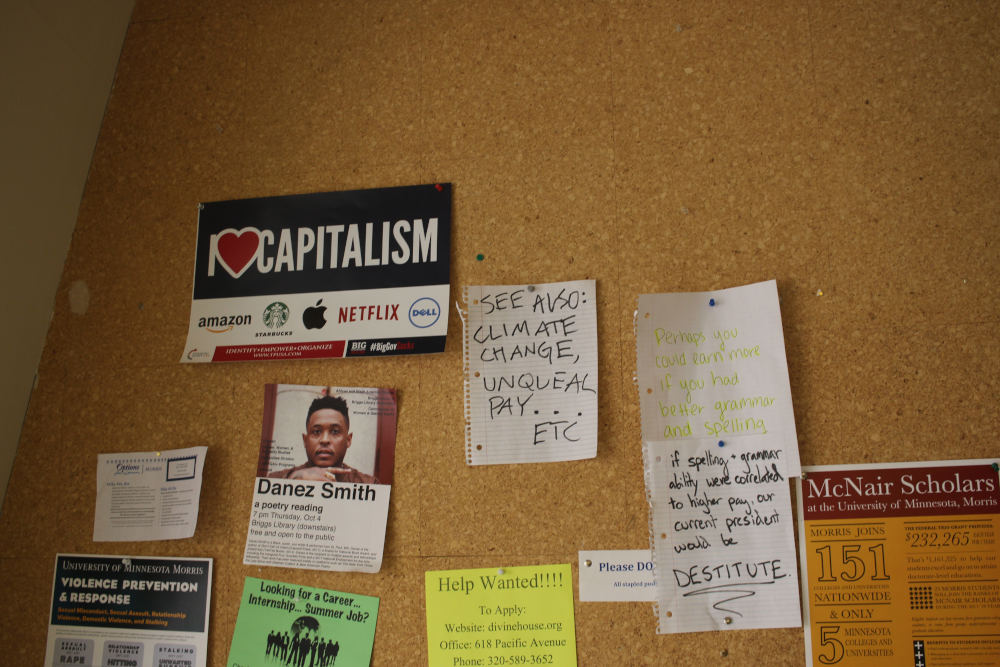
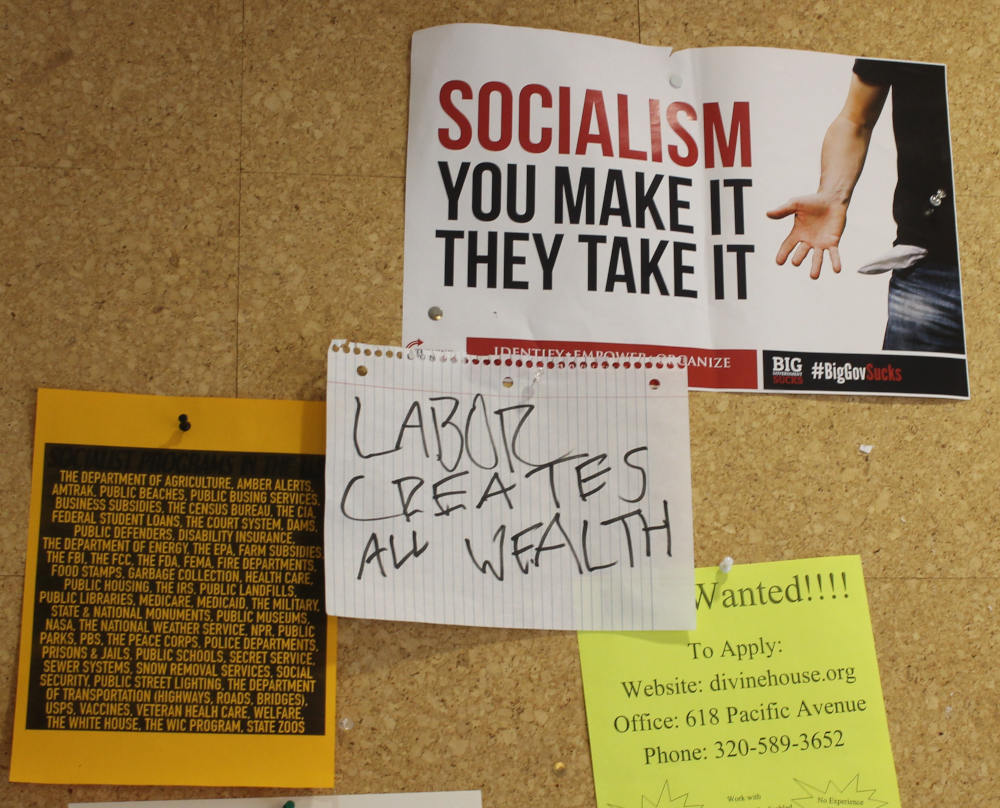
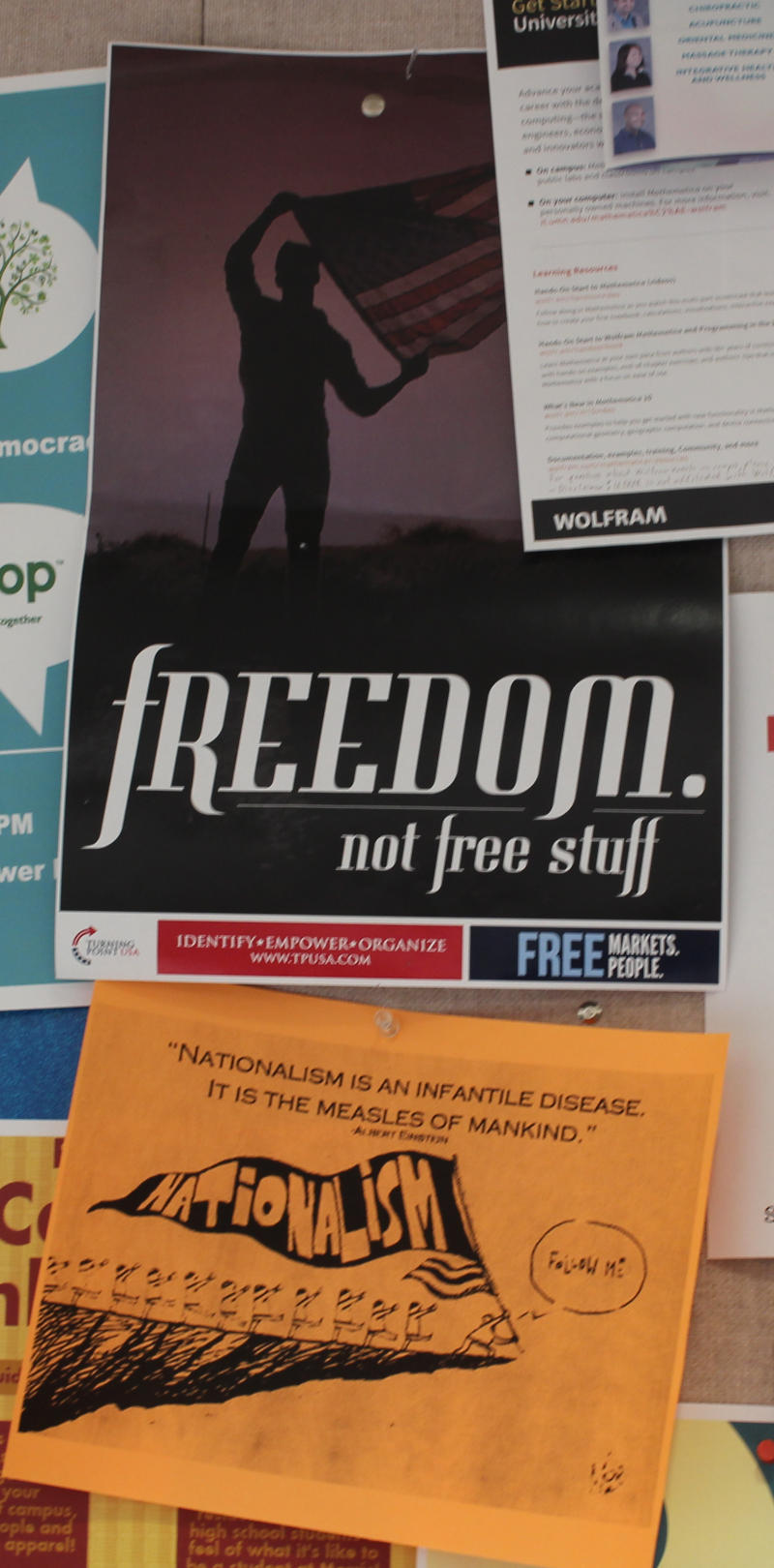
I kind of despise Turning Point USA. A few students splatter their stupid, shallow red, white, and blue slogan signs all over campus, and what can you do? They just sit there all trite and jingoistic, but students get to use that space as they see fit.

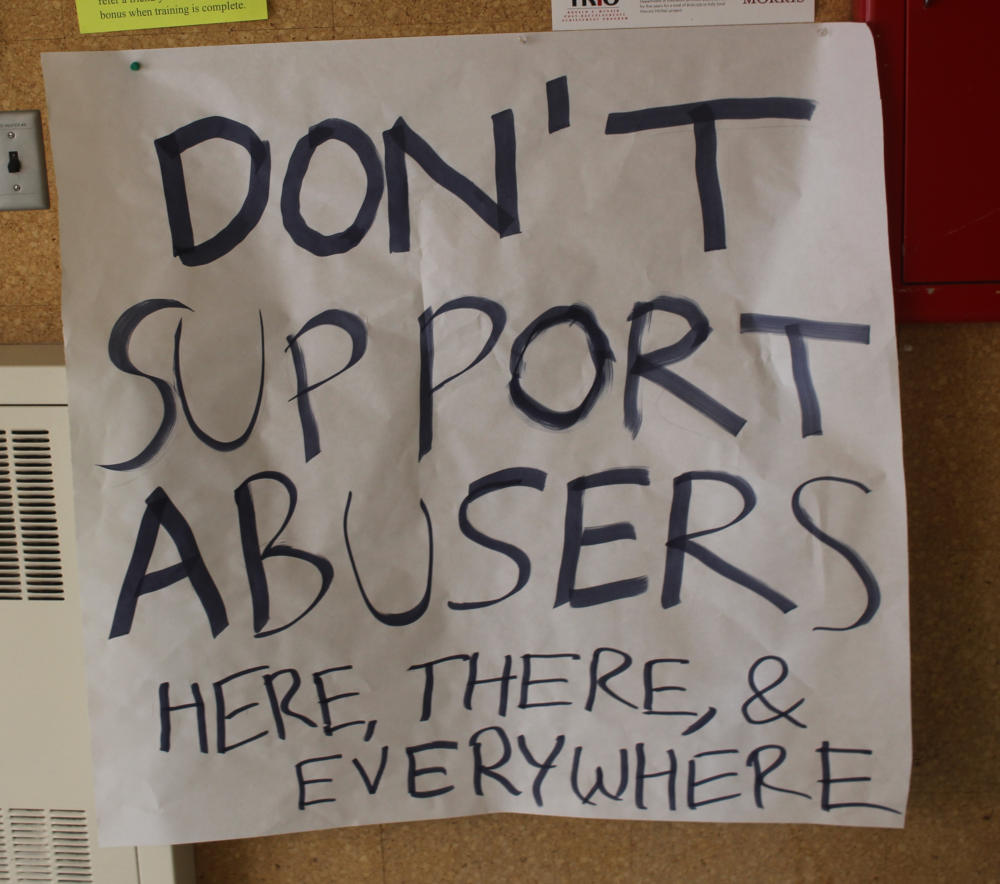
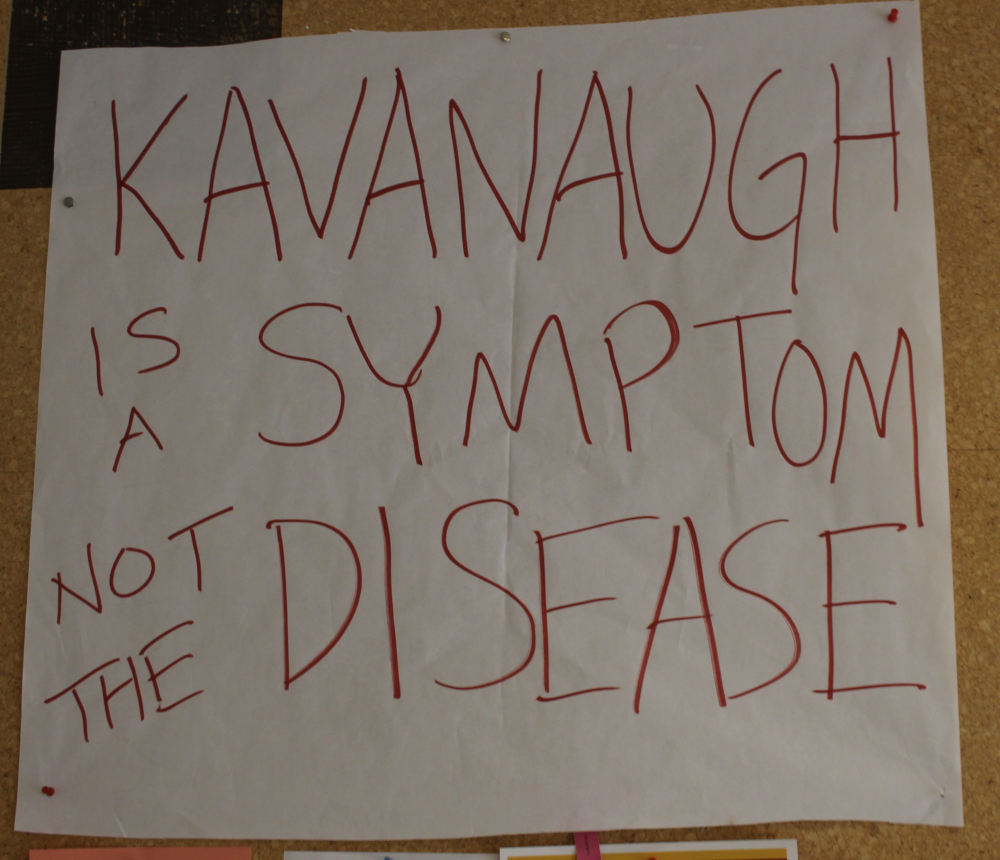
It turns out, though, there is something our smarter students can do: they can splatter back with signs refuting Charlie Kirk’s idiotic propaganda, and this year they’ve been doing that. Everywhere there’s a TPUSA sign in the science building, there’s another sign or two right next to it.

Once again, our students earn my affection.

Locker room talk

The latest from Jane Mayer and Ronan Farrow brought back ugly memories. Kavanaugh made some coded references to a girl in his yearbook, and now claims they were innocent.

Kavanaugh and thirteen other Georgetown Prep boys described themselves in their high-school yearbook as “Renate Alumnius,” which other classmates have told the Times was a crude sexual boast. During his Senate hearing, Kavanaugh said that the reference was an endearment, saying, “she was a great friend of ours. We—a bunch of us went to dances with her. She hung out with us as a group.” He said that a “media circus that has been generated by this, though, and reported that it referred to sex. It did not.”

I don’t believe him. The other crap in his yearbook were sniggering references to drinking to excess and sex, and in the midst of all that, he’s making an affectionate, sentimental reference to a good friend? He’s lying.

This, on the other hand, is more believable.

but the classmate who submitted the statement said that he heard Kavanaugh “talk about Renate many times,” and that “the impression I formed at the time from listening to these conversations where Brett Kavanaugh was present was that Renate was the girl that everyone passed around for sex.” The classmate said that “Brett Kavanaugh had made up a rhyme using the REE NATE pronunciation of Renate’s name” and sang it in the hallways on the way to class. He recalled the rhyme going, “REE NATE, REE NATE, if you want a date, can’t get one until late, and you wanna get laid, you can make it with REE NATE.” He said that, while he might not be remembering the rhyme word-for-word, “the substance is 100 percent accurate.” He added, “I thought that this was sickening at the time I heard it, and it left an indelible mark in my memory.”

And then I remembered my unpleasant years of having to go through a boys’ locker room in high school. I didn’t like it — I’d take my quick shower, get dressed, and get out as fast as possible — but there were the jocks who reveled in it, strutting around naked, snapping towels at each other (or the nerds, more incentive for me to get out), and bragging about their hot dates. Worst of all was that Coach Earl would also come out and egg them on, asking about specific girls, and what they would do together, and the jocks would eagerly tell stories.

I remember in particular that there were a couple of names always getting thrown around with salacious details — names I knew of people who were quite nice and good in school and friendly and decent to others, but they had committed the crime of being attractive and dating a football player, who would then turn them into objects of lust in the locker room, and spread intimate details, whether true or not, that I’m sure they wouldn’t have wanted told to a gang of giggling apes. I doubt they did any of the things that were talked about — it was more that if you didn’t brag about your conquests, Coach would make sneering remarks about the size of your testicles, and you wouldn’t get high fives from your team mates.

Jeez, but I hated that place. It contributed greatly to my low opinion of douchebros.

But I didn’t tell anyone about their behavior, and in particular I didn’t tell any of the named girls what their so-called friends were saying about them behind their backs, because I knew how they’d respond. They’d feel like Renate.

Reached for comment, Dolphin noted that she had asked for her name to be removed from a statement signed by female supporters of Kavanaugh’s nomination. “If this report is true, I am profoundly hurt,” she said, of the account in the affidavit. “I did nothing to deserve this. There is nothing affectionate or respectful in bragging about making sexual conquests that never happened. I am not a political person, but my reputation matters to me and to my family. I would not have signed the letter if I had known about the yearbook references and this affidavit. It is heartbreaking if these guys who acted like my friends in high school were saying these nasty, false things about me behind my back.”

If I’d given any advice to my daughter on this matter, it would have been to never date a jock. But I didn’t, because I trusted her to make wise choices…but still, I always worried that someone was going to break her heart, because of those boys.

We’re living in a cyberpunk world

I thought this story was remarkable. The Chinese military has been placing teeny-tiny chips in the microchips China makes for the whole world that provide a backdoor into all kinds of confidential information on servers. Big companies like Apple and Amazon figured this out, and rather than making it public, have been quietly blacklisting major suppliers. But weirdly, everyone is denying it.

But that’s just what U.S. investigators found: The chips had been inserted during the manufacturing process, two officials say, by operatives from a unit of the People’s Liberation Army. In Supermicro, China’s spies appear to have found a perfect conduit for what U.S. officials now describe as the most significant supply chain attack known to have been carried out against American companies.

One official says investigators found that it eventually affected almost 30 companies, including a major bank, government contractors, and the world’s most valuable company, Apple Inc. Apple was an important Supermicro customer and had planned to order more than 30,000 of its servers in two years for a new global network of data centers. Three senior insiders at Apple say that in the summer of 2015, it, too, found malicious chips on Supermicro motherboards. Apple severed ties with Supermicro the following year, for what it described as unrelated reasons.

In emailed statements, Amazon (which announced its acquisition of Elemental in September 2015), Apple, and Supermicro disputed summaries of Bloomberg Businessweek’s reporting. “It’s untrue that AWS knew about a supply chain compromise, an issue with malicious chips, or hardware modifications when acquiring Elemental,” Amazon wrote. “On this we can be very clear: Apple has never found malicious chips, ‘hardware manipulations’ or vulnerabilities purposely planted in any server,” Apple wrote. “We remain unaware of any such investigation,” wrote a spokesman for Supermicro, Perry Hayes. The Chinese government didn’t directly address questions about manipulation of Supermicro servers, issuing a statement that read, in part, “Supply chain safety in cyberspace is an issue of common concern, and China is also a victim.” The FBI and the Office of the Director of National Intelligence, representing the CIA and NSA, declined to comment.

But other sources say otherwise.

The companies’ denials are countered by six current and former senior national security officials, who—in conversations that began during the Obama administration and continued under the Trump administration—detailed the discovery of the chips and the government’s investigation. One of those officials and two people inside AWS provided extensive information on how the attack played out at Elemental and Amazon; the official and one of the insiders also described Amazon’s cooperation with the government investigation. In addition to the three Apple insiders, four of the six U.S. officials confirmed that Apple was a victim. In all, 17 people confirmed the manipulation of Supermicro’s hardware and other elements of the attacks. The sources were granted anonymity because of the sensitive, and in some cases classified, nature of the information.

The devices targeted were circuit boards in servers that do ubiquitous stuff, like compressing video so you can Netflix & chill, or doing language processing so Siri can figure out what you’re saying around a mouthful of Doritos. It’s all around us, and we take it for granted.

One country in particular has an advantage executing this kind of attack: China, which by some estimates makes 75 percent of the world’s mobile phones and 90 percent of its PCs.

See? This is what you get when you want all the slick new gadgets but you’re only willing to pay starvation wages to Chinese peons to get it done — all the fundamental work flees expensive America to cheap Asia. If we’d actually supported a semi-conductor industry in this country, just think…it could have been American spies bugging everyone’s computer.

There are reasons I don’t allow students to cite Wikipedia articles

This is one of them.

Strickland is an associate professor of physics and astronomy at the University of Waterloo and former president of the Optical Society, but when a Wikipedia user attempted to create a profile for her in March, the page was denied by a moderator.

“This submission’s references do not show that the subject qualifies for a Wikipedia article,” said the moderator.

Donna Strickland won the Nobel in Physics this year, the first woman to win in that category since 1963. Physics really does have a bias problem. I guess they’re in competition with Wikipedia!

The episode also cast light on Wikipedia’s own gender bias: just 16% of the site’s volunteer editors are female and only 17% of entries dedicated to notable people are for women.

Give it a rest, Boghossian and pals

You’d think they’d learn. When Boghossian and Lindsay published their phony “conceptual penis” paper, they were roundly mocked and ridiculed for concluding that academia was corrupt because they got a badly written paper published in an obscure journal, proving nothing. It’s the skeptical equivalent of p-hacking — yes, if you carry out a badly designed experiment, you will sometimes get a positive hit, but you can’t conclude anything from it. No one is surprised that, in the volume of papers submitted to the peer-reviewed literature, clunkers get through. We know the system is not perfect.

But now we learn that, after their initial ‘success’ with the “conceptual penis” article, they sat down and repeated the same thing, over and over again. They intentionally flooded journals with “fake news”, and when some of it leaked through, cried triumph.

Beginning in August 2017, the trio wrote 20 hoax papers, submitting them to peer-reviewed journals under a variety of pseudonyms, as well as the name of their friend Richard Baldwin, a professor emeritus at Florida’s Gulf Coast State College. Mr. Baldwin confirms he gave them permission use his name. Journals accepted seven hoax papers. Four have been published.

What I have learned from this is that the familiar trio of frauds — Peter Boghossian, James Lindsay, and Helen Pluckrose — have a real talent for writing garbage papers, which I’d actually kind of already known from their activities on social media. Now they’ve gone beyond their original efforts of making nonsensical interpretations to making up data, as in a paper about observations made at a Portland dog park, which made a number of people suspicious, and which led to an unraveling of their game.

All of this prompted me to ask my own questions. My email to “Helen Wilson” was answered by James Lindsay, a math doctorate and one of the real co-authors of the dog-park study. Gender, Place & Culture had been duped, he admitted. So had half a dozen other prominent journals that accepted fake papers by Mr. Lindsay and his collaborators—Peter Boghossian, an assistant professor of philosophy at Portland State University, and Helen Pluckrose, a London-based scholar of English literature and history and editor of AreoMagazine.com.

The three academics call themselves “left-leaning liberals.” Yet they’re dismayed by what they describe as a “grievance studies” takeover of academia, especially its encroachment into the sciences. “I think that certain aspects of knowledge production in the United States have been corrupted,” Mr. Boghossian says. Anyone who questions research on identity, privilege and oppression risks accusations of bigotry.

You know, if you’re a left-leaning liberal, there are plenty of gigantic targets you could be taking aim at: all you need to do is look at all three branches of the federal government, or police activities nation-wide, or the military-industrial complex, or the undermining of regulations by big corporations, or wealth inequality. We have no shortage of big, serious problems. But for some reason, these left-leaning liberals have decided that academia is too left-leaning, and must be exposed. And what have they exposed? A set of problems that Francis Bacon railed against in the 17th century.

Bacon was well aware that science had a weakness, that it was done by flawed humans who had their own biases (he was rather deeply flawed himself), and strove to make people self-aware of their own weaknesses and make efforts to use a rigorous methodology to circumvent those problems. Even the big name journals in technical fields occasionally publish terrible work because it meets pro forma conventions and is backed by lots of money (<cough, cough&> the ENCODE project), but you don’t see PluckBogSay going after those — instead, they have an agenda of conspiring against feminist and social science journals, which says something about their intent.

It might have been interesting if they’d chosen journals in their own fields, and written articles that satirized weaknesses in their own discipline…oh. Hey. I just realized — maybe Boghossian’s entire career has been a performance art piece criticizing how lackluster frauds can get academic jobs in philosophy. He may yet pull a valid criticism out of his hat.

But punching down at marginal journals because they have a soft spot for tendentious prattle ain’t it. It’s also exploiting a feature of academia that I rather like — trust. Even Alan Sokal has problems with what they’re doing.

This isn’t the first time scholars have used a hoax paper to make a point. In 1996 Duke University Press’s journal Social Text published a hoax submission by Alan Sokal, a mathematical physicist at New York University. Mr. Sokal, who faced no punishment for the hoax, told me he was “not oblivious to the ethical issues involved in my rather unorthodox experiment,” adding that “professional communities operate largely on trust; deception undercuts that trust.”

I could agree that many disciplines can be too trusting, and that more self-discipline is warranted. We do, however, have an ethical mechanism for addressing that problem: it’s called writing rebuttals and critical arguments that directly address bad work. It’s what I do with creationism, for instance. I’ll write a confrontational article pointing out why their claims are bogus, using knowledge of my own field to explain why they are wrong. I don’t sit down and write 20 garbage creationist articles (even though that would be trivially easy to do) and contribute to their body of work, which they’ll then use to justify creationism.

If you can find a bad article accepted for publication in a feminist journal, please do jump on it and tear it apart. That contributes to the strength of the discipline. Don’t write a bunch of bad articles of your own, which are clearly intended only to weaken the whole discipline and provide a set of easy, straw-man arguments that you can use to pretend you’re a smart guy.

They seem to know deep down that what they’re doing is wrong and unethical, and they have a rather fatalistic view of their future prospects.

Mr. Boghossian doesn’t have tenure and expects the university will fire or otherwise punish him. Ms. Pluckrose predicts she’ll have a hard time getting accepted to a doctoral program. Mr. Lindsay said he expects to become “an academic pariah,” barred from professorships or publications.

Interesting that they frame the anticipated consequences in terms of being punished or barred. That’s not the case at all. They’re going to have serious problems with a future in academia because they’re writing trashy papers that don’t further the knowledge in their disciplines at all, and seem to be more interested in policing people they don’t like than in advancing philosophy, mathematics, or literature. Maybe if there were a department of anti-feminist studies somewhere, they could fit in. Or maybe their real specialty is “grievance studies,” the very thing they are complaining about.

Otherwise, setting themselves up as martyrs is all the qualification they need to get a position in some right-wing think-tank, which is clearly the appropriate destiny for these “left-leaning liberals.”

Spider party!

Just another mundane spider update. This batch of babies are now 18 days post-fertilization, and they’re just rockin’ out in their dish.

I also got some good news: I was awarded a small in-house grant to pick up a bunch of supplies for embryo imaging, so that’s in the works. I ordered a few necessities today.

And now everywhere I go on the internet, ads for halocarbon oil pop up everywhere. Or does everyone get those?

[Read more…]