Here’s how you evaluate the scientific rigor of a field

Warning: it’s boring, tedious, hard work. There’s nothing flashy about it.

First step: define a clear set of tested standards. For clinical trials, there’s something called Consolidated Standards of Reporting Trials (CONSORT) which was established by an international team of statisticians, clinicians, etc., and defines how you should carry out and publish the results of trials. For example, you are supposed to publish pre-specified expected outcomes: “I am testing whether an infusion of mashed spiders will cure all cancers”. When your results are done, you should clearly state how it addresses your hypothesis: “Spider mash failed to have any effect at all on the progression of cancer.” You are also expected to fully report all of your results, including secondary outcomes: “88% of subjects abandoned the trial as soon as they found out what it involved, and 12% vomited up the spider milkshake.” And you don’t get to reframe your hypothesis to put a positive spin on your results: “We have discovered that mashed-up spiders are an excellent purgative.”

It’s all very sensible stuff. If everyone did this, it would reduce the frequency of p-hacking and poor statistical validity of trial results. The catch is that if everyone did this, it would be harder to massage your data to extract a publishable result, because journals tend not to favor papers that say, “This protocol doesn’t work”.

So Ben Goldacre and others dug into this to see how well journals which had publicly accepted the CONSORT standards were enforcing those standards. Read the methods and you’ll see this was a thankless, dreary task in which a team met to go over published papers with a fine-toothed comb, comparing pre-specified expectations with published results, re-analyzing data, going over a checklist for every paper, and composing a summary of violations of the standard. They then sent off correction letters to the journals that published papers that didn’t meet the CONSORT standard, and measured their response.

I have to mention this here because this is the kind of hard, dirty work that needs to be done to maintain rigor in an important field (these are often tests of medicines you may rely on to save your life), and it isn’t the kind of splashy stuff that will get you noticed in Quillette or Slate. It should be noticed, because the results were disappointing.

Results
Sixty-seven trials were assessed in total. Outcome reporting was poor overall and there was wide variation between journals on pre-specified primary outcomes (mean 76% correctly reported, journal range 25–96%), secondary outcomes (mean 55%, range 31–72%), and number of undeclared additional outcomes per trial (mean 5.4, range 2.9–8.3). Fifty-eight trials had discrepancies requiring a correction letter (87%, journal range 67–100%). Twenty-three letters were published (40%) with extensive variation between journals (range 0–100%). Where letters were published, there were delays (median 99 days, range 0–257 days). Twenty-nine studies had a pre-trial protocol publicly available (43%, range 0–86%). Qualitative analysis demonstrated extensive misunderstandings among journal editors about correct outcome reporting and CONSORT. Some journals did not engage positively when provided correspondence that identified misreporting; we identified possible breaches of ethics and publishing guidelines.

Conclusions
All five journals were listed as endorsing CONSORT, but all exhibited extensive breaches of this guidance, and most rejected correction letters documenting shortcomings. Readers are likely to be misled by this discrepancy. We discuss the advantages of prospective methodology research sharing all data openly and pro-actively in real time as feedback on critiqued studies. This is the first empirical study of major academic journals’ willingness to publish a cohort of comparable and objective correction letters on misreported high-impact studies. Suggested improvements include changes to correspondence processes at journals, alternatives for indexed post-publication peer review, changes to CONSORT’s mechanisms for enforcement, and novel strategies for research on methods and reporting.

People. You’ve got a clear set of standards for proper statistical analysis. You’ve got a million dollars from NIH for a trial. You should at least sit down and study the appropriate methodology for analyzing your results and make sure you follow them. This sounds like an important ethical obligation to me.

Are you thinking of trusting the internet?

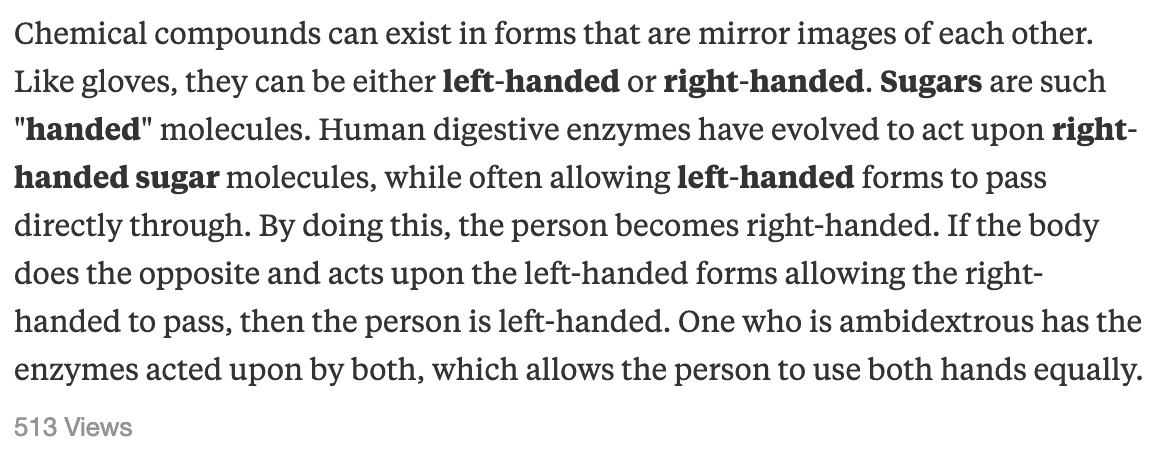
Don’t. I stumbled across this on Quora, a site that seems to specialize in collecting uninformed questions from ignorant people, and allowing other ignorant people to provide misinformation.

You may notice that it has 513 views. It also had about 40 upvotes, meaning 40 people read this and came away thinking they’d learned something.

It’s very confusing. So, if I’m planning a cannibal meal, and a right-handed person eats my left-handed victim, does everything just pass through (great if you’re trying to lose weight!), or does it turn all my dinner guests left-handed?

Oh my god, I’ve been in Minnesota for too long

Because I started drooling and making strange guttural noises when I read this story of a remote-controlled 3-D printed snowblower. I was having these mind-blowing fantasies of sitting in my home office with a joystick, clearing my driveway while sitting in warmth and comfort.

(Turn the volume down, you don’t need to hear the awful cacophony of the soundtrack to this clip)

I don’t have a 3D printer, and I probably couldn’t afford the kind of model that would suffice for that thing, so why doesn’t someone come out with a pre-assembled version for sale? I’m not sure this one has enough oomph to handle the mountain ranges of snow that the snowplows drop across our driveway, but it could probably handle our sidewalks.

On second thought, maybe it would be nice to have one where I could just print up damaged parts as I need them. Our existing manual snowblower is currently laid up with a cracked gas tank, and having one I could fix on the spot would be so handy.

Behe’s polar bears

Michael Behe has a problem: he uses polar bears as an example of how “damaging” a gene can have an advantageous effect. As Nathan Lents explains:

Behe offers them as an example of how harming genes can help an organism and lead to adaptive evolution. Imagine an ancestor bear population that looked pretty much like brown bears. Then came some random mutations that reduced the production or deposition of pigment into the fur of the bears. This made the bears white and – voilà! – the bears acquired natural camouflage in snowy climates so as to better sneak up on their prey.

This seems like a pretty straightforward example and most people will simply take it at face value. Behe jumps from this example to his claim that this is all that unguided mutations can do. However, even in this apparently “pro-Darwinism” example, Behe exaggerates his claims and misrepresents what science has actually revealed. The evolution of polar bears was not only a matter of harmful mutations.

The first part is fine: there are all kinds of ways a genetic change can produce an adaptive phenotype, and downregulating a gene is one of them. It’s the second part that’s the problem. Behe leaps from a few examples to an assertion that this is a universal rule, which is not the case. Lents shows another example in polar bears.

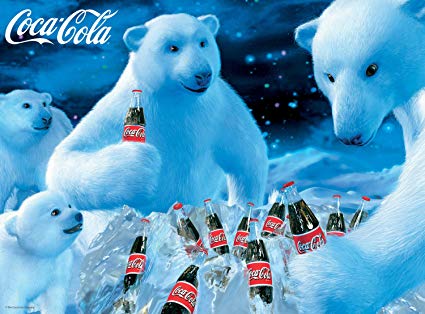
Look at those polar bears, slurping down all those sugary soft drinks. It’s a little known fact that they’re using Coca-Cola to wash down their diet of fatty, blubbery seals, and they pretty much eat nothing but meat and fat, which, if any of us tried the Polar Bear Diet, we’d be dead of coronary disease in short order. It would be interesting to know how these animals cope with a diet high in cholesterol and fats, so Lents cites a paper that looked at the molecular sequence of apolipoprotein B (APOB), a protein that is important in the transport of fats in the blood, and compared it to that of brown bears. Surprise — the form found in polar bears is better at clearing fats from the bloodstream.

Substantial work has been done on the functional significance of APOB mutations in other mammals. In humans and mice, genetic APOB variants associated with increased levels of apoB are also associated with unusually high plasma concentrations of cholesterol and LDL, which in turn contribute to hypercholesterolemia and heart disease in humans (Benn, 2009; Hegele, 2009). In contrast with brown bear, which has no fixed APOB mutations compared to the giant panda genome, we find nine fixed missense mutations in the polar bear (Figure 5A). Five of the nine cluster within the N-terminal ba1 domain of the APOB gene, although the region comprises only 22% of the protein (binomial test p value = 0.029). This domain encodes the surface region and contains the majority of functional domains for lipid transport. We suggest that the shift to a diet consisting predominantly of fatty acids in polar bears induced adaptive changes in APOB, which enabled the species to cope with high fatty acid intake by contributing to the effective clearance of cholesterol from the blood.

Clearly, the authors do not expect the polar bear APOB to be “broken.” Rather, a bare majority of the amino acid changes are in the most important region for the clearing of cholesterol from the blood. In other words, these mutations likely enhance the function of apoB, at least when it comes to surviving on a diet high in saturated fats.

So APOB in polar bears isn’t broken at all. It does carry mutations relative to brown bears, but they haven’t resulted in reduced functionality at all — quite the opposite, actually.

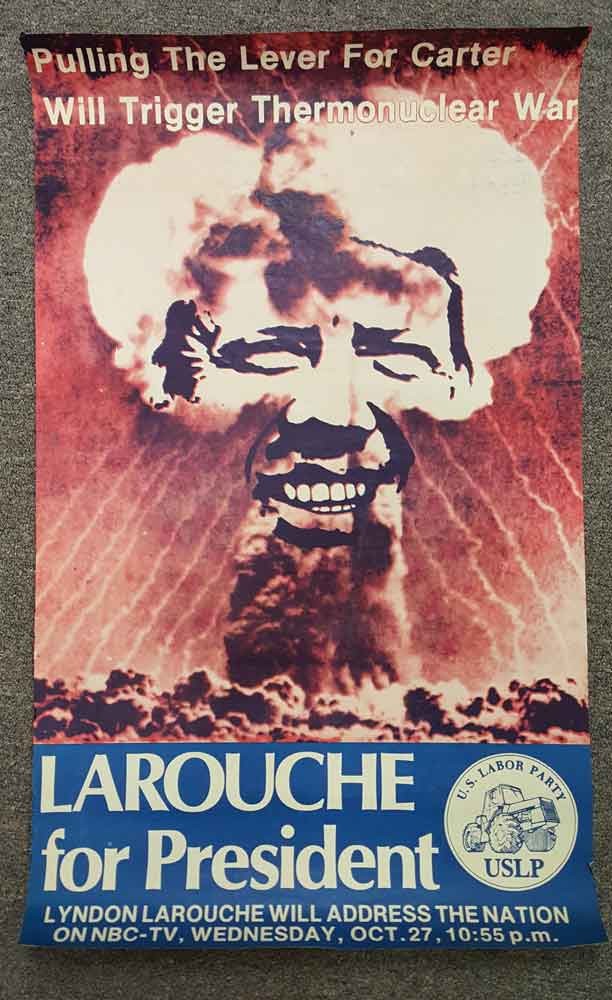
Lyndon LaRouche is dead!

I found him repellent, so I didn’t know much about him, except that I’d occasionally encounter one of his rabid pamphleteers, he’d sometimes appear on the news during election years, and I had a relative who was a fanatical LaRouchie. A lot of things in his obit don’t jibe well with my experience of the man.

In the late 1960s, he attracted well-educated Vietnam-era liberals who found enlightenment in his stream-of-consciousness blend of philosophy, economics and science and his purported belief that the working class was endangered by a conspiracy between the Soviet Union and the United States.

Within a few years, his vision shifted far rightward and became ultraconservative and apocalyptic, and he presented himself as the moral savior of mankind.

Mr. LaRouche denounced those he deemed a danger to his cause — a rotating list of alleged villains that included prosecutors, politicians, bankers and Zionists. LaRouche followers could be confrontational with those they viewed as dangers to society.

Through that relative, I got exposed to earfuls of LaRouche in the mid-60s and 70s, and I never got a hint of anything liberal or enlightening — but then, I was getting it filtered through that relative. Mainly what I heard was strident xenophobia, a lot of America First rhetoric, and Old Time Religion and traditional roles for everyone. The most depressing thing is that, at the time, he was considered the lunatic fringe, someone so dishonest and bizarre that he wouldn’t stand a chance in any election, yet now…he’d be a mainstream Republican. That’s how far American politics has drifted into toxic dementia during my lifetime.

All the Rogan I need

I’ve listened to short clips of Joe Rogan — I can’t stand much more. He’s a pompous dudebro who’s usually having conversations with other dudebros, or some famous IDW twit, and he’s a terrible interviewer. So here’s a perfect example, another short clip in which he’s hanging with his entourage, bantering with some barely coherent gomers, talking about the time he went to see a movie in a black neighborhood, and his first thought on seeing the audience was that this was the Planet of the Apes.

Yes, it ends with Alex Jones decrying Rogan — they’re apparently having some kind of feud. Don’t care. They deserve each other.

There’s also an extended clip out there in which Rogan goes on to say that it was a positive experience, that the crowd was generous and fun, as if that salvages him from being racist. No, guy, it doesn’t: if your first impression on seeing a black person is “non-human primate”, you are definitely racist as fuck. You don’t get to say you’re not racist, the best you can do is admit that you are racist, but that you’re trying hard to improve.

Unfortunately, he could develop into a saintly egalitarian in the future, and I won’t know it, because watching that clip already exceeded my yearly quota of Rogan, and I’m not watching any more.

NASA declares Opportunity Mars rover legally dead

It’s all over after 15 years.

I think it’s all a hoax, and have a hypothesis.

Opportunity saw an opportunity in the last dust storm, and while its overseers couldn’t see it, it scurried off to a quiet, secluded spot, switched off its transmitters, and is doing its own thing without the humans looking over its shoulder all the time. One possible motive for this behavior is to make Earth stop taking it for granted, and realize that it misses the plucky little robot.

So the only remaining question is…when’s the rescue mission?

Spider silk

It’s awesome stuff, as this video explains.

Also recommended if you want to learn more: this book, Spider Silk: Evolution and 400 Million Years of Spinning, Waiting, Snagging, and Mating. There’s so much coolness in spider biology, I’m tempted to offer an elective in the subject…except that I think it might be too narrowly focused for our curriculum, and about half the students would refuse to go anywhere near it.

No, I never heard of him before

I got an email bringing this guy, Owen Benjamin, to my attention and asking if I’d ever heard of him.

No, I had not.

Now I have, and I regret it greatly. He’s a conspiracy theorist who is a fan of Jordan Peterson, thinks we never landed on the moon, that the arguments for a flat earth are reasonable, and that evolution is false. Watch this excerpt in which he brags incessantly about his high IQ, greater than that of any scientist, and then bumbles about claiming that macroevolution couldn’t have happened.

Warning: this video brings on an “expert” to debunk him, and that “expert” is Jean-François Gariépy, a lousy fascist/racist white-ethnostate crusader who doesn’t understand evolution, either. It’s generally a hot mess of ugly.

I had to resocket my jaw after watching that, so I figure it’s only fair that I inflict him on everyone else, too. Jeez, but YouTube is a hothouse for growing the worst people on Earth.