Spider meeting is done

Waaah. I just have the closing banquet tonight, and then tomorrow is a long travel day home. So what did I learn?

  • Spiders are cool, but I guess I already knew that.
  • Spiders are a jillion times more complicated than I thought, and I’ve got a lot to learn.
  • Spider meetings are small and cozy and nice.
  • I’ve made a list of a dozen experiments that I think are doable by undergrads, and will provide interesting information.
  • I need to get home to start putting these ideas to work.

I guess that’s a pretty good outcome for a meeting, to end it inspired and better informed than I was at the beginning.

Next year AAS2020 will be held in Davis, California. I’m hoping I can fit it into my budget.

That makes it official

I was at dinner with a group of arachnologists last night, and I was surprised when I mentioned that I was from Minnesota and was then told that I was one of the only two arachnologists in the state. I was firstly startled at actually being told I was an arachnologist since I’m still trying to get a good grasp of the field, and secondly surprised that they’re so rare (would you believe there are only 500 people in the International Society of Arachnology?). He qualified it by saying that I was one of two people who had officially registered with the American Arachnology Society, from which I learned a few things.

If you want to be an arachnologist on paper, it’s easy — just send in your membership dues.

If you are a real arachnologist in Minnesota, with skills and expertise and deep knowledge, rather than a wanna-be like me, you’re behind. Send in your membership dues. Otherwise, people will keep mistaking me for you.

Otherwise, if you want to become a real arachnologist, here’s an article on the subject. It recommends starting in childhood and your teenage years, which is a little worrisome, since I waited until I was 61 to start. But you can do it! Unfortunately, unlike being an arachnologist on paper, it’s going to take a lot of hard work.

Doctors advising doctors

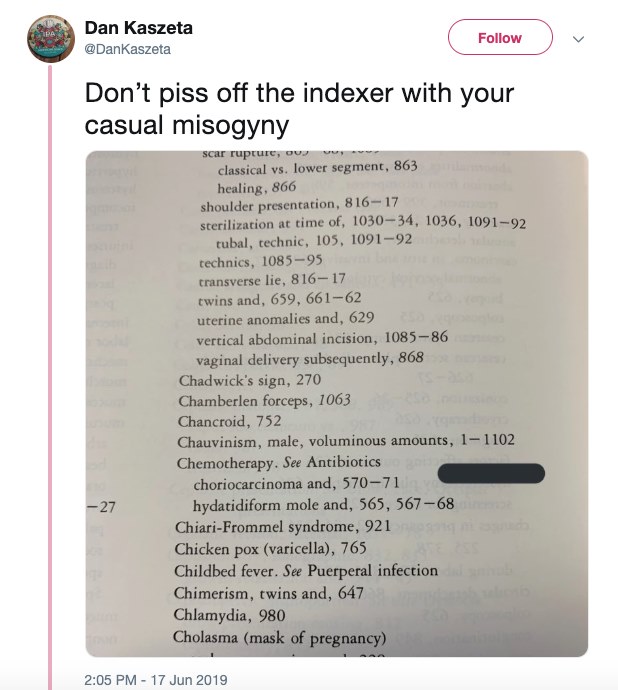
Hey, I guess people have known about that cutting entry in the index to an obstetrics text for a good long while. Here’s an article on the book and general ob-gyn attitudes, in which we learn that the indexer was … the author’s wife! I guess she’d know. But doctors know better now, right?

Recall that preeclampsia was once called toxemia because it was thought to be a build-up of toxins in the maternal blood that had not been secreted through the normal monthly purification of the menstrual cycle. Miscarriages must be caused by the woman doing something she shouldn’t have done, like picking up a bag of groceries. Bottle feeding was superior to breast feeding because men had used science to outsmart the female breast. In fact, for about half of the twentieth century, obstetrics consisted of rendering pregnant women unconscious, cutting a procto-episiotomy, and ripping the child out with forceps. Sounds very efficient and modern. [Yikes. That’s how I was born.]

But surely we don’t think this way today. Have you ever recommended that a woman be on bed rest for any condition in pregnancy? Have you ever mocked a woman with a birth plan? Have you ever told a woman to “take it easy”? Do you believe that a Cesarean delivery is an improvement over vaginal delivery? Do you believe that when women suffer from depression or anxiety it is related to abnormal hormone levels? Much of the worldview of modern obstetric practiced was formed with the belief that women were inept and incapable and that science needed to fix them. Think about that next time you integrate old myths into your practice.

Another day, another overwhelming mess of spiders

This meeting is really an exercise in attitude readjustment. I’ve been steeped in the zebrafish world for so long that I’ve unconsciously held the model organism perspective — here’s my animal, all I have to do is query it deeply with increasingly thorough techniques, and I shall understand biology. Now I’m in a world where every observation is tested against a dozen closely related species, and a dozen distantly related species, and a dozen outgroups that aren’t even in the same order, and everyone is sprawling out horizontally to get a feel for the dimension of a problem rather than digging down vertically into one convenient animal bred specifically to thrive in the artificial environment of the lab. It feels strange and sometimes uncomfortable.

I’m also sometimes totally lost. I was at a session yesterday where arachnologists were just projecting photos from their personal collections, and where I was content to just think “OK, I guess that’s a spider”, other people were shouting out latin names and recognizing old friends. Or worse, “here’s a spider I haven’t been able to identify, and I consulted the world’s foremost expert, and they had never seen it before either”, and it begins to sink in that we’re surrounded by an immensely diverse population that is so wild and weird that we have no idea who they all are, and that I’m going to have to do a lot of work to catch up. It is intellectually terrifying and bizarrely stimulating.

Every once in a while, fortunately, I find something to anchor myself. Yesterday was all about spider silk, which, on the one hand, is molecular biology and can be reduced to genes and physical interactions with the environment (adhesive droplets on webs are a product of self-assembly, contingent on things like humidity and temperature), but on the other hand, of course spiders produce an incredible diversity of different kinds of silk. Sometimes, it all gets to be a bit much.

Looking at the program, this morning is all about biogeography, diversity, evolution, ecology, and life history, while this afternoon is all about behavior. I’m pretty sure my brain will explode at some point today, because I can assure you that there won’t be any single principle that I’ll be able to condense everything down to.

A concentration camp by any other name is still a concentration camp

I find it hard to believe that conservatives are currently trying to argue that the USA does not have concentration camps by redefining the term to mean only camps for Jews. No, just stop it and face up to reality. The US has concentration camps. This country has always had concentration camps. We are the world’s greatest master of concentration camps and ethnic cleansing. I wrote about this in 2015.

“Hitler’s concept of concentration camps as well as the practicality of genocide owed much, so he claimed, to his studies of English and United States history,” Toland wrote in his book, Adolf Hitler: The Definitive Biography. “He admired the camps for Boer prisoners in South Africa and for the Indians in the wild west; and often praised to his inner circle the efficiency of America’s extermination—by starvation and uneven combat—of the red savages who could not be tamed by captivity.”

A concentration camp is “a place where large numbers of people, especially political prisoners or members of persecuted minorities, are deliberately imprisoned in a relatively small area with inadequate facilities, sometimes to provide forced labor or to await mass execution.” It’s a general term. Liz Cheney is the one trying to redefine it by claiming a concentration camp doesn’t count as one unless it’s being used to persecute Jewish people.

“Please @AOC do us all a favor and spend just a few minutes learning some actual history,” Cheney wrote on Twitter on Tuesday morning. “6 million Jews were exterminated in the Holocaust. You demean their memory and disgrace yourself with comments like this.”

Hitler used concentration camps in the Holocaust, no one is claiming he didn’t. But America used them to round up and imprison people of Japanese descent in WWII, and we’re also using them now to isolate people of Latin American descent. We are throwing people who have committed no crime into crowded, inadequate facilities on the basis of their ethnicity, and people are dying.

Learn some history, and remember: Hitler’s concentration camps were inspired by an American model.

You aren’t owed admission to Harvard, Kyle

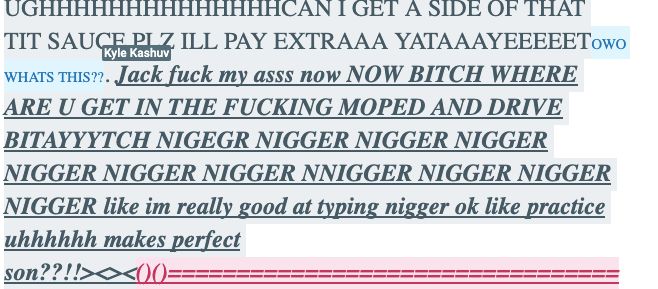
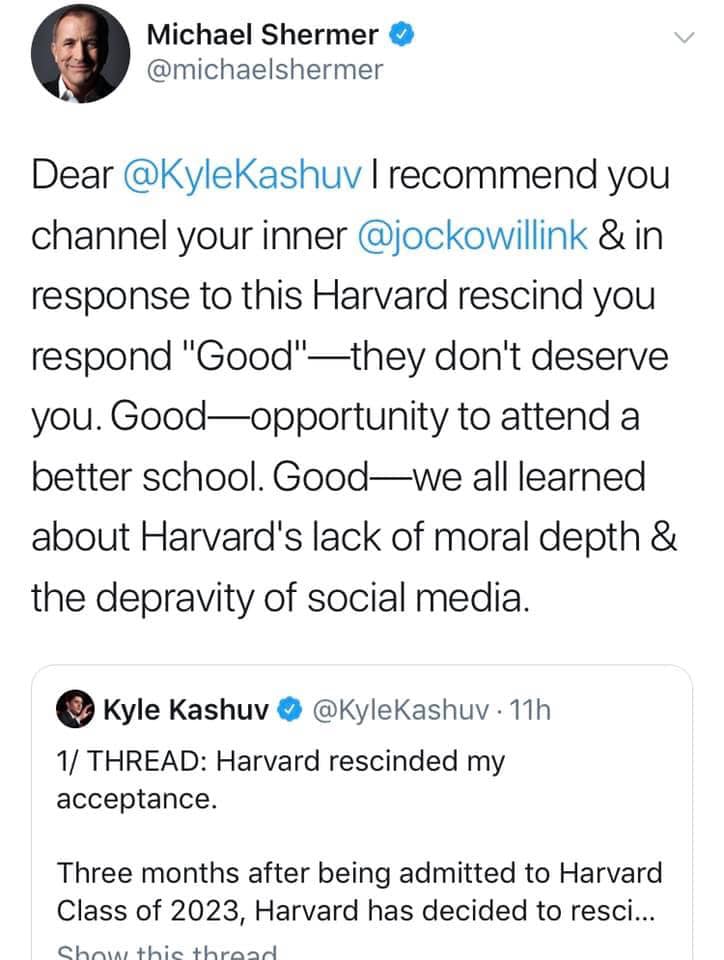
Harvard has rescinded an offer of admission to Kyle Kashuv, Parkland shooting survivor, pro-gun advocate, former member of Turning Point USA, and young rising star of dumbass conservatism, because of stupid things he wrote on a message board. He’s now complaining that he should not be judged on the basis of crap he wrote when he was 16 or 17.

That ridiculous defense has now reached peak absurdity. The whole college admissions process is about evaluating your prospects on the basis of what you did in high school! What’s the acceptable window here? Can I say you can’t criticize me for something I wrote yesterday, because I’m a new me today?

The late teens is a period of rapid changes, and we see lots of increases in maturity in college age students. It’s possible he has acquired wisdom in the last few years, but he has to show it, not just say it, and his affiliation with TPUSA is not a good sign that he has become a better adult. Also, the messages go a long way to reveal the content of his character, and it’s not good.

Wow. There’s some remarkable code-switching going on here, because, setting aside the ugly content, that’s not college-eligible writing. That’s simply vomiting up toxins from the id.

Oh, well. He has defenders. The “Intellectual” Dork Web is out in force, deploring the no-platforming of another asshole. Ben Shapiro is whining something fierce, and this guy is, of course, supporting the racist twink.

Lo, the Skeptical Movement.

My first day really hanging out with arachnologists

Good morning from the arachnid meetings! I had a busy day yesterday, soaking in new knowledge and trying to absorb it, and boy is my brain tired. This is a whole new experience for me.

When I go to zebrafish meetings, there is one thing you know for sure: everyone is going to be working on pretty much the same highly inbred organism, raised in similar sterile institutional environments, and when there’s a subtle difference in some individuals, everyone wants to jump on it and dissect out the causal mechanism. These meetings are…the opposite of that. The exact opposite. Everyone is confronting this massive diversity of form and species, and diverse forms within species, and trying to map it out without recourse to stuff I would have thought routine. You’ve got some oddball individual? Cross it with others, clone it, breed it up into a large working population, figure out what genes are involved. Grind it up, sequence it, tell me what nucleotides are responsible.

You can’t do that when trying to puzzle out a few hundred species living in natural environments, and it’s not even the approach most people want to take. Yesterday I got to sit through lots of taxonomy talks where the number of claws on the foot of 1800 species (or is it 800 species? Depends on who did the naming) there are. I’m left wondering whether all of this is allelic, or even just developmental noise, and no one is even looking at that aspect of the problem, because they can’t. They’re just drowning in data.

I think the answer is that we’re going to have to train an army of 10,000 arachnologists, give each of them multi-million dollar grants for the indefinite future, and turn them loose. The problems are so big that that’ll give them a reasonable start.

Oh, also, most of yesterday seemed to be talking about Opiliones, non-spider arachnids. The fact that this was an arachnology meeting, not limited to mere spiders, was thrust into my face repeatedly. Fine. I’m here to learn stuff I don’t know, so go ahead, throw all the exotic arthropods at me willy-nilly.

There were a few talks that fell into my comfort zone. There was some stuff on sex determination pathways in Parasteatoda tepidariorum, all preliminary, but with enough connections to known pathways in Drosophila and mice that I could see roughly where it was going and where interesting surprises would lurk. There was a long session on nothing but circadian rhythms in diverse spider species that had me wondering lots of things, like why there aren’t a hundred labs working on this one problem.

Spider circadian rhythms are freakishly weird, unlike what you see in other animals. The endogenous rhythm is wildly variable in different species, some running on a 16 hour clock, others on a 29 hour clock. That’s part of the opportunity in spiders — so many species, and you can just toss one in a testing apparatus and get lots of data. They also exhibit different patterns when free-running, sometimes changing their periodicity. They just don’t care about phase shifts, recovering with surprising rapidity from jet lag. Everyone is trying to figure out why they’re so different from other animals; I’m thinking maybe the answer is simple, that they’re uncoupled from any need to maintain a rhythm, and that what we’re seeing here is the vestiges of an evolutionary relic that’s being retained for its coupling with other pathways, but that doesn’t really do anything for a circadian clock anymore. It’s a lot of broken clocks, all broken in different ways.

But what do I know? Put more experts to work on the molecular signaling pathways in spiders, I say.

Today is more of the same strangeness — the whole morning is dedicated to silk. That’s another phenomenon unique to spiders, and sure to leave me reeling. In a good way.

I think there’s also another taxonomic session coming up. I’m mainly going to that for the disruptive confusion it induces in my brain. It’s like taking random drugs all day long, although I won’t be going home with a filthy systematics habit, a little adventurousness for a week is fine.