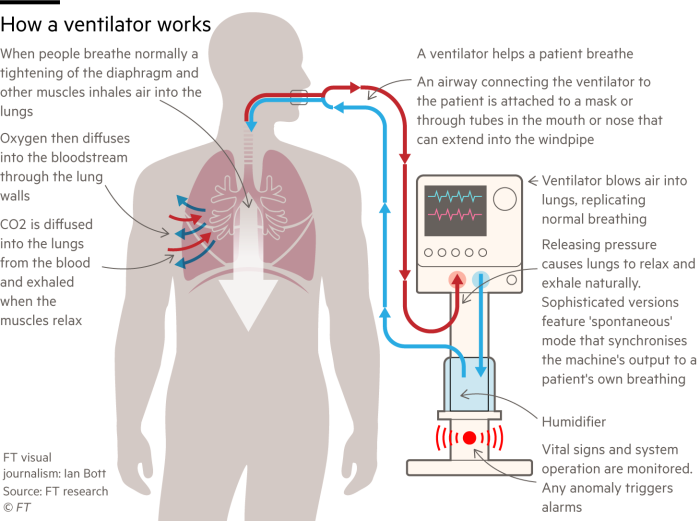
I was fascinated by this article for two reasons: first, because it clearly explains how ventilators work, and what some of the complex parameters of their operation are. There is information here. They need, for instance, to be able to sense the patient’s natural breathing rhythm and follow it, rather than just simply imposing a robotic rhythm of their own. This stuff is difficult.
But the second interesting thing is the clear explanation of how Boris Johnson and the UK government barreled ahead, deciding to harness the power of British industry to build ventilators, just as they built Spitfires in WWII. Unfortunately, the job was put in the hands of bureaucrats who didn’t have the slightest idea of what the medical requirements were, so they issued contradictory and invalid specifications that led to wasted effort and failure.
The author is on Twitter and explains some of the underlying concepts. The article itself is formally written, but Twitter lets him say what he really feels.
Over the last week I've had SO many conversations with docs and experts that remind of the conversations I had with logisticians, port operators, customs clearers over #Brexit.
Expert people TEARING their hair out at the willful numbskullery of the people at the top. /20
— Peter Foster (@pmdfoster) April 18, 2020
What worries me is if this 'how hard can it be?' principle is applied to testing, to PPE procurement etc.
The government needs to show some HUMILITY. It needs to LISTEN TO PEOPLE WHO KNOW STUFF. I think this is a clear example of where it did not. ENDS
Good weekend all.
— Peter Foster (@pmdfoster) April 18, 2020
“LISTEN TO PEOPLE WHO KNOW STUFF” is something the US government also needs to do.