
Time to wake up the spider children and move them to shiny new homes!
Also, I guess I have to fire up the snowblower before I can leave.

Time to wake up the spider children and move them to shiny new homes!
Also, I guess I have to fire up the snowblower before I can leave.

Luke Letlow was described as a “mainstream Republican”, whatever that means any more. It used to be I’d picture an Eisenhower Republican when I heard those words — a cautious conservative. Now the words say to me “someone not quite as openly racist as Louie Gohmert”. Anyway, Letlow got elected to congress in Louisiana, where he did things like this:
As the coronavirus ravaged Louisiana, Letlow urged residents to follow social distancing guidelines and to listen to doctors, noting that Abraham, a physician, had returned to Louisiana to help treat covid-19 patients.
But photos on his Twitter page show he had an inconsistent record of wearing masks while campaigning, sometimes covering his face at meet-and-greets but also speaking indoors without a mask on to rooms of mask-free residents. At a candidate forum in October, Letlow urged the state to ease pandemic restrictions, saying, “We’re now at a place if we do not open our economy, we’re in real danger.”
You know where this is going. He’s dead of COVID.
After his symptoms worsened earlier this month, Letlow was first taken to St. Francis Medical Center in Monroe, where he sounded a hopeful note on Dec. 21, tweeting that he was “confident” in his recovery. Two days later, he was taken to a Shreveport hospital and placed in an intensive care unit, where he was treated with remdesivir and steroids, according to a statement from his office.
This week, he was in critical condition but showing signs of recovery, G.E. Ghali, the chancellor of LSU Health Shreveport, told the Advocate. But on Tuesday, he suffered a “cardiac event” and died, Ghali said. Asked whether any underlying conditions might have contributed to his death, Ghali said, “None. All covid related,” the Advocate reported.
He was only 41, with two kids, and that’s a hard death. I have sympathy for the man, but not his politics, and it’s his politics that killed him.


We’ve got this vaccine, right? The only problem is getting it to the people. In order to reach that desired state of herd immunity by this summer, a promise the Trump administration has been dangling in front of us, we need to get 3.5 million people vaccinated per day. This isn’t happening. Just the fact that a nurse getting the shot is front page photo op material ought to tell you that. But look at the actual numbers — they’re pathetic. This is a massive job that will require a massive investment in medical infrastructure, and the Republicans can’t do it.
There’s reason to believe the administration won’t be able to ramp up vaccination rates anywhere close to those levels. Yes, as vaccine production increases, more will be available to the states. And Brett Giroir, assistant secretary for health at HHS, argued on Sunday that the 2.1 million administered vaccines figure was an underestimate due to delayed reporting. So let’s be generous and say the administration actually administered 4 million doses over the first two weeks.
But even that would still fall far short of the 3.5 million vaccinations needed per day. In fact, it falls far short of what the administration had promised to accomplish by the end of 2020 — enough doses for 20 million people. And remember, the first group of vaccinations was supposed to be the easiest: It’s hospitals and nursing homes inoculating their own workers and residents. If we can’t get this right, it doesn’t bode well for the rest of the country.
Here’s what concerns me most: Instead of identifying barriers to meeting the goal, officials are backtracking on their promises. When states learned they would receive fewer doses than they had been told, the administration said its end-of-year goal was not for vaccinations but vaccine distribution. It also halved the number of doses that would be available to people, from 40 million to 20 million. (Perhaps they hoped no one would notice that their initial pledge was to vaccinate 20 million people, which is 40 million doses, or that President Trump had at one point vowed to have 100 million doses by the end of the year.) And there’s more fancy wordplay that’s cause for concern: Instead of vaccine distribution, the administration promises “allocation” in December. Actual delivery for millions of doses wouldn’t take place until January, to say nothing of the logistics of vaccine administration.
The vaccine rollout is giving me flashbacks to the administration’s testing debacle. Think back to all the times Trump pledged that “everyone who wants a test can get one.” Every time this was fact-checked, it came up false. Instead of admitting that there wasn’t enough testing, administration officials followed a playbook to confuse and obfuscate: They first attempted to play up the number of tests done. Just like 2 million vaccines in two weeks, 1 million tests a week looked good on paper — until they were compared to the 30 million a day that some experts say are needed. The administration then tried to justify why more tests weren’t needed. Remember Trump saying that “tests create cases” or the CDC issuing nonsensical testing guidance?
Contrast that with what Germany is doing.
German states plan to set up hundreds of vaccination centers across the country starting in December, the newspaper Welt am Sonntag reported on Sunday.
It said the health ministers of the 16 federal states have drawn up plans to create one to two centers per administrative district — totaling hundreds of centers — as well as employing mobile vaccination teams.
The capital, Berlin, alone is allegedly planning to set up six such centers, Welt am Sonntag said.
Germany realizes that delivering all those doses is a gigantic logistical problem, and is preparing the pipeline. It’s all well and good to have a source for the life-giving vaccine, but if you don’t have a mechanism for delivery, it’s just going to sit in pharmaceutical company warehouses. Or it’s going to dribble out haphazardly to rich greedy people, like some of our members of Congress, before it is delivered efficiently.
I don’t even want to think about what it’s going to take to get through to the hordes of anti-maskers/anti-vaxxers out there, who have found validation in the words and actions of Trump.
Heckuva job, Donny. Worst disaster in American history since the 1918 flu epidemic, and you flopped badly at coping with it. You made it worse.

Remember Cardinal Pell? Tim Minchin wrote a catchy song about him. Did you see Spotlight? Even the mainstream movie industry could make critically acclaimed movies about Catholic sex abuse. It was an easy target. Now Rebecca Watson singles out another rape apologist in…watch to the end for the unsurprising twist.
I’ll refer you to the Washington Post, in a 2018 article:
Organized secularism has been struggling with charges of misogyny, sexism and sexual harassment for almost a decade. The problem went public in 2011 when a then-little-known atheist blogger, Rebecca Watson, described unwanted sexual advances from a man at an atheist conference who followed her into an elevator and to her hotel room.
She was flooded with both supportive and haranguing comments. World-renowned atheist Richard Dawkins told her to “stop whining” and “grow up.” Dawkins — whose appearances at secularist gatherings can make or break attendance — has been called out multiple times for sexist statements but remains much in demand as a speaker.
Richard Carrier, a science historian and popular secularist speaker, has both apologized for and denied accusations of unwanted sexual advances at secularist and atheist events. He has been banned from at least one conference.
Michael Shermer, who has denied allegations of sexual harassment and assault from several women, remains editor of Skeptic magazine and a top speaker at secularist events.
Most recently, cosmologist Lawrence Krauss, another star speaker and best-selling author, was suspended in the spring by Arizona State University for what it described as a decade of inappropriate behavior, some of it at secularist events.
Has Dawkins ever commented on the behavior of his good buddy, movie co-star, and lecture circuit partner Krauss? I am also amused by the sneaky low blow of saying that Carrier “has both apologized for and denied accusations”.

My large collection of baby spiders is much smaller now. This morning, I went through the whole collection, scrutinizing them carefully for health, and tallied up the end result of my breeding experiments. Then I gave everyone a last meal in their baby vials, because tomorrow I rip up their natal cobwebs and transfer each to new, clean, larger containers so I can raise them to full adulthood.
It was a grim morning. There’s been a steady die-off of spiders over the last two months, often occurring at molting — they sometimes seem to get stuck, and that’s the end of that. I had three separate lines of spiderlings: 1) The R (for Runestone) line collected from a female at Runestone park, well off the beaten track; 2) The H (for Horticulure) line collected at an outdoor building at the local Horticulture garden; and 3) The M (for Myers) line collected right here in my garage at home. There was considerable variation in mortality.
R line: 95% (!) ☠
H line: 75% ☠
M line: 50% ☠
Maybe I’m just terrible at spider husbandry. I don’t have a good feel for how much normal juvenile death I ought to expect. It’s possibly interesting that the line collected from an indoor spider thrived best in the lab, while the ones found in a rather ‘wilder’ environment did worst.
Today wasn’t great, but the survivors all look fat and handsome and healthy, and tomorrow they get moved to their new roomier abodes, and I’ll also take photos of them. I’ll probably flood my Instagram account with pictures of my pretty young spider children, so watch out for that.

They’re still digging things out of Pompeii? Cool. Here’s an open food stand that’s beautifully painted and would tempt me even now:

Known as a termopolium, Latin for hot drinks counter, the shop was discovered in the archaeological park’s Regio V site, which is not yet open the public, and unveiled on Saturday.
Traces of nearly 2,000-year-old food were found in some of the deep terra cotta jars containing hot food which the shop keeper lowered into a counter with circular holes.
The front of the counter was decorated with brightly coloured frescoes, some depicting animals that were part of the ingredients in the food sold, such as a chicken and two ducks hanging upside down.
Analysis revealed traces of pork, fish, snails and beef remaining in the cylindrical containers. What I really need to know is what spices were used and how they were prepared, and I’m not handing over a single as until I smell the food being cooked.

I presume a Christian painted this, completely oblivious to implicit heresy.
That abomination is a denunciation of both the cult of MAGA and the cult of Christianity.

Mary is continuing to be obsessed with birds, and they keep coming back and hanging around. Today she was all excited by something called a Brown Thrasher, which would be a great name for a spider or a shark, but no, it’s a bird.


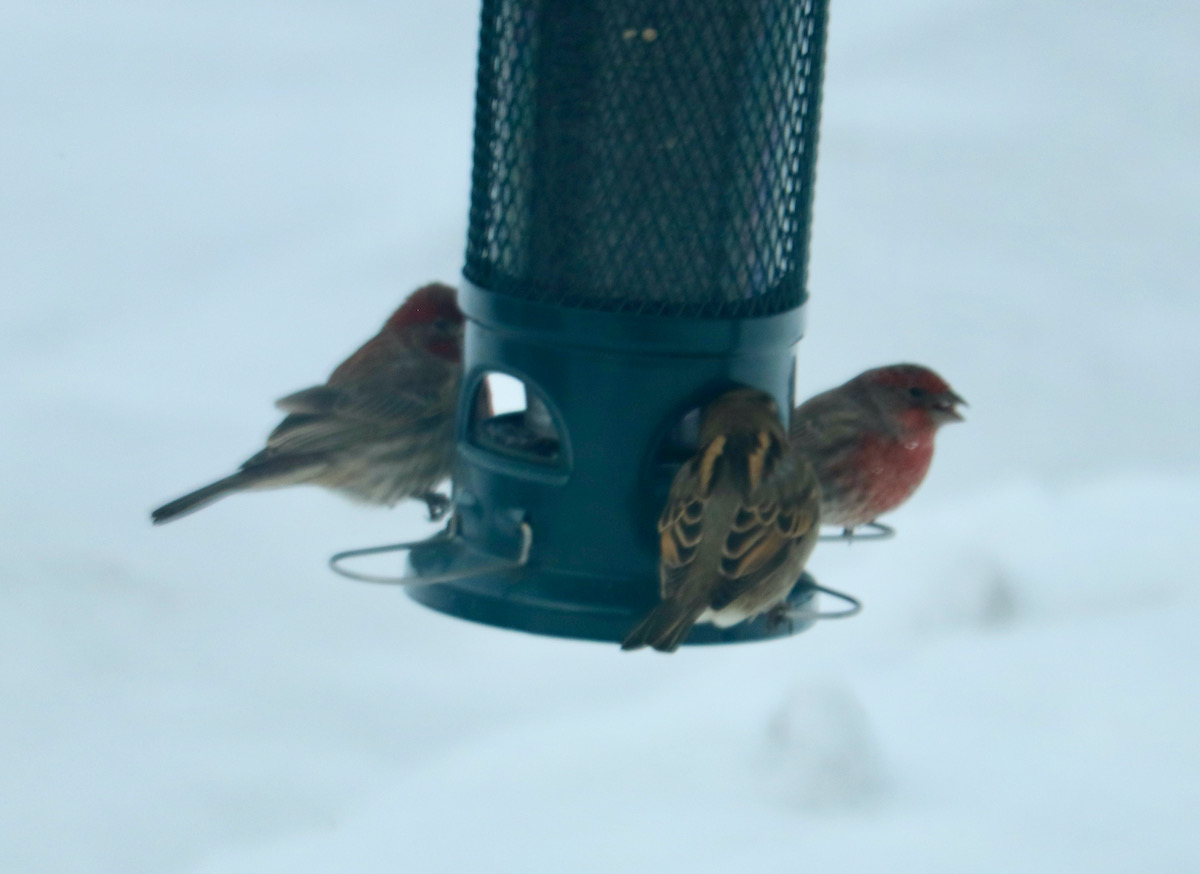

I like the blue jay because I can recognize it. Because it’s blue.
I may have to work on my avian taxonomy skills.

But it’s so intuitive! The idea that the less people know, the more they have an unwarranted confidence that they know more than they do, seems to explain so much. There is now evidence that the Dunning-Kruger Effect is an artifact.
The two papers, by Dr. Ed Nuhfer and colleagues, argued that the Dunning-Kruger effect could be replicated by using random data. “We all then believed the [1999] paper was valid,” Dr. Nuhfer told me via email. “The reasoning and argument just made so much sense. We never set out to disprove it; we were even fans of that paper.” In Dr. Nuhfer’s own papers, which used both computer-generated data and results from actual people undergoing a science literacy test, his team disproved the claim that most people that are unskilled are unaware of it (“a small number are: we saw about 5-6% that fit that in our data”) and instead showed that both experts and novices underestimate and overestimate their skills with the same frequency. “It’s just that experts do that over a narrower range,” he wrote to me.
Then I have to rethink who it applies to. We’re so used to pointing at stupid people doing stupid things and explaining it as Dunning-Kruger in action, and it’s not.
The most important mistake people make about the Dunning-Kruger effect, according to Dr. Dunning, has to do with who falls victim to it. “The effect is about us, not them,” he wrote to me. “The lesson of the effect was always about how we should be humble and cautious about ourselves.” The Dunning-Kruger effect is not about dumb people. It’s mostly about all of us when it comes to things we are not very competent at.
Wait wait wait. So I may have been a victim of the Dunning-Kruger Effect when I thought I knew what the Dunning-Kruger Effect was about? Dang. Well, that was a good solid punch in the balls to start my morning. But then, it’s always good to rethink your assumptions and reconsider your ideas, so thank you very much may I have another?
Are there dumb people who do not realize they are dumb? Sure, but that was never what the Dunning-Kruger effect was about. Are there people who are very confident and arrogant in their ignorance? Absolutely, but here too, Dunning and Kruger did not measure confidence or arrogance back in 1999. There are other effects known to psychologists, like the overconfidence bias and the better-than-average bias (where most car drivers believe themselves to be well above average, which makes no mathematical sense), so if the Dunning-Kruger effect is convincingly shown to be nothing but a mirage, it does not mean the human brain is spotless. And if researchers continue to believe in the effect in the face of weighty criticism, this is not a paradoxical example of the Dunning-Kruger effect. In the original classic experiments, students received no feedback when making their self-assessment. It is fair to say researchers are in a different position now.
Wait, what, so maybe I’m not afflicted with Dunning-Kruger? OK, I need to get out of the house and take a walk now.

I’m still going to criticize it, though.
For years, anthropologists and evolutionary biologists have struggled to explain the existence of menopause, a life stage that humans do not share with our primate relatives. Why would it be beneficial for females to stop being able to have children with decades still left to live?
According to a study published today in the journal Proceedings of the Royal Society B, the answer is grandmothers. “Grandmothering was the initial step toward making us who we are,” says senior author Kristen Hawkes, an anthropologist at the University of Utah. In 1997 Hawkes proposed the “grandmother hypothesis,” a theory that explains menopause by citing the under-appreciated evolutionary value of grandmothering. Hawkes says that grandmothering helped us to develop “a whole array of social capacities that are then the foundation for the evolution of other distinctly human traits, including pair bonding, bigger brains, learning new skills and our tendency for cooperation.”
I guess I’m personally inclined to appreciate the importance of grandmothers, having had a pair of good ones myself, and seeing how much time my wife invests in our granddaughter, but I’m less impressed with the study, which is based entirely on a computer simulation. I don’t trust simulations of complex phenomenon that necessarily have to simplify all the parameters. What about aunts and sisters? What about uncles?
What about the grandfathers?
None of those individuals are of interest, because this version of the hypothesis is structured around explaining menopause as the product of selection. Nope, I don’t buy it.
But why would females evolve to only ovulate for 40 or so years into these longer lives? Hawkes and other advocates of the hypothesis note that, without menopause, older women would simply continue to mother children, instead of acting as grandmothers. All children would still be entirely dependent on their mothers for survival, so once older mothers died, many young offspring would likely die too. From an evolutionary perspective, it makes more sense for older females to increase the group’s overall offspring survival rate instead of spending more energy on producing their own.
I’m willing to accept the benefit of an extended family and social cooperation, but the effort to justify menopause seems misplaced. There are many grandmothers who are not menopausal, and there would have been even more in ancient populations, where pregnancy shortly after the onset of menstruation would have been common. It also doesn’t explain the contributions of sisters and aunts to childrearing, or that brothers and sisters, who are also “distractions” from the business of raising a single delicate child. Why couldn’t it benefit a woman to raise her own child born late and also contribute to the well-being of grandchildren born to previous offspring? I suspect the simulation has assumptions built into the code about how much grandparental investment can be offered if they also have a child.
But, yeah, what about the grandfathers?
We help, too. So why isn’t there a male menopause where our testicles shrivel up and make us more willing to contribute to child-rearing? A man has a certain number of progeny, then boom, the reproductive urge goes away and he has to sit down and focus on taking care of the kids he’s got. Or his grandchildren. Or his nieces and nephews. That would be the logical endpoint of this arch-selectionist model, after all, and what’s good for the goose is good for the gander.
Yet somehow people feel compelled to come up with adaptationist explanations for accidents of evolutionary history.