An evening discovery

So, last night I went out to the movies and left poor Mary home alone — it was a creepy movie, she doesn’t like that sort of thing — and she found her own entertainment. She found a spider in the garden! When I got home around 9 she had to send me out to take a picture of it and identify it.

That’s the Eastern Long-Legged Cobweaver, Theridion frondeum, that I’ve seen many times around here, but they’re very pretty.


Minnesota pride

Not to confuse anyone — we also have gay pride events all across the state — but I’m talking about general pride in one’s state, which seems to be doing a lot of right things, in addition to being a regular rainbow state.

Even our ‘criminals’ are heroic.

The U.S. Attorney’s Office for the District of Minnesota on Tuesday announced that 15 Antifa members have been indicted for their alleged roles in conspiring to hinder federal immigration enforcement operations in Minneapolis earlier this year.

The suspects, 12 of whom are in custody, are all charged with conspiracy to impede or injure a federal officer, according to a 94-page criminal complaint, and some are charged with further crimes. Federal prosecutors allege that each suspect took part in a conspiracy to obstruct federal immigration enforcement officers, including ICE personnel, through force, intimidation and threats.

The suspects are alleged members of the Antifa cell Direct Action Minnesota Network (DAMN), a radical far-left group accused of coordinating operations against federal immigration officers.

Hah, “radical far-left”. Those are just normal Minnesotans resisting the real criminals, the fascist state. Spread the news: most of us are antifa to some degree. There are almost 6 million citizens here, they better be prepared to arrest 3 million.

Anyway, Minnesotans are disgracefully and arrogantly proud of our state for many reasons, including our generally progressive politics. There’s a song about it.

Now if only we could be so unashamedly proud of our whole dang country, but it’s going to take a lot of work to change that course.

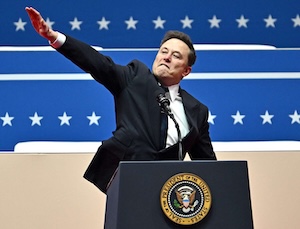
Elon Musk is a dangerous racist

There was a violent crime in Belfast: a black immigrant stabbed a white man. It’s a common kind of crime, horrible and deserving of condemnation, but trust Elon Musk to fan the flames of hatred and turn it into a cause celebre, and the city was consumed with violent riots.

As the bedlam raged in Belfast after the stabbing—resulting in far-right rioters torching cars, buses, and even the homes of immigrants—Musk egged it on. Using X—the platform he acquired precisely for moments like these—he posted locations for groups of rioters to congregate. He elevated vile, overtly fascist and white-supremacist exhortations. When one far-right British politician called for the prosecution of officials who “placed dangerous third world savages in our communities,” Musk replied: “This is the way.”

These developments graphically illustrate the future that Musk truly envisions. They also demonstrate that Musk will use his stratospheric wealth and influence to incite untold levels of global fascist violence going forward. Which leads to an unavoidable conclusion: At some point, friends of liberal democracy throughout the advanced democracies—including future liberal governments—will simply have to come together in a concerted and deliberate way to constrain Musk and all he’s unleashing. Whenever Democrats take back power in the United States, this must be squarely on the agenda.

The article has a lot to say about Musk’s outrageous fascism, and don’t deny it: it’s fucking fascism of the kind Hitler would have endorsed, combined with the same crazy ignorance of actual genetics, and he has a plan that Donald Trump would recognize.

It’s instructive that amid the violence, Musk endorsed a call for “Reconquista,” an allusion to Christian military campaigns to retake the Iberian peninsula from Islamic forces. (Modern-day keyboard fascists have long rather pathetically imagined themselves to be akin to Charles Martel, who turned back the Muslims at Tours in 732.) And Musk boosted a call for the removal of millions from the U.K.

I was wondering what Democrats could possibly do against a trillionaire. Here are some suggestions.

Then there’s what a future Democratic Congress can do. The Musk problem will have to be on its agenda in a serious and meaningful way. Claire Finkelstein, a professor of national security law at the University of Pennsylvania, points out a core problem here: His many government contracts, and his access to privileged information, pose a “national security threat,” even as Space X itself is in many ways a “national security asset.” We need to know a lot more about what Musk’s contracts actually translate into in terms of his personal influence inside the government.

“Congress has to do rigorous oversight of Musk’s government contracts as well as his entire financial empire,” Finkelstein tells us.

Other ideas abound. Brian Beutler has urged the next Democratic administration to closely scrutinize the murky circumstances of Musk’s own immigration to the United States. Beyond such things, we’ll need a coordinated effort across liberal democracies. Appropriately, the targeting of apartheid in Musk’s native South Africa provides a model. We need an international consensus that recognizes the threat Musk poses and works against it with boycotts, with the withdrawal of support and funding, and with whatever creative tools are available. Politicians and publics alike need to think internationally.

OK, let’s strip him of his government contracts, and then turn his own plans against him: deport Musk. Maybe we can seize all of his assets and turn SpaceX into a subdivision of NASA, too. And that’s a mild response: he really ought to be jailed for incitement.

The war is over. We lost.

And the winner is…

I can’t say that I’m particularly upset at our defeat — it was an unjust attack, a war of aggression instigated by our right wing and Israel, and it was doomed from the start — except that we killed a lot of people for no good reason. Fortunately, now Trump has signed what is called a “Memorandum of Understanding” that ought to be more accurately labeled our terms of surrender.

He signed it at Versailles.

On social media, the historian Kevin Kruse reacted with disbelief to the president signing the agreement to end his war in the same location where Germany was forced to sign the humiliating treaty of Versailles in 1919, accepting its loss in the first world war.

“He signed an unconditional surrender at Versailles?” Kruse wrote. “Come the fuck on.”

It is most definitely a surrender. Look at point 6 of the memorandum.

6. The United States undertakes, together with its regional partners, to create a comprehensive plan agreed upon by both parties for the rehabilitation and economic development of the Islamic Republic of Iran, While ensuring financing of at least $300 billion. The implementation mechanism of this plan, as part of the final agreement, will be formulated within 60 days.

The US also agrees that “frozen or restricted funds and assets of the Islamic Republic of Iran will be released and made fully available”. There are no concessions to the US other than the promise that Iran will never produce nuclear weapons, a promise that was in place before we started bombing everything. We’re paying $300 billion in reparations!

The war might be over, except for one little clause.

The Islamic Republic of Iran and the United States, together with their allies in the current war, declare upon the signing of this Memorandum of Understanding an immediate and permanent end to the war on all fronts, including Lebanon, and undertake that from now on they will not launch any hostile action against each other, and will refrain from the threat or use of force against each other. The final agreement will confirm the provisions of this Article and the remaining Articles.

Our “ally” in this war was Israel. Netanyahu has already declared that they aren’t leaving Lebanon. He’s going to start firing missiles everywhere, isn’t he?

The MAGA rationalizations are going to be epic.

How do they avoid motion-sickness?

This little orbweaver was just sitting innocently in her web, and I don’t know how they do it.

The thing is, when they’re on that web and the wind is blowing, they’re just vibrating all over the place. You’d think they’d be hopelessly motion-sick.

I couldn’t stand it so I let her take a break from the gale on my finger.

Don’t worry, I returned her to the same branch.

Anticipating Kent Hovind’s next wack-a-…what?

I’ve been featured in Kent Hovind’s regular Wack-An-Atheist nonsense, as have many other opponents of creationism. Now a different person has criticized him, Dan McClellan, a bible scholar, who points out that no, the bible does not discuss dinosaurs.

Ol’ Kent is going to have to flail about a bit in response, and I’ll be looking forward to it. I’m going to predict that what he’ll do is declare McClellan to be an atheist by default.

Also, I despise those tik-toks or whatever that feature someone just smiling and nodding along, but making sure that their face is on screen the whole time. I’ve seen a few lefty videos like that. Speak up and contribute something!

Respect the intelligence of all living things!

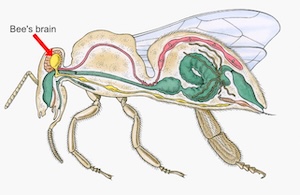
As an undergraduate, my introductory neuroscience course was taught by Johnny Palka, a developmental biologist and neuroscience who worked with Drosophila, who had to explain to us on the first day of class that flies have brains. It was memorable because I was surprised that anyone thought otherwise (don’t worry, the class got much more sophisticated and mathematical after that). But it’s true that there are an awful lot of people with that degree of ignorance.

Confirmation:

“Most people think insects are reflex-based machines,” said Dr Olli Loukola, a behavioural ecologist at the University of Oulu, Finland, and senior author. “That they can’t have any emotional states or feel pain. Some people don’t even realise that they have brains. I hope that these results change the worldview about that.”

That’s from an article about bee intelligence, and if you think insect anatomy is a confusing topic for the general public, wait until you find out there are people who think intelligence can be reduced to a single number.

Only…biology can surprise you. We don’t even understand what intelligence is, so you should avoid limiting preconceptions. All it takes is a simple test to demonstrate the capabilities of insects.

The bees, which were only a couple of weeks old, were first trained to associate a blue artificial flower with a reward of sugar water. During the test, the flower was moved to the ceiling of a transparent petri dish-style chamber whose ceiling was too high for them to reach, but with insufficient space for them to hover. A ball was also introduced into the chamber. To reach the flower, the bee had to roll the ball under it and climb on top – a behavioural sequence they had never previously encountered or been trained to perform.

In the most basic version of the test, 75% of the bees were successful in reaching the flower. “This is essentially an insect version of the classic ‘box-and-banana’ problem,” said Loukola. “The animal must realise that an object can be repositioned and then used as a tool to reach an otherwise inaccessible goal. What stands out about the result is that this kind of spontaneous problem solving is now demonstrated in an insect.”

This is not to say that bees have the breadth of ability that a chimpanzee has. It’s saying that some things we regard as a significant intellectual capability can be implemented with a tiny number of neurons, and that includes tool use.

“There’s a general perception that intelligent behaviour requires big brains because we are big-brained and relatively intelligent among animals,” Chittka added. “Bees are a model of how much intelligence you can squeeze into a small nervous system … It’s a good reminder of there being a motivation to pay some respect to these other beings.”

Another example I’d point to is corvids — teeny tiny little bird brains that are remarkably smart.

I don’t understand American Christians

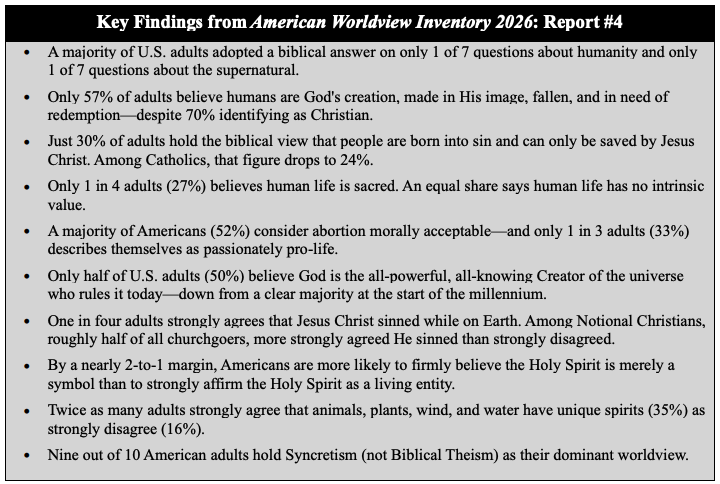
Barna has put out the results from a survey of American beliefs, and it bewilders me.

• A majority of U.S. adults adopted a biblical answer on only 1 of 7 questions about humanity and only
1 of 7 questions about the supernatural.
• Only 57% of adults believe humans are God’s creation, made in His image, fallen, and in need of
redemption—despite 70% identifying as Christian.
• Just 30% of adults hold the biblical view that people are born into sin and can only be saved by Jesus
Christ. Among Catholics, that figure drops to 24%.
• Only 1 in 4 adults (27%) believes human life is sacred. An equal share says human life has no intrinsic
value.
• A majority of Americans (52%) consider abortion morally acceptable—and only 1 in 3 adults (33%)
describes themselves as passionately pro-life.
• Only half of U.S. adults (50%) believe God is the all-powerful, all-knowing Creator of the universe
who rules it today—down from a clear majority at the start of the millennium.
• One in four adults strongly agrees that Jesus Christ sinned while on Earth. Among Notional Christians,
roughly half of all churchgoers, more strongly agreed He sinned than strongly disagreed.
• By a nearly 2-to-1 margin, Americans are more likely to firmly believe the Holy Spirit is merely a
symbol than to strongly affirm the Holy Spirit as a living entity.
• Twice as many adults strongly agree that animals, plants, wind, and water have unique spirits (35%) as
strongly disagree (16%).
• Nine out of 10 American adults hold Syncretism (not Biblical Theism) as their dominant worldview

• A majority of U.S. adults adopted a biblical answer on only 1 of 7 questions about humanity and only
1 of 7 questions about the supernatural.

What is a “biblical answer”? I don’t think there is such a thing — the Bible is a tremendous hodge-podge of archaic, conflicting, and fuzzy ideas. This is an assumption that there is a clear “biblical” position on everything, so I’m unsurprised that there is an absence of a coherent response. The survey returned results that don’t match Barna’s presupposition of what Americans should believe.

• Only 57% of adults believe humans are God’s creation, made in His image, fallen, and in need of
redemption—despite 70% identifying as Christian.

57% is still too damn high. I’m curious as to what the 43% believe.

• Just 30% of adults hold the biblical view that people are born into sin and can only be saved by Jesus
Christ. Among Catholics, that figure drops to 24%.

That’s just a fundamentally horrible belief. What is sin? What is it that a newborn is a sinner? I’m happy to see that belief is in decline.

• Only 1 in 4 adults (27%) believes human life is sacred. An equal share says human life has no intrinsic
value.

I believe that human life is valuable and should be protected, but I don’t believe in the “sacred,” so I guess I’m in the majority. A lot of people are becoming cynical if they think life has no intrinsic value.

• A majority of Americans (52%) consider abortion morally acceptable—and only 1 in 3 adults (33%)
describes themselves as passionately pro-life.

The pro-life movement has always been nothing but an ideological game that was ginned up in the 1970s. The Bible doesn’t say much of anything about abortion, and basically takes it for granted that it happens. Is this one of the things they score as a “non-biblical answer”?

• Only half of U.S. adults (50%) believe God is the all-powerful, all-knowing Creator of the universe
who rules it today—down from a clear majority at the start of the millennium.

Good. Let’s see that number continue it’s decline. The concept of an ominipotent supernatural agent is nonsensical.

• One in four adults strongly agrees that Jesus Christ sinned while on Earth. Among Notional Christians,
roughly half of all churchgoers, more strongly agreed He sinned than strongly disagreed.

I’ve never even thought about this idea! Why would anyone care about the sin-status of a rabble-rousing Jewish preacher who lived 2000 years ago? Apparently it’s a serious theological question, which is an indictment of theology.

• By a nearly 2-to-1 margin, Americans are more likely to firmly believe the Holy Spirit is merely a
symbol than to strongly affirm the Holy Spirit as a living entity.

Don’t you suspect that most people are confused about this whole business of a “holy ghost”? I know I was only exposed to the concept of the trinity as a grade school child, and found it absurd, so I’m sure theology has a more “sophisticated” muddle of excuses, but I suspect most Americans have the equivalent of my childish explanation.

To be a good Christian, must one believe in a nebulous space ghost?

• Twice as many adults strongly agree that animals, plants, wind, and water have unique spirits (35%) as
strongly disagree (16%).

“Spirits.” Stop there. When your survey is treating spirits as discrete entities that need to be evaluated, you’re lost.

• Nine out of 10 American adults hold Syncretism (not Biblical Theism) as their dominant worldview

OK, good. Ken Ham is thus rebuked.

I read the whole paper, and I’m mainly confused about why we should consider it significant that American religious belief is complicated and messy and does not conform to one particular view. There are tens of thousands of protestant denominations! I guess it’s nice that Barna is highlighting how incoherent religious belief is.