Friday Cephalopod: They can see color?

cuttleeye

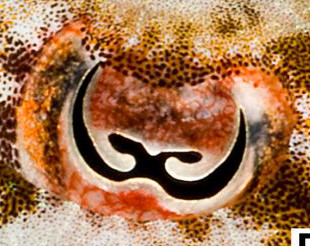
This is kind of awesome: cephalopods only have one kind of photoreceptor, so it was thought that they would be only able to see the world in shades of gray. Those amazingly clever camouflage tricks they pull? That was just matching intensities and textures, fooling our eyes. But now someone has figured out a way they could see color, and special bonus, it also explains those funky weird pupil shapes, like you see in the cuttlefish eye to the right.

They use chromatic aberration! We think of chromatic aberration as an imaging problem — it’s caused by the fact that the degree refraction of light is partly dependent on wavelength, so the blue light in an image focuses closer to the lens than the red light. When you focus optimally on the green wavelengths, for instance, that means that the red and blue colors form an out of focus, blurry image on top of the sharp greens, producing a pattern of color fringes around objects. They jump out clearly to me when I use the cheap student microscopes here, and are why I spent a lot of extra money getting planapochromat lenses for my microscope. They have lots of corrective glass to tweak the different wavelengths into the same focal plane.

But where I see an annoyance, cephalopods evolved an opportunity. Where an object comes into sharpest focus on the eye can actually tell you what wavelengths are — so by focusing backwards and forwards on something, they can extract a rough idea of its color.

And that leads into the next nifty explanation. Where I want to minimize chromatic aberration, cephalopods want to increase it…and as it turns out, having weird off-axis apertures causes more disparity in the focal plane of different wavelengths of light, which makes it easier to discriminate color using this mechanism.
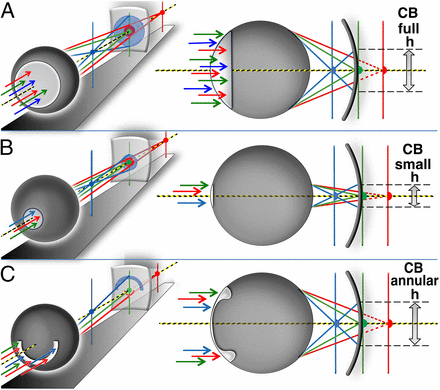
Chromatic blur and pupil geometry. The (A) full and (C) annular aperture pupils produce more chromatic blurring (CB) than (B) the small on-axis pupil, because they transmit rays with a larger ray height h. Vertical lines show best focus positions for blue, green, and red light.

Chromatic blur and pupil geometry. The (A) full and (C) annular aperture pupils produce more chromatic blurring (CB) than (B) the small on-axis pupil, because they transmit rays with a larger ray height h. Vertical lines show best focus positions for blue, green, and red light.

It’s settled then. Cephalopods are cleverer than we are. Or maybe it’s evolution that is smarter than we are. One of those two.


Stubbs AL, Stubbs CW (2016) Spectral discrimination in color blind animals via chromatic aberration and pupil shape. Proc Natl Acad Sci U S A. 2016 Jul 5. pii: 201524578. [Epub ahead of print]

Gene activity in the dead

Now you’ve got another paper you can file with that dead salmon fMRI paper: one that analyzes the transcriptome, or excuse me, the thanatotranscriptome, of dead zebrafish and mice.

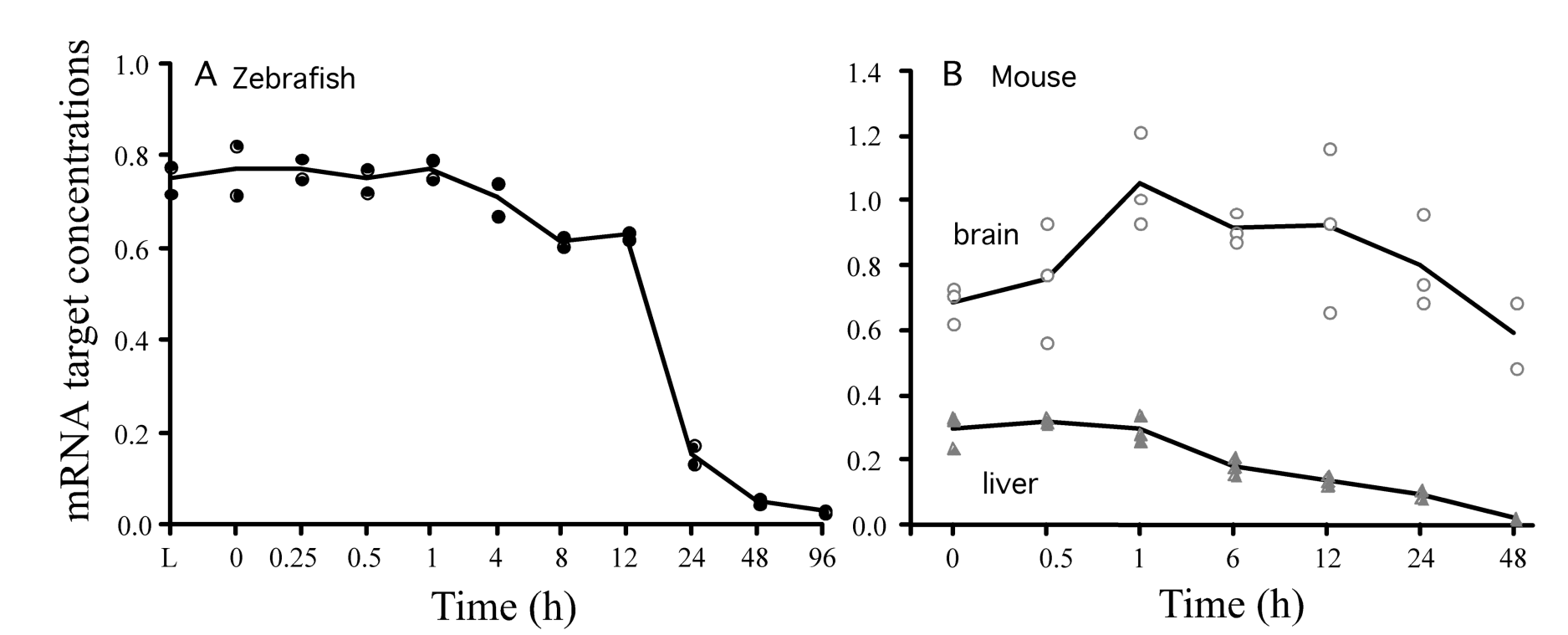
You should not be surprised to learn that when a multicellular organism dies, it’s not as if every single cell is abruptly extinguished: the integrated, functional activity of the individual as a whole ceases, but individual cells struggle on for a while — they’re not getting oxygen or nutrients, in a mouse they’re experiencing thermal stress as the body rapidly cools, but it takes a while for all of the cells to starve or suffocate or undergo necrosis. It seems to take a couple of days, actually. You can measure the declining amounts of RNA present in the dead animals, and yep, it looks like everything is done after a few days. This kind of study has also been done in human corpses, which show that RNA transcription continues for a couple of days.

Total mRNA abundance (arbitrary units, a.u.) by postmortem time determined using all calibrated microarray probes. A, extracted from whole zebrafish; B, extracted from brain and liver tissues of whole mice. Each datum point represents the mRNA from two organisms in the zebrafish and a single organism in the mouse.

Total mRNA abundance (arbitrary units, a.u.) by postmortem time determined using all calibrated microarray probes. A, extracted from whole zebrafish; B, extracted from brain and liver tissues of whole mice. Each datum point represents the mRNA from two organisms in the zebrafish and a single organism in the mouse.


[Read more…]

Minnesotans react to the Philando Castile murder

falconheights

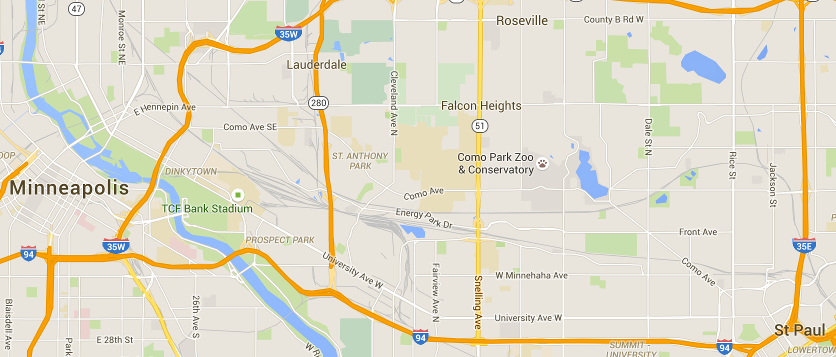
I knew exactly where the killing took place: midway between Minneapolis and St Paul, east of the Twin Cities campus of the University of Minnesota. I’ve driven on Larpenteur many times. But Greg Laden knows the area much, much better.

A neighborhood where bad things don’t happen, filled with people who probably carry out their share of white collar crime (or who are academics, and thus have other problems) but otherwise pretty quiet. Nearby are the scary neighborhoods, the neighborhoods that are actually pretty typical urban zones, with varying degrees of charm, development, decay, all that. Nothing exceptional. But I have the sense that the people of Falcon Heights, Saint Anthony, Lauderdale, and this part of Roseville, a generally liberal and highly educated enclave, collectively identify, label, and talk about those other neighborhoods, which are blacker, crimier, scarier, bits of the “Inner City” (a term disdained by Twin City dwellers, just so you know) creeping out into the “better neighborhoods.”

The victim, of course, was a school employee and citizen of good standing who didn’t live in any of those nearby scary neighborhoods, and was not part of an inner city creeping, even if such a characterization was valid (which it only barely is). But he and the others in the car were black, and they were driving down a street where the city police probably feel a duty to keep the Inner City away, keep the blackness away. One good way to do that is to encourage black people to avoid driving down that particular street, a major local thoroughfare, and instead, stay south and in the city. Let Saint Paul take care of its own problems. Don’t be driving through our quiet neighborhood. How do you do that? Pull over black people with broken tail lights, obviously. Then shake them down. Make them regret driving down that particular street.

[Read more…]

I shoulda gone to the Ark Park today #OhNoahHeDidnt

I didn’t attach any importance at all to the opening day of Ken Ham’s Ark Park, but maybe I should have — all the photos I’m seeing are of nearly empty spaces, with more protesters than creationist attendees, so it may not be around all that long. I’ll still definitely try to make a trip out there at some time, and now maybe I’ll have to attach a little more urgency to it.

But, you see, today I had other, better things to do.

I got a root canal. Seriously.

Rage

This is Diamond Reynolds speaking out after the murder of Philando Castile.

The Roseville police held her in custody at the precinct after one of their own murdered her boyfriend. They kept her at the police, and separated her from her daughter, when she should have been at the hospital with her dying boyfriend.

This is appalling. The Roseville police are apparently incompetent bumblefucks — whey else would you treat this woman like a criminal?

Motherfuckers. Remember this. The American police force no longer deserves any respect at all. You have to obey them because they’ve got guns, but they have earned no honor.

All problems will be solved in #Rationalia

I am so happy. Most days I wake up to a world of pain and chaos, and don’t know what to do…but now Neil deGrasse Tyson has fixed everything with a single tweet.


Earth needs a virtual country: #Rationalia, with a one-line Constitution: All policy shall be based on the weight of evidence

Why has no one thought of this before? It’s brilliant!

Let’s try it with a simple test case and see if it works. There’s currently a bit of a tussle between competing interests in the Boundary Waters Canoe Area Wilderness of Minnesota, which, if you’ve never heard of it, is a gorgeous pristine wilderness in the northern part of my state. On the one hand, you have the fact that it’s beautiful and wild…but that doesn’t seem very logical, especially when, on the other hand, a Chilean company wants to excavate a giant open pit copper mine there.

So, rational reasonable residents of Rationalia, please use your reason and rationality to deliver an evidence-based verdict to this problem. And don’t you try to sneak in human values into your solution, that would be cheating.

I’ll wait on that rational answer, preferably delivered in the form of a mathematical equation with clearly defined, confirmable parameters, before moving on to a slightly more difficult problem.

Aww, OK, I know you’re going to tear through the easy problem fast, so I’ll just give you a hint of what’s next: are justice and equality rational?

I’d recommend you avoid reading any philosophy on that kind of thing — it’ll just muddy the waters of your cold clear solutions — but I suspect it would be a superfluous warning, since all the philosophers in Rationalia are hanging from the lampposts, anyway.

Disarm the police

This is not a radical proposal — it’s actually simple common sense.

This week, Alton Sterling was shot by the police — his “crime” was either having a gun (which, as the NRA frequently tells us, is perfectly legal) or selling CDs, which may have been illegal, but did not to be dealt with with violence. It’s telling that no one can even say what he did wrong to justify his execution.

Yesterday, Philando Castile was killed for having a broken brake light, right here in my state, in Roseville.

Both murders were caught on video. I expect none of the police officers will face any serious penalties for murdering black men.

But I have a serious question about these incidents. Why are the police armed? Do you need a gun to issue traffic citations? I remember when the police would send a representative to my public school — that “Officer Friendly” crap — and they always had a great big scary handgun strapped to their hip. Why? Were they concerned that a firefight might break out in the fifth grade?

All those policemen patrolling the streets, looking for parking infractions or speeders or jaywalkers…they don’t need guns to do their job. Given that many of them are turning out to be bullying cowards, having a gun is even a detriment to their role of defending the law and the public peace.

So disarm them. Keep a few weapons back in the police station that can be issued to deal with specific situations in which they are necessary, but for the most part, guns are totally inappropriate for the job at hand. This would have a number of beneficial effects. For one, the swaggering assholes who need their firearm to be tough would quit, and good riddance to them. For another, the police would actually have to take non-violent approaches to confrontations seriously. Maybe they’d live up to the title of “peace officer”.

I know what the arguments against this proposal will be: but then civilians will be more heavily armed than the police! After all, Philando Castile had a handgun — which he openly declared, and had a permit for — so what is the policeman to do?

That’s easy. If he were scared, the appropriate response would have been to run away, and call for assistance. But in this case, there was no sign that the man in the car was a threat. All escalation was caused by the armed policeman. Except for the fact that the policeman drew a gun and shot the man, this whole incident should have ended with a warning or ticket given to the driver, and everyone would have gone on their way.

You know what else tells me that the police don’t deserve to be armed? What they did with the murdered man’s girlfriend. They had just shot the man, she was weeping and worried about her daughter, and they handcuffed her and took her to the police station, when they should have been helping her get to her boyfriend’s side at the hospital. That made no sense. She was not a threat. She had done nothing wrong, other than maybe having a car with a broken taillight. Yet they treated her like the criminal, after murdering her boyfriend in front of her.

I’m white, and I don’t trust the police. They’re out of control everywhere. It’s time to change.

Meanwhile, in Kentucky…

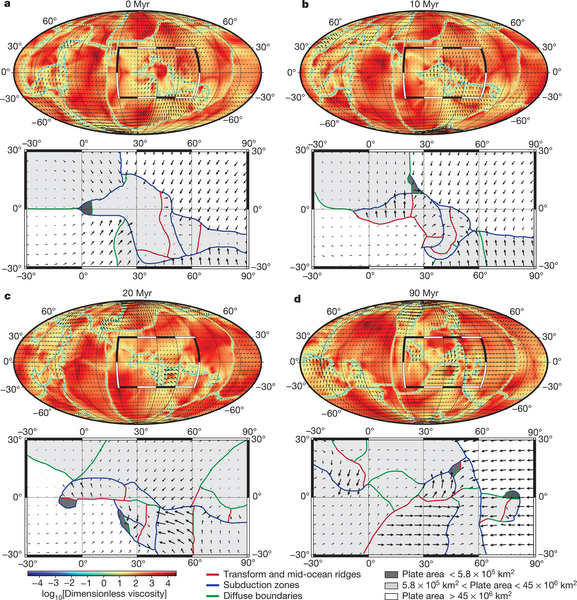
This week, Nature has an article on the reconstruction of global tectonics during the past 200 million years.

a–c, Maps are separated by 10 Myr. The shapes of the large plates do not change much, whereas the adjustment of the small plates evolves quickly. d, 90 Myr after the first snapshot (a), the distribution of the large plates and smaller plates has evolved substantially. In a–d, the top panels show the viscosity of the mantle (colour scale); the bottom panels show the different boundary types (coloured lines) and plate sizes (shading) within the boxed regions in the top panels (which focus on longitudes between −30° and 90° and latitudes between −30° and 30°). The arrows indicate the direction and magnitude (represented by arrow length) of the mantle flow.

a–c, Maps are separated by 10 Myr. The shapes of the large plates do not change much, whereas the adjustment of the small plates evolves quickly. d, 90 Myr after the first snapshot (a), the distribution of the large plates and smaller plates has evolved substantially. In a–d, the top panels show the viscosity of the mantle (colour scale); the bottom panels show the different boundary types (coloured lines) and plate sizes (shading) within the boxed regions in the top panels (which focus on longitudes between −30° and 90° and latitudes between −30° and 30°). The arrows indicate the direction and magnitude (represented by arrow length) of the mantle flow.

In Science, we can read about a thorough analysis of a site where a mastodon was butchered by North American hunter-gatherers 14,550 years ago.

(A) Location of Page-Ladson in northwestern Florida. (B) Map of the Page-Ladson underwater excavations, showing the entire sinkhole and previous excavation areas, as well as excavation areas and sediment cores reported in this paper. Core 4A is marked with a blue star. Other cores are marked with blue circles. Previous excavations are marked with yellow. Our excavations are marked with red. Contours are in meters below datum. (C) Detailed map displaying the location of bones (gray), drawn to scale, and artifacts (black) recovered from geological Units 3a to 3c and 4a to 4b

(A) Location of Page-Ladson in northwestern Florida. (B) Map of the Page-Ladson underwater excavations, showing the entire sinkhole and previous excavation areas, as well as excavation areas and sediment cores reported in this paper. Core 4A is marked with a blue star. Other cores are marked with blue circles. Previous excavations are marked with yellow. Our excavations are marked with red. Contours are in meters below datum. (C) Detailed map displaying the location of bones (gray), drawn to scale, and artifacts (black) recovered from geological Units 3a to 3c and 4a to 4b

.

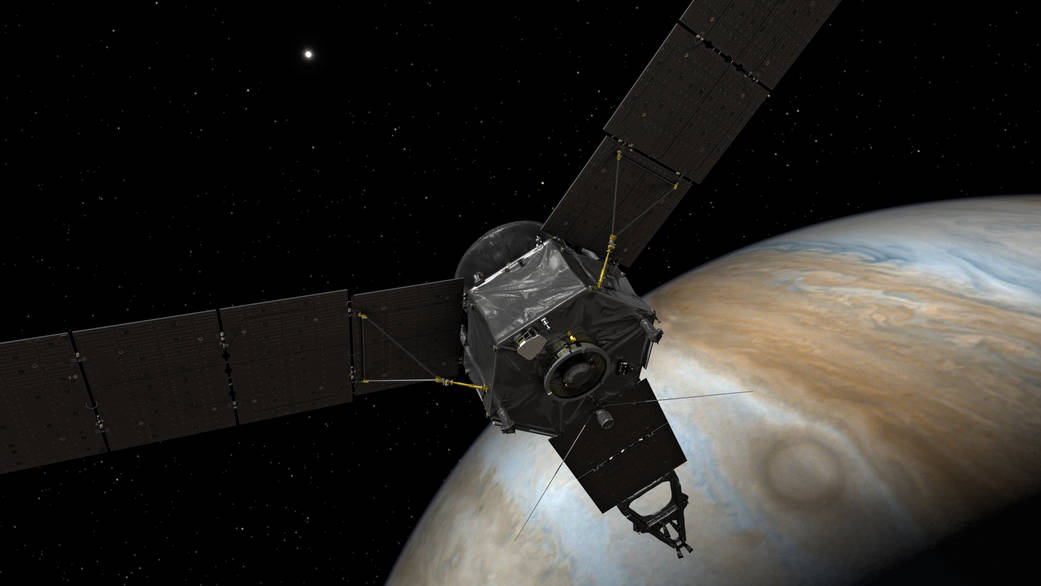
And of course, the big news, scientists have put a probe in orbit around Jupiter.

junoart

Meanwhile, in Kentucky…

[Read more…]