One down

David Koch is dead.

One more malignant, poisonous criminal whose sole contribution to history is bringing the end of civilization a little closer is gone. Jane Mayer’s review of a book documenting the Koch brothers’ perfidy is appropriate reading today.

“Kochland” is important, Davies said, because it makes it clear that “you’d have a carbon tax, or something better, today, if not for the Kochs. They stopped anything from happening back when there was still time.” The book also documents how, in 2010, the company’s lobbyists spent gobs of cash and swarmed Congress as part of a multi-pronged effort to kill the first, and so far the last, serious effort to place a price on carbon pollution—the proposed “cap and trade” bill. Magnifying the Kochs’ power was their network of allied donors, anonymously funded shell groups, think tanks, academic centers, and nonprofit advocacy groups, which Koch insiders referred to as their “echo chamber.” Leonard also reports that the centrist think tank Third Way quietly worked with the Kochs to push back against efforts to renegotiate the North American Free Trade Agreement, which could have affected their business importing oil from Canada. Frequently, and by design, the Koch brothers’ involvement was all but invisible.

Others have chronicled the cap-and-trade fight well, but Leonard penetrates the inner sanctum of the Kochs’ lobbying machine, showing that, from the start, even when other parts of the company could have benefitted from an embrace of alternative energy, Koch Industries regarded any compromise that might reduce fossil-fuel consumption as unacceptable. Protecting its fossil-fuel profits was, and remains, the company’s top political priority. Leonard shows that the Kochs, to achieve this end, worked to hijack the Tea Party movement and, eventually, the Republican Party itself.

He will be remembered. Unkindly.

Maybe we need to think more deeply about the ethics of science funding

Most of the scientists I know, including myself, live in a world of scientific poverty, constantly struggling to scrape together the funds needed to do their work. Some of us, again like me, consciously select research topics that are doable on a tiny budget; others lock themselves into their offices and write grant proposal after grant proposal, watching most of them get rejected, and hoping that one or two get funded so they can pay their students to do the science while they lock themselves back into the office to start writing again in preparation for the next grant cycle. That’s the real life of your typical scientist.

Except for some who manage to get noticed enough to attract celebrity money. There are millionaires who look to gain a little prestige and a reputation as a patron of the sciences by splashing money at high profile research projects. There is no glory to be earned by tossing $10,000 to an obscure spider biologist at a small liberal arts college, even though that’s a sum that would have him reeling deliriously with joy and fund some major upgrades to his lab. That’s not something you could brag about to your millionaire friends! On the other hand, being able to say “I gave a million dollars to an already incredibly well funded lab at Harvard” is going to earn you admiring glances and plenty of back-slaps from your cronies.

Hmm. Somebody ought to do the experiment of handing some massive money, like a million dollars, to some weird little biologist in Minnesota, just to see what kind bragging rights they’d get. No, don’t; I wouldn’t know what to do with that kind of money, I’d probably just hand it over to administrators to turn into teaching projects, and no one brags about enhancing teaching. I also kind of like the small science I do, and don’t want to end up obligated to some smug investment banker.

You know, like Jeffrey Epstein. Suddenly, a lot of big money scientists at high-toned institutions are finding themselves scrambling to back away from the cash they received.

Epstein called himself a “science philanthropist”, and donated handsomely to prestigious organizations such as Harvard, MIT, and the Santa Fe Institute. At one point, he was allegedly giving as much as $20m a year to fund scientists. Some institutions and researchers continued to take Epstein’s money even after his 2008 conviction, like MIT, according to BuzzFeed News.

Epstein called himself a ‘science philanthropist’ and donated handsomely to prestigious organizations
Joi Ito, the head of MIT’s world-famous Media Lab issued an apology last week for having accepted donations for the Media Lab and his own tech startups. In his open letter on the MIT Media Lab’s website, he said: “I take full responsibility for my error in judgment. I am deeply sorry to the survivors, to the Media Lab, and to the MIT community for bringing such a person into our network.

You can read Ito’s odd little apology — it’s strangely evasive. He disavows any knowledge of Epstein’s actions, despite receiving money after he was convicted. Hey, somebody gives him money, he’s not going to question where it came from. He doesn’t say how much money it was, either, although he promises to raise an equal amount from other donors and donate it to non-profits that defend survivors of sex trafficking. So…he’d be a middle man, taking donations to the MIT Media Lab and redirecting them to a completely unrelated charity? Is that ethical?

And wait — who is he taking money from? Ito is stumbling all over himself in embarrassment over having taken money from a slimy multi-millionaire, but isn’t he just setting himself up to take more money from more millionaires? I don’t think we can assume subsequent donors will be non-slimy. They’re millionaires, by definition they’re contemptible parasites who have exploited others to obtain their excessive wealth. He wants to find donors who stole their money by means forgivable by capitalists and who haven’t tainted their cash by raping children. Cash smeared with the blood of exploited workers, or by manipulation of capital, why, that’s OK.

Now I’m wondering, though, why we tolerate science philanthropy at all. Was Jeffrey Epstein a competent judge of the quality of science being done to make those who received his largesse proud of the donation? All you’d be able to say is that you superficially impressed a fool with a bucket of loot into giving you some. You haven’t earned the grant, you’ve just been handed money for being a great glad-hander and schmoozer, not for the science. Your donor is going to use your acceptance and your friendliness at parties to inflate their ego some more.

I’m not going to pretend that grant review at our funding institutions is perfect, but I’d be far more impressed with a donor who recognized their limitations and and handed their $20 million to the NSF, and asked them to distribute it to the most qualified research applications. I’d also be more impressed with scientists who won awards by the assessment of their peers than their ability to chat up bankers at cocktail parties.

But then, I’ve just admitted to being a guy who does small science on a shoestring, so nobody cares what I think. Maybe if I could woo some wealthy financiers with irrelevant stories, then my opinion might matter.

Synergy: Norovirus will allow you to poop and puke on ecological communities more effectively!

Have you ever taken a vacation on a cruise ship?

Why?

I’m just curious because these things have negative appeal to me. Going out on a floating hotel to circle around in the water, spewing sewage into the ocean, descending en masse on tourist traps, confined to a totally artificial environment surrounded by people with more money than sense? Eww. I really don’t get it, but these abominations are monstrously profitable.

And then…these are basically glamorous plague ships. To be fair, Tara does nod to an explanation for why people like them, but the negatives loom too large in my mind.

I know plenty of people love cruises. The convenience of seeing a variety of places without having to plan them individually; the all-inclusive meals; the variety of entertainment options; and for those with kids, the special activities provided for youngsters. I get it. But as an individual trained in microbiology and infectious diseases, what I see when contemplating such an excursion is the potential to be trapped with thousands of others in a confined space, suffering from gastrointestinal aliments like norovirus and E. coli, respiratory infections including influenza and chickenpox, or, as a recent Scientology cruise demonstrated, measles. And that just doesn’t sound like a fun vacation to me.

This hardly a secret: Just this week it was reported that inspectors from the Centers for Disease Control and Prevention (CDC) gave the Carnival ship “Fantasy” one of the company’s worst ever sanitation inspection reports. (The Carnival Corporation & plc made close to $19 billion in full revenues in 2018.)

Read the rest to learn more about norovirus than you ever wanted! She doesn’t even get into the environmental catastrophe that is a cruise ship.

Fierce mama

Yesterday, we let Iliana play in a cardboard box. But before we could do that, we had to clear out the spiders that had rapidly colonized it first, and that’s how we caught this nice Parasteatoda. Last night, while we slept, she spun an egg case and laid a lot of eggs in it, and then today, I had to put her in a different container. She would not go. I tried every trick in the book to separate her from her egg case, and she would frantically scurry back up into the vial. Then I tried removing the egg case; no go. She had it tethered, and as soon as I got it away, thwip, she’d reel it back up. I had to give up and let her stay with her eggs. These spiders are extraordinarily maternal.

Nope, I’m not going to battle that to get her treasure. My party is going to have to level up a lot more.

We have a plethora of spiders now!

I’ve got one baby at home, and today when I came in to the lab we found even more babies…cute little spider babies. It seems this was the weekend almost everyone decided it was time to emerge from the egg sac, and seven egg sacs spewed out clouds of spiderlings.

This is a little overwhelming. I spent a few hours separating out spiderlings and trying to spread out the masses to more containers.

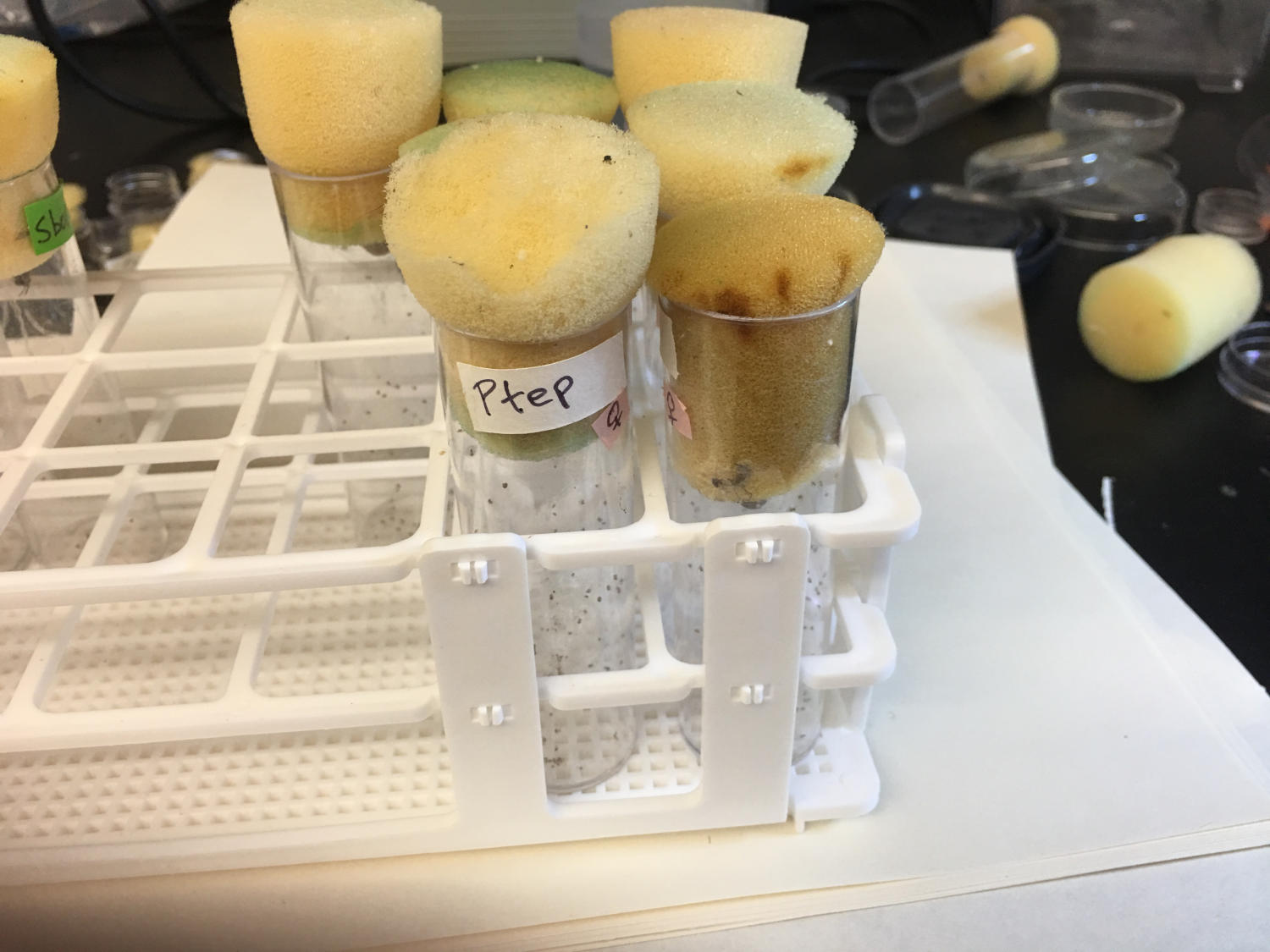
Here is the maternity ward. See all those vials with foam plugs? Each one contains a female spider and one or more egg sacs. If you look closely, you can see lots of little dots, and that’s the cloud of new babies. That’s probably a thousand spiders you’re looking at.

Let’s zoom in a little on one of the vials.

[Read more…]

Big brains…what are they good for?

An interesting thought experiment: what if intelligent dinosaurs had evolved? Would we know it?

If, in the final 7,000 years of their reign, dinosaurs became hyperintelligent, built a civilization, started asteroid mining, and did so for centuries before forgetting to carry the one on an orbital calculation, thereby sending that famous valedictory six-mile space rock hurtling senselessly toward the Earth themselves—it would be virtually impossible to tell. All we do know is that an asteroid did hit, and that the fossils in the millions of years afterward look very different than in the millions of years prior.

So that’s what 180 million years of complete dominance buys you in the fossil record. What, then, will a few decades of industrial civilization get us? This is the central question of the Anthropocene—an epoch that supposedly started, not tens of millions of years ago, but perhaps during the Truman administration. Will our influence on the rock record really be so profound to geologists 100 million years from now, whoever they are, that they would look back and be tempted to declare the past few decades or centuries a bona fide epoch of its own?

I agree.Two of the major consequences of great intelligence seem to be heightened conceit about your importance, and an enhanced ability to exploit and wreck the environment on which your success depends. Maybe those are the two things we ought to be working on reducing, if we hope to last a little longer.

The arctic is melting and is on fire

Isn’t this a lovely example of a catastrophic threshold effect? Humans produce excess carbon in the atmosphere, warming the planet; warming the planet dries out gigantic swathes of peat in the arctic, which catches fire and releases more carbon into the atmosphere. The Earth has all these colossal reservoirs of sequestered carbon, and we burn through one, the buried fossil fuels, and it unlocks all the others, such as the peat bogs.

The Arctic is warming twice as fast as the rest of the planet, leading to the desiccation of vegetation, which fuels huge blazes. Fortunately for us, these wildfires typically threaten remote, sparsely populated areas. But unfortunately for the whole of humanity, so far this year Arctic fires have released some 121 megatonnes of CO2 into the atmosphere, more than what Belgium emits annually. That beats the previous Arctic record of 110 megatonnes of CO2, set in 2004—and we’re only in June.

Yes, that article is from June, and being late in paying attention to it by a mere two months feels like I’m disgracefully tardy. We’re talking about climate events on a planetary scale, and they’re moving so fast that we need to be talking on a time scale of months. Usually, scientists and science reporters are telling you that geology moves incredibly slowly, but humans have effectively goosed the planet into bringing change so fast that we’re seeing it in a fraction of a lifetime.

These fires are largely happening where few people live, so we don’t see the effects directly. Aren’t we fortunate that we have satellites that let us see what destruction we have wrought?

All those fires are producing clouds of soot that darken the arctic ice, absorbing heat from the sun and increasing warming and melting. These are “some of the biggest fires on the planet”, and I don’t think anyone is going to put them out.

Meanwhile, back in the American fantasyland, we have a leadership that is denying that climate change is occurring, or that it’s entirely natural, or part of a normal cycle, and besides, even if it is happening, it would hurt the economy to do anything about it. Someone ought to explain to them that gradual change can lead to a crisis point and catastrophe…and that can happen in politics, too. There are fires smoldering everywhere.