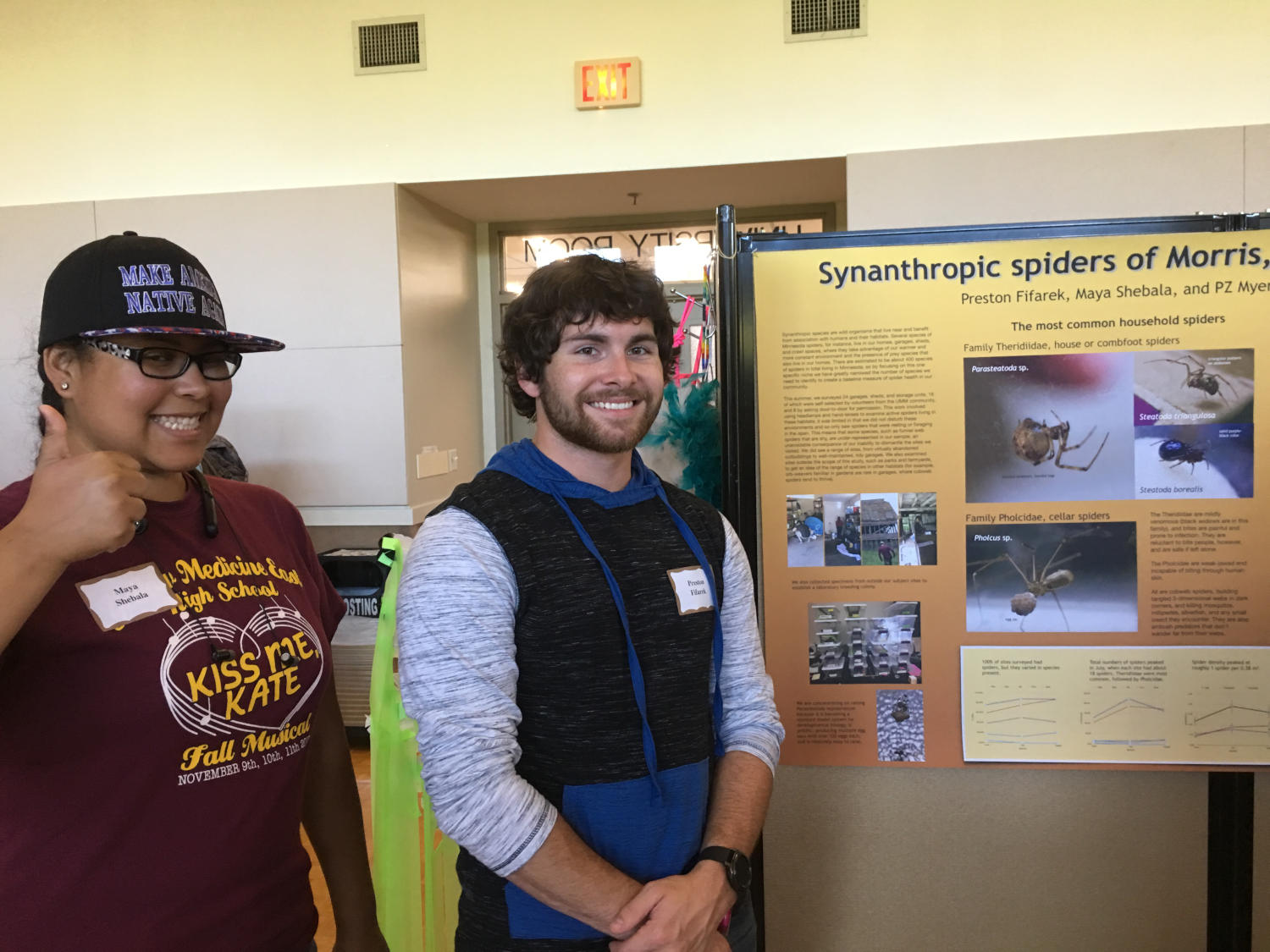
I was at our student summer research presentations. Look at this clever pair, showing off their poster to a milling mob. They did good work.
But now I get to go home and pass out, maybe get some dinner.

I was at our student summer research presentations. Look at this clever pair, showing off their poster to a milling mob. They did good work.
But now I get to go home and pass out, maybe get some dinner.

I got a call from campus Medical Services today — they’ve been invaded by spiders lately, and were wondering if they should be concerned. So I scurried over, because I’m wondering what exciting kind of spider they’ve found…although also I predicted exactly what it would be, and I was right.
They had a squashed specimen, and it was Agelenopsis, a grass spider, just like the one captured here in the science building the other day. I told them they were perfectly safe, these aren’t going to bite anyone, and they aren’t at all venomous to humans, but I guess they need to keep on smacking them, since they are a medical clinic and it wouldn’t do to have spiders everywhere. The problem is that this time of year the males are horny, and they’re wandering everywhere looking for mates. Also, they had an exterminator come by yesterday and spray all the vegetation outside, so all the nearby females are probably dead and they’re getting desperate.
I also checked out ceilings and corners, and I’m sorry to say our medical services office is stunningly pristine, with no cobwebs anywhere. Darn.


Also acutely relevant to the problem I just described is this article by Bruce Schneier, who explains how the problems of computer and software security are very similar to those in biological engineering.
Programmers write software through trial and error. Because computer systems are so complex and there is no real theory of software, programmers repeatedly test the code they write until it works properly. This makes sense, because both the cost of getting it wrong and the ease of trying again is so low. There are even jokes about this: a programmer would diagnose a car crash by putting another car in the same situation and seeing if it happens again.
Even finished code still has problems. Again due to the complexity of modern software systems, “works properly” doesn’t mean that it’s perfectly correct. Modern software is full of bugs — thousands of software flaws — that occasionally affect performance or security. That’s why any piece of software you use is regularly updated; the developers are still fixing bugs, even after the software is released.
Bioengineering will be largely the same: writing biological code will have these same reliability properties. Unfortunately, the software solution of making lots of mistakes and fixing them as you go doesn’t work in biology.
In nature, a similar type of trial and error is handled by “the survival of the fittest” and occurs slowly over many generations. But human-generated code from scratch doesn’t have that kind of correction mechanism. Inadvertent or intentional release of these newly coded “programs” may result in pathogens of expanded host range (just think swine flu) or organisms that wreck delicate ecological balances.
We can’t release “gene patches” to correct errors introduced when tinkering with genomes! I can imagine that someday being an issue — by analogy, going in for dialysis is kind of like a routine software management problem. But no one likes having to do dialysis, it’s a symptom of an underlying problem that is just being patched superficially, not fixed, and modifying genomes can introduce new concerns. I wonder how often software updates create new problems that weren’t present in previous versions? 100%?
I don’t think we think enough about the potential for disaster in genetic engineering, because we are enthusiastic about the potential for great good. We need a balance. It would be helpful for those most optimistic about gene modification to have more consideration for the dangers by, for instance, talking to software security experts.
Opportunities for mischief and malfeasance often occur when expertise is siloed, fields intersect only at the margins, and when the gathered knowledge of small, expert groups doesn’t make its way into the larger body of practitioners who have important contributions to make.
Good starts have been made by biologists, security agencies, and governance experts. But these efforts have tended to be siloed, in either the biological and digital spheres of influence, classified and solely within the military, or exchanged only among a very small set of investigators.
What we need is more opportunities for integration between the two disciplines. We need to share information and experiences, classified and unclassified. We have tools among our digital and biological communities to identify and mitigate biological risks, and those to write and deploy secure computer systems.
I’m optimistic about the future of genetic engineering, but I still cringe when I see some ‘bio-hacker’ inject themselves with some home-brewed cocktail of gene fragments that they think will improve their genome, but is more likely to do nothing or make them sick. I get the same feeling when I see someone stick a flash drive into the USB port of some random public terminal. I hope they’re going to practice good data hygiene and quarantine that widget before they put it in their work computer! (They probably won’t.)

It was a cunning plan. All these mosquitos are carrying terrible diseases like dengue fever and Zika, so what if we fired back and gave the mosquitos terrible genetic diseases that decimated their populations? That would serve them right and also reduce their affliction of human populations.
Scientists made it so. They genetically modified swarms of mosquitos to carry a lethal gene, called the OX513A strain, and released them into the Brazilian wilderness to breed with, and taint the precious germ plasm of the native mosquitos.
In an attempt to control the mosquito-borne diseases yellow fever, dengue, chikungunya, and Zika fevers, a strain of transgenically modified Aedes aegypti mosquitoes containing a dominant lethal gene has been developed by a commercial company, Oxitec Ltd. If lethality is complete, releasing this strain should only reduce population size and not affect the genetics of the target populations. Approximately 450 thousand males of this strain were released each week for 27 months in Jacobina, Bahia, Brazil.
Wow. That’s almost 50 million genetically diseased male mosquitos. I hope the scientists said, “Fly, my pretties!” when they dispatched them on their devious mission.
It worked for a while. Mosquito numbers dropped. But then…
Genetic sampling from the target population six, 12, and 27–30 months after releases commenced provides clear evidence that portions of the transgenic strain genome have been incorporated into the target population. Evidently, rare viable hybrid offspring between the release strain and the Jacobina population are sufficiently robust to be able to reproduce in nature.
Uh-oh. Is anyone surprised?
Our data clearly show that release of the OX513A has led to significant transfer of its genome (introgression) into the natural Jacobina population of Ae. aegypti. The degree of introgression is not trivial. Depending on sample and criterion used to define unambiguous introgression, from about 10% to 60% of all individuals have some OX513A genome
They don’t know what effects these other genes will have on the mosquitos.
It is not known what impacts introgression from a transgenic strain of Ae. aegypti has on traits of importance to disease control and transmission. We tested OX513A and Jacobina before releases for infection rates by one strain each of the dengue and Zika viruses and found no significant differences. However, this is for just one strain of each virus under laboratory conditions; under field conditions for other viruses the effects may be different. Also, introgression may introduce other relevant genes such as for insecticide resistance. The release strain, OX513A, was derived from a laboratory strain originally from Cuba, then outcrossed to a Mexican population. The three populations forming the tri-hybrid population now in Jacobina (Cuba/Mexico/Brazil) are genetically quite distinct, very likely resulting in a more robust population than the pre-release population due to hybrid vigor.
Before their experiment, there was one known population of Ae. aegypti around Jacobina, and they understood the genetic properties of those animals and could predict the salutary effect of introducing their lethal gene there. Unfortunately for their clever plan, the mosquito vector used to introduce that gene also had all those other mosquito genes, which have also been introduced into the region, and now they have become three genetically distinct mosquito populations, and their response to the ‘lethal’ gene has become complex and unpredictable. Yikes. Unintended consequences are entirely predictable, not in detail, of course, but the general chaos is.
You know what else is predictable? This.
Oxitec, the company responsible for developing the GM mosquito strain discussed in this article, has contacted New Atlas claiming that the report cited in this article contains “false, speculative and unsubstantiated claims and statements about Oxitec’s mosquito technology.” Oxitec says it is currently working with the journal publishers, Nature Research, to remove or update the article, which now carries a disclaimer.
Clearly, it is the scientists who exposed this problem, not the corporation that released transgenic mosquitos, that have Meddled with the Primal Forces of Nature.
You have meddled with the primal forces of nature, Mr. Beale, and I won’t have it, is that clear?! You think you have merely stopped a business deal — that is not the case! The Arabs have taken billions of dollars out of this country, and now they must put it back. It is ebb and flow, tidal gravity, it is ecological balance! You are an old man who thinks in terms of nations and peoples. There are no nations! There are no peoples! There are no Russians. There are no Arabs! There are no third worlds! There is no West! There is only one holistic system of systems, one vast and immune, interwoven, interacting, multi-variate, multi-national dominion of dollars! petro-dollars, electro-dollars, multi-dollars!, Reichmarks, rubles, rin, pounds and shekels! It is the international system of currency that determines the totality of life on this planet! That is the natural order of things today! That is the atomic, subatomic and galactic structure of things today! And you have meddled with the primal forces of nature, and you will atone!
Let’s be clear here. The scientists behind OX513A haven’t created a monster, the humans of Jacobina don’t have to flee for their lives, they haven’t done something that creates immediate medical issues. No, what they’ve done is increased the genetic diversity of the mosquito population and made the problem of controlling them more complex for future management.
Benjamin R. Evans, Panayiota Kotsakiozi, Andre Luis Costa-da-Silva, Rafaella Sayuri Ioshino, Luiza Garziera, Michele C. Pedrosa, Aldo Malavasi, Jair F. Virginio, Margareth L. Capurro & Jeffrey R. Powell (2019) Scientific Reportsvolume 9, Article number: 13047.

At last, I’m useful! I was called to a colleague’s office because a big ol’ spider was squatting on their papers, staring at them, so I was summoned to capture the beast. I wasn’t too useful, though, since it fled under the desk and we couldn’t find it again. But later a brave student, Sophie, encountered it and scooped it up, and here it is. It’s Agelenopsis, a grass spider, perfectly harmless, but good sized for its species.
I will remind everyone that we’re hiring an ecologist, and one of the bonuses of working here is that I’ll be at your beck and call to handle any office spiders. Or if I fail, we have many bold strong students who are not at all intimidated by monstrous creatures.

The first sign of a biased dilettante is when they try to reduce biological phenomena to a single parameter that exhibits a straightforward linear effect. It’s true of IQ, and it’s also true of testosterone. This is an excellent video that discusses the complex relationship of testosterone levels to athletic performance.
Why, it’s almost as if there are a thousand parameters, each nudging performance this way or that, and acting in a combinatorial fashion!

I’ve been seeing a lot of excitement about this new discovery on an extrasolar planet: it’s got water.
“We know that water vapor exists in the atmospheres of one extrasolar planet and there is good reason to believe that other extrasolar planets contain water vapor,” said Travis Barman, an astronomer at the Lowell Observatory in Arizona who made the discovery.
That’s cool. Not at all surprising, but cool. I shouldn’t think it unexpected that H2O is found throughout the universe. I’ve also been seeing naive gushing about prospects for colonizing other worlds. They never seem to take the other parameters of this planet into account.
HD209458b is separated from its star by only about 4 million miles (7 million kilometers)-about 100 times closer than Jupiter is to our Sun-and is so hot scientists think about it is losing about 10,000 tons of material every second as vented gas.
It’s also 220 times the mass of Earth and has a surface (I’m curious about what kind of surface this gas giant has) temperature of about 1000°C. Since it’s 159 light years away, I won’t be taking a vacation there in my lifetime.
Well, when you put it that way, maybe I’d like to visit, just a little bit.
Correction: the latest buzz is about K2-18b, a rocky planet that is only 7-10 times Earth’s mass, and a mere 110 light years away. Compared to HD209458b, it’s a paradise practically right next door!
How to interpret the data they’ve got seems to be complicated.
Ingo Waldman, on the University College London team, explained that three different scenarios fit the data equally well: The atmosphere could be pure hydrogen with lots of water, or the atmosphere could contain hydrogen and nitrogen with just a little bit of water. Or a third option allows for a hydrogen atmosphere, a “tiny speck” of water, and high-altitude clouds or hazes that obscure the view.
Benneke and his colleagues throw in another option: liquid water in addition to water vapor. Their calculations suggest that it could rain in the mid-atmosphere of this world.
I don’t think that, after our quick jaunt for a vacation on K2-18b, we’re going to be breathing that atmosphere. H2 on Earth is present in less than one part per million, so that they’re even discussing how much hydrogen fills the skies of K2-18b is a little off-putting.

I made a stop to check on that lovely Argiope at the local Subway…and she was gone! I was very sad. So I made a trip out to our sludgy Lake Crystal to see if there was anything cool out there, and there was! There was a long girl hanging out in the grass along the shore.
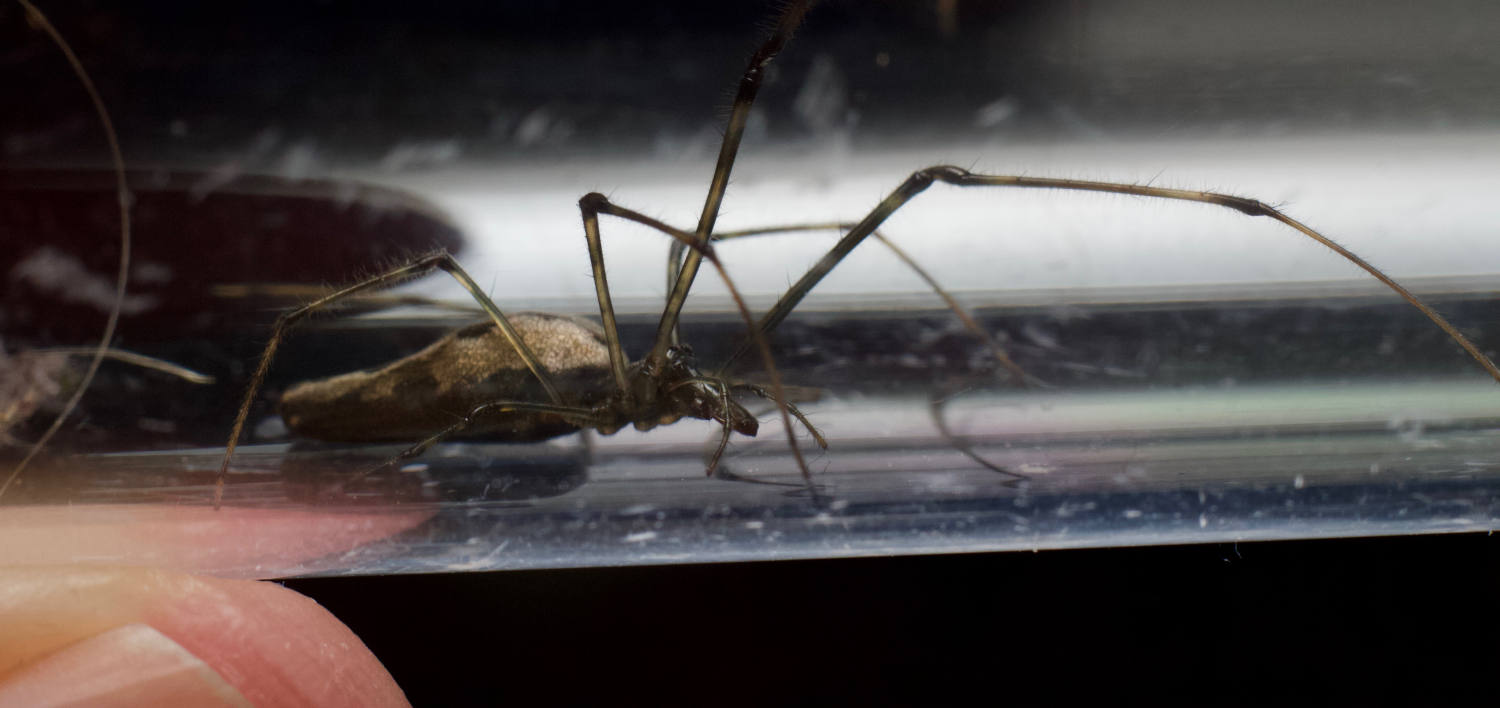
Tetragnathid, obviously, a long-jawed orbweaver. How long?

Hey! Hey, you! The University of Minnesota Morris is offering employment to an ecologist! Apply now!
(Special attention will be paid to anyone studying arachnid ecology…OW. OK, OK, fellow UMM biologists, I admit that’s not true, stop punching me. I’m not even on the search committee. See the description below for the real requirements: “broadly trained ecologists with expertise at the community, landscape, and/or ecosystem level who connect basic and applied ecology“. At least it doesn’t exclude arachnid ecology.)
Assistant Professor of Biology
University of Minnesota, MorrisThe University of Minnesota, Morris seeks an individual committed to excellence in undergraduate education, to fill a tenure-track position in biology beginning August 17, 2020. Responsibilities include: Teaching undergraduate biology courses including sophomore biodiversity with lab, ecology with lab, electives in the applicant’s areas of expertise, and other courses that support the Biology, Environmental Science, and Environmental Studies programs; advising undergraduates; conducting research that could involve undergraduates; and sharing in the governance and advancement of the Biology program, the division, interdisciplinary programs, and the campus.
Applicants must hold or expect to receive a Ph.D. in ecology or a related field by August 17, 2020. Experience and evidence of excellence in teaching undergraduate biology is required (graduate TA experience is acceptable). Preference will be given to applicants who are able to develop and teach upper-level elective courses in their area of expertise that complement those offered by the current biology faculty (https://academics.morris.umn.edu/biology/biology-faculty). We strongly encourage applications from broadly trained ecologists with expertise at the community, landscape, and/or ecosystem level who connect basic and applied ecology. We particularly value research that can involve the habitats endemic to our region.
A distinctive undergraduate campus within the University of Minnesota system, the University of Minnesota Morris combines a student-centered residential liberal arts education with access to the resources and opportunities of one of the nation’s largest universities. A founding member of the Council of Public Liberal Arts Colleges (COPLAC), UMN Morris provides students with a rigorous academic experience, preparing them to be global citizens who value and pursue intellectual growth, civic engagement, intercultural competence, and environmental stewardship. The student body of nearly 1600 is supported by approximately 130 faculty members with a student/faculty ratio of 13:1. UMN Morris serves one of the most diverse student bodies in Minnesota. Forty percent of UMN Morris students are Native American, persons of color, or of international origin. UMN Morris is the only federally recognized Native American Serving Non-Tribal Institution in the Upper Midwest.
UMN Morris is highly ranked by national publications – U.S. News & World Report as a top-ten public liberal arts college; Forbes as one of the best colleges and universities in the nation; and Fiske Guide to Colleges includes Morris campus in its list of “the best” and “most interesting” schools in the U.S., Canada, and the United Kingdom. Morris students are taught by a faculty with the highest per capita representation in the University of Minnesota’s Academy of Distinguished Teaching and students consistently win national awards, as demonstrated by UMN Morris’s status among the top baccalaureate institutions producing student Fulbright awards. The campus is also a national leader in sustainability, evidenced by receipt of the inaugural Excellence in Sustainability award from the National Association of College and University Business Officers and an AASHE STARS Gold rating.
This tenure-track position carries all of the privileges and responsibilities of University of Minnesota faculty appointments. A sound retirement plan, excellent fringe benefits and a collegial atmosphere are among the benefits that accompany the position. Appointment will be at the Assistant Professor level for those having the Ph.D. in hand and at the Instructor level for those whose Ph.D. is pending. The standard teaching load is twenty credit hours per year.
Applications must include a letter of application describing how working at a small liberal arts college fits into your career plan, a curriculum vitae, copies of graduate and undergraduate transcripts, a teaching statement documenting teaching effectiveness, a research statement proposing a research program that is viable at a small liberal arts college and accessible to undergraduates, and three letters of reference. To apply for this position go to the University of Minnesota Employment System at https://humanresources.umn.edu/jobs. The job ID # is 333212. Please click the Apply button and follow the instructions. Attach a cover letter, curriculum vitae and as many supporting documents as are allowed. Additional supporting documents may be emailed to: Ann Kolden, Administrative Assistant, at [email protected], (320) 589-6301, or they may be sent to:
Ecology Search Committee Chair
Division of Science and Mathematics
University of Minnesota, Morris
Morris, MN 56267-2128Applications will be accepted until the position is filled. Screening begins October 18, 2019. Inquiries can be made to Ann Kolden, Executive Office and Administrative Specialist, at (320) 589-6301 or [email protected].
The University of Minnesota shall provide equal access to and opportunity in its programs, facilities, and employment without regard to race, color, creed, religion, national origin, gender, age, marital status, familial status, disability, public assistance status, membership or activity in a local commission created for the purpose of dealing with discrimination, veteran status, sexual orientation, gender identity, or gender expression.
UMN Morris values diversity in its students, faculty, and staff. UMN Morris is especially interested in qualified candidates who can contribute to the diversity of our community through their teaching, research, and /or service because we believe that diversity enriches the University experience for everyone.
This publication/material is available in alternative formats upon request. Please contact Human Resources, 320-589-6024, Room 201, Behmler Hall, Morris, Minnesota.

After I was done protesting yesterday (lie: we’re never done protesting), it was late, it had been a long day, and I was too tired to cook, so I just picked up some wraps at Subway. The Sandwich Artist, who is also a student at UMM, said, “Hey, aren’t you really into spiders?” Yes, of course, my reputation is spreading, I guess. “There’s a big spider on the window over there, it’s been here for several days.”
Of course I looked.
I came back this morning when the light was good, with my camera. There she was, with a big orb web against the glass…Argiope aurantia.
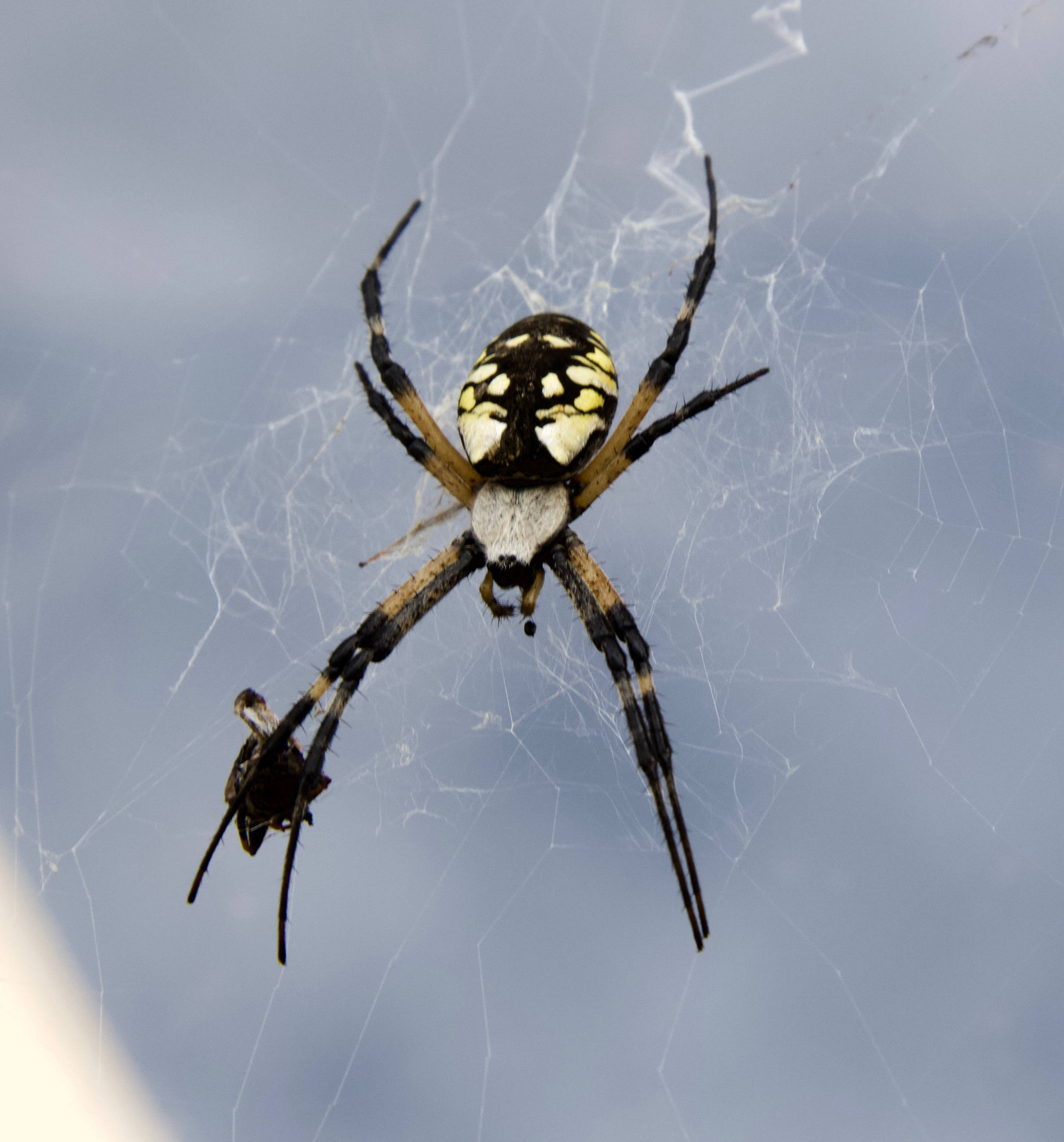
It was impressive, especially since it’s been so chilly lately. I noticed the stabilimentum on the web are rather disorganized and scraggly — a kind of disordered denser mess around the center of the orb here. But she was huge and pretty, and most conveniently right at eye height. This was shot with just my 17-85mm zoom lens, nothing fancy, and I’m tempted to go back later with my good macro setup and get some closeups.