We’re hiring a biochemist!

Whoa. We were stunned when we were told we get to hire a tenure-track ecologist, but now I’m totally gobsmacked that we have been given permission to hire a tenure-track biochemist as well. Two job searches at once? So much work, so much opportunity.

Assistant Professor of Biology
University of Minnesota, Morris

The University of Minnesota, Morris seeks an individual committed to excellence in undergraduate education, to fill a tenure-track position in biology beginning August 17, 2020. Responsibilities include: Teaching undergraduate biology courses including junior/senior level biochemistry with lab, electives in the applicant’s areas of expertise, introductory biology, and other courses that support the Biology and pre-health programs; advising undergraduates; conducting research that could involve undergraduates; and sharing in the governance and advancement of the Biology program, the pre-health programs, the division, interdisciplinary programs, and the campus.

Applicants must hold or expect to receive a Ph.D. in biochemistry or a related field by August 17, 2020. Experience and evidence of excellence in teaching undergraduate biology is required (graduate TA experience is acceptable). Preference will be given to applicants who are able to develop and teach upper-level elective courses in their area of expertise that complement those offered by the current biology faculty. We strongly encourage applications from broadly trained biochemists with complementary expertise in microbiology or physiology or related fields that will support the pre-health programs.

A distinctive undergraduate campus within the University of Minnesota system, the University of Minnesota Morris combines a student- centered residential liberal arts education with access to the resources and opportunities of one of the nation’s largest universities. A founding member of the Council of Public Liberal Arts Colleges (COPLAC), UMN Morris provides students with a rigorous academic experience, preparing them to be global citizens who value and pursue intellectual growth, civic engagement, intercultural competence, and environmental stewardship. The student body of nearly 1600 is supported by approximately 130 faculty members with a student/faculty ratio of 13:1. UMN Morris serves one of the most diverse student bodies in Minnesota. Forty percent of UMN Morris students are Native American, persons of color, or of international origin. UMN Morris is the only federally recognized Native American Serving Non-Tribal Institution in the Upper Midwest.

UMN Morris is highly ranked by national publications – U.S. News & World Report as a top-ten public liberal arts college; Forbes as one of the best colleges and universities in the nation; and Fiske Guide to Colleges includes Morris campus in its list of “the best” and “most interesting” schools in the U.S., Canada, and the United Kingdom. Morris students are taught by a faculty with the highest per capita representation in the University of Minnesota’s Academy of Distinguished Teaching and students consistently win national awards, as demonstrated by UMN Morris’s status among the top baccalaureate institutions producing student Fulbright awards. The campus is also a national leader in sustainability, evidenced by receipt of the inaugural Excellence in Sustainability award from the National Association of College and University Business Officers and an AASHE STARS Gold rating.

This tenure-track position carries all of the privileges and responsibilities of University of Minnesota faculty appointments. A sound retirement plan, excellent fringe benefits and a collegial atmosphere are among the benefits that accompany the position. Appointment will be at the Assistant Professor level for those having the Ph.D. in hand and at the Instructor level for those whose Ph.D. is pending. The standard teaching load is twenty credit hours per year.

Applications must include a letter of application describing how working at a small liberal arts college fits into your career plan, a curriculum vitae, copies of graduate and undergraduate transcripts, a teaching statement documenting teaching effectiveness, a research statement proposing a research program that is viable at a small liberal arts college and accessible to undergraduates, and three letters of reference. To apply for this position go to the University of Minnesota Employment System. The job ID # is 333760. Please click the Apply button and follow the instructions. Attach a cover letter, curriculum vitae and as many supporting documents as are allowed. Additional supporting documents may be emailed to: Ann Kolden, Administrative Assistant, at [email protected], (320) 589-6301, or they may be sent to:

Biochemistry Search Committee Chair Division of Science and Mathematics University of Minnesota, Morris Morris, MN 56267-2128

Applications will be accepted until the position is filled. Screening begins December 3, 2019. Inquiries can be made to Ann Kolden, Executive Office and Administrative Specialist, at (320) 589-6301 or [email protected].

The University of Minnesota shall provide equal access to and opportunity in its programs, facilities, and employment without regard to race, color, creed, religion, national origin, gender, age, marital status, familial status, disability, public assistance status, membership or activity in a local commission created for the purpose of dealing with discrimination, veteran status, sexual orientation, gender identity, or gender expression.

UMN Morris values diversity in its students, faculty, and staff. UMN Morris is especially interested in qualified candidates who can contribute to the diversity of our community through their teaching, research, and /or service because we believe that diversity enriches the University experience for everyone.

This publication/material is available in alternative formats upon request. Please contact Human Resources, 320-589-6024, Room 201, Behmler Hall, Morris, Minnesota.

A few personal hints for applicants:

  • UMM really, really likes good teaching. Your primary role in this position is teaching. You should have some solid teaching bona fides if you want to come here, but we also recognize that some biologists come out of grad school with a passion for teaching, so make your case.
  • This is a small liberal arts college, with small faculty teaching big subjects, like biology. That means everyone has to wear multiple hats. The prime requisite in research for this job is biochemistry, but it really is a major plus if you’re dual-classed in an additional subject, especially one appealing to our pre-health majors. This is a replacement appointment to fill the shoes of someone who taught biochemistry and microbiology, but anything to enrich our department is lovely.
  • Morris is isolated. Not quite Overlook Hotel isolated, but we’re a couple of hours drive away from the nearest major airport. In any interview, we’ll be asking questions about your ability to cope with the small-town rural Midwest, to make sure you don’t go all Jack Torrance on us. We had our first snow already, temperatures are hovering around freezing, and it will get much colder.
    Don’t be discouraged. The survivors all like it here very much, and it’s a great place to work.

May I take a few closeups of your genitals?

Here’s another wintertime project I’ve got to work on. I’ve got all these spiders I collected, and I’m confident that they’re all of genus Parasteatoda. However, we’ve got two species in this genus here in Minnesota: P. tepidariorum, which is the darling model system in developmental biology, and P. tabulata, which is more obscure, but I suspect is fairly common around here. In the literature, P. tabulata is the one that builds nests of debris suspended in their webs; P. tepidariorum isn’t described as doing that, but who knows? I’ve collected a lot of spiders in outdoor environments with the fancy cribs made of leaves and gravel, and the ones I collect indoors don’t do that. Is this just an environmentally-induced variant?

That’s not what the taxonomic literature says. Rather, there is some contentious debate about distinguishing the two, which is made clear by close-up inspections of dissected genitalia. Their epigynes have subtly different shapes.

This is not a playing field I’m competent to contest. You should see this stuff: intricate, carefully drawn illustrations of the P. tepidariorum epigyne vs. equally detailed drawings of the P. tabulata epigyne. OK, gang, I surrender — I struggle to figure out what the heck I’m looking at there. I clearly need to work on my knowledge of spider sexual organs, not something I ever expected I’d have to do. I’m also handicapped by the fact that I’m working with live animals, and killing them and ripping out their genitals and clearing them in clove oil is kind of antithetical to breeding them. Also, I like my little spider friends.

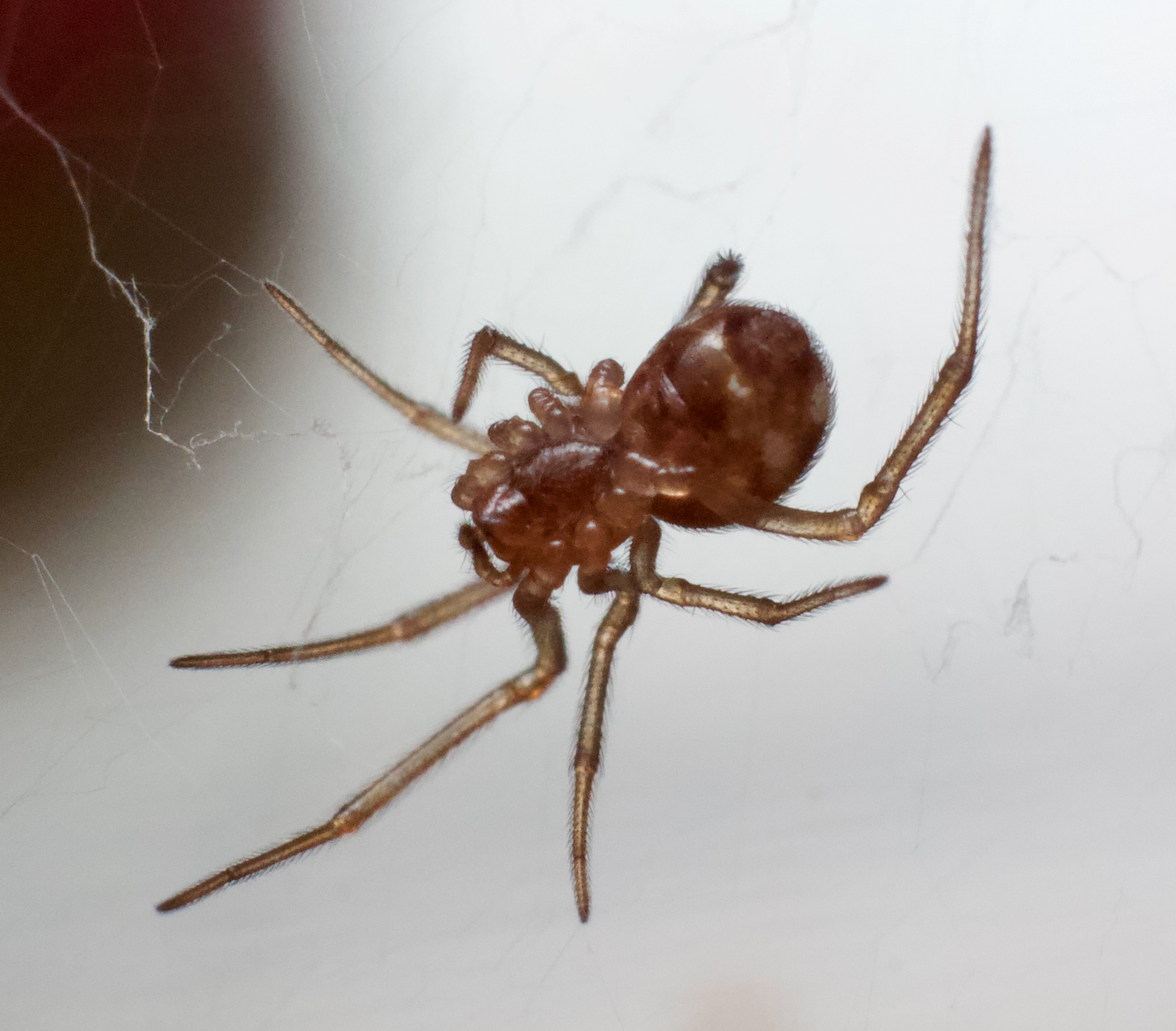
So I’m trying to get photos of their genitals to see if I can distinguish them. Here’s one. Pretty racy, I know.

[Read more…]

You’re supposed to talk out your cool idea before you embarrass yourself publicly

So that’s how unicorns fly through space — by pooping out rainbow-colored slinkies. I’ve always wondered.

The brain-twisting image comes from a review of NASA’s “helical drive” proposal, the idea that you could get massless thrust by accelerating particles to the speed of light as they traveled forward, gaining mass, and then slowing them down as they bounce back so they’d lose mass. Presto! Net acceleration forward. Only it won’t work, because:

The problem is that, even though the author does a very nice simulation, he has left out the fields that do the accelerating. When we accelerate ions using a magnetic or electric field, the ions push back on the field. There is an equal and opposite force exerted on the electrodes and coils that produce the fields, and those just happen to be in the spaceship, too.

The concept is trivially dismissed. What’s odd about it all is that the guy who proposed it to NASA is at NASA, and even admitted in his proposal that there are a few weaknesses.

  • Basic concept is unproven
  • Has not been reviewed by subject-matter experts
  • Math errors may exist!

His proposal is full of charts and calculations, and is obviously carefully thought out and represents a substantial investment of work, yet he never rolled his office chair out into the hallway and asked an engineer in one of the cubicles nearby for a quick reality check, before going public with a crazy idea that was going to get shot down in a few seconds by some smart guy on the internet? Is this what NASA managers do all day?

This is a good example of how communication is an essential component of science. Individual minds can get led down the garden path by a tantalizing notion, but a group of minds can ferret out the problems before you make a big splashy investment of your reputation in something with a fatal flaw.

Adventures in Spider Husbandry #arachtober

I’m done with seeking out spiders in their natural environment, for a while. I’m keeping an eye on a few outdoors (Jenny By-The-Front-Door still lives, despite the recent snow, and there’s a nearby compost bin I have my eye on), but mainly I’m settling in for a winter of laboratory observations now. So here’s a quick review of how I’m raising my spider family.

[Read more…]

The Discovery Institute is getting better at shooting themselves in the foot

Abby Hafer has pissed off the Discovery Institute. Good.

Hafer is a professor at Curry College who has done two horrible things: she helped draft a bill for the Massachusetts legislature that would require some rigor in what can be taught in public schools — specifically excluding the use of non-scientific materials for instruction in the classroom — and she has written about the lack of rigor in the Discovery Institute’s propaganda. Uh-oh. That’s a one-two punch that hits the DI right in the gut, so they’ve tried to counter it, ineffectively.

First, they tried to defend their strengths and weaknesses tactic, and claim that the Massachusetts bill weakened academic freedom.

As I’ve noted previously, academic freedom laws are very limited in their scope. They do not authorize bringing in material on intelligent design, nor make teachers teach anything differently. They simply provide freedom for teachers and students to analyze the strengths and weaknesses of controversial scientific issues in the curriculum in an objective fashion. They protect teachers and students who want to engage in scientific inquiry, which means examining evidence critically. If science is defined as investigating nature objectively, then they represent the opposite of “science denial.”

Note the bit I highlighted. There is nothing in the bill against the use of evidence, or critical thinking. To the contrary, it requires that ideas be supported by good fact-based, scientific evidence. The DI claims to support that. The problem is that no one considers the religion-based speculations of Intelligent Design creationism to be either fact-based or scientific.

So what does the Discovery Institute do? They decided to attack the author. They explicitly claimed that Hafer is not a biologist, nor a biology teacher in an article initially titled When non-biologists speak to biology teachers, which is easily discredited by simply looking up her credentials. How lazy are the hacks at the DI? They apparently just assumed that only a non-biologist would ever cooperate with their state legislators, and barreled in, guns blazing. It’s revealing that they’d do so little investigating, a quick googling would have revealed the facts, and further, they’re complaining about an article she published in — get ready for it — The American Biology Teacher, which right there on the front page lists her affiliations: “Dr. Abby Hafer is a Professor at Curry College”. Remarkable. That’s how bad the DI’s “research” is.

Furthermore, all the DI does is fund-raising, lobbying, and the production of propaganda, and they want to complain about an imaginary “non-biologist” trying to dictate to biology teachers? They keep killing irony.

When it was pointed out that their leading claims were trivially false, they hastily changed the title and edited the text to obliterate their stupidities. It is now titled When Biologists Speak to Biology Teachers, Cont.. It’s written by Sarah Chaffee, who is the Program Officer in Education and Public Policy at Discovery Institute, not a biologist. It’s revised to follow an article titled When Biologists Speak to Biology Teachers, no Cont., written by David Klinghoffer, who is also not a biologist. It’s kind of obvious that their preference is to have only non-biologists tell teachers what to do, except when the imaginary non-biologist disagrees with them.

What they’re doing in this edited article is complaining about an article Hafer wrote, titled “No Data Required: Why Intelligent Design Is Not Science”. It’s a straight-forward bit of analysis. She asks a simple question, do the papers promoted by the DI include data and reference evidence, or do they cobble together arguments without presenting supporting data? Here’s the abstract.

Intelligent Design (ID) proposes that biological species were created by an intelligent Designer, and not by evolution. ID’s proponents insist that it is as valid a theory of how biological organisms and species came into existence as evolution by natural selection. They insist, therefore, that ID be taught as science in public schools. These claims were defeated in the Kitzmiller case. However, ID’s proponents are still influential and cannot be considered a spent force. The question addressed here is whether ID’s claim of scientific legitimacy is reinforced by quantified results. That is, do they have any data, or do they just argue? The ID articles that I analyzed claimed to present real science, but they rarely referred to data and never tested a hypothesis. Argumentation, however, was frequent. By contrast, peer-reviewed articles by evolutionary biologists rarely argued but referred frequently to data. The results were statistically significant. These findings negate claims by ID proponents that their articles report rigorous scientific research. Teachers will find this article helpful in defending evolution, distinguishing science from non-science, and discussing the weaknesses of ID.

She contrasted the DI’s “work” with peer-reviewed papers published by real scientists. The DI fails on this simple criterion — they don’t talk about the evidence. They’d rather just say there is doubt and debate, instead of backing up their claims.

Now for the hilarious part: that awkwardly revised DI article simply asserts that Hafer’s claims are wrong, and then to show that she’s got it all wrong, it doesn’t show contrary data — it just says that some scientists question neo-Darwinism! We don’t need no data, all we have to say is that there is a debate.

We know that a significant number of scientists worldwide, such as those who attended the 2016 Royal Society meeting on evolution, question the sufficiency of neo-Darwinism in accounting for biology complexity. Yet don’t tell the biology teachers that! Because they might tell their students, and then, Katie, bar the door!

They also clumsily try to apply Hafer’s methods to a classic peer-reviewed paper in science.

Hafer’s method sounds scientific, maybe. But to see how absurd it is, perform the same analysis on the 1953 article by Watson and Crick describing the structure of DNA. Is the seriousness of this work somehow to be gauged by observing that they use the “argu” root once and “data” three times? No, what matters is what the article actually says.

Except the entirety of the Watson-Crick paper is about presenting their evidence for the structure of DNA, and the DI’s analysis actually supports Hafer’s point, that the words used focus attention on the data, not the arguments, and that their result is entirely congruent with Hafer’s analysis. Just to hammer it home, I had to look up the paper to see how they’re using the word “argument”.

The previously published X-ray data on deoxyribose nucleic acid are insufficient for a rigorous test of our structure. So far as we can tell, it is roughly compatible with the experimental data, but it must be regarded as unproved until it has been checked against more exact results. Some of these are given in the following communications. We were not aware of the details of the results presented there when we devised our structure, which rests mainly though not entirely on published experimental data and stereochemical arguments.

Data, results, results, data, stereochemical arguments. Does the Discovery Institute even realize that in this usage “arguments” is being used to refer to stereochemical structures as evidence for their model of DNA?

Everyone at the Discovery Institute is either a fool or a fraud or both.

Shinya Inoué has died

Another great scientist is gone. Inoué wrote my Bible that I relied on greatly in the 80s and 90s, Video Microscopy: The Fundamentals (which now costs $129? Wow), a very thorough overview of television and closed-circuit TV, as well as microscope optics. It’s now rather dated — it’s quaint to imagine there was a time we relied on RS-170 and NTSC to do video microscopy, and the extensive discussion of tape formats and antique gadgetry isn’t of much use any more, unless you’re planning to pick up an OMDR on eBay. Once upon a time, though, it was an indispensable guide to the thicket of rapidly emerging imaging technologies.

I never met Inoué, but I’d also heard he was a great teacher, and I can believe it. The book is dense but extremely well written and thorough. I’ve still got my copy in an honored position on my bookshelf, even if I probably haven’t cracked it open in 10 or 20 years. But in its time…I even taught a course a couple of times that was built around it as a reference text. It would still be useful if I were splicing together antique devices now and then for use in the lab.