Is it surprising that dissecting human cadavers is the ethical thing to do?

For prospective pre-med students looking for an undergrad institution: the UMM biology discipline just approved a change to our anatomy class. No more cats to dissect, no more mink, no more fetal pigs. Instead, we’re going to have two human cadavers for all anatomy instruction. I know, that sounds strange, but it means we won’t be killing a large number of small mammals to teach the course anymore, and instead will use voluntary donations of individual large mammals that died of natural causes. So it’s actually more ethical, and it means our pre-health profession students will get a more thorough grounding in human anatomy.

I’m mentioning this because I’m predicting it might increase our pre-med enrollment, so I’m trying to influence the outcome. No, I don’t have any money riding on it. I wish we could teach more comparative anatomy, but at least with this approach we won’t be killing any animals in this course.

Don’t you love seeing how science is done?

I have a few fossil molluscs from the Devonian — they’re fairly common orthocerids, these cone-shaped shells that once housed mighty ancient cephalopods. Mine are small, but some of these shells get to be 5 or more meters long. We have to imagine big eyes and swarms of arms writhing out of the broad end of the cone, because those squishy bits don’t fossilize well. Well, not just imagine, because we do have data that lets us reasonably infer what the animal looked like. Here’s an excellent post that describes how this kind of reconstruction of Endoceras was done.

That’s not guesswork. Using trace fossils and phylogenetic bracketing and assembling bits of evidence from multiple specimens, you can make an informed estimation of the main features of the animal.

And it is awesome. Bring ’em back.

Mayflies on Patreon

This feels mildly peculiar, to put posts up behind a paywall, but that’s what I’ve done because I’m anxious to build up a revenue stream to cover certain ugly circumstances. There is now a 1500-word post on the science of mayfly population declines available for my patrons, at any level, to read.

I’m in the business of science communication, so it’s an awkward compromise on just flinging tasty science freely about, but if you can’t afford it, that’s fine — I’ll be posting an openly accessible copy of the article right here in about a week. Check back in!

Also, there’s more coming — I’ve also got a cool article on mayflies as experimental organisms, in addition to being significant as populations ecologically. That’ll appear there later this week.

My lab is a junkyard!

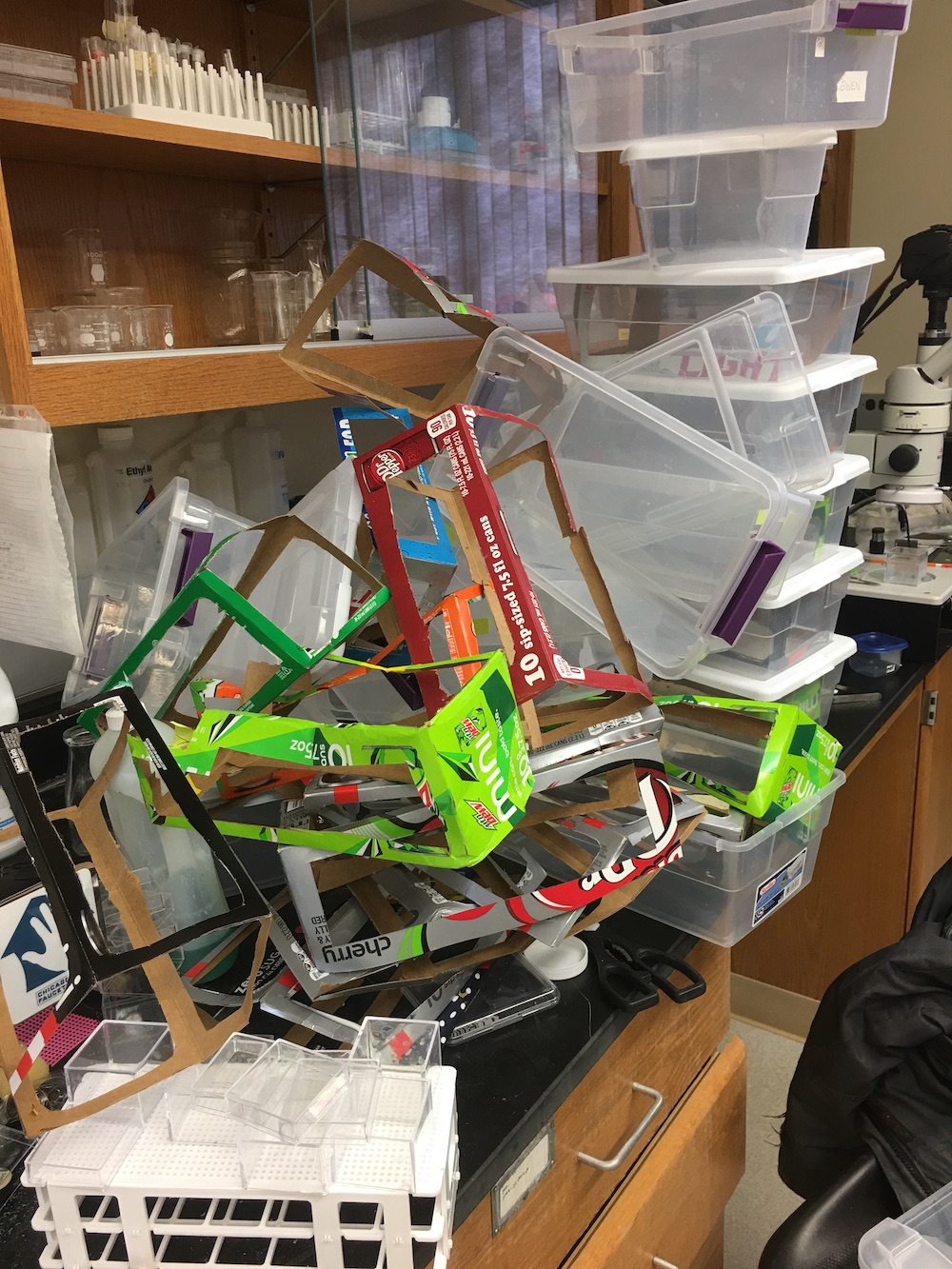
I’ve been doing a lot of maintenance on the spider colony, moving spiders into new, clean cages, and so far, throwing the old cages and the cardboard frames into a pile. This pile:

It’s colorful, at least. All the cardboard is going to be thrown out after being thoroughly inspected (today I found 3 egg sacs hidden in the irregularities of the old cardboard frames; one advantage of the new wooden frames is greater uniformity, so it’s easier to find new additions), and the plastic cages will be washed and stacked for later use. In the future, rather than just disrupting all the spiders all at once, I’m planning to do a regular cycle of cleaning up a few cages per week, so that they don’t all pile up at once.

Not shown is the pile of wood scraps and sawdust on the other side of the lab. That needs to be swept up and thrown out, too.

Also, I’ve made a difficult decision: I’m going to avoid posting spider photos here in the future. I know that it’s driven a few people away — I have no idea how many — and it’s sad, but some people have a visceral reaction to close up photos of arachnids. I’ve realized, though, that this Patreon thingie gives me an easy way to self-select people with its various tiers — I’ve got an “Arachnid tier” and an “Architeuthis tier” that differ in only one way: one of them will include posts with the special reward of spider stuff, and the other one has the special reward of no spider stuff. If you want to see more spiders, join the Arachnid tier, and if you’d rather not, you don’t have to do anything.

The downside is you’ll have to pay $5/month, and I’m not going to compel my fellow arachnophiles to cough up cash…an alternative is just to follow me on Instagram, where I also post spider photos. No charge!

OH NO RICHARD DAWKINS NO!

Chuck Asay

His reputation would be so much better if he never ever discovered Twitter. Which is to say, he’s done it again.

It’s one thing to deplore eugenics on ideological, political, moral grounds. It’s quite another to conclude that it wouldn’t work in practice. Of course it would. It works for cows, horses, pigs, dogs & roses. Why on earth wouldn’t it work for humans? Facts ignore ideology.

That word “work” sure is doing a lot of work in there. If only we could ignore ideology, politics, and morality, as well as philosophy, sociology, the limitations of our own knowledge, and empathy, why, then of course eugenics would “work”! All we have to do is set aside our humanity and reduce existence to selective breeding, and we could produce radical biological change in human populations in just a few generations. Of course, we’ll have no idea of any unintended genetic consequences (there will be many, just as there have been with cows, horses, pigs, dogs & roses), and we’ll have to live with the kind of ideology that promotes eugenics, which has its own set of consequences, and we’ll be producing generations of people that can only live with a fascist ideology, but hey, it’s just selection, we know that will “work”.

Is he even aware that dismissing the trivial issues of politics and morality actually is an ideological decision? It always surprises me when smart people decry “ideology” in general, as if they’re oblivious to the fact that their perspective is totally shaped by their own ideology. You have an ideology, I have objective knowledge of the facts. How dare you annoy me with your ideology in the midst of my logical defense of the objective utility of eugenics?

I also have to ask…has anyone ever made the argument that eugenics can’t produce biological change? I don’t think so. I think everyone is aware that eugenic policies can make sweeping demographic changes. Just ask the Jews of Poland, 90% of whom were exterminated. Ask the Hutus of Burundi — over 100,000 people murdered was an effective culling. It “worked” if we judge such things solely in terms of accomplishing a shift in the population. No one questions that it “worked”, we just recognize that when eugenics is working as intended it is a horror.

His last line is backwards. Ideologies often ignore facts, like the simple fact that every nation that has tried to implement eugenics, such as the United States and Nazi Germany, has ended up causing immeasurable misery, suffering, and death with no desirable outcome as a reward, and just ends up digging themselves into a pit of contempt and hatred that can only be escaped with blood and destruction. I guess if you redefine “work” to mean that, Richard Dawkins made a true statement.

A few have escaped the custodians!

Usually, the science building I work in isn’t great for finding spiders — the custodians are good at their jobs. But sometimes, if you get down on your knees and poke around in the little crannies, you can find a few (I tell you, they’re everywhere, they’re just good at hiding). We explored my lab a bit today, and discovered a few things.

  1. The Pholcidae have moved in, those great long-legged thugs. They’ve displaced at least one Theridiidae individual I knew of, and was leaving in place. Tsk.
  2. The false widows I follow are generally small, which may mean they’re not finding much to eat.
  3. We found wild Steatoda triangulosa! Or maybe feral. I can’t rule out the possibility of baby escapees.

    The reddish-yellow color is interesting. I don’t know if that’s a pigment variant, or if she’s been eating something weird.
  4. One lonely tiny Parasteatoda was hiding beneath the desk.

    It shall be given flies.

This may not be what some of you want to hear, but try getting down and looking under your furniture or in the dark gaps between your furniture and the wall. You may find you have friends.

More eerie cave creatures!

Um Ladaw Cave in India is a chamber 300 feet below the surface that fills to the brim with water in the rainy season, and is only accessible in the winter dry season…well, “accessible” is a relative term. This is how you get there.

Once you make the descent, there are pools of water filled with a large population of pale, blind cave fish. These are big fish, too. They are probably fed by the constant trickle of organic material flowing down from the surface. Deep caves are also a nesting place for bats that poop into the water, which just tells you that some animals can eat anything.

That kind of diet must leave them desperate — in the video, you can see them trying to gnaw on the camera lens. Anything is fair game.

The existence of this pattern of pigment and eye loss in multiple species around the world tells you that something as complex as vision requires constant maintenance via natural selection, though. It’s remarkably consistent that animal species living in the total darkness of deep caves tend to all become pallid and blind over time.

Behold! The official Myers Lab Spider-Cam!

Remember how I complained about my defunct microscope camera? I complain no more. Thanks to a gift from an exceedingly generous donor, I now have a brand new beautiful Canon camera for the lab! Here it is, mounted on a microscope adapter on my Wild M3C; I can also mount it on my Leica.

So glorious. It’s going to see a lot of use, too. I share this scope with my colleagues in the department, and they can also use it to photograph their non-spider specimens. Most kindly, it also came with a collection of lenses, which means I can use it for more than just lab work — I’m trying to get funding for a summer student to do a spider diversity survey, and this means we’ll both be going out around West Central Minnesota, documenting spiders all over the place.

This is going to make my work so much easier. Next, I’m going to have to get some really tiny things I can photograph on the new setup — in the next week or so, I’ll post some samples.

It was like Christmas around here this afternoon! An entirely secular, scientific Christmas, of course.

I ♥ my hot glue gun & Dremel

It’s a busy day with all these job interview related things, but over my lunch hour I banged out 8 more spider cages, even with my gimpy left arm. I used a saw attachment on my Dremel (sorry, neighbors, if there was a lot of high-pitched screaming noises from my lab) to quickly hack up some bamboo strips and quarter-inch dowels, and then slapped them all together with hot glue. So easy.

I’m letting them cool now, and then I have to go through and clear out the threads of hardened glue scattered around — although the spiders probably won’t mind the strings — and let any fumes air out for a day, and then fill them up with more spiders.

And clean up. My lab is full of sawdust and little scraps of wood right now.