Gemini Man and Replicas: two movies with big name stars and big budgets, and writers who know nothing about science.
For once, the YouTube algorithm is working in my favor. It’s currently saying “Oh, so you like big spiders, do you?” every time I check in, which is factually true, so I keep seeing spectacular Argiope behaviors.
This one tickled me because I have vivid memories of seeing my first Cicada Killer, the Most Terrifying Wasp in the World, as a child. It was perched on a tree branch in my back yard, and it was swiftly and brutally dismembering a cicada, the Most Obnoxiously Noisy Insect in the World, and it was mesmerizing. It would just tear into it sloppily with its mandibles, slurping down slimy crunchy bits, and scraps of chiting and fragments of body parts were raining down out of the tree. I swore I’d never go near one of those monsters.
Yet here’s Argiope, my hero, neatly turning a Cicada Killer into lunch.
The camera work isn’t great, but you can see how effective Argiope‘s web spinning is — she isn’t tying up her prey with single threads, but with these broad ribbons of silk. I’ve seen them immobilize a large grasshopper in seconds.
Here’s another video of Argiope making an egg sac. The difference is that this is a time-lapse, so you can see the whole process in 10 minutes rather than 10 hours.
I particularly like how she squeezes out a big ball of eggs, looking like a mass of tapioca.
It’s OK if you skip around. This video of Argiope aurantia making an egg sac is over 8 hours long.
It’s very cool, though. It’s an impressive feat of spider engineering, and the mama spider invests a lot of effort into building that sac and filling it with many hundreds of eggs. My spiders build quicker, simpler sacs, and though I’ve tried, I haven’t been able to catch them in the act — it also doesn’t help that they seem to construct them in the middle of the night.
It also makes me anxious. I’m quarantined — hopefully for only a few days — so I can’t go into the lab to feed the colony, and they’re probably getting hungry. It’s nothing to panic over yet, since spiders are adapted for sporadic prey capture, but if I get bad news on my COVID test, I’m going to have to do something. My idea is to make one visit to the lab at some late hour and bring all the spiders to my house for prolonged care. It’s a lovely home decor idea as well, don’t you think?
I’d much prefer to get positive news in the next day or two so I can get back in the lab without cluttering up my house with more spiders, though.
One of the winners of the 2020 IgNobels was this study of attitudes in entomology.
Richard Vetter won an Ig Nobel for his paper looking at why people who spend their lives studying insects are creeped out by spiders.
His paper, “Arachnophobic Entomologists: Why Two Legs Make all the Difference,” appeared in the the journal American Entomologist in 2013.
Vetter, a retired research associate and spider specialist who worked in the entomology department at the University of California Riverside for 32 years, found during the course of his work that many insect lovers hate spiders.
“It always struck me as funny that when I talked to entomologists about spiders, they would say something along the lines of, ‘Oh, I hate spiders!’” he said in a telephone interview.
He found that many bug lovers had had a negative experience with a spider, including bites and nightmares. The fact that spiders are often hairy, fast, silent and have all those creepy eyes freaks out entomologists, he said.
Except…the entomologists I know are appreciative of spiders. Unless they’ve been lying to me, I don’t know that this is really a problem.
Besides, once you get to know spiders, everyone loves them.
I’m reading this recent article on Population genomics of the Viking world, the one with a bazillion authors, and it’s nice and well done, but the popular press seems to find it surprising, when it’s pretty much what I would have expected.
The maritime expansion of Scandinavian populations during the Viking Age (about AD 750-1050) was a far-flung transformation in world history1,2. Here we sequenced the genomes of 442 humans from archaeological sites across Europe and Greenland (to a median depth of about 1×) to understand the global influence of this expansion. We find the Viking period involved gene flow into Scandinavia from the south and east. We observe genetic structure within Scandinavia, with diversity hotspots in the south and restricted gene flow within Scandinavia. We find evidence for a major influx of Danish ancestry into England; a Swedish influx into the Baltic; and Norwegian influx into Ireland, Iceland and Greenland. Additionally, we see substantial ancestry from elsewhere in Europe entering Scandinavia during the Viking Age. Our ancient DNA analysis also revealed that a Viking expedition included close family members. By comparing with modern populations, we find that pigmentation-associated loci have undergone strong population differentiation during the past millennium, and trace positively selected loci-including the lactase-persistence allele of LCT and alleles of ANKA that are associated with the immune response-in detail. We conclude that the Viking diaspora was characterized by substantial transregional engagement: distinct populations influenced the genomic makeup of different regions of Europe, and Scandinavia experienced increased contact with the rest of the continent.
Well, yes. If my Scandinavian ancestors were all tall, blue-eyed, blonde- and red-haired giants out of a Frazetta painting, how did I end up with this [sweeps hand dramatically over frumpy body] particular genetic complement? Why are my relatives so…variegated? I’ve been to Norway, and the people there are wonderfully diverse. This result should be what we all expected — and the scientists who did it were certainly unsurprised, just appreciative of the data — but somehow, the stories in the popular press all about how this upsets stereotypes. Like this one, “Vikings may not be who we thought they were, DNA study finds”.
History books typically depict Vikings as blue-eyed, blonde-haired, burly men sailing the North Atlantic coast to pillage wherever they set foot on land. While some of that may be true, a new genetic study of Viking DNA is flipping much of this history on its head.
In the largest genetic study of Viking DNA ever, scientists have found that Vikings — and their diaspora — are actually much more genetically diverse than we may have thought and were not necessarily all part of a homogenous background.
Notice what the title and the opening paragraph do: they center the story on public misconceptions about a group of humans. I guess “Humans had children with other humans” isn’t quite as exciting as “Cartoon version of ancient people isn’t quite accurate”. The real interesting question, other than the science of the study, is about how pervasive racist myths are.
It’s all about gene flow, which is important and interesting and pretty much universal, and not at all scary, all you white supremacists out there with your phony Asatru tattoos.
Finally, our findings show that Vikings were not simply a direct continuation of Scandinavian Iron Age groups. Instead, we observe gene flow from the south and east into Scandinavia, starting in the Iron Age and continuing throughout the duration of the Viking Age, from an increasing number of sources. Many Viking Age individuals—both within and outside Scandinavia—have high levels of non-Scandinavian ancestry, which suggests ongoing gene flow across Europe.
I wish I could hang around for a thousand years to see the results of anthropological studies of American graveyards. “History books typically depict Americans as obese, orange-skinned, and profoundly stupid, lying and cheating their way to exploit other people’s wealth. While some of that may be true, a new genetic study is revealing that they were much more diverse and complex than that.”
We took a walk last night, and found a place in some cinder block where, suspended in a framework of silk, there were these little collections of grass and twigs glued together. I pulled out this one, which is nicely boat-shaped, and inside were two egg sacs and a shy momma spider. I carried it home in my hand, which was a little tricky — as momma became somewhat alarmed that her house was moving, she would peek out and sometimes scurry around on my hand. Fortunately, I think she was also concerned about her eggs, so she didn’t go far.
This is probably a mistake — I’ve got way too many spiders as it is — but I’ll take her into the lab today and feed her and care for her and raise her little babies as if they were my own.
Hey, here’s a game! I picked this photo because the spider isn’t at all obvious in her nest. Can you find the spider?
As usual, you can find closeups on Instagram and Patreon.
It’s in all the best webcomics!
I’ll take Paul Lynde for the center square, please. (oops, dated myself.)
Finding phosphine in the atmosphere of Venus is interesting, and it sure sounds like the scientists who found it were all cautious and conservative and thorough, so I believe them that it’s there. I have a couple of caveats about how it’s interpreted, though. Phosphine can be produced abiotically — it’s found in the atmosphere of Jupiter, for instance — but it takes a lot of energy in reactions that weren’t thought to occur on Venus, but that could be the “weird high-heat chemistry” the comic mentions. It’s also produced biotically, on Earth by the decay of organic matter, but here it’s only a small component, and it’s also fairly rapidly broken down by sunlight. So we’re postulating huge quantities of organic matter decaying on Venus to produce phosphines, or an unusual organic process that produces persistent phosphines from a small quantity of biomass? I don’t know. Sounds unlikely and strange, but I love to see unlikely and strange.
No matter what, though, don’t expect Venusian cloud-cities and communicative aliens. Phosphine is a flammable, toxic gas, and at best we’re seeing the excretions of bacteria-like organisms, and even that is not likely.
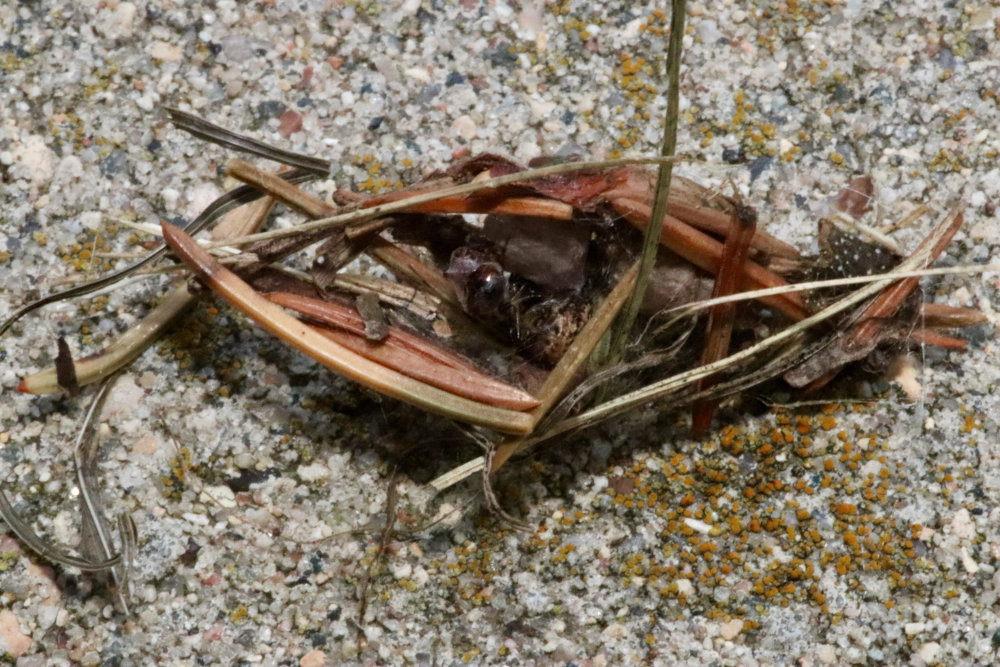
I have an office spider, Diana, who lives in a display case with a wooden climbing frame and a floor made of left over calcareous sand and shells from my aquarist days. Today I found that she’d seized stuff from the ground, like this:
…lifted them up to her web up high, and build a hemispherical nest, which she was snuggled down inside of. Clever girl.
If you want to see the nest, I put a photo on Patreon (reminder: I have a patreon account I use to try to pay off our legal debt) and also on Instagram.
Last chance to support a fun science project, Crow Scientist, the real-world science app for kids. Go read about it, it looks good!