I’ve got my neurobiology students blogging — all I ask is that they write something relevant to understanding how brains work. Let’s see where their minds are at this week, shall we?
-
Lies!
(Also on Sb)

Emily Baldry is six years old. Emily has a little plastic shovel. Emily dug up a 160 million year old cephalopod.

I’m 54, I have a little plastic spoon, and I’m eyeing the backyard. There used to be cephalopods swimming around in this neighborhood…of course, there were also some annoying glaciers that scoured the landscape. But I can dream!
(Also on Sb)

This orchid actually does just that. Explicit, detailed diagrams of it fertilizing itself below. Tell the children to close their eyes!
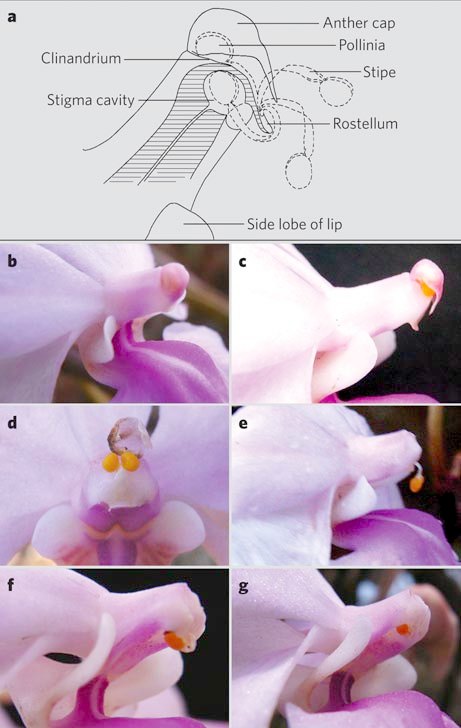
(via National Geographic)
(Also on Sb)

I criticized the Zietsch and Santilla paper on the female orgasm. Now one of the authors has responded.
One response he makes is that some of the limitations to the study that I pointed out were also explicitly recognized in the paper. This is true; however, my purpose in mentioning them was to highlight the fact that they make it impossible to draw even the tentative conclusions the authors do…which obviously is not something that was done in the paper. Admitting that assessing orgasmic function with self-reports, for instance, is a limitation doesn’t really change the fact that extremely weak evidence was published to support a particular hypothesis.

This is tragic. A unique site where the giant cuttlefish migrates and breeds is under threat by the construction of a desalination plant that would render the local waters unsupportable to cuttlefish life. This must be stopped!
There is a petition: sign it.
(via Cuttlefish, of course)
(Also on Sb)

One of my favorite science books ever is Elisabeth Lloyd’s The Case of the Female Orgasm, which does a beautiful job of going case-by-case through postulated adaptive explanations for female orgasms and showing the deficiency of the existing body of work. It’s a beautiful example of the application of rigorous scientific logic; it does not disprove that female orgasms have an adaptive function, but does clearly show that the scientists who have proposed such functions have not done the work necessary to demonstrate that fact, and that some of the explanations are countered by the evidence. Her conclusion was that the likely explanation for the female orgasm was that it wasn’t directly adaptive: women have them because men are selected for having them, and that the women are just along for the happy ride, just as men have nipples because there has been selection for women to have them.
A lot of people detest the book, though. It does rather ruthlessly cut through many adaptive scenarios, and some people just seem to have a bias that if something exists, it must have a purpose. And for some reason, there is an odd preconception that purposeless features are counter to evolution (they aren’t).
Now there’s a new paper out by Zietsch and Santtila that purports to challenge the non-adaptive explanation. It fails. It fails pretty badly, actually. I’ll go further: I thought it was a terrible paper, especially in contrast to the clarity of Lloyd’s work. Here’s the abstract:
The evolutionary basis of human female orgasm has been subject to furious scientific debate, which has recently intensified. Many adaptive explanations have been proposed, invoking functions from pair bonding and mate selection to sucking up sperm, but these have been attacked as being based on flawed logic and/or evidence. The popular alternative theory is that female orgasm is not adaptive and is only evolutionarily maintained as a by-product of ongoing selection on the male orgasm-ejaculation system. This theory has not been adequately tested. We tested one of its central tenets: that selection pressure on the male orgasm is partially transmitted to the female via a positive cross-sex correlation in orgasmic function (susceptibility to orgasm in response to sexual stimulation). Using questionnaire data from over 10 000 Finnish twins and siblings, we found significant genetic variation in both male and female orgasmic function, but no significant correlation between opposite-sex twins and siblings. This suggests that different genetic factors underlie male and female orgasmic function and that selection pressures on male orgasmic function do not act substantively on female orgasmic function. These results challenge the by-product theory of female orgasm.
So their method was to survey twins and siblings about their sexual performance, and an absence of a correlation between different-sex siblings was interpreted to suggest an absence of a shared, heritable property between males and females. The logic of this experiment falls apart at every level.
First, they are relying on self-reporting of a trait that has strong psychological and cultural components, without making any effort to isolate any of the variables that would bias the subjects’ answers. I would be extremely cautious in interpreting the answers, yet the authors are making quantitative assessments of an inferred genetic network on the basis of some very mushy data.
Secondly, and this one drove me up the wall in trying to read this paper, they are comparing men and women…but asking the two sexes completely different questions. How can you even compare the answers? Men were asked, “How fast have you typically ejaculated after the intercourse (vaginal or anal) has commenced?” — a question about speed that assumes a 100% incidence of orgasm, and only considers intercourse. Women were asked, “Over the past four weeks, when you had sexual stimulation or intercourse, how often did you reach orgasm?” — so no constraint on how orgasm was achieved, or how long it took, but they do limit the interval. In order to compare a time to a frequency, the authors crunch the numbers down to a single value they call a measure of orgasmic function in males and females. But this is still bogus: they really are comparing apples and oranges at every step.
It seems to me that the relevant parameter to measure is whether the subject has any capacity to have an orgasm — do they have the physiological machinery to carry out this function? The question of how robustly this property is expressed is a different issue altogether. When you look at their data this way, it looks just as flawed, but with another twist. All of 1.9% of the male subjects reported never achieving orgasm through intercourse; 12% of the female subjects reported “rarely or never” having an orgasm in the last 4 weeks. This is actually a surprisingly good number; worldwide frequency of anorgasmia in women is typically around 20%, but the sample the authors are taking their data from is fairly homogeneous, consisting of Finns between 18 and 49. Again, though, the results highlight the cultural variability: the female response seems to be much more sensitive to environmental conditions, while the male response is strongly canalized. You can’t assess orgasm in women without taking a whole battery of social issues into account, while men are easy. The orgasmic response in men is locked in as a response to testosterone levels, which are reliably high in most men, while the same response in women relies on other, probably diverse, developmental cues to be switched on.
The situation is that when you examine orgasm in men, you find a heritability that’s near zero — what that means is that there are almost no phenotypic differences in the population that can be accounted for by genetic variation. There could be hidden variation that is swamped out by a robust environmental effect (like testosterone!), but you can’t measure it. One interesting way to look at women, though, is they have the same genetic variations as men, but those variations are unmasked and exposed phenotypically by the absence of the canalizing effect of testosterone, and that’s one mildly suggestive result of this paper — they found a correlation in the frequency of orgasmic response in monozygotic female twins that was stronger than that between dizygotic female twins. Similarly, they found a correlation in the rapidity of orgasmic response between male monozygotic twins, which suggests there could be some genetic component there, as well.
But you can’t compare the male and female measures! They’re different things! Men and women could be sharing the very same genetic circuitry behind orgasm, supporting the by-product hypothesis, but the different endocrine regimes of male and female embryos could be activating entirely different auxiliary genetic circuitry that contributes to the response. In fact, I’d consider it extremely unlikely that female orgasm doesn’t use exactly the same genetic apparatus as male orgasm. If anyone wants to really show that the byproduct hypothesis is false, a demonstration that the female orgasm is produced by pathways that are independent of, and evolved in parallel to, the male machinery would be more than sufficient. A study that is built around subjective reporting of the experience of orgasm isn’t going to do it, though.
A few other sites have looked at this paper.
Greg Laden has more on the behavioral biology of primates, but I’m afraid he doesn’t really get the byproduct theory at all — he keeps talking about the adaptive value of female orgasm, but they’re all post-hoc rationalizations. That culture adapts to the existence of female orgasms does not imply that female orgasms evolved as an adaptive phenomenon. I can show that orgasms make women happy; the question is, does the happiness of women contribute to the evolutionary success of the species? And I’m sorry, evolution doesn’t care.
Scicurious rightly concludes that the paper does not demonstrate what the authors claim it does, but I get the impression that she hasn’t read Lloyd — she has a brief summary of the adaptive alternatives that is fairly casual. Really, Lloyd demolishes them all. She doesn’t necessarily prove that they’re wrong, nor does she claim to do so, but she does show that most of the hypotheses are little more than wishful thinking.
Zietsch B, Santtila P (2011). Genetic analysis of orgasmic function in twins and siblings does not support the by-product theory of female orgasm Animal Behaviour DOI: 10.1016/j.anbehav.2011.08.002
(Also on FtB)

One of my favorite science books ever is Elisabeth Lloyd’s The Case of the Female Orgasm, which does a beautiful job of going case-by-case through postulated adaptive explanations for female orgasms and showing the deficiency of the existing body of work. It’s a beautiful example of the application of rigorous scientific logic; it does not disprove that female orgasms have an adaptive function, but does clearly show that the scientists who have proposed such functions have not done the work necessary to demonstrate that fact, and that some of the explanations are countered by the evidence. Her conclusion was that the likely explanation for the female orgasm was that it wasn’t directly adaptive: women have them because men are selected for having them, and that the women are just along for the happy ride, just as men have nipples because there has been selection for women to have them.
A lot of people detest the book, though. It does rather ruthlessly cut through many adaptive scenarios, and some people just seem to have a bias that if something exists, it must have a purpose. And for some reason, there is an odd preconception that purposeless features are counter to evolution (they aren’t).
Now there’s a new paper out by Zietsch and Santtila that purports to challenge the non-adaptive explanation. It fails. It fails pretty badly, actually. I’ll go further: I thought it was a terrible paper, especially in contrast to the clarity of Lloyd’s work. Here’s the abstract:

Islands swarming with tens of millions of red crabs. Yellow crazy ants. Vicious arthropod battles for dominance. Cats are freakin’ boring.