How many genes does it take to make a squid eye?

This is an article about cephalopods and eye evolution, but I have to confess at the beginning that the paper it describes isn’t all that interesting. I don’t want you to have excessive expectations! I wanted to say a few words about it, though, because it addresses a basic question I get all the time, and while I was at it, I thought I’d mention a few results that set the stage for future studies.

I’m often asked to resolve some confusion: the scientific literature claims that eyes evolved multiple times, but I keep saying that eyes show evidence of common origin. Who is right? Why are you lying to me, Myers? And the answer is that we’re both right.

Eyes evolved independently multiple times: the cephalopod eye evolved about 480 million years ago, and the vertebrate eye is even older (490 to 600 million years), but both evolved long after the last common ancestor of molluscs and chordates, which lived about 750 million years ago. The LCA probably did not have an image-forming eye at all.

And that’s the key point: a true eye is a structure that has an image forming element, a retina, and some kind of morphological organization that allows a distant object to form a pattern of light on that retina. That organization can be something as simple as a cup-shaped depression or pinhole lens, or as elaborate as our camera eye, or an insect’s compound eye, or the mirror eyes of a scallop. An eye is photoreceptors + structure. Eyes have evolved multiple times; they’ve even evolved multiple times within the phylum Mollusca, and different lineages have adopted different strategies for forming images.

i-0f6286e48f36b86c30ae81bdbfc6f415-eye_phylo-thumb-500x210-70144.jpeg
(Click for larger image)

Phylogenetic view of molluscan eye diversification. Camera eyes were independently acquired in the coleoid cephalopod (squids and octopuses) and vertebrate lineages.

The LCA probably didn’t have an eye, but it did have photoreceptors, and the light sensitive cells were localized to patches on the side of the head. It even had two different classes of photoreceptors, ciliary and rhabdomeric. That’s how I can say that eyes demonstrate a pattern of common descent: animals share the same building block for an eye, these photoreceptor cells, but different lineages have assembled those building blocks into different kinds of eyes.

Photoreceptors are fundamental and relatively easy to understand; we’ve worked out the full pathways in photoreceptors that take an incoming photon of light and convert it into a change in the cell’s membrane properties, producing an electrical signal. Making an eye, though, is a whole different matter, involving many kinds of cells organized in very specific ways. The big question is how you evolve an eye from a photoreceptor patch, and that’s going to involve a whole lot of genes. How many?

This is where I turn to the paper by Yoshida and Ogura, which I’ve accused of being a bit boring. It’s an exercise in accounting, trying to identify the number and isolate genes that are associated with building a camera eye in cephalopods. The approach is to take advantage of molluscan phylogeny.

As shown in the diagram above, molluscs are diverse: it’s just the coleoid cephalopods, squid and octopus, that have evolved a camera eye, while other molluscs have mirror, pinhole, or compound eyes. So one immediate way to narrow the range of relevant genes is a homology search: what genes are found in molluscs with camera eyes that are not present in molluscs without such eyes. That narrows the field, stripping out housekeeping genes and generic genes involved in basic cellular processes, even photoreception. Unfortunately, it doesn’t narrow the field very much: they identified 5,707 candidate genes that might be evolved in camera eye evolution.

To filter it further, the authors then looked at just those genes among the 5,707 that were expressed in embryos. Eye formation is a developmental process, after all, so the interesting genes will be expressed in embryos, not adults (a sentiment with which I always concur). Unfortunately, development is a damnably complicated and interesting process, so this doesn’t narrow the field much, either: we’re down to 3,075 candidate genes.

Their final filter does have a dramatic effect, though. They looked at the ratio of non-synonymous to synonymous nucleotide changes in the candidate genes, a common technique for identifying genes that have been the target of selection, and found a grand total of 156 genes that showed a strong signal for selection. That’s 156 total genes that are different between coleoids and other molluscs, are expressed in the embryonic eye, and that show signs of adaptive evolution. That’s manageable and interesting.

They also looked for homologs between cephalopod camera eyes and vertebrate camera eyes, and found 1,571 of them; this analysis would have been more useful if it were also cross-checked against other non-camera-eye molluscs. As it is, that number just tells us some genes are shared, but they could have been genes involved in photoreceptor signalling (among others), which we already expect to be similar. I’d like to know if certain genes have been convergently adopted in both lineages to build a camera eye, and it’s not possible to tell from this preliminary examination.

And that’s where the paper more or less stops (I told you not to get your hopes up too high!) We have a small number of genes identified in cephalopods that are probably important in the evolution of their vision, but we have no idea what they do, precisely, yet. The authors have done some preliminary investigations of a few of the genes, and one important (and with hindsight, rather obvious) observation is that some of the genes are expressed not just in the retina, but in the brain and optic lobes. Building an eye involved not just constructing an image-forming sensor, but expanding central tissues involved in processing visual information.


Fernald RD (2006) Casting a genetic light on the evolution of eyes. Science 313(5795):1914-8.

Yoshida MA, Ogura A (2011) Genetic mechanisms involved in the evolution of the cephalopod camera eye revealed by transcriptomic and developmental studies.. BMC Evol Biol 11:180.

(Also on FtB)

Someone tell Santa about good kids’ books

There aren’t enough children’s books telling the story of evolution — every doctor’s office seems to be stocked with some ludicrous children’s book promoting that nonsensical Noah’s ark story, but clean, simple, and true stories about where we came from are scarce. Here’s one, a new children’s book called Bang! How We Came to Be by Michael Rubino. Each page is formatted the same: on the left, a color picture of an organism (or, on the early pages, a cosmological event); on the right, a short paragraph in simple English explaining what it is and when it occurred. The book just marches forward through time, showing us where our species came from. Easy concept, nice execution, and it fills a gap in children’s literature.

It’s short enough to be good bedtime reading, and simple enough for pre-schoolers. The illustrations are thought-provoking enough for older kids, but won’t keep them engaged for too long — they’ll be asking for more books to satisfy their curiosity about these strange creatures that lived billions or hundreds of millions or tens of millions of years ago. Which is exactly what we want to do to our kids, right?

(Also on Sb)

Grace under pressure

The BBC is running an interview with Dame Jocelyn Bell-Burnell, and it’s very good. Bell-Burnell is the woman who discovered pulsars, and until I heard this interview, I hadn’t realized how it was done.

Yeah, there weren’t computers available so the reams of data came out on strip chart – paper chart – and the configuration produced a hundred foot a day and I ran it for six months, which gave me about three miles of paper, which I had to analyse by hand. I would go through the charts and I would log where I saw what I thought were quasars and I also saw that there were chunks of manmade interference – artificial interference. But just occasionally, one time out of five or one time out of 10, when we looked at a particular bit of sky there was this additional signal that didn’t look exactly like a quasar, didn’t look exactly like low level interference, occupied about a quarter inch of the chart.

So…spotting periodic quarter inch blips scattered on 3 miles of paper. I don’t want to hear any of you students complaining about your daily grind any more!

Unfortunately, she was robbed: she discovered pulsars, it was her persistence that got her advisor to take the observations seriously, after initially dismissing the whole idea — and guess who won the Nobel in 1974 for the discovery? Her advisor, and not Jocelyn Bell-Burnell. She does not complain, however; those were the facts of life.

I think at that time science was perceived as being done by men, senior men, maybe with a whole fleet of minions under him who did his bidding and weren’t expected to think. I believe the Nobel Prize committee didn’t even know I existed.

And then the newspapers covered pulsars, and called her the “girl”…

Oh yes and worse than that what were my vital statistics and how tall was I and you know – chest, waist and hip measurements please and all that kind of thing. They did not know what to do with a young female scientist, you were a young female, you were page three, you weren’t a scientist.

Apparently, it was also the custom when she was a student in Glasgow for the men to stamp their feet and wolf-whistle whenever a woman walked into a lecture hall, and she of course was the only woman in the entire physics program at the time.

None of this could possibly have influenced the career decisions of an entire generation of women, I’m sure.

(Also on Sb)

What have my students been thinking about lately?

I gave them an exam, that’s what. That and long boring lecturings at 8am on pattern formation in the nervous system. But otherwise, I’ve had them blogging, so we can take a peek into the brain of a typical college student and see what actually engages them.

I understand these are all the things all college students everywhere are contemplating.

(Also on Sb)

Watts wrote a check he couldn’t cash

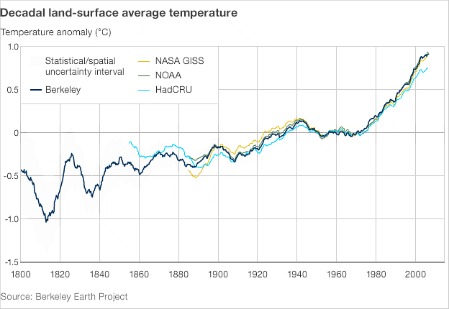
That wacky climate change denier and radio weather broadcaster Anthony Watts took a brave step a while back, and I commend him for it. He was enthused about an independent research project, the Berkeley Earth Project, that would measure the planet’s temperature over the last centuries and compare it to the work of NOAA and NASA on earth’s temperature — he apparently expected that it would show that NASA and NOAA had been inflating the data. He was so confident that he went on the record saying:

I’m prepared to accept whatever result they produce, even if it proves my premise wrong.

Excellent! That’s a good scientific attitude.

So the results have been published, and they look like this:

Results from the Berkeley Earth project data fits existing NASA and NOAA temperature records like a glove

You can probably see the NASA/NOAA data wiggling beneath the dark bold line of new data from the Berkeley Earth Project. They’re rather…close. Intimate, even.

What do you think Anthony Watts’ response was?

I consider the paper fatally flawed as it now stands, and thus I recommend it be removed from publication consideration by JGR until such time that it can be reworked.

Yep. Didn’t give the results he wanted. Therefore, the experiment is bad.

(Also on Sb)

How to examine the evolution of proteins

In my previous post, I described the misguided approach Gauger and Axe have taken to criticizing evolution, and one of the peculiarities of their criticism is that they cited another paper by a paper by Carroll, Ortlund, and Thornton which traced (successfully) the evolutionary history of a class of proteins. Big mistake. As I pointed out, one of the failings of the Gauger/Axe approach is that they’re asking how one protein evolved into a cousin protein, without considering the ancestral history …they make the error of trying to argue that an extant protein couldn’t have directly evolved into another extant protein, when no one argues that they did.

The tactical error is that right there in the very first paragraph of their paper, Carroll, Ortlund, and Thornton point out the fallacy of what the creationists were doing.

Direct comparisons among present-day proteins can sometime yield insights into the sequence and structural mechanisms that underlie functional differences. Such “horizontal” comparisons, however, cannot determine which protein features are ancestral and which are derived, so they are not suited to reconstructing the events that produced functional diversity.

They don’t mention Gauger and Axe, of course — this paper was written before the creationists wrote theirs — but a methodological flaw is still spelled out plainly, the creationists reference it so I presume they read it, and they still charged ahead and did their flawed study, and then had the gall to claim their work was superior.

[Read more…]

How to examine the evolution of proteins

In my previous post, I described the misguided approach Gauger and Axe have taken to criticizing evolution, and one of the peculiarities of their criticism is that they cited another paper by a paper by Carroll, Ortlund, and Thornton which traced (successfully) the evolutionary history of a class of proteins. Big mistake. As I pointed out, one of the failings of the Gauger/Axe approach is that they’re asking how one protein evolved into a cousin protein, without considering the ancestral history …they make the error of trying to argue that an extant protein couldn’t have directly evolved into another extant protein, when no one argues that they did.

The tactical error is that right there in the very first paragraph of their paper, Carroll, Ortlund, and Thornton point out the fallacy of what the creationists were doing.

Direct comparisons among present-day proteins can sometime yield insights into the sequence and structural mechanisms that underlie functional differences. Such “horizontal” comparisons, however, cannot determine which protein features are ancestral and which are derived, so they are not suited to reconstructing the events that produced functional diversity.

They don’t mention Gauger and Axe, of course — this paper was written before the creationists wrote theirs — but a methodological flaw is still spelled out plainly, the creationists reference it so I presume they read it, and they still charged ahead and did their flawed study, and then had the gall to claim their work was superior.

Ah, silly creationists. They just assume their target audience won’t bother to read the work they’re citing, and isn’t competent to understand it anyway. And they’re usually right.

The crew doing the work in the Carroll paper did not make the same mistakes. They are doing ancestral sequence reconstruction (ASR), so the effort to work backward to trace ancestral states is implicit. The bulk of the paper describes the sequencing of homologous and paralogous genes in more organisms (in this case, especially cartilaginous fishes), and the analysis of synthesized, reconstructed ancestral proteins, so it’s built entirely on an empirical foundation. And their answers actually advance our understanding of the base-by-base changes that led to the evolution of the current set of proteins. I think they were courteous and sensible (and probably, the idea didn’t even occur to them) in not comparing their work to that of the creationists — it would have been less than gracious to point out how ugly, cheap, and cheesy the stuff coming out of the Biologic Institute looks.

What the real scientists were studying is a class of receptors that respond to mineralocorticoid and/or glucocorticoid hormones. These proteins are similar in sequence and structure to one another, and are clearly paralogous: they arose by an ancient gene duplication event, somewhere around 450 million years ago. The two copies have since diverged to have different roles in hormone physiology.

The two receptors are called MR, for mineralocorticoid receptor, and GR, for glucocorticoid receptor.

MRs are activated by adrenal hormones, aldosterone and deoxycorticosterone, and to a lesser exent, cortisol. The receptors are extremely sensitive to the hormones. These hormones are important in regulating salt balance, and you might well imagine that in our fishy ancestors, as well as ourselves, regulating the concentrations of salts in our blood and tissues is a very important function. Deviations can cause death, after all.

GRs are activated by high doses of cortisol; these receptors are much less sensitive, requiring high doses of the hormone to trigger a response. They are important in regulating stress responses: they adjust the immune system and sugar metabolism. These aren’t ‘twitchy’, fast response functions like maintaining salt balance is; they are long-term, ‘last-ditch’ reactions to growing stresses, so functionally it makes sense that activation requires high levels of accumulated hormone.

Using ASR techniques — phylogenetic analysis and estimating the most likely sequence of the ancestral protein — the investigators have put together a picture of the receptor before MR and GR diverged. This protein is called AncCR, for Ancestral Corticosteroid Receptor, and it has been synthesized in the lab, so we know about its properties. AncCR is a lot like MR: it’s sensitive to low concentrations of hormone, and it responds to low concentrations of a broad spectrum of hormones.

The pedigree of these proteins is illustrated below.

i-8821726c17d966da50a695e8a1d903b7-grmr_phylo-thumb-500x280-70023.gif
(Click for larger image)

Simplified phylogeny of corticosteroid receptors. Ancestral sequences are shown at relevant nodes: AncCR, the last common ancestor of all MRs and GRs; AncGR1, the GR ancestor of cartilaginous fishes and bony vertebrates; AncGR2, the GR ancestor of ray- and lobe-finned fishes (including tetrapods); AncMR1, the MR ancestor of cartilaginous fishes and bony vertebrates. (AncGR1.0 and AncGR1.1 are different reconstructions of node AncGR1, inferred from datasets with different taxon sampling.) Black, high sensitivity receptors; gray, low sensitivity receptors. Single and double gray dashes mark functional shifts towards reduced sensitivity and increased specificity, respectively. Support values are the chi-square statistic (1 – p, where p equals the estimated probability that a node could occur by chance alone) calculated from approximate likelihood ratios. The length of branches from AncCR to AncMR1 and to AncGR1, expressed as the mean number of substitutions per site, are indicated in parentheses.

The MRs are similar in function to the AncCR, so they aren’t particularly interesting in this context — there’s no big question about how the MRs retained similar properties to their ancestor. The interesting questions are all about the GRs: what changed to make GRs different from the ancestral protein? What amino acid changes set AncGR1 apart from AncCR?

The investigators have an answer. The first step was the evolution of reduced hormone sensitivity, so that these receptors only responded to very high concentrations of the hormone, and the second step was a loss of sensitivity to the mineralocorticoids, already handled by the MRs, so that they only respond to high doses of cortisol, which at this point became exclusively a stress hormone. And they know exactly which amino acids changed to confer the reduced sensitivity.

They identified three changes: the conversion of a valine at position 43 into an alanine, called V43A; the conversion of an arginine at position 116 into a histidine, R116H; and the conversion of a cysteine at position 71 into a serine, C71S. They also know the effect of the mutations. V43A and R116H each loosen the structure of the receptor so that it’s less sensitive, and when both mutations are present the effect greatly reduces sensitivity about 10,000-fold…too much! They make the mutant hormone too insensitive, and much less insensitive than their reconstructed AncGR1.

The most interesting change is C71S. It basically does nothing to the sensitivity; make the C71S change to AncCR, and you get a receptor protein that is essentially indistinguishable in its response. This is effectively a neutral mutation. It can spread freely through a population with no deleterious or advantageous effect.

C71S does have one significant effect in cooperation with the other two mutations: it buffers both V43A and R116H. When all three mutations are present, the desensitizing effects of V43A and R116H are reduced to produce the level of sensitivity expected for the AncGR1 protein. This means we can reconstruct the order of the amino acid changes in evolution. First came C71S, because it doesn’t cause any particular adaptive change, and because if either V43A or R116H came first, the resulting receptor would be generally non-functional. The existence of C71S first means the subsequent V43A/R116H changes produced receptors that are still functional, but simply operate only at higher concentrations of the hormones.

All of these changes are perfectly compatible with an evolutionary model of their origin. No sudden leaps, no deleterious intermediates are required — everything hangs together beautifully and is backed up by solid empirical evidence. In addition, the work explains the mechanics of receptor-hormone interactions, stuff I haven’t explained here, but if you’re a biochemist, there’s much to savor in the paper.

It’s an amazing contrast to the Gauger and Axe paper, too. No wonder I’m not a creationist!


Carroll SM, Ortlund EA, Thornton JW (2011) Mechanisms for the evolution of a derived function in the ancestral glucocorticoid receptor. PLoS Genet.7(6):e1002117. Epub 2011 Jun 16.