I’m always telling people you need to understand development to understand the evolution of form, because development is what evolution modifies to create change. For example, there are two processes most people have heard of. One is paedomorphosis, the retention of juvenile traits into adulthood — a small face and large cranium are features of young apes, for instance, and the adult human skull can be seen as a child-like feature. A complementary process is peramorphosis, where adult characters appear earlier in development, and then development continues along the morphogenetic trajectory further than normal, producing novel attributes. You may have encountered examples of this in fiction: the best known are the Pak Protectors in Niven’s science-fiction stories, which are the result of longer-lived humans continuing the processes of aging to reach a novel form. There’s also the story of After Many a Summer Dies the Swan, a novel by Aldous Huxley, in which a paedomorphic species (a human) lives for a very long time and develops to reach the ancestral state — a more primitive apelike form.
Just to make it more complicated, though, this isn’t to say that evolution proceeds by arresting the whole of development, turning the adult into an overgrown baby. What’s going on here is that genes that control the rate of development are being tweaked by genetic change, and there are many of those genes. There can be all sorts of mixing and matching — one organ or feature can undergo paedomorphosis in a species at the same time that another is undergoing peramorphosis.
A beautiful example has recently been published in Nature: the evolution of the avian skull. The postcranial bird skeleton can’t be neatly categorized as changes in rate: wings, the correlated changes in the pelvis and thorax, all that is a messy collection of novelties. The skull, though, can at least be broken down into a couple of key avian adaptions: brains and beaks. The cranium has gone through a set of changes with all the behavioral and sensory changes (big eyes, motor aspects of flight, navigation), while the beak has obviously diversified for different feeding strategies. The beak has changed to take over the manipulatory role lost as forelimbs became wings.
Here’s how the role of heterochrony (changes in rate of development) of different species was determined. The authors collected quantitative morphological data on a set of fossil dinosaurs and birds and extant birds for which there were both embryological and adult data. There are some straightforward observations that just leap out at you. For instance, embryonic alligator skulls have the same proportions as the skull of adult Confuciusornis, a crow-sized bird from the Cretaceous.
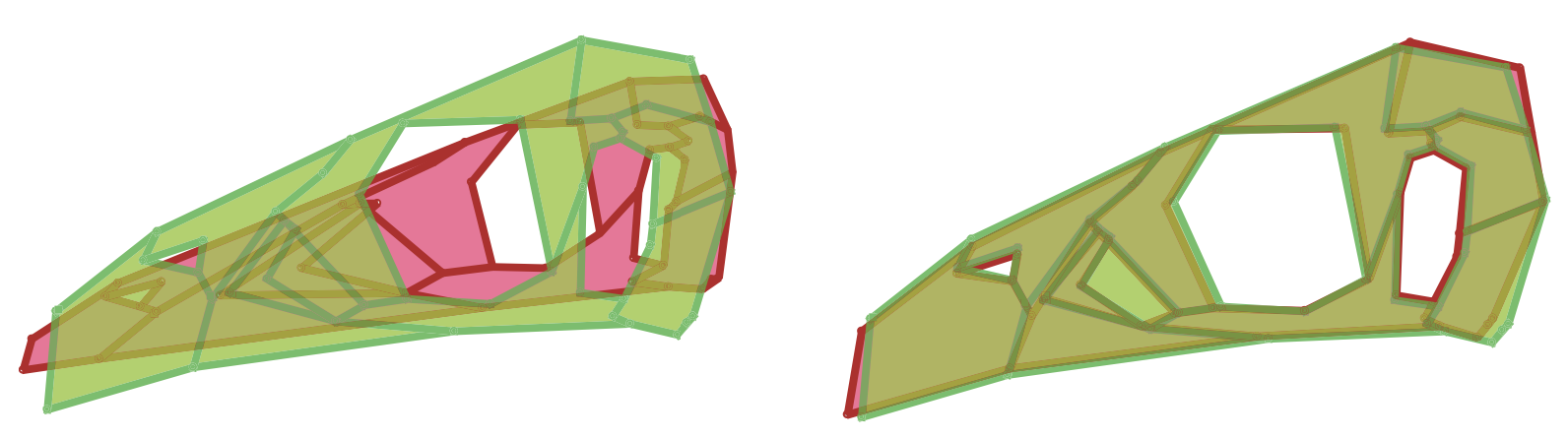
Similarity of embryonic Alligator and adult Confuciusornis skulls. Superimposition of Alligator embryo skull (green) onto Alligator adult skull (red, left) and onto Confuciusornis adult skull (red, right), showing the nearly identical skull configuration of the latter two and indicating paedomorphic cranial morphology in Confuciusornis.
Another common and long-hallowed technique in developmental biology is to trace a standard skull onto a 2-D grid and then determine what distortions of the grid are necessary to reshape the skull into a specific form. This method makes the stretching and skewing and compression that had to have occurred over time to sculpt these skulls from an ancestor. Here are the ontogenetic changes for different species, illustrating how they changed shape as they grew up.
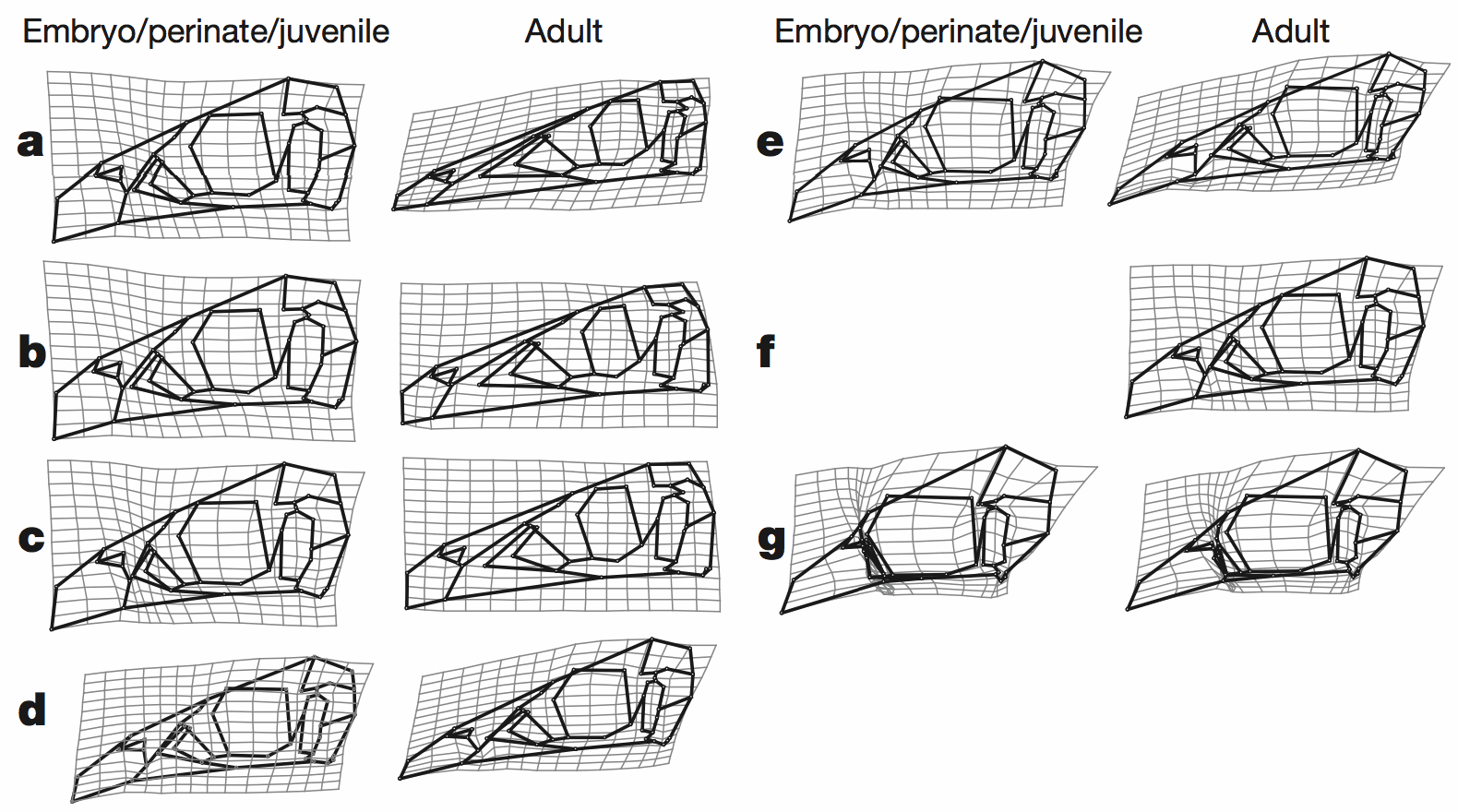
Summary of ontogenetic changes in archosaur skulls; outlines on deformation grids from average. a, Alligator. b, Compsognathidae. c, Therizinosauridae. d, Archaeopteryx. e, Enantiornithes. f, Confuciusornis. g, Ostriches (Struthio).
If you can do this kind of assessment of transformations over development, you can also do it over phylogeny. Below are shown the trends observed in dinosaur and avian evolution.
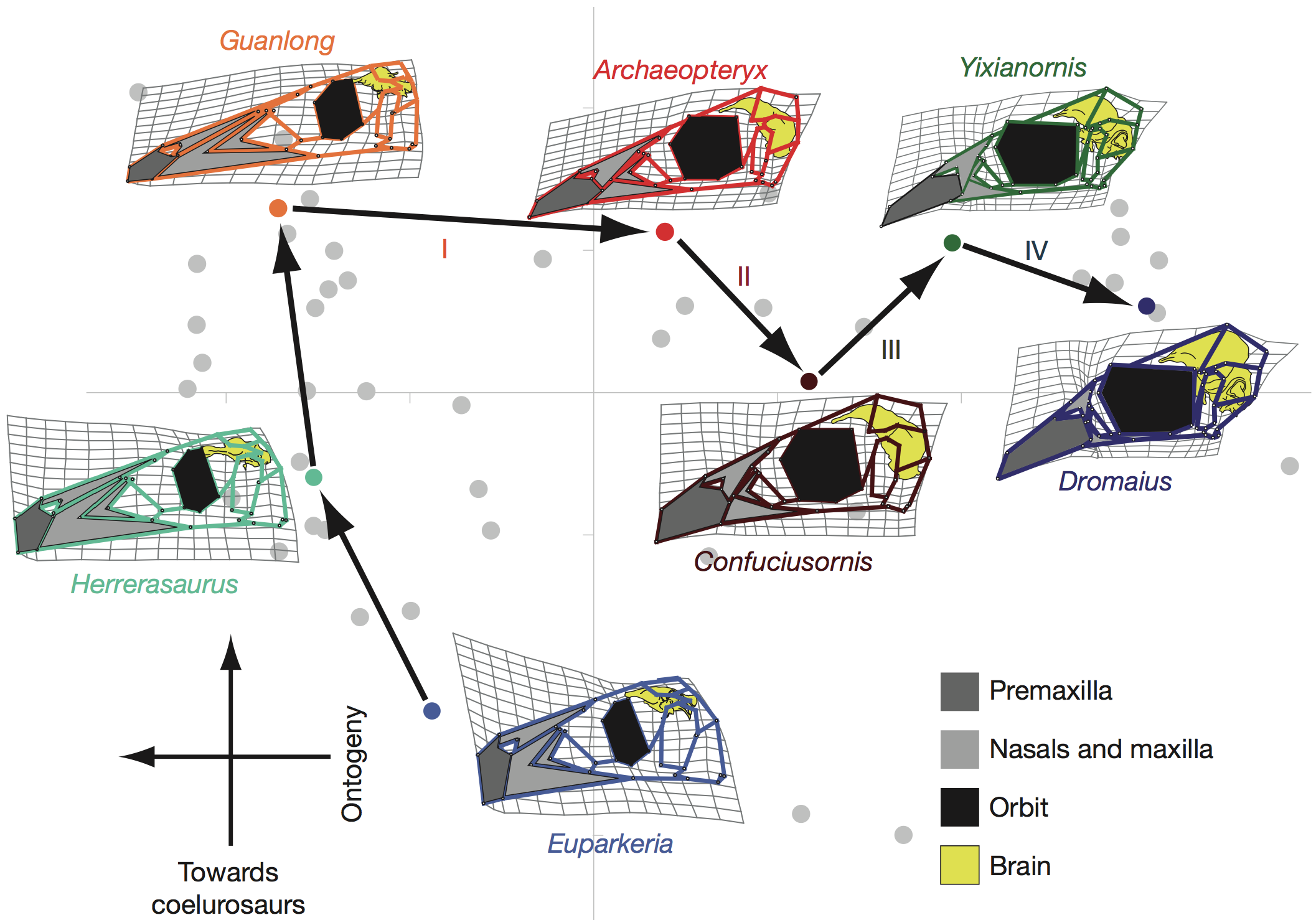
Summary of heterochrony and phylogeny in bird skull evolution. emu Dromaius. Heterochronic transformations referred to in the text are A phylogenetic sequence with skull outlines set on deformation grids is enumerated with Roman numerals. Major anatomical regions involved in depicted from the primitive stem-group archosaur Euparkeria to the modern heterochronic transformations are labelled.
The coordinate system on which those skulls are mapped is a little tricky to explain. With all the numerical data available from their skull measurements, the authors did a principal component analysis, determining metrics that accounted for most of the variability between skulls. What they found were two axes of change: one is in the shape of the cranium, which exhibited paedomorphic patterns of change (although the contents of that cranium, the brain, is known to have undergone more complex heterometric change); the second was in the beak, which shows a pattern of peramorphic change.
But that’s the cool thing about this! We can quantitatively describe the plastic changes in the shape of the skull over evolutionary history as largely the product of two trends: a retention of the bulbous embryonic shape of the skull, and increased extension of the facial bones to form a beak. It’s not magic, it’s the expected incremental shifts in shape over long periods of time, in which we can actually visualize the pattern of transformation.
Now we just need to work out the genes behind these morphological changes, and their mode of action. That’s all. Hey, I think the developmental biologists have at least a century of gainful employment ahead of them…
Bhullar BA, Marugán-Lobón J, Racimo F, Bever GS, Rowe TB, Norell MA, Abzhanov A (2012) Birds have paedomorphic dinosaur skulls. Nature doi: 10.1038/nature11146. [Epub ahead of print]