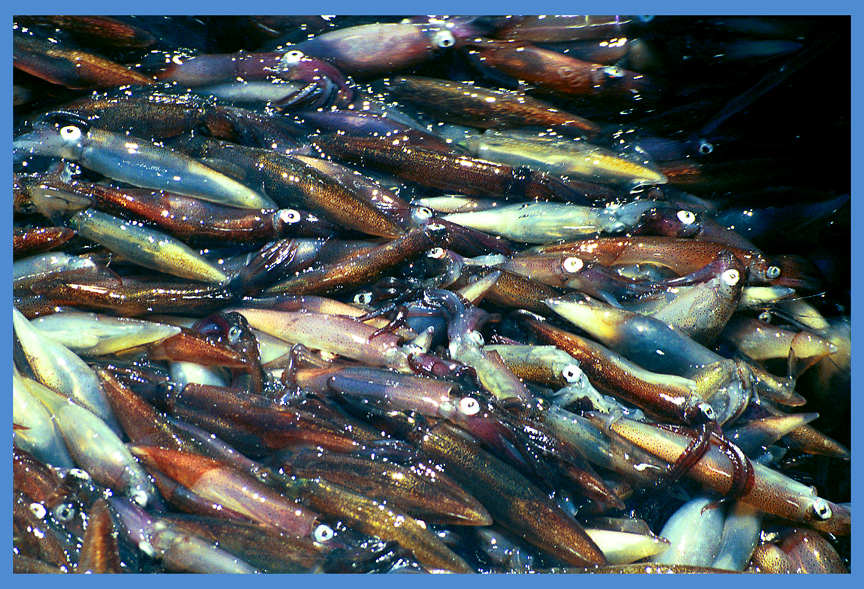
(It’s from the California Seafood Council, but let’s not hold that against them)

I had never heard of the Women in Space Program before, but apparently, after the Soviets sent Valentina Tereshkova into space, there was actually an effort to train American women as astronauts.
The participants of the Women in Space Program experienced tremendous success. “Nineteen women enrolled in WISP, undergoing the same grueling tests administered to the male Mercury astronauts,” Brandon Keim wrote in 2009. “Thirteen of them — later dubbed the Mercury 13 — passed ‘with no medical reservations,’ a higher graduation rate than the first male class. The top four women scored as highly as any of the men.”
The graduates were Geraldyn “Jerrie” Cobb, Wally Funk, Irene Leverton, Myrtle “K” Cagle, Jane B. Hart, Gene Nora Stumbough, Jerri Sloan, Rhea Hurrle, Sarah Gorelick, Bernice “B” Trimble Steadman, Jan Dietrich, Marion Dietrich, and Jean Hixson, called the “Mercury 13”.
I never heard of them before. They didn’t go into space, either. What happened?
Well, there were some revoltingly sexist attitudes at NASA.
In fact, one NASA official who declined to give his name to a reporter, said it made him “sick to his stomach” to think of women in space. Another called Tereshkova’s flight “a publicity stunt.”
A few did think of one use for women in space: “improving crew morale”. They nixed that because “such a situation might create interpersonal tensions far more dynamic than the sexual tensions it would release”. Yeah, they went there: the one thing a woman astronaut might be good for is getting her male colleagues off during long space flights.
So they come up with a lovely catch to prevent well-qualified women from joining the space program.
For a short while, it seemed that their quest to fly might advance. In 1962, the women were scheduled to continue testing at the Naval School of Aviation Medicine in Pensacola, Florida, but NASA declined to support their visit. Without official backing, the Navy canceled the trip. Cobb tried to save the program, flying to Washington and testifying before Congress. But NASA officials, John Glenn among them, told the Congressmen that women couldn’t be astronauts because they hadn’t flown jets, which were only available to the military, which also barred women.
This argument apparently proved persuasive and the Mercury 13 never got another chance to make their case for space, even after Tereshkova’s record-setting flight.
Would you believe I got a comment from a Thunderf00t acolyte on youtube just this morning?
FEMINISM IS A NON ISSUE. WOMEN ALREEEEEEEEADY HAVE EQUAL RIGHTS IN THE WEST. NO MORE NEED FOR FEMINISM IN THE WEST.
Nice to know these problems have all gone away already.

There is an extremely common sort of experiment to understand plasticity of the developing brain. These are important experiments to understand an important phenomenon: the brain does not simply unfold ineluctably to produce a fully functional organ, but actually interacts constantly with its environment to build a functioning organ that is matched to the world it must model and work with. This was one of the very first things I learned as a budding neuroscientist; my first undergraduate research experience was in the lab of Jenny Lund at the University of Washington, where we were given prepared slices of embryonic and infant human brains (the products of abortions, stillbirths, and childhood mortality) and counted dendritic spines in the visual cortex. The brain is constantly remodeling itself, and is especially doing so in young individuals.
Now in those old observations, we weren’t really manipulating either the brain or the environment: you don’t get to do that with human babies! All we were doing was documenting the natural progression of synaptic connection density — which, by the way, declines rapidly as the brain learns and refines. What we could see anatomically is that as young children adapt to their environment, the brain is busily pruning and shifting connections — but what we couldn’t see is what was causing those changes, or what effect those anatomical changes had on visual processing.
For that, you have to tinker. And since you can’t do that with human babies, you have to go to animal models.
And the most common animal models for studying the visual system in humans are mammals: cats (also ferrets, for technical reasons involving some of the pathways). And since we’re interested in the plasticity of the brain in young, developing animals, you can see where this is going.
Neuroscientists do experiments on kittens.
THE WHOLE KITTY-LOVING INTERNET EXPLODES IN OUTRAGE.
Actually, it sort of does. The Mirror just put up an article decrying kitten experimentation, with lots of quotes from celebrities moaning in horror.
Ricky Gervais: “I am appalled that kittens are being deprived of sight by having their eyelids sewn shut. I thought sickening experiments like these were a thing of the past.”
Why, no, Ricky. These experiments go on right now. It’s how we learn to understand the role of sensory input in shaping the function of the visual cortex.
Michelle Thew of The British Union for the Abolition of Vivisection: “This is unacceptable cruel research. The public will be shocked to learn of publicly-funded experiments where kittens have been subjected to this.”
Of course they will, because your organization will beat the drum of ignorance and lie about their practice and utility.
Dr Ned Buyukmihci, a vet: “The eyelid procedures would have been painful for the kittens. There are substantial differences in cats versus humans. There are established methods of obtaining information humanely.”
I’ve done experiments like these in the past, and even more substantial surgical manipulations. The investigators know how to do these experiments humanely: we know about anesthesia, for instance, and anything involving surgery on animals is tightly policed by Institutional Review Boards (actually, they tend to be discouraged by IRBs, but that’s a different complaint), which usually have veterinarians serving on them. If Buyukmihci has evidence that these surgeries were done in a way that did not minimize suffering, he should speak up, and the neuroscience community would join him in deploring them.
But these protocols went through Cardiff University’s ethical review process and the Home Office Animals in Science Regulation Unit. There’s no reason to think they were anything less than impeccable.
Ralph Cook, some politician or bureaucrat: “It’s an academic producing a paper which is meaningless and can’t be transferred to humans. Vivisection is completely wrong.”
No, actually, most of this research isn’t just an abstract pursuit of knowledge (although there’s nothing wrong with that, either). This is research that is directly applicable to alleviating human suffering. Treatment of visual system disorders in children is informed directly by these kinds of experiments: they tell us about the sensitivity of the visual system to abnormalities in inputs and long term effects of sustained aberrations. I had a child with ‘lazy eye’ at birth: the doctors (as well as the parents in this case) knew how important it was to correct this problem as quickly as possible, and gave us protocols (tested in cats!) that we could implement until she was old enough to get surgery.
Ingrid Newkirk, PETA’s fanatical nutball: “Not only is sewing shut the eyes of kittens ethically and morally abhorrent, it is so crude and cruel that it sets science back decades. The kittens will suffer from having their eyes sewn shut and will also experience psychological distress from being reared in the dark. We learn far more about what happens in humans by investing in state-of-the-art research methods that provide reliable data on human experience.”
Scientists don’t do these experiments to get their jollies torturing kittens. These are experiments that advance our understanding of the wiring of the brain.
I agree that there is an amount of suffering involved, and having done similar work, I also know that good investigators do their best to minimize it. My second job as an undergraduate was as an animal care assistant in a surgery, and one of the things I was paid to do was to spend a few hours a day just playing with post-op cats and kittens, and making sure that their housing was clean and comfortable. These were conscientious scientists. They needed to do these experiments, but they also cared about the animals. I was really impressed with their concern and respect for the animals they had to do experiments on.
(By the way, this was an animal surgery that was also used as a training unit for the medical school. One other thing I learned there was that while Ph.D. researchers were people with a deep affection for their subjects, M.D. students were assholes who didn’t give a damn. I hope they learned some humanity later in their careers, because I didn’t see it at the early stage when they were practicing on animals.)
So, after doing a hatchet job on the research and quoting lots of ignorant celebrity wankers and cranky nobodies, the Mirror has a poll. This will be a challenge: you’re going to have to go up against the whole kitty-loving internet to shift this one.
Is the scientific experiment on kittens acceptable?
Yes 7.44%
No 92.56%
Good luck with that one.

This is supposed to be an artificially synthesized jellyfish. They layered some rat heart muscle cells on a sheet of elastic silicone polymer, and then applied a current to the medium, causing it to contract.
And they call that a jellyfish! I ask you, does it have a syncytial nerve net to regulate muscle contractions? It does not. Does it have the ability to digest particles in the water to produce energy? It does not. Can it respond to tactile contact, to dissolved chemicals, to light? It can not. Can it reproduce itself? No, not even close.
I say to you, ladies and gentlemen, that is no jellyfish. It is a rubbery toy.
They also hope to reverse-engineer other marine life forms, says Parker. “We’ve got a whole tank of stuff in there, and an octopus on order.”
No way, guy. No freakin’ way.

The NY Times is touting a computer simulation of Mycoplasma genitalium, the proud possesor of the simplest known genome. It’s a rather weird article because of the combination of hype, peculiar emphases, and cluelessness about what a simulation entails, and it bugged me.
It is not a complete simulation — I don’t even know what that means. What it is is a sufficiently complex model of a real cell that it can uncover unexpected interactions between components of the genome, and that is a fine and useful thing. But as always, the first thing you should discuss in a model is the caveats and limitations, and this article does no such thing.
I’d like to know how fine-grained the model is; I get the impression it’s an approximation of interactions between molecular components based on empirically determined properties of those elements. Again, I don’t think the authors have claimed otherwise, but it’s implied by the NY Times that now we have an electronic simulation that we can plug variables into and get cures for cancer and Alzheimer’s, without ever having to dirty our hands with real cells and animals anymore.
That’s nonsense. Everything in this model has to be a product of analyses of molecules from living organisms; they certainly aren’t deriving the functions and interactions of individual proteins from sequence data and first principles. We can’t do that yet! The utility of a model like this is that it might be able to generate hypotheses: upregulating gene A leads to downregulation of gene Z, a gene distantly removed from A, in the model, and therefore we get a preliminary clue about indirect ways to modulate genes of interest. The next necessary step would be to test potential drug agents in real, living cells. This model will have a huge mountain of assumptions built into it — and you can only build further on those speculations so far before it is necessary to cross-check against reality.
Also, isn’t it a bit of a leap to jump from a single-celled, parasitic organism like M. genitalium to human cancers and brain disease? Yet there it is in the second paragraph, a great big bold exaggeration.
And then there’s the really weird stuff. Some people need to step back and learn some biology.
“Right now, running a simulation for a single cell to divide only one time takes around 10 hours and generates half a gigabyte of data,” Dr. Covert wrote. “I find this fact completely fascinating, because I don’t know that anyone has ever asked how much data a living thing truly holds. We often think of the DNA as the storage medium, but clearly there is more to it than that.”
What the hell…? Look, I could (if I had the skills) generate an hourglass simulator that calculated the shape and bounciness and stickiness of every grain of sand, and stored the trajectory of each as they fell, and by storing enough data for each grain, generate even more than half a gigabyte of data. So? This doesn’t mean that an hourglass is a denser source of information than a cell. The storage requirements for the output of this program do not tell us “how much data a living thing truly holds” — that statement makes no sense.
As for “We often think of the DNA as the storage medium, but clearly there is more to it than that”…jebus, does a professor of bioengineering really need to go back and take some introductory cell biology courses, or what? Heh. “More to it than that.” I’m glad to see that someone needed an elaborate computer simulation to figure that out.
I am, for some reason, reminded of the time I attended a seminar by a computer scientist on an exciting new simulation of the genetic behavior of viruses that I was told would have great predictive power for epidemiology. One of the first things the speaker carefully explained to us was how they’d incorporated sexual reproduction into the model. I wish she’d waited to the end to say that, because it meant that I sat there listening to the whole hour talk with absolutely no interest in any other details.

All right, the last few times I’ve done this, I’ve hit you with concentrated cuteness. Now, though, it’s a shotgun-blast of multiple qualities: cute, colorful, squishy, stingie, and slimy, all the things we look for in an adorable critter. Nudibranchs!

If you’re looking for a meaty weekend read, look no further than Paul McBride’s thorough dismantling of Science and Human Origins
The creationists are howling. McBride’s evisceration, with Carl Zimmer’s detailed description of the evidence for chromosome fusion, all discrediting what they thought would be a hot new text on the scientific evidence for creation, has made them so furious that they’re even lashing out at me in email — I just linked to the evidence, so I imagine Zimmer and McBride must be seeing some entertaining spectacles in their inboxes. I do so love to see the creationists dancing in the flames of their own immolation.
I will say this, though: I did get one very polite email from a creationist, who told me that he was not a scientist, but that he’d read a couple of articles that sounded impressively sciencey to him, and asked if they didn’t represent a legitimate criticism of the chromosome fusion idea? And he very nicely sent along the two papers for me to read. Here they are:
Bergman J, Tomkins J (2011) The chromosome 2 fusion model of human evolution—part 1: re-evaluating the evidence. Journal of Creation 25(2):106-110.
Tomkins J, Bergman J (2011) The chromosome 2 fusion model of human evolution—part 1: re-evaluating the evidence. Journal of Creation 25(2):111-117.
Two things jumped out at me: it’s by batty Jerry Bergman, no credible source at all, and it’s published in the inbred in-house journal of the Institute for Creation Research. These are not legitimate science papers, although they do throw around enough science terms and techniques, and follow the form of a real science paper, to generate confusion in the mind of the naive reader. They’re beautiful examples of cargo cult science by creationists. Would you like to read them, or use them as bad examples? Here you go, download it for entertainment purposes only.
I read them anyway. I’m not going to bother with a detailed refutation, but I’ll give you the gist. The fundamental confusion in both papers is the nature of the evidence for an ancestral chromosome fusion, and a focus on irrelevant details that are not central to the argument.
The story is this. At some time after the separation of the human and chimpanzee lineages, two ancestral chromosomes, #12 and #13 in the chimpanzee, fused end-to-end to form a single chromosome, #2, in humans. Chimpanzee chromosome 13 forms the short arm (2p) and part of the long arm (2q) of human chromosome 2, while chimpanzee chromosome 12 forms most of the long arm (2q) of chromosome 2.
The primary evidence for this fusion is the comparative genetic content of these chromosomes. That is, most of the genes in chimpanzee chromosome 13 are found in human 2p, and most of the genes in chimpanzee chromosome 12 are in human 2q. The chromatin binding patterns line up, the sequence analysis confirms, and there have been some lovely FISH studies that show the correspondence.
What has since been done is that a prediction was made that there ought to be fragments of telomeres (the end caps of chromosomes) in the middle of chromosome 2, at the fusion site. Which has been examined. And the prediction has been confirmed.
Bergman and Tomkins ignore every single bit of that. Instead, what they do is focus on just the region of the fusion, and complain that it is a tangled mess and hard to interpret — that it is a degenerate telomeric region, rather than a complete and intact telomere, which is what they demand be present. This is an unrealistic expectation, given that every paper on the structure of the fusion region makes the point that it is degenerate.
An analogy: imagine a red Ford Mustang and a blue BMW X6 are in a head-on collision, and both have totally wrecked front ends, with bumpers and radiators and headlights interlocked and everything about their grilles in tangled confusion, and with bits and pieces torn loose and flung about. You’d be able to look at the crash and still tell by everything in and behind the engine compartment that Car #1 was a Mustang and Car #2 was an X6.
Bergman and Tomkins are the bewildered and incompetent investigators who ignore every other factor in the crash, look at a few particularly mangled bits of the wreckage, and declare that they can’t identify it, therefore…the two vehicles were assembled at the factory in this particular configuration, and no crash occurred. But they use lots of sciencey language to explain this at tendentious length, which is sufficient to convince non-scientists that the interpretation of an obvious historical event has been refuted. And that’s all they need to do to accomplish their goals: fling about unfounded fear, uncertainty, and doubt to win over the ignorant.

I always have unwarrantedly high expectations of creationists. I know that there are some flamingly ignorant nutjobs out there, all your Hams and Hovindses and Luskins, but lurking in my mind is always this suspicion that somewhere there has to be one or two biologically competent ideologues on their side of the fence. And I am always disappointed.
For example, there’s this one fellow, Douglas Axe, who has a legitimate and well-earned doctoral degree in chemical engineering, and several published papers in real science journals (not the fake journals creationists create). The Discovery Institute tapped him to head their Biologic Institute, their attempt to create an organization that would do genuine biological research (it hasn’t, so far). And I thought, hey, maybe this guy at last is a worthy opponent.
But let’s be honest here. I have no illusions that I’m a super-mega-genius, or that I have high standing as a researcher in my field. I’m a grunt in the army of biology, not an officer. So I can imagine someone smarter than me in opposition; I certainly know many on my side who are far more accomplished and intelligent than I am. So you can imagine my disappointment at looking over Axe’s ideas and seeing that he, too, is an incompetent twit.
I was really shocked when he revealed that he didn’t understand coalescence theory at all. It may be a bit esoteric for the lay public, but if you’re a critic of genomics and population genetics, you must at least comprehend the basics. And he doesn’t.
And now he lets me down again. The Biologic Institute is putting out some fresh horror of pseudoscience, a book called Science and Human Origins
This stuff isn’t that hard. I’ve explained the basics of synteny, or conserved linkage blocks; fragments of chromosomes are constantly getting shuffled about, inverted, duplicated, and deleted, and we can compare chromosome structure between two species and see exactly how they’ve been juggled. These movements leave traces, and are mechanically well understood; we can see the evidence right therein the sequences.
So Carl Zimmer engaged the Biologic Institute ideologues on their facebook page. They denied that a fusion had occured, and claimed that the evidence was actually against such an event. So Zimmer hit them right where they’re weakest: he asked them to cite that evidence. And what did they do? You know it, it’s familiar. They went dumb and stopped answering. They couldn’t answer the basic question. And this is why I’m vaguely disappointed. Even their self-proclaimed science stars can’t explain something a small-town teaching professor in the Midwest can see laid out plainly in the data.
One benefit, though, is that Carl Zimmer summarized the whole affair in a must-read post. He explains step by step with simple cartoons every event that occurred in the chromosomal fusion, and what the molecular evidence for the phenomenon is. And he shows up the creationists for frauds who won’t address a simple question of sources.
For added hilarity, David Klinghoffer of Evolution News & Views, the DI’s dishonest propaganda organ, has challenged Carl to debate the issue. I don’t know what there is to debate; Gauger, Axe, and Luskin claim there is evidence against a chromosome fusion in human history, Carl asked what it was, and they refused to give it.
So he flatly turned them down, as was sensible to do. Debating creationists is a waste of time. Now that refusal is getting trolled by creationists, accusing him of being ‘afraid’ to debate…and I still don’t know what he’s supposed to argue about. Did the Discovery Institute refuse to cite any evidence supporting their claim? Yes. We’re done.
And my quest for an honest, scientifically competent creationist continues, fruitlessly.

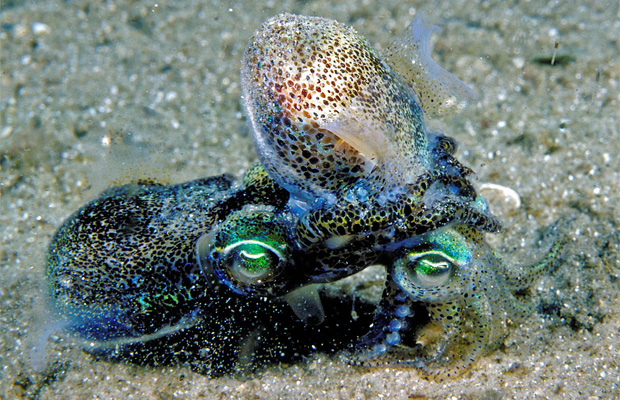
The dumpling squid is as unprepossessing as its name implies, but beneath that plump exterior lurks a savage lust. They mate for 1-3 hours, to the point where they’re completely physically exhausted, and an easy target for a predator…but it’s all so worth it.