Yeah, sorry, but at the vertex of all those slimy tentacular columns lies this hard, knife-edged, pointy, shiny, muscular beak.
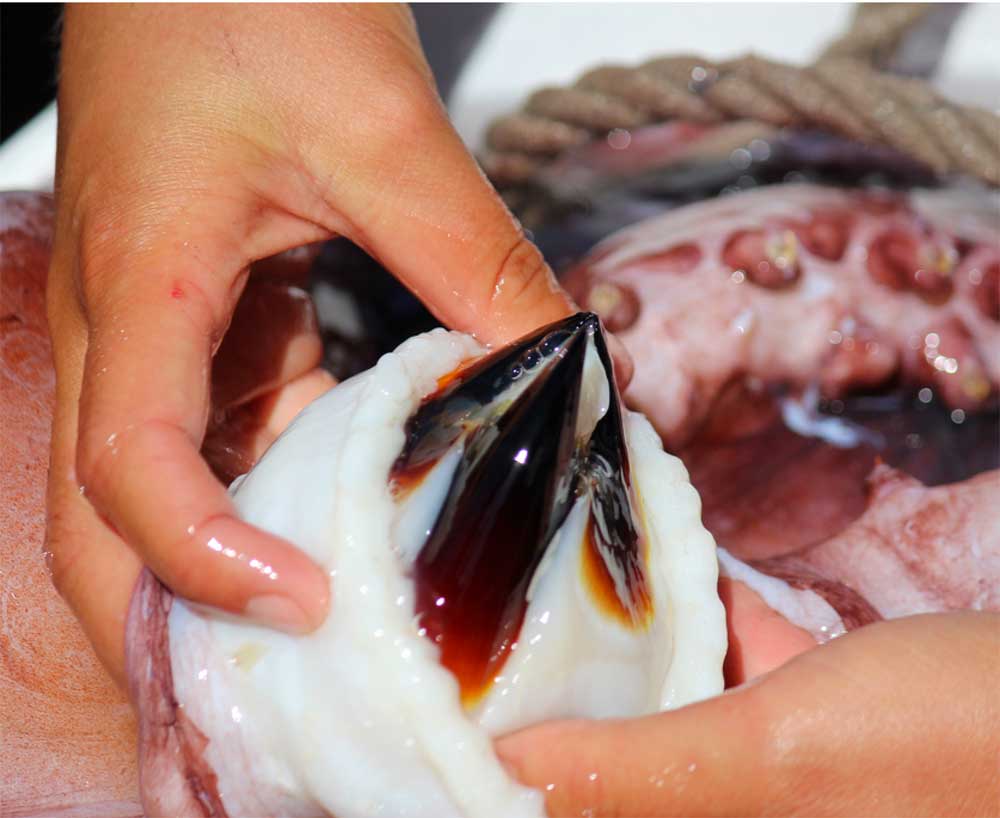
(via Naturetrek)

Yeah, sorry, but at the vertex of all those slimy tentacular columns lies this hard, knife-edged, pointy, shiny, muscular beak.
(via Naturetrek)

Beneath the mysterious waters of the Sea of Japan, strange symbolic artworks have been spontaneously appearing — intricate mandalas, six feet in diameter, dot the sandy bottom. What could they mean?
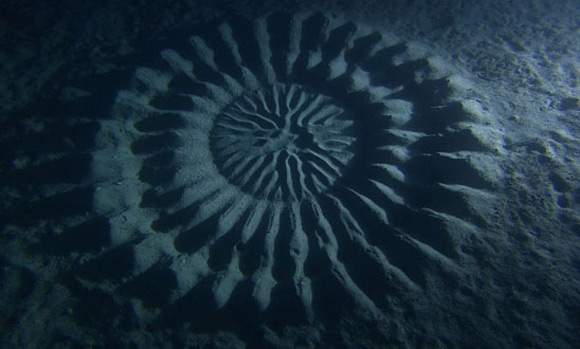
Perhaps the aliens have been making these all along, at the same time they’ve been sending secret messages in crop circles. Perhaps they are manifestations of the Universal Consciousness, erupting into expressions of cosmic beauty. Maybe their meaning is their mystery, telling us to appreciate more what we do not know.
Nah, I don’t go for any of that mumbo-jumbo. Scientists put video cameras underwater, and caught the creator in the act. It’s this little puffer fish, a few inches long.
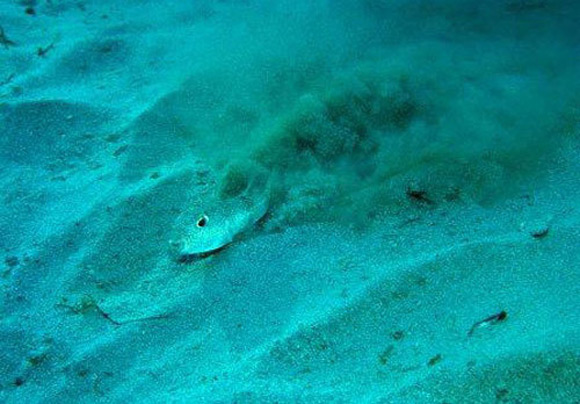
Using underwater cameras the team discovered the artist is a small puffer fish only a few inches in length that swims tirelessly through the day and night to create these vast organic sculptures using the gesture of a single fin. Through careful observation the team found the circles serve a variety of crucial ecological functions, the most important of which is to attract mates. Apparently the female fish are attracted to the hills and valleys within the sand and traverse them carefully to discover the male fish where the pair eventually lay eggs at the circle’s center, the grooves later acting as a natural buffer to ocean currents that protect the delicate offspring. Scientists also learned that the more ridges contained within the sculpture resulted in a much greater likelihood of the fish pairing.
I don’t believe in cosmic consciousness, but I do believe horny little animals will go to great lengths for sex.

I spend a lot of time paying attention to threats to the organisms that live in the desert, and what with all the environmental bad news available online these days that can be pretty damned depressing. This past weekend, though, I was reminded that there is actually hope for the future. Centuries from now we may well find that desert plants, especially those that now live within a day’s drive of Los Angeles, have a vital role to play in making yet-undiscovered planets habitable.
I was reminded of this while re-watching a set of documentary films describing the terraforming of an entire complex system full of dozens of more or less habitable planets, in many cases using entire vegetative suites once native to the California desert. I’ve gone back and taken some screenshots of these films to illustrate some of the ways in which the terraformers used desert plants, and they — along with discussion of the terraformed vegetation –are below the fold.

About a year ago I was exploring the desert east of Joshua Tree National Park, looking for a good spot to hold a desert camping meetup for readers of Coyote Crossing, and I stopped at a little open spot not far from a mature desert ironwood tree.
It had rained a week or so beforehand, catastrophically so in some places. The storm series that came through closed major roads through the park for some months afterward. Where I stopped there was about a ten-foot earthen flood-control berm put in place to protect the (LA) Metropolitan Water District’s buried aqueduct from storm damage, and a flash flood had taken a slice out of that ten-foot berm that was as straight-sided as if it was a cake recently attacked by a knife.
The ground had recently been very wet, in other words. And when the desert soil gets wet in the late summer, interesting things happen. Winter rains are more predictable, and after a wet winter you can predictably get a pretty damn nice bloom across the desert; yellow primroses and pink desert verbena and white ghost flower covering entire bajadas that are usually shades of brown desert varnish.
But summer rains are sporadic, unpredictable, and usually very localized. A given valley in the desert might go fifty years without a good summer rain. When that valley does get a summer rain, annual plants that have been waiting in the soil seed bank for decades can come up within a few days, flower within a couple weeks, set seed and disperse that seed and die back within a month and a half. My desert botanist friends watch the weather carefully in summer, ready to plan trips out into the backcountry with the plant presses within two weeks of the drop of a hat.
The North American deserts are essentially terra incognita for botanists. There are a few things that are quite well known, because they grow and bloom during the more comfortable parts of the year within a few miles of pavement. And then there are the valleys that are a difficult day’s hike from the hearest two-rut 4WD road, and we generally don’t know what blooms there when it’s 115°F during the day because botanists are not that much more insane than the rest of us. That’s true of herpetologists and entomologists as well, and so we don’t really know some of the smaller fauna of the remote parts all that thoroughly either.
Jim André of the Sweeney Granite Mountains Desert Research Center in the Mojave Preserve tells me that if you look out at a typical Mojave Desert landscape, 10% or more of the species in your field of view aren’t known to science. He says that just about every time he goes out in the field he finds either a species or subspecies not formerly known to lie in that area, or even new to science. I’ve been in places relatively easy to get to, the California Black Hills for example, and noted plants that had not been recorded by any botanist whose records are available to the Calflora database: this tiny little cactus being one inconspicuous example:
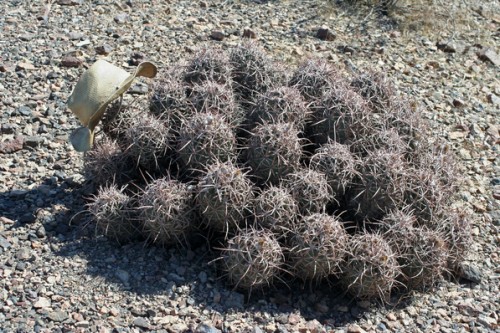
Echinocactus polycephalus with Size XL Scala hat
But you find totally expected things too, like for instance on that day on which I was scouting out possible meetup campsites. A week or so after a drenching rain, in an area in which a mature ironwood tree had been dropping its leguminous seeds for some centuries, it wasn’t at all surprising to find that a couple had sprouted.
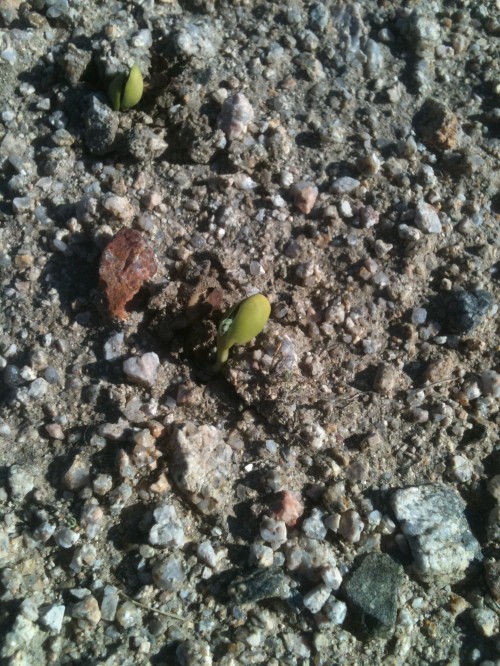
Olneya tesota seedlings
I don’t know how long the seeds had lain there before sprouting. Unlike a lot of other hard-coated desert tree seeds, ironwoods will sprout without scarification — without scratching the seed coats to let moisture in. They might have been there for six months or a century, waiting.
Ironwoods are likely my second favorite desert tree, possibly third if you count saguaros as trees. They fix nitrogen, always in short supply in the desert. They grow slowly, When they die, the wood they leave behind is — in the words of Phillips and Comus’ A Natural History of the Sonoran Desert,“rich in toxic chemicals and essentially non-biodegradable.” It’s supposed to be the second densest wood known after lignum vitae, and it’s a gorgeous chocolate color when carved and polished, which trait southwestern gift shops use to their full advantage. (The Seri Indians pioneered the art of ironwood carving using fallen wood, but the art proved so popular that others appropriated it and started cutting live trees to meet demand.)
It was a little hard to imagine that these tiny seedlings, first true leaves just starting to peek out from between the waxy cotyledons, might within a few months become some of the toughest, most enduring organisms the desert knows.
It’s been a year: I’ll have to go back and check on them.

Our rebuttal to claims about the adaptive significance of the female orgasm has been published, as Zietsch & Santtila's study is not evidence against the by-product theory of female orgasm. I blogged about this a while back, and also dealt with some counter-arguments, and Elisabeth Lloyd thought my arguments were strong enough to be incorporated into a letter, so there you go…now I just need a badge or a t-shirt with a proclamation about my expertise on it.
Wallen K, Myers PZ, Lloyd EA (2012) Zietsch & Santtila’s study is not evidence against the by-product theory of female orgasm. Animal Behaviour http://dx.doi.org/10.1016/j.anbehav.2012.05.023

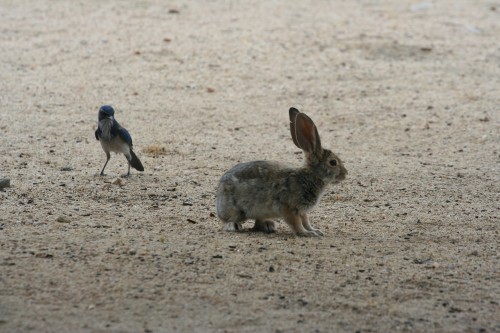
Dinosaur v. Mammal. Photo taken from my back porch.
Our fearless leader is down, so it’s time to put on our Sixpak Chopra outfits for a little visualization. Imagine the Audubon’s cottontail in the image as the demons that have possessed PZ’s gastrointestinal system, and the jay as our Waves O’ Healing Energy® preparing to kick the rabbit’s butt. It’s guaranteed infinitely more effective than the most popular homeopathic remedies commonly available.
Spoiler: half a second after this image was taken, the jay hopped on to the rabbit’s butt, chasing him away from the sunflower seeds.

Warning: autotuning ahead. If you don’t like it, don’t listen.
It’s a good message: we need to address the changes we’re making to our planet.

I know it’s early, but I expect it to be the best thing for a few days yet. David Byrne writes about his love affair with sound, and I came away from it feeling like I’d both learned something new and that it fit well with other ideas I already had — it was a revelation to see how well music and evolution fit together.
Because music evolves. Byrne’s thesis is that it evolves to fit its environment (sound familiar?), and that you can see the history of a genre of a music in its sound. It’s all about the spaces it was played in, which shapes the kind of sound can be used effectively…and he makes the strong point that you can’t fully appreciate the music of a culture or a time when you transpose it to a different space. He goes through all kinds of music, from medieval chants (cathedrals!) to hip hop (cars!). The iPod isn’t just a passive delivery system for generic music, it influences how music will sound — ear buds represent a completely different sonic environment from a cluttered dance club.
Apparently, David Byrne is an Ecological Developmental Biology
Because that’s what eco devo is all about. Development and environment are all intertwined, with one feeding back on the other — species are products of the spaces they evolved and developed in, and cannot be comprehended in isolation. It’s one of the weird things about modern developmental biology, that we preferentially study model systems, organisms that have been able to thrive when ripped out of their native environments and cultured in the simplified sterility of the lab. My zebrafish live now in small uncluttered tanks with heavily filtered water; their environment is like iPods, simple, streamlined, focused with relatively little resonance. The zebrafish evolved in mountain streams feeding into the Ganges, in lands seasonally flooded by great monsoons, a vast and complicated opera hall of an environment. A wild zebrafish and a lab zebrafish are two completely different animals.
Oh, look. I have a new metaphor for issues I’ve been thinking about for some time. Thanks, David Byrne!
I might just make his essay part of the readings for my developmental biology course next term.