It’s nice to see someone willing to live by their own advice

All the scientists and naturalists out there crying foul on behalf of the desert need to hang their intellects up for a moment and spend some time in their hearts for a while.

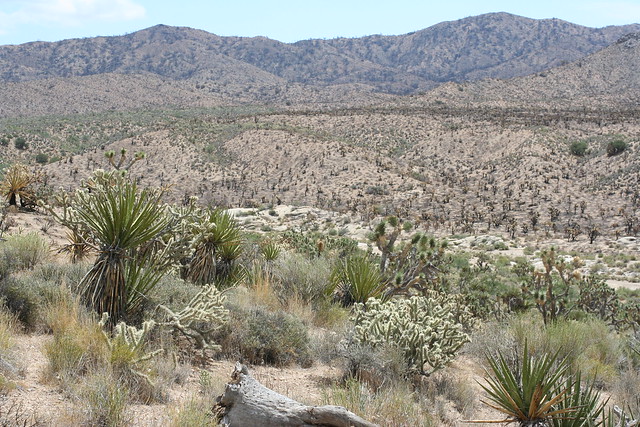
I get the best rebuttal yet to my piece taking down Allan Savory’s “green the deserts by filling them with cows” pseudoscience.

(And remember, when you hang your intellects up for a moment, to heed Joan Crawford’s timeless counsel.)

So what else is new?

In a classic bit of strange understatement, Gizmodo reports that HeLa cells are weird.

Recent genomic sequencing on the popular "Kyoto" HeLa line reveals known errors common to cancer cells like extra copies of certain chromosomes, but also shows unexpected mutations like strong expression of certain genes and segment reshuffling on many chromosomes.

Uh, “recent”? HeLa cells were isolated from a cancer. Cancer cells have these common features, like genomic instability, aneuploidies, and loss of cell cycle control that we all know about. These particular cells were selected for properties that differ from healthy undisrupted human cells.

I also don’t know anyone studying them as models for humans (although I have heard animal rights people claim they’re adequate substitutes for mice, which is just as ridiculous).

So no surprises, and no understanding of cell culture research. We’re done!

How about if we just retire Dollo’s Law altogether?

Earlier this month, there was a flurry of headlines in the pop-sci press that exasperated me. “Have scientists discovered reversible evolution?” was one; “Evidence of Reverse Evolution Seen in Dust Mites” was another. They failed because they always tried to express a subtle idea in a fluffy way that screwed up a more fundamental concept in evolution — it was one step forward in trying to explain a legitimate science paper, and ten steps back in undermining understanding of evolution. This was just awful:

Researchers who deny the idea that evolutionary traffic can only move forward saw their arguments bolstered this week with the publication of a study suggesting that house dust mites may have evolved from free-living creatures into full-time parasites, only to abandon that evolutionary track and go back the way they came, reverting to the free-living creatures that live invisibly in your carpet, bed, and other places in your home that it’s probably best not to think about them living.

“Evolutionary traffic can only move forward”? Please, define “forward” in this context for me. Evolution doesn’t have a direction. You can talk about a temporal sequence of historical changes in a gene, for instance, but from the point of view of the process, there’s no “forward” or “backwards”, only change over time. Is a genetic deletion a backwards step? Is a duplication a forward step? If a mutation changes a cytosine to an adenine, is that going forward, and if there is a revertant, a mutation that changes that adenine back to a cytosine, is that going backwards? I keep hearing this talk about directions, and it doesn’t even fit into my understanding of the process of evolution. Direction is always something people infer retrospectively.

The paper all this comes from, Is Permanent Parasitism Reversible?–Critical Evidence from Early Evolution of House Dust Mites, by Klimov and O’Connor, isn’t that bad, but still it has some bits that annoy me.

Long-term specialization may limit the ability of a species to respond to new environmental conditions and lead to a higher likelihood of extinction. For permanent parasites and other symbionts, the most intriguing question is whether these organisms can return to a free-living lifestyle and, thus, escape an evolutionary “dead end.” This question is directly related to Dollo’s law, which stipulates that a complex trait (such as being free living vs. parasitic) cannot re-evolve again in the same form. Here, we present conclusive evidence that house dust mites, a group of medically important free-living organisms, evolved from permanent parasites of warm-blooded vertebrates. A robust, multigene topology (315 taxa, 8942 nt), ancestral character state reconstruction, and a test for irreversible evolution (Dollo’s law) demonstrate that house dust mites have abandoned a parasitic lifestyle, secondarily becoming free living, and then speciated in several habitats. Hence, as exemplified by this model system, highly specialized permanent parasites may drastically de-specialize to the extent of becoming free living and, thus escape from dead-end evolution. Our phylogenetic and historical ecological framework explains the limited cross-reactivity between allergens from the house dust mites and “storage” mites and the ability of the dust mites to inhibit host immune responses. It also provides insights into how ancestral features related to parasitism (frequent ancestral shifts to unrelated hosts, tolerance to lower humidity, and pre-existing enzymes targeting skin and keratinous materials) played a major role in reversal to the free-living state. We propose that parasitic ancestors of pyroglyphids shifted to nests of vertebrates. Later the nest-inhabiting pyroglyphids expanded into human dwellings to become a major source of allergens.

It’s actually rather interesting that these mites have a phylogenetic history that shows some dramatic changes in lifestyle. Parasitism is a specialized pattern that typically involves a loss of shedding of generalized abilities that allow for autonomous living; they can get rid of functions that won’t be needed in the conditions they’ll be living in. A mammalian parasite is swimming in a sea of nutrients provided by the host; it can lose genes for the synthesis of many amino acids, for instance, and still survive because it’s immersed in those amino acids, provided by the mammalian bloodstream. But that makes it difficult to leave the parasitic life — if it moves out to the more limited diet available in the external world, it may find itself starving to death, unable to synthesize essential building blocks. Yet here they have evidence that mites shifted from parasitism to free-living.

But I have two complaints. One is this framing as a refutation of Dollo’s Law — I really don’t give a damn about Dollo’s “Law” at all. The second is that they haven’t really shown any evidence of molecular/genetic reversibility.

I just roll my eyes at papers that talk about Dollo’s Law anymore. Do people realize that it was a macroevolutionary hypothesis formulated in the 1890s, before anyone had a clue about how genetics worked, much less how genetics and evolution worked together? It was a reasonable prediction about how traits would distribute over time. A horse, for instance, runs on a single robust toe on each leg, the other digits reduced to vestigial splints; Dollo’s law says that those splints won’t re-expand to reform toes identical to those found in horse ancestors. Why, he didn’t know.

A modern understanding of the principle, informed by the underlying genetics, would instead say that a complex character involving multiple genetic changes and relying on a particular background for its expression is statistically unlikely to be reconstituted by stochastic changes in a different genetic background, in exactly the same way. It’s not a ‘law’, it’s a consequence of probability.

The authors have only found reversion to an ancestral pattern on a very coarse scale: there are a great many ways to be a free-living organism, and there are a great many ways to be a parasite. They can say on a very gross level that mites have changed their niches in their evolutionary history, but they can’t claim there has been an evolutionary reversal: if we compared the ancestral free-living form (pre-parasite phase) to the modern free-living form (post-parasite phase), I have no doubt, and there’s nothing in the paper to contradict me, that there would be significant differences in form, physiology, biochemistry and genome, and further, that the parasitic phase would have left evolutionary scars in that genome.

Dollo’s Law is archaic and superficial, and I have no problem agreeing that Klimov and O’Connor have refuted it. But the more interesting principle, founded in a modern understanding of microevolutionary and genetic events, has not been refuted at all — it’s just confusing that we’re still calling that Dollo’s Law, and that we mislead further by talking about a direction for evolution and ‘reversibility’ and all that nonsense. The only source of direction in this process is time’s arrow, and that doesn’t go backwards.

How not to read a graph

This ought to be on Skepchick’s Bad Chart Thursday. The Daily Mail — hey, why are you already groaning? — put up a graph to prove that global warming forecasts are WRONG. They say:

The graph on this page blows apart the ‘scientific basis’ for Britain reshaping its entire economy and spending billions in taxes and subsidies in order to cut emissions of greenhouse gases. These moves have already added £100 a year to household energy bills.

The estimates – given with 75 per cent and 95 per cent certainty – suggest only a five per cent chance of the real temperature falling outside both bands.

But when the latest official global temperature figures from the Met Office are placed over the predictions, they show how wrong the estimates have been, to the point of falling out of the ‘95 per cent’ band completely.

Now here’s the graph. Let’s see if you can detect where they mangled the interpretation.

mailgraph

(Note: I haven’t looked to see whether the underlying data is correctly presented. I’m only examining the Mail’s ability to read their own chart.)

One error of interpretation is the claim that the ‘predictions’ were plotted in retrospect…as if the scientists had just made up the data. That’s not true — what they did was enter the same kinds of measurements available in the past as we have now, plug them into the computer as inputs, and let it generate predictions. This is an important part of testing the validity of the model — if it gave a poor fit to past data, we’d know not to trust it. That it worked well when giving the past 50 years worth of data is a positive result.

The big error of interpretation is to look at that graph and claim it demonstrates a “spectacular miscalculation.” To the contrary, it shows that the predictions so far have been right. As Lance Parkin says,

It’s an argument presented entirely in their own terms, using only data they presented, framed in language of their choosing. It’s been spun and distorted and shaped as much as they possibly can to get the result they want to get and it still says that the scientists who have consistently and accurately predicted that the world is warming were right. That’s their best shot? It’s rubbish.

Need a cleanser after seeing that? Here are ten charts interpreted correctly and demonstrating the reality of climate change.

People actually read the Daily Mail in the UK, huh? I guess it’s like the US’s Fox News…unaccountably popular.

Nightmare fuel

It’s morning here, so it’s probably safe to post this now. I read this article just before bed last night, and then I had a nightmare.

I dreamt that I walked into my classroom, and 50 pairs of eyes all turned to me, and they were all wearing Google Glass, and there were all these little red cyborg lights blinking at me. And there I was torn between the horror of my every word and expression being uploaded to Google’s servers, and…wanting one myself.

Don’t worry, though, I knew it was a dream, so I just flooded the whole room with salt water and shorted out their gadgets, and then I turned them all into mermaids and we…well, you don’t need to know.

But still! After the conversation about privacy yesterday, it was a bit worrisome.

Adam Merberg on grazing and Allan Savory and TED

I wish I’d seen Adam Merberg’s excellent takedown of Allan Savory’s TED talk on “greening the deserts” before I wrote my own. Merberg provides a history of Savory’s career that’s remarkably detailed for its relative brevity, with a couple of damning quotes by Savory, including this one:

You’ll find the scientific method never discovers anything. Observant, creative people make discoveries. But the scientific method protects us from cranks like me.

Merberg offers perhaps the best summation of both Savory’s attitude and the pseudoscientific impulse I’ve seen:

Savory argued at TED that Holistic Management “offers more hope for our planet, for your children, and their children, and all of humanity.” What Savory does not tell us is that there is the distinct possibility that if we try to implement those ideas, we will fail. In this case, he will tell us that we misunderstood his ideas. How comforting it will be to know that his ideas were correct, as they always have been!

Also of interest, Merberg offers a sampling of credulous responses from people who pride themselves on being skeptical, including this one:

In Shermer’s defense, it may be that suspension of credulity isn’t really a guy thing.

One of the more interesting parts of Merberg’s piece is his conclusion, where he directs certain uncomfortable questions at TED:

In December, TED responded to concerns that independent TEDx authorized events were “dragging the TED name through the mud” by sending a letter to “the TEDx community” warning that bad science could lead to revocation of the TEDx license. The letter also included some advice for identifying bad science. I can’t help but think that Savory’s work should have raised concerns for anybody familiar with that list. At the least, Savory’s work “has failed to convince many mainstream scientists of its truth,” much of it “is not based on experiments that can be reproduced by others,” it comes from an “overconfident fringe expert,” and it uses imprecise vocabulary to form untested theories.

Of course, TED has no contractual incentive to apply the standards it sets for TEDx organizers to its own talks. However, the letter emphasizes that “your audience’s trust is your top priority,” and I think it’s fair to ask what TED did to respect that trust in this case. Did they research the science behind Allan Savory’s ideas? Are they satisfied that his talk amounts to “good science”? If Savory’s talk had run at a TEDx event, would that event’s license have been revoked? Now that TED has reined in TEDx, perhaps its next move should be to look in the mirror.

Go check it out.