The first day of the rest of my summer!

twitch

It’s going to be a good season, I can tell already. It’s finals week, so I’ll still have an abrupt pile of grading to do on Thursday, but otherwise, my teaching obligations are done for the semester. Now I’m trapped, trapped I tell you, in Morris for almost (I do have two quick trips to Europe planned) the entire summer with a collection of administrative responsibilities, but the good part of that is that I have ambitious plans for what I’ll be doing in the lab. I’m also going to be living the good life.

So this morning I slept in to 7:00. I know, it’s slothful of me, but I have the freedom to indulge myself a little bit now and then. After I got up, I took a nice brisk walk downtown, did some shopping, stocked up on some fresh vegetables, and once I got home, chopped them up and set them to soak in a tasty marinade. I’ll roast them up for dinner tonight.

Then I started reading up an accumulated mass of papers that’ll give me some implementation ideas for the work I have planned.

I’ll have a student working with me, and we’ve got a couple of projects in the works.

  1. There’s some boring scut work to be done: lab cleanup, clearing out old reagents from the refrigerator, making up new stock solutions. Don’t be disillusioned, but part of the research life is janitorial…so much dishwashing.

  2. My grand plan requires an expansion of my fish colony to include multiple genetic strains, so we’re going to be scrubbing tanks, sterilizing surfaces, setting up new tanks with boring feeder fish to get the nitrogen cycle going and condition the water, getting the brine shrimp hatchery (live fish food!) thriving, all that sort of stuff that qualifies you to be a clerk in a pet store.

  3. Once all the tanks are bubbling away happily, we’re getting some new strains from the zebrafish stock center. Then it’s a few months of nursing them along, collecting eggs, propagating new generations and raising them to adulthood to get the whole colony self-sustaining, and to prepare for crosses to produce hybrid strains. After all this, my student will be well-trained to be a hobbyist aquarist.

  4. Concurrently, we’ll be doing some real science on the embryos we get, analyzing their behavior quantitatively to identify consistent differences between strains, and also in response to different environmental stresses. This is going to require a bit of computer work and — oh, no! — basic math to develop image analysis protocols. That’s what I’ve been reading about; I’ve done some of this in the past on an obsolete software system, so I’m going to have to piece together some custom bits to make it all work. I’ve been reading about Fourier analysis and power spectra all morning, and I’m kinda jazzed. Math! Computers! Embryos! Science!

  5. The dream is that once we’ve found some subtle differences between different strains, we can start doing crosses to dissect out and isolate the genetic components, if any, of the behavior. That’s going to take a couple of generations of crosses, which means that if I’m lucky we’ll get those results next year, or at worst, the year after. Behavioral Genetics! Yay! Long generation times! Boo!

It’s step #4 that’ll give us some quick quantitative results, I hope, and maybe something presentable at a meeting or even publishable. It’s all going to be preliminary and descriptive, but that’s what you need to do to establish a foundation for experiments.

Unfortunately for you, I won’t be blogging about any of the details of the work this summer — I’ve been scooped before when I foolishly posted protocols on the web, and especially when you have a very small lab with limited humanpower to throw at a problem, that costs. But I might just occasionally say a few general things about the kinds of analyses we’re doing.

Or I could talk about the moldy stuff we throw out of the refrigerator. That’s probably safe.

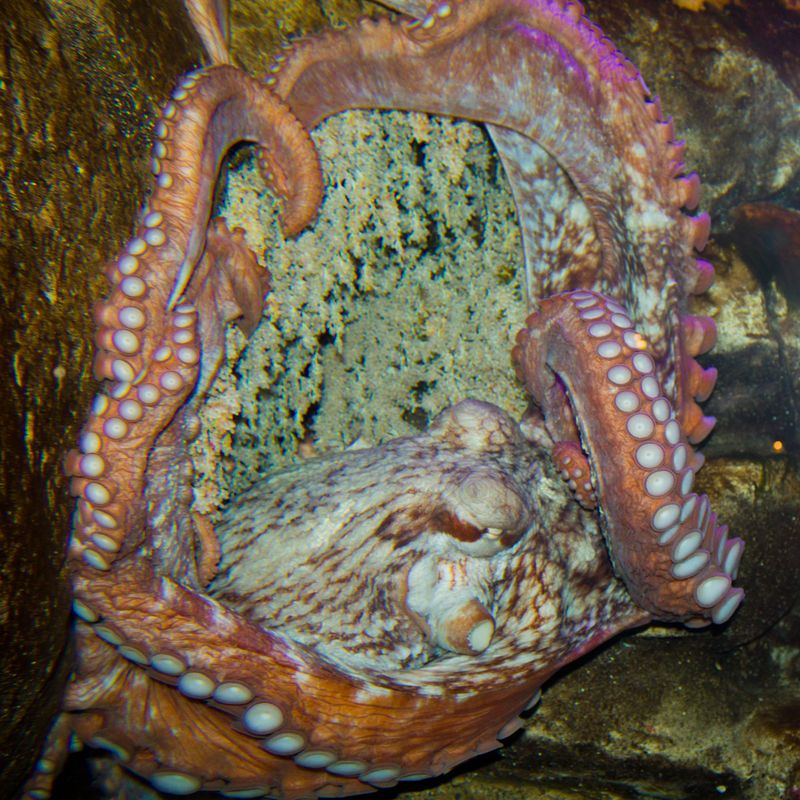
Mary’s Monday Metazoan: More charismatic megafauna?

Oh, no. The metazoan curator sent me this photo for this time around, and I groaned a bit: more big furries. I told her, “Where are the tubeworms, the crustaceans, the zooplankton? Why no jellyfish or echinoderms?” And she said, “But they’re so cute!” and gave me that look. That look that means I have to do as I’m told.

kangaroo-and-wombat

You know, if she starts sending me cats, I’m just gonna blow up. Me posting cats? That would be one of the signs of the End Times, along with the Last Trump and deluges of blood and whores riding dragons.

(via NatGeo)

What I taught today: FINAL EXAM TIME!

I’m in Arizona, on my way to Orange County, but that doesn’t stop me: I’ve given my students a take home final exam. I wouldn’t want them to be bored over finals week, you know.

1. In the last lecture, I tried to give you a little context, and explained that a dynamic picture of biology would include evolution, ecology, and development, all subdisciplines that deal with change over time. You’re all upper level students; explain to me how developmental biology fits into the perspective on biology that your experience here at UMM has given you so far. Are there pieces you wish our curriculum emphasized more? Why?

2. We’ve spent most of the semester talking about animals — as it currently stands, evo-devo has an unfortunately limited emphasis on metazoans, with an occasional nod to higher plants. Explore a little deeper. What would an evo-devo of fungi, or bacteria, or protists talk about? Is the toolkit we’ve been talking about truly universal? Give me a brief precis of the developmental principles for any other kingdom.

3. Imagine that after you graduate, you find yourself in an unexpected job: you’re working in university press office or as a science journalist. You have to explain scientific research to the public every day. What general principles would guide you? These should be ideas about ethics, effective communication, psychology, etc. in addition to purely scientific concerns. Tell me what standards you’d have to become a great reporter of science.

There. That should make them think.

“Frack” should be the new obscenity

Read this article on fracking and you’ll agree with me. The oil companies have reached new despicable lows in their efforts to poison the air and water.

Like any good little privileged American, my first thought was…is this going on in my back yard? And the answer is no, it’s not, there is no fracking going on in Minnesota. However, we are one of the prime suppliers of industrial silica sand used in fracking, and we’ve got lots of mining going on in the southeastern part of the state. So we’re just enablers of fracking.

All that sand is going next door to allow lots of fracking in North Dakota, though. Sorry, neighbor. I do find it ironic that a state known for its regressive/conservative social policies is happily making a big chunk of its territory uninhabitable, though.

What I taught today: toroids!

Hox 11/13 expression in an echinoderm blastula

It was the last day of classes for us. I brought donuts.

Dammit, I just realized I missed a golden opportunity. I should have talked to them about Thrive and Pivar and Fleury and Andrulis. Crackpot fringe developmental biologists all seem to have a thing for donuts.

Rats. Well, I’ll just send all my students an email and tell them they have to come back. They don’t even realize the importance of our little snack together.

Animal-rights activists are the danger to animals

It is possible to have a conscientious opposition to research on animals, and every university has channels by which activists can register their dissent, and by which they can also influence ethical decisions made by institutional animal research review committees. There is a right way and a wrong way to protest. And the wrong way is charge into a lab, disrupt experiments in progress, and “liberate” highly inbred, specialized animals that are dependent on laboratory care for their health and survival. Protesters in Milan chose the wrong way.

Activists occupied an animal facility at the University of Milan, Italy, at the weekend, releasing mice and rabbits and mixing up cage labels to confuse experimental protocols. Researchers at the university say that it will take years to recover their work.

Many of the animals at the facility are genetic models for psychiatric disorders such as autism and schizophrenia.

I don’t even understand the mindset here. Where are you going to release lab animals to? They may require special diets and care, they most likely have been raised in a very specific environment and have no ability to cope with a different place, and they may have genetic diseases that make them completely unable to compete with wild forms. Years ago at the University of Oregon, ALF pulled a stunt like this; they released lab-bred animals along the side of I5. The only animals to benefit in the area were the red-tailed hawks who saw a sudden bounty of terrified white rodents.

And further, scrambling the data for research into human neurological disorders accomplishes nothing other than slowing research. Why? This is nothing but hatred of science.

There’s not much one can do in the face of determined stupidity other than to show a united front. Sign the Call for Solidarity with the scientists in Milan.

What I taught in the development lab today

After our disastrous chick lab — it turns out that getting fertilized chicken eggs shipped to remote Morris, Minnesota during a blizzard is a formula for generating dead embryos — the final developmental biology lab for the semester is an easy one. I lectured the students on structuralism and how there are more to cells then genes (there’s also cytoplasm and membranes and environment) earlier today. This afternnon I’ve given them recipes for soap bubble solution and told them to play. They’re supposedly making little model multicellular organisms by chaining soap bubbles together, and observing how the membranes follow rules of organization just like the ones we see in living tissue.

In case you’re wondering what the recipe is so you can do it too, here’s my bubble soap formula:

  • 5ml Dawn dishwashing soap

  • 100ml DI water

  • 1ml glycerine

It gets better as it ages — there are perfumes and a small amount of alcohol solvent in the dishwashing liquid which evaporate off with time. The students are playing with concentrations, and if you’re making it up fresh and don’t want to wait until tomorrow, you can increase the concentrations of soap and glycerine.

The more glycerine you add, the more long-lasting the bubbles are…and unfortunately, the heavier they are. If you want bubbles that will waft gently on the breeze, you’ll want less glycerine. It’s a very forgiving recipe, just play.

I’ve also provided the students with a couple of books: the classic Soap Bubbles: Their Colors and Forces Which Mold Them by C.V. Boys, and The Science of Soap Films and Soap Bubbles by Cyril Isenberg. They’re more about math and physics, but they have some nice illustrations. These are projects you can do at home with cheap ingredients bought at the grocery store, so those of you with kids might try playing with it this summer. There are simple rules about the angles of intersection between bubbles — if you’re mathematically inclined, take pictures and use a protractor and see if you can work them out. There’s also some really cool stuff going on with colors, since the bubbles have a gradient of thickness from top to bottom and you get wonderful colors caused by refraction and reflection and phase shifts across the membrane.

OK, if you don’t have kids, you have my permission to play with soap bubbles, too. Tell everyone who looks at you funny that you’re doing Science!

Bad laws for science and all growing things

Now it’s getting personal. When the Republicans were just dedicated to making the poor poorer and the rich richer, I could shrug it off. When they kept arguing for the righteousness of bombing foreigners (well, Democrats do that too), I could console myself that they weren’t bombing me, yet.

But now they’re aiming to destroy science in the US, and I have to complain.

The legislation, being worked up by Representative Lamar Smith (R-TX), represents the latest-and bluntest-attack on NSF by congressional Republicans seeking to halt what they believe is frivolous and wasteful research being funded in the social sciences. Last month Senator Tom Coburn (R-OK) successfully attached language to a 2013 spending bill that prohibits NSF from funding any political science research for the rest of the fiscal year unless its director certifies that it pertains to economic development or national security. Smith’s draft bill, called the "High Quality Research Act," would apply similar language to NSF’s entire research portfolio across all the disciplines it supports.

Oh, the “High Quality Research Act”…given the Republican’s fondness for giving their bills the most misleading names possible, we already know this intends the opposite.

What they intend to do is write patriotism into the funding of science. Our work most promote AMERICA, and also must be of utmost importance, where importance is to be defined by Texas a-holes in shitkickers and big ol’ cowboy hats, who probably don’t care much for them fruit flies.

1) "…in the interests of the United States to advance the national health, prosperity, or welfare, and to secure the national defense by promoting the progress of science;

2) "… the finest quality, is groundbreaking, and answers questions or solves problems that are of utmost importance to society at large; and

3) "…not duplicative of other research projects being funded by the Foundation or other Federal science agencies."

If the Republicans really want to start a brain drain, pass that bill. Great way to poison science.

Oh, and yeah, I also hate what they’ve done to both domestic and foreign policy. Is there anything Republicans do that is less than soul-destroying evil?